易方达基金

Search documents
加仓!
中国基金报· 2026-01-09 06:07
Group 1 - On January 8, the A-share market saw a collective decline in the three major indices, with the Shanghai Composite Index down 0.07%, the Shenzhen Component Index down 0.51%, and the ChiNext Index down 0.82% [4] - Despite the overall market decline, the stock ETF market experienced a net inflow of over 4.65 billion yuan, with a total of 1300 stock ETFs reaching a total scale of 4.93 trillion yuan [4][5] - The leading sectors included defense and military industry, commercial aerospace, controllable nuclear fusion, and the AI industry chain, while the large financial sector faced adjustments, particularly in insurance and brokerage [4] Group 2 - The top inflows on January 8 were led by the securities ETF from Guotai Fund with a net inflow of 1.128 billion yuan, followed by the Hang Seng Technology Index ETF and the non-ferrous metals ETF with inflows of 1.101 billion yuan and 1.035 billion yuan, respectively [5][6] - A total of 50 ETFs saw net inflows exceeding 100 million yuan, indicating strong investor interest in specific funds [5] - Conversely, broad-based ETFs experienced significant outflows, totaling 3.951 billion yuan, with the CSI 500 Index product leading the outflows at 1.367 billion yuan [9][10] Group 3 - The outlook for the market suggests that the current environment of loose domestic liquidity and low-risk interest rates is expected to continue, with anticipated steady growth measures to be implemented in the first quarter [11] - Investment strategies for January are recommended to focus on growth and large-cap styles, particularly in light of the upcoming Spring Festival [11]


生物股份股价涨5.06%,易方达基金旗下1只基金重仓,持有23.91万股浮盈赚取20.08万元
Xin Lang Cai Jing· 2026-01-09 06:06
Group 1 - The stock price of Bio Co., Ltd. increased by 5.06% on January 9, reaching 17.45 CNY per share, with a trading volume of 918 million CNY and a turnover rate of 4.80%, resulting in a total market capitalization of 19.4 billion CNY [1] - Bio Co., Ltd. has experienced a continuous increase in stock price for five consecutive days, with a cumulative increase of 10.73% during this period [1] - The company, established on March 13, 1993, and listed on January 15, 1999, is primarily engaged in the research, production, and sales of veterinary biological products, with main business revenue composition being 94.42% from biopharmaceuticals, 3.18% from other income, and 2.40% from supplementary sources [1] Group 2 - E Fund's fund under management has a significant position in Bio Co., Ltd., with the E Fund CSI Modern Agriculture Theme ETF (562900) increasing its holdings by 19,600 shares in the third quarter, totaling 239,100 shares, which accounts for 2.79% of the fund's net value, ranking it as the eighth largest holding [2] - The estimated floating profit from the recent stock price increase is approximately 200,800 CNY, with a total floating profit of 385,000 CNY during the five-day increase [2] - The E Fund CSI Modern Agriculture Theme ETF (562900) was established on December 2, 2021, with a latest scale of 82.62 million CNY, and has reported a year-to-date return of 0.38%, ranking 5235 out of 5509 in its category [2]

干货满满!2026年基金策略会核心观点来了
Ge Long Hui· 2026-01-09 04:53
Core Insights - 2025 is marked as a historic year with significant changes in global capital markets driven by generative AI and shifting interest rate cycles [1][2] - The focus is shifting from short-term market movements to long-term structural changes and variables that will shape the future [2] Group 1: Technological Revolution and Investment Strategies - The year 2025 is identified as the "starting year" of the third global technological revolution, with generative AI as the core driving force [4] - The speed of technological iteration is unprecedented, with new architectures emerging every 2-3 months and significant performance improvements in large models [4] - China has transitioned from a follower to a leader in this technological revolution, supported by advantages such as a strong engineering workforce and a complete supply chain [4] - Three key investment themes are proposed: global AI industry participants, semiconductor self-sufficiency, and Hong Kong technology platform companies [4] Group 2: Market Valuation and ETF Opportunities - Concerns about an AI bubble are deemed premature, as current AI investment levels are significantly lower than during the internet bubble [6] - The decline in Hong Kong tech stocks in Q4 2025 is attributed to temporary funding disruptions, but a recovery is anticipated in 2026 with improved liquidity [6] - The analysis framework for Hong Kong tech stocks includes domestic macroeconomic expectations, U.S. Federal Reserve policies, and AI industry logic [6] - A focus on the Hang Seng Tech Index is recommended, emphasizing a pure TMT approach while avoiding sectors like pharmaceuticals and automotive [6] Group 3: Dividend Strategies in a Low-Interest Environment - In a low-interest and asset-scarce environment post-2022, dividend assets have shifted from cyclical to core allocation assets with bond-like characteristics [8] - The China Securities Dividend Index, which includes 100 high-dividend stocks, is projected to yield a dividend rate of 6% by December 2024, significantly above the market average [8] - A "barbell strategy" is suggested, combining dividend and growth assets to reduce volatility without sacrificing long-term returns [8] Group 4: Structural Changes in the Market - The consensus among industry experts is that the 2026 market will experience structural reorganization rather than being driven by emotional trends [10] - The global economy is in a critical phase of transitioning between old and new drivers, with technological revolutions altering production efficiency and competitive landscapes [10] - The importance of structural differences is increasing, as opportunities become less uniform across the market [11] - Technology represents a long-term productivity leap, while dividends provide stable cash flow in a low-interest environment [12]
两大赛道,猛烈“吸金”
Shang Hai Zheng Quan Bao· 2026-01-09 04:51
Group 1: Non-ferrous Metals Sector - The non-ferrous metals sector has seen significant inflows into ETFs, with notable funds like Wanji Industrial Non-ferrous ETF surpassing 10 billion yuan in scale [1][3] - As of January 7, 2026, major non-ferrous metal ETFs received substantial net inflows: Southern Non-ferrous Metal ETF (2.39 billion yuan), Huaxia Non-ferrous Metal ETF (1.44 billion yuan), and Dachen Non-ferrous ETF (0.93 billion yuan) [3] - Factors driving the non-ferrous metals sector include improved supply-demand dynamics and the global trend of "re-industrialization," alongside geopolitical tensions affecting resource supply [1][4] Group 2: Commercial Aerospace Sector - The commercial aerospace sector has also attracted significant investment, with the Yongying Satellite ETF rising by 6.2% and leading the market [5][6] - As of January 7, 2026, the Yongying Satellite ETF and the Zhaoshang Satellite Industry ETF each gained over 1 billion yuan in net inflows since the beginning of the year [6] - The commercial aerospace sector is expected to accelerate in 2026, driven by policy support, IPOs of leading companies, and heightened strategic value due to geopolitical factors [6]
2025年FOF收益全线飘红!易方达规模断层领先、兴证全球基金屈居第二
Sou Hu Cai Jing· 2026-01-09 03:59
Group 1 - The core viewpoint of the news is that the FOF (Fund of Funds) market has experienced a significant resurgence, marked by a strong start in 2026 with rapid fundraising activities, contrasting sharply with previous years of stagnation [2][3] - The first FOF product of 2026, Wanjiatai Stable Three-Month Holding (FOF), completed its fundraising in just one day, followed by another FOF from GF Fund, which ended its fundraising in two trading days [2] - The FOF market has evolved over eight years since the first public FOF was approved in 2017, reaching a peak in 2021 before entering a three-year adjustment period due to various challenges [3][6] Group 2 - The FOF market faced significant challenges from 2021 to 2024, including underperformance, high fees, and a decline in market size, which fell to 1,331.50 billion yuan by December 2024, a drop of over 40% from its peak [6][9] - In 2025, the FOF market rebounded, with the total scale reaching 2,383.76 billion yuan by the end of the year, marking a 79.03% increase from the previous year [6][7] - The number of newly established FOFs in 2025 was 88, with a total issuance of 785.81 million shares, significantly surpassing the figures from previous years [7] Group 3 - The competitive landscape of the FOF market has shifted, with over 80 institutions now managing public FOFs, and six managers exceeding 10 billion yuan in management scale [9][10] - E Fund leads the industry with a management scale of 221.22 billion yuan, followed by Xingzheng Global Fund at 182.17 billion yuan, indicating a clear gap in leadership [9][10] - The performance of FOF products in 2025 showed a wide disparity, with an average return of 11.83%, but the top products significantly outperformed the lower-tier ones, with the best return exceeding 60 percentage points compared to the worst [11][12] Group 4 - The FOF market is undergoing a transformation towards diversified asset allocation, moving beyond traditional A-shares and bonds to include Hong Kong stocks, commodity futures, and public REITs [13] - In 2025, 38 FOF funds entered liquidation, a significant increase compared to previous years, primarily due to low asset scales leading to operational cost pressures [13][14] - The trend of "survival of the fittest" continues, with a high percentage of newly established FOFs failing to meet minimum asset thresholds, indicating ongoing challenges for smaller institutions [14]

华测导航股价涨5.1%,易方达基金旗下1只基金位居十大流通股东,持有1057.88万股浮盈赚取2242.71万元
Xin Lang Cai Jing· 2026-01-09 02:14
Group 1 - The core viewpoint of the news is that Huace Navigation's stock price increased by 5.1% to 43.69 CNY per share, with a trading volume of 589 million CNY and a turnover rate of 2.17%, resulting in a total market capitalization of 34.359 billion CNY [1] - Huace Navigation, established on September 12, 2003, and listed on March 21, 2017, specializes in the research, development, production, and sales of high-precision satellite navigation and positioning technology products related to the BeiDou system [1] - The company's main business revenue composition includes 50.42% from system applications and solutions, and 49.58% from high-precision positioning equipment [1] Group 2 - Among the top ten circulating shareholders of Huace Navigation, E Fund's Chuangye ETF (159915) reduced its holdings by 1.6898 million shares in the third quarter, now holding 10.5788 million shares, which accounts for 1.64% of the circulating shares [2] - The E Fund Chuangye ETF (159915) was established on September 20, 2011, with a latest scale of 110.2 billion CNY, yielding 3.11% this year, ranking 2798 out of 5509 in its category; over the past year, it achieved a return of 66.93%, ranking 560 out of 4198 [2]
基金早班车丨港股结构性行情延续,基金经理看好结构性机会
Jin Rong Jie· 2026-01-09 01:28
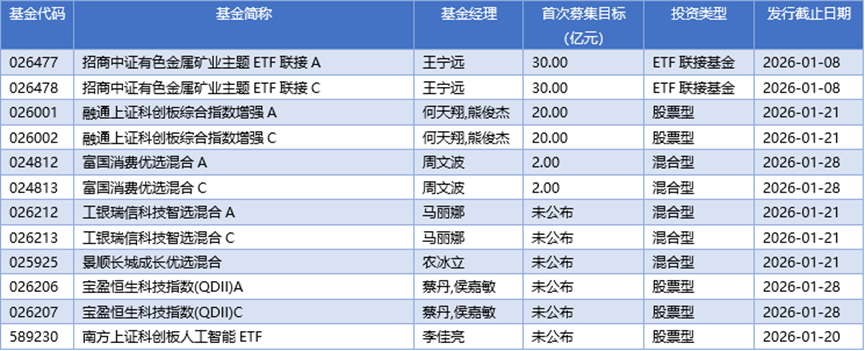
Group 1: Market Overview - The Hong Kong stock market is experiencing a recovery with innovative pharmaceuticals and internet platforms leading the gains, as institutional investors continue to seek structural opportunities in 2026 [1] - After two years of valuation compression, the overall Hong Kong stock market is at historical lows, with innovative drug pipelines entering a harvest phase and platform-based internet companies showing stable cash flows [1] - High-dividend central enterprise assets are highlighted for their defensive characteristics, suggesting that these three categories of stocks are likely to benefit from profit upgrades and capital inflows [1] Group 2: Fund News - On January 8, 12 new funds were launched, primarily mixed and equity funds, with the招商中证有色金属矿业主题ETF联接A aiming to raise 3 billion yuan [2] - A total of 11 funds announced dividends, with the华富天鑫灵活配置混合型证券投资基金 distributing the highest dividend of 0.5000 yuan per 10 fund shares [2] - In early 2026, 19 public funds, including华商, 银河, and泰康, launched fee reductions, indicating a shift from scale-driven to quality competition in the industry [2] Group 3: Fund Dividends - The华富天鑫灵活配置混合A fund will distribute a dividend of 0.5000 yuan per 10 shares on January 9, 2026 [4] - The安信永鑫增强债券A and C funds will each distribute a dividend of 0.0500 yuan per 10 shares on the same date [4] - The华泰柏瑞中证红利低波ETF联接 funds will also distribute dividends of 0.0500 yuan per 10 shares on January 9, 2026 [4]
公募2025年自购超5600亿
2 1 Shi Ji Jing Ji Bao Dao· 2026-01-08 23:36
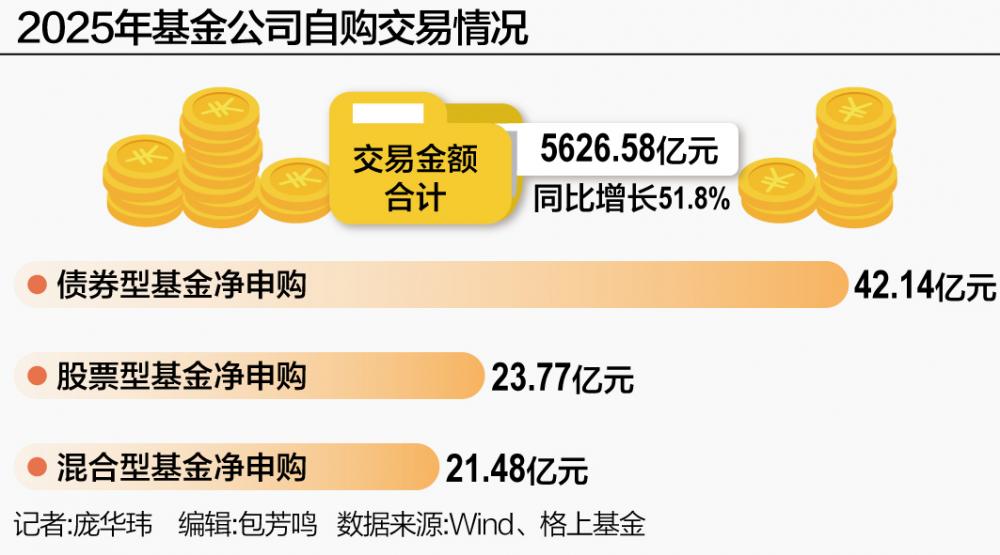
Core Insights - The public fund industry in 2025 demonstrated strong confidence in the market through a large-scale "self-investment" initiative, with total self-purchase transactions amounting to 562.66 billion yuan, a significant increase of 51.8% compared to 370.65 billion yuan in 2024 [1][3][9] - The structure of self-purchases underwent significant changes, with non-monetary funds seeing a net subscription of 9.34 billion yuan, a year-on-year surge of 130%, while monetary funds faced nearly 200 billion yuan in net redemptions [1][4][9] Self-Purchase Scale and Structure Changes - In 2025, the total self-purchase amount for public non-monetary products reached 9.34 billion yuan, up from 4.06 billion yuan in 2024, marking an increase of 5.28 billion yuan [4][12] - Among non-monetary funds, bond funds led with a net subscription of 4.21 billion yuan, while stock and mixed funds saw net subscriptions of 2.38 billion yuan and 2.15 billion yuan, respectively [4][12] - In stark contrast, monetary funds experienced a net redemption of 193.95 billion yuan, compared to a net subscription of 2.53 billion yuan in 2024, indicating a shift of institutional funds from traditional cash management tools to assets with higher return expectations [4][12] Focus on Index Funds - Index funds have become a key focus for public institutions in their self-purchase strategies, with passive index bond funds, passive index funds, and enhanced index funds collectively accounting for 49.55 billion yuan, representing over 53% of the total self-purchase amount for non-monetary funds [5][14] - Notably, the E Fund's index products received a total of 1.8 billion yuan in self-purchases, with eight index products exceeding 100 million yuan in net subscriptions [5][14] Market and Policy Drivers - The A-share market exhibited a "W-shaped" trend in 2025, with major indices showing impressive annual performances, including a rise of 18.41% for the Shanghai Composite Index and 49.57% for the ChiNext Index, creating a favorable environment for fund self-purchases [6][15] - Regulatory policies have played a crucial role, with the China Securities Regulatory Commission's action plan in May 2025 enhancing the evaluation criteria for self-purchases, thereby incentivizing long-term self-investment behavior among fund managers [6][15] Long-term Investment Trends - The self-purchase behavior in 2025 reflects a shift towards "increasing non-monetary investments, long-term orientation, and normalization," moving from a short-term market stabilization tool to a systematic arrangement for long-term value investment [7][16] - The industry is witnessing a growing emphasis on aligning self-purchases with long-term performance, which is expected to drive the public fund industry towards a high-quality development phase, moving away from a focus on scale expansion [8][17]
公募自购升温 去年交易金额大增51.8%,锚定长期价值投资
2 1 Shi Ji Jing Ji Bao Dao· 2026-01-08 23:36
Core Viewpoint - In 2025, the public fund industry demonstrated strong confidence in the market through a large-scale "self-investment" initiative, indicating optimism for future market performance [1][11]. Group 1: Self-Investment Scale and Structure Changes - The total self-purchase transaction amount by fund companies reached 562.658 billion yuan in 2025, a significant increase of 51.8% compared to 370.651 billion yuan in 2024 [2][4][16]. - Non-monetary fund net subscriptions amounted to 9.339 billion yuan, a staggering increase of 130% year-on-year, while monetary funds faced nearly 200 billion yuan in net redemptions [2][12]. - Among non-monetary funds, bond funds led with a net subscription of 4.214 billion yuan, while stock and mixed funds saw net subscriptions of 2.377 billion yuan and 2.148 billion yuan, respectively, marking a reversal from net redemptions in 2024 [5][17]. Group 2: Focus on Index Funds - Index funds have become a key focus for self-purchases by public fund institutions, with passive index bond funds, passive index funds, and enhanced index funds collectively accounting for 49.55 billion yuan, representing over 53% of non-monetary fund self-purchases [6][19]. - Notably, eight index products had net subscription amounts exceeding 100 million yuan, indicating strong market interest [19]. Group 3: Market and Policy Drivers - The A-share market exhibited a "W-shaped" trend in 2025, with major indices showing impressive annual gains: the Shanghai Composite Index rose by 18.41%, the Shenzhen Component Index by 29.87%, and the ChiNext Index by 49.57% [8][21]. - Regulatory policies, particularly the China Securities Regulatory Commission's action plan released in May 2025, have incentivized long-term self-purchase behaviors by aligning the interests of fund managers and investors [21]. Group 4: Long-term Investment Trends - The self-purchase behavior in 2025 reflects a shift towards "increasing non-monetary, long-term, and normalized" investment strategies, moving away from short-term market stabilization tools [22]. - Companies are increasingly committing to long-term holdings, with many pledging to maintain self-purchased shares for no less than one year, signaling a focus on long-term value [23].
公募“圈地”指数基金,“一指多发”仍是头部游戏
券商中国· 2026-01-08 23:29
Core Viewpoint - The article discusses the "land-grabbing" strategy of fund companies in the index fund market, highlighting the trend of major public funds issuing multiple products linked to a single index to capture market share and meet diverse investor needs [2][10]. Group 1: Fund Company Strategies - Major public funds like Huatai-PB, Huitianfu, and E Fund are adopting a "one index, multiple products" strategy, continuously launching various forms of products linked to a single index to dominate market share [2][10]. - This strategy involves first establishing core products (such as ETFs) to achieve scale effects, followed by the gradual issuance of other products based on market conditions [2][4]. Group 2: Index Fund Market Dynamics - The CSI A500 index, launched in September 2024, has attracted nearly 80 fund companies, with Huatai-PB's CSI A500 ETF reaching a scale of over 50 billion yuan by January 7, 2025, making it the largest fund tracking this index [3][5]. - Other major public funds have also launched multiple products linked to the CSI A500 index, with E Fund having over five related products, indicating a trend of extensive product offerings in this popular index [3][4]. Group 3: Performance and Market Trends - As of January 7, 2025, several CSI A500 ETFs have shown significant net inflows, with Huatai-PB's fund seeing a net inflow of 26.17 billion yuan since 2025 [5][6]. - The article notes that the "one index, multiple products" strategy is not limited to the CSI A500 index but is also applied to other indices like the CSI 300, reflecting a broader trend in the index fund market [8][9]. Group 4: Future Outlook - The shift towards index funds is driven by changing investor preferences and the increasing complexity of market conditions, leading fund companies to diversify their product lines to meet varied funding demands [10][11]. - The article suggests that while major public funds are actively expanding their index fund offerings, smaller public funds may struggle to compete effectively in this evolving landscape [10][11].