顺丰控股

Search documents
交通运输行业周报:原油运价大幅回落,顺丰国际与安睿物流签署战略合作协议-20251229
Bank of China Securities· 2025-12-29 01:49
Investment Rating - The report rates the transportation industry as "Outperform" [2] Core Insights - Crude oil freight rates have significantly decreased, while long-distance shipping rates have increased. The China Import Crude Oil Composite Index (CTFI) dropped by 40.6% to 1354.35 points as of December 25. Meanwhile, shipping rates from Shanghai to Europe and the US have risen by 10.2% and 9.8% respectively [3][14] - The National Development and Reform Commission (NDRC) has issued a trial classification for the low-altitude economy, aiming to clarify the concept and boundaries of the industry. This classification includes a framework of "4 categories + 23 subcategories + 65 small categories" [3][15][16] - China's high-speed rail operating mileage has surpassed 50,000 kilometers, marking a significant milestone in global rail infrastructure. This expansion supports logistics networks and enhances regional connectivity [3][21] Industry Dynamics Shipping and Logistics - The Baltic Air Freight Index has shown a month-on-month decline, while domestic air freight volumes decreased by 2.03% in November 2025. Conversely, international air freight volumes increased by 14.88% [4][35] - The Shanghai Containerized Freight Index (SCFI) reported a week-on-week increase of 6.66% but a year-on-year decrease of 32.68% [39] - In November 2025, the total express delivery volume reached 180.60 billion pieces, a year-on-year increase of 5.00%, while revenue decreased by 3.70% [52] Investment Recommendations - The report suggests focusing on the industrial goods export chain, recommending companies such as COSCO Shipping, China Merchants Energy Shipping, and Huamao Logistics. It also highlights opportunities in the low-altitude economy, road and rail sectors, and e-commerce logistics [5]



金银铜齐齐新高-周期怎么看
2025-12-29 01:04
Summary of Key Points from Conference Call Records Industry Overview Commodities - Recent strong performance in commodity prices, with gold surpassing 4,600 yuan, silver increasing by 11% to 80 USD, and LME copper stabilizing above 12,000 USD. Early year copper prices were below 75,000 yuan [2][7] - Short-term price fluctuations due to factors like silver delivery month squeeze, not driven by supply-demand improvements. Long-term outlook remains positive due to a weaker dollar and anticipated Fed rate cuts [2][7] - The current commodity cycle is influenced by international competition, differing from previous cycles driven by real estate and infrastructure [3][8] Aviation Sector - Positive outlook for the aviation sector in 2026, with New Year ticket prices up by 6-7% and passenger load factors increasing by 1-2%. Recovery in China-Japan-Korea routes noted [4] - Anticipated recovery in airline profitability to exceed 2019 levels due to extended holiday periods and improved travel demand [4] Express Delivery Industry - Jitu's stable growth in Southeast Asia, recommended as a stock with potential for doubling in three years. SF Express exited the Douyin return segment to protect profits, with a 30% increase in package volume but unfulfilled profit expectations [5][6] - Focus on bottoming SF Express stock, while waiting for data from other express companies for validation of growth potential [6] Non-Ferrous Metals - Positive outlook for the non-ferrous metals sector in 2026, though growth may not match 2025 levels. Current valuations are lower than in 2025, with high certainty of EPS recovery [10] - Energy metals remain undervalued, presenting investment opportunities [10] Coal Industry - Recent decline in coal prices, with the coal index down by 0.89%. However, coking coal fundamentals remain strong, with prices up 170 yuan per ton year-on-year [11][12] - High inventory levels suppress price rebounds, but potential stabilization due to weather factors is noted. Recommendations include investing in high-dividend coal companies [12] Core Insights and Arguments - The commodity price center is expected to rise long-term, supported by macroeconomic factors such as a weaker dollar and Fed rate cuts [2][7] - The aviation sector is projected to recover significantly, driven by increased travel demand and favorable pricing trends [4] - The express delivery market shows resilience, with specific companies like Jitu and SF Express highlighted for their growth potential [5][6] - Non-ferrous metals are positioned for a strong performance, with a focus on energy metals as attractive investment options [10] - The coal industry faces challenges with price declines but offers opportunities in high-dividend stocks amidst stable fundamentals [12] Additional Important Points - The equity market is not overheated, with P/E and P/B ratios at historical lows, indicating a favorable environment for investment [9] - The end of the current commodity cycle will depend on factors such as the restoration of dollar credit, supply chain restructuring, and domestic policies [8]
低空司最新统计分类政策解读及行业后市展望
2025-12-29 01:04
Summary of Low Altitude Economy Conference Call Industry Overview - The low altitude economy is projected to experience a surge in business in 2024, with sales expected to match the total of the past decade, driven by government infrastructure investments and the construction of state-owned platform application devices, as well as a clearer understanding of low altitude economy and GDP data boundaries [1][2][3] Key Points and Arguments - **New Policy Framework**: The recent low altitude economy statistical classification policy clarifies the statistical scope of four major sectors: infrastructure (communications, navigation), hardware (general aviation aircraft, drones), operations, and services training, aligning with the "14th Five-Year Plan" and annual economic work conference expectations [1][2][3] - **Government Guidance**: The State Council issued documents in June and November to guide state-owned enterprises in low altitude economy development and classify air traffic control platforms at provincial and municipal levels, providing clear guidance for social capital inflow and avoiding redundant construction [1][3] - **Project Approval Process**: Low altitude economy projects must connect with local government departments, such as transportation or water resources, and report to national ministries. The proportion of special bonds or treasury bonds in infrastructure projects has significantly increased, with notable projects like Shandong's 4 billion yuan tender for flying vehicles [4][5] - **Investment Trends**: In Zhejiang Province, low altitude projects are encroaching on traditional infrastructure project shares, indicating a trend where local governments aim to maintain special bond shares through low altitude economy development, expected to improve steadily over the next 3-5 years [5][6] Challenges and Opportunities - **Local Government Challenges**: Local governments face challenges in funding sources, attracting capable enterprises, and coordinating resources across departments. Collaborative efforts with major tech companies like Alibaba and Tencent are being made to support data collection and business model innovation [7] - **Mature Applications**: The application of cargo drones is relatively mature, with significant commercial scenarios in logistics, agricultural protection, and inspections. The agricultural protection sector alone sees annual sales of about 200,000 drones, with a penetration rate nearing double digits [8][9] - **Cost Efficiency in Logistics**: Drones demonstrate significant cost efficiency in logistics, with examples showing reduced transportation costs and time savings in specific scenarios, such as using hydrogen-powered drones for frozen goods delivery [9][10] Industry Leaders and Innovations - **Prominent Companies**: Key players in the low altitude economy's information technology sector include military state-owned enterprises like Lai Si, China Electronics, and Aerospace Science and Industry, which are expected to become industry leaders [11][12] - **Regulatory Platform Development**: The construction of provincial and municipal regulatory platforms is progressing, with companies like Zhongke Xingtou and Zhongke Yuntu showing strong performance in supporting application scenarios [12][13] Future Outlook - **Investment Projections**: Expected investment amounts for low altitude special bonds range from 2 to 4 billion yuan in Hubei and over 5 billion in Guangdong, with ongoing efforts to promote project implementation [15] - **Infrastructure Needs**: The development of low altitude economy is hindered by lagging infrastructure, necessitating government investment and policy support to facilitate technology innovation and application promotion [22][23] - **Market Potential**: The low altitude economy is anticipated to see explosive growth in infrastructure projects from 2024 to 2027, leading to significant procurement of drones and related equipment [17][19] Conclusion - The low altitude economy is positioned for substantial growth, driven by government policies, technological advancements, and increasing market demand. However, challenges related to infrastructure and regulatory frameworks must be addressed to fully realize its potential.
人享其行 物畅其流 链动全球
Sou Hu Cai Jing· 2025-12-28 23:25
Group 1: Logistics and Transportation Development - SF Express has initiated the construction of its Yangtze River Delta Innovation Headquarters in Kunshan, aiming to enhance the integration of industrial, supply, and value chains in the region [2] - Kunshan is leveraging its advanced transportation infrastructure to support modern logistics systems, focusing on a multi-dimensional circulation pattern that enhances economic growth [2] - The Long Triangle International Airport Kunshan Logistics Center has begun operations, significantly improving logistics efficiency by reducing operational costs by over 30% and increasing logistics timeliness by over 60% [10][11] Group 2: Low-altitude Economy and Technological Innovation - Kunshan has launched the world's first "sea-air integrated low-altitude economic solution," which includes a zero-carbon water airport and eVTOL aircraft, facilitating rapid deployment for commercial operations [3] - The establishment of a civil drone test flight base in Kunshan marks a significant step in developing a comprehensive low-altitude economy, with over 70 related enterprises and a market size nearing 5 billion [5] - The low-altitude economy is reshaping production efficiency in Kunshan, with drones enhancing delivery speed and reducing operational costs significantly [6] Group 3: Urban Connectivity and Infrastructure - Kunshan has developed a low-altitude transportation network that allows for a 20-minute commute to downtown Shanghai, enhancing urban connectivity and efficiency [7] - The integration of Kunshan's metro and high-speed rail systems has improved daily commuter flow, facilitating talent and resource movement between major cities [8] - Recent upgrades to Kunshan's road network have resolved transportation bottlenecks, further supporting the city's economic development [9] Group 4: Global Trade and E-commerce - The establishment of a cross-border e-commerce sea freight collection hub in collaboration with Shanghai and Suzhou ports aims to streamline logistics for cross-border enterprises [12] - The logistics center has successfully connected Kunshan to global shipping routes, enhancing the competitiveness of "Kunshan manufacturing" in international markets [11][12] - The ongoing improvements in Kunshan's logistics infrastructure are projected to save regional enterprises over 2 billion annually in logistics costs [12]


京东物流首个海外智狼仓在英国投用;飞书在海外上线AI办公App“AnyGen”|36氪出海·要闻回顾
36氪· 2025-12-28 13:34
Core Insights - The article highlights significant developments in various companies and industries, focusing on their international expansions, technological advancements, and strategic partnerships. Group 1: Logistics and Supply Chain - JD Logistics has launched its first overseas automated warehouse in the UK, enhancing its supply chain efficiency and enabling same-day delivery for consumers [5][6]. - SF International signed a memorandum of cooperation with MSC Air Cargo to improve global supply chain resilience through integrated air, land, and sea transport [8]. Group 2: Technology and AI - Feishu (Lark) has introduced an AI office app called "AnyGen" overseas, which allows users to convert voice notes and ideas into documents and presentations seamlessly [5][6]. - Alibaba's Tongyi has released two foundational models to enhance industrial-grade video and voice capabilities, including a video generation model that supports multi-scene storytelling [5][6]. Group 3: Automotive Industry - XPeng Motors is expanding its presence in the Middle East and Africa, launching its brand in Qatar and establishing partnerships in Mauritius and the UAE [9]. - Lynk & Co has officially entered the UAE market, showcasing its flagship SUV and emphasizing community engagement and high-end positioning [9]. Group 4: Investment and Financing - Sazhi Intelligent has completed several rounds of financing, with over 20% of its revenue coming from overseas markets, aiming to increase this to around 50% [12]. - Qianjue Technology has secured nearly 100 million yuan in financing to accelerate global commercialization and technology development in the embodied intelligence sector [13]. Group 5: Market Regulations - Thailand will eliminate the tax exemption for cross-border packages valued under 1,500 THB starting January 1, 2026, which is expected to increase costs for cross-border e-commerce [15].

无人配送圈变天!融资4亿对6亿,菜鸟九识联手能否撼动新石器霸权
Sou Hu Cai Jing· 2025-12-28 06:45
Core Insights - The collaboration between Cainiao and Jiushi Intelligent aims to capture market share in the rapidly evolving unmanned delivery sector [1][18] - This partnership is driven by mutual needs: Cainiao requires technology and manpower, while Jiushi seeks to enhance its market presence and resolve ongoing challenges [3][4][6] Group 1: Collaboration Dynamics - Cainiao is looking to expand its "4-hour delivery" service across 31 cities, necessitating additional resources beyond manual delivery [3] - Jiushi Intelligent, having faced difficulties since its spin-off from JD, is in need of a strategic partnership to survive amidst increasing competition [4][6] - The collaboration is seen as a way for both companies to leverage each other's strengths: Cainiao's logistics network and Jiushi's technological expertise [6][8] Group 2: Challenges Ahead - Internal resource allocation may pose a challenge for Cainiao, which is already managing multiple projects [8] - Jiushi must balance its commitments to other major clients, such as China Post, complicating its operational dynamics [8] - Technical integration between Cainiao's dispatch system and Jiushi's autonomous driving model is expected to be contentious, with prior disagreements already noted [11] Group 3: Industry Context - The unmanned delivery sector faces significant hurdles, including operational challenges in complex environments and high costs associated with technology [13][14] - Regulatory inconsistencies across cities like Beijing and Shenzhen create additional uncertainty for long-term planning [14] - The partnership may signal a shift in industry practices, moving towards deeper collaborations rather than isolated efforts [18] Group 4: Competitive Landscape - The collaboration could reshape the competitive dynamics, as leading firms like SF Express and JD may seek similar partnerships [18][21] - Smaller players in the unmanned delivery market may find it increasingly difficult to survive as larger companies consolidate their advantages through such collaborations [21] - The industry remains in a cash-burning phase, with profitability being a critical factor for future success [22]

顺丰充值赠送金“陷阱”背后
Di Yi Cai Jing Zi Xun· 2025-12-28 06:32
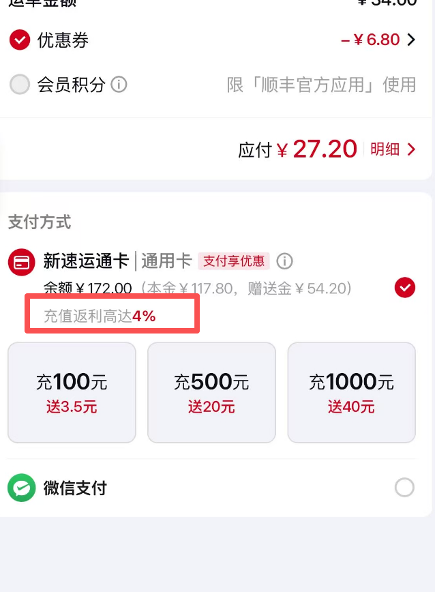
Core Viewpoint - The promotional "4% recharge benefit" of SF Express's new speed transport card is becoming a "digital chicken rib" for many consumers, as the "gift money" remains unused due to complex rules and restrictions [2][4][10]. Group 1: Consumer Experience - Many users report that their "gift money" is difficult to consume, with some having significant amounts stuck in their accounts due to stringent usage rules [4][6]. - The rules for using the gift money are not easily noticeable, requiring users to navigate through multiple conditions to utilize it effectively [6][9]. - A consumer example illustrates that even with a small balance of gift money, users face challenges in making payments due to system restrictions [9][10]. Group 2: Financial Performance - SF Express's gross profit margin has declined from 20% in 2017 to 13% in the third quarter of 2024, indicating increasing pressure on profitability [2][12]. - The company's total business volume reached 12.15 billion packages in the first three quarters of 2025, a year-on-year increase of 28.3%, but revenue growth does not translate into profit growth [12]. - The average revenue per package has dropped significantly, with a reported decline of 8.49% in November 2024 compared to the previous year [12][13]. Group 3: Market Dynamics - The express delivery industry is experiencing intense price wars, leading to a consolidation of smaller companies and increased competition among major players [12][14]. - SF Express has a large user base, with over 240,000 active monthly customers and more than 780 million individual members, which contributes to the accumulation of unused gift money [11][12]. - The company is adjusting its strategies in response to market pressures, including a shift in e-commerce return logistics to other service providers [14]. Group 4: Stock Market Performance - Despite stable operational performance, SF Express's stock price has declined significantly, losing two-thirds of its value since its peak in February 2021 [3][15]. - The introduction of an employee incentive plan has added pressure to the stock price, as it requires accounting for stock-based compensation [15]. - The company's recent IPO in Hong Kong and subsequent stock dilution have also negatively impacted its stock performance [17].

顺丰充值赠送金“陷阱”背后
第一财经· 2025-12-28 06:25
Core Viewpoint - The article highlights the challenges faced by consumers using SF Express's new prepaid card, which offers a 4% recharge benefit but has complex rules that make it difficult to utilize the bonus funds effectively. This situation reflects the ongoing price war in the express delivery industry, which has pressured the profitability of SF Holding [3][5][12]. Group 1: Consumer Experience with Bonus Funds - Many consumers report that the bonus funds from the SF Express prepaid card remain unused due to complicated rules that restrict their usage [5][6]. - Users must adhere to a 9:1 ratio when using bonus funds alongside principal funds, and specific conditions must be met for bonus funds to be used independently [8][9]. - The complexity of these rules has led to the emergence of a gray market where intermediaries buy back unused bonus funds at a significant discount [11][12]. Group 2: Financial Performance and Market Position - SF Holding's gross profit margin has declined from 20% in 2017 to 13% in Q3 2025, indicating increasing pressure on profitability [12][15]. - In Q3 2025, the company reported a total business volume of 12.15 billion packages, a year-on-year increase of 28.3%, but revenue growth did not translate into profit growth, highlighting a "revenue without profit" dilemma [15][16]. - The average revenue per package has dropped significantly, with a reported 8.49% decrease in November 2025 compared to the previous year [17][18]. Group 3: Market Dynamics and Competitive Landscape - The express delivery industry is experiencing intense competition, with price wars that began in 2019 leading to the consolidation of smaller companies and leaving only a few major players [16]. - SF Holding's stock price has fallen significantly, losing two-thirds of its value since its peak in 2021, reflecting market skepticism despite stable operational performance [20][21]. - The company is also facing challenges from changes in e-commerce logistics, as it loses some business to competitors like JD Logistics and Zhongtong Express [19].

顺丰充值赠送金背后:预付卡沉淀资金是个“好生意”
Di Yi Cai Jing· 2025-12-28 06:20
Group 1 - The core viewpoint is that SF Express's new prepaid card, which claims a "4% benefit on recharge," is becoming a "digital burden" for many consumers due to the difficulty in utilizing the bonus funds [1] - Users have reported that their bonus funds remain idle and difficult to spend, with one user stating that after recharging 1,000 yuan, only 100 yuan of the principal remains, while over 50 yuan in bonus funds is stuck due to usage restrictions [1] - The underlying issue is attributed to ongoing price wars in the express delivery industry, which have pressured company profits, as evidenced by SF Holding's gross profit margin dropping from 20% in 2017 to 13% in Q3 of this year [1] Group 2 - The average revenue per order for SF Express has fallen to 13.47 yuan in November, nearly halving compared to the same period in 2017 [1] - The capital market has responded cautiously, with SF Holding's A-share price having decreased by two-thirds from its peak in 2021 [1]
顺丰充值赠送金“陷阱”背后:预付卡沉淀资金是个“好生意”
Di Yi Cai Jing· 2025-12-28 05:56
Core Viewpoint - The express delivery industry is experiencing a price war, leading to pressure on company profitability, particularly for SF Holding, which has seen a significant decline in its gross profit margin and single-ticket revenue [2][10][12]. Group 1: Financial Performance - SF Holding's gross profit margin has decreased from 20% in 2017 to 13% in Q3 2024, with a net profit margin of 3.7% remaining stable year-on-year [11]. - In November 2024, the single-ticket revenue dropped to 13.47 yuan, nearly halving compared to 22.17 yuan in 2017 [12]. - For the first three quarters of 2025, SF Holding reported a total business volume of 12.15 billion tickets, a year-on-year increase of 28.3%, and revenue of 225.3 billion yuan, up 8.9% [11]. Group 2: Customer Experience and Issues - Users of SF Holding's "New Express Card" have reported difficulties in utilizing the promotional "gift money," which is often left unused due to complex rules [4][6]. - The rules for using the gift money require a 9:1 ratio with the principal amount, and specific conditions must be met for its use, leading to frustration among customers [7][8]. - A secondary market has emerged where intermediaries buy back unused gift money at a significant discount, indicating dissatisfaction with the redemption process [9]. Group 3: Market Position and Competition - The express delivery market is undergoing consolidation, with smaller companies exiting, leaving a few major players, including SF Holding, to compete [11]. - SF Holding's stock price has declined significantly, losing two-thirds of its value since its peak in 2021, reflecting market skepticism despite stable operational performance [3][15]. - The company faces ongoing pressure from competitors and changing market dynamics, particularly in the e-commerce return logistics sector [14].