DeepSeek

Search documents
Stock Market Today: Dow Positive For November, But Nvidia Slides; Delayed Inflation Data Looms (Live Coverage)
Investors· 2025-11-28 19:08
Group 1 - The Dow Jones Industrial Average and other major indexes showed an upward trend early on Black Friday before a trading halt occurred at CME [1] - Alphabet (GOOGL) continued to lead the market, while Nvidia (NVDA), Tesla (TSLA), Robinhood Markets (HOOD), and GE Vernova (GEV) aimed to regain key support levels [1] - China's DeepSeek released a new open-source AI model, which impacted Nvidia's stock negatively in early 2025 [2] Group 2 - The stock market experienced a rally with significant gains for companies like Google, Broadcom, and Kohl's [4] - Tesla launched a free trial for its Full Self-Driving (FSD) version 14 in North America, indicating a push in its autonomous vehicle technology [4] - The Dow Jones signaled further gains post-holiday, with ASML leading five stocks that flashed buy signals [4]





Microsoft Rebounds After Nearing Correction Territory. Is The Stock A Buy Now?
Investors· 2025-11-28 15:59
Group 1 - Microsoft (MSFT) stock has rebounded amid a four-day winning streak, following a pullback to its 200-day moving average, leaving the stock 16% from its all-time high [1] - Shares of Microsoft fell in November due to a stock market sell-off driven by valuation concerns for high-tech stocks [1] - The release of a new open-source AI model by China's DeepSeek has impacted Nvidia stock, which sold off in early 2025 [2] Group 2 - The article discusses the volatility of AI stocks, highlighting how companies like Amazon, Google, Oracle, Microsoft, and Meta have experienced significant fluctuations [4] - There is a growing concern about an AI bubble, with Wall Street weighing the risks associated with AI stocks, particularly in relation to Google's competitive position [4] - The stock market is currently in a rally mode, with notable performances from major indices and companies like Tesla, indicating a potential recovery [4]
一周热榜精选:CME故障引发市场“瘫痪”!AI变局中英伟达四面楚歌
Jin Shi Shu Ju· 2025-11-28 13:21
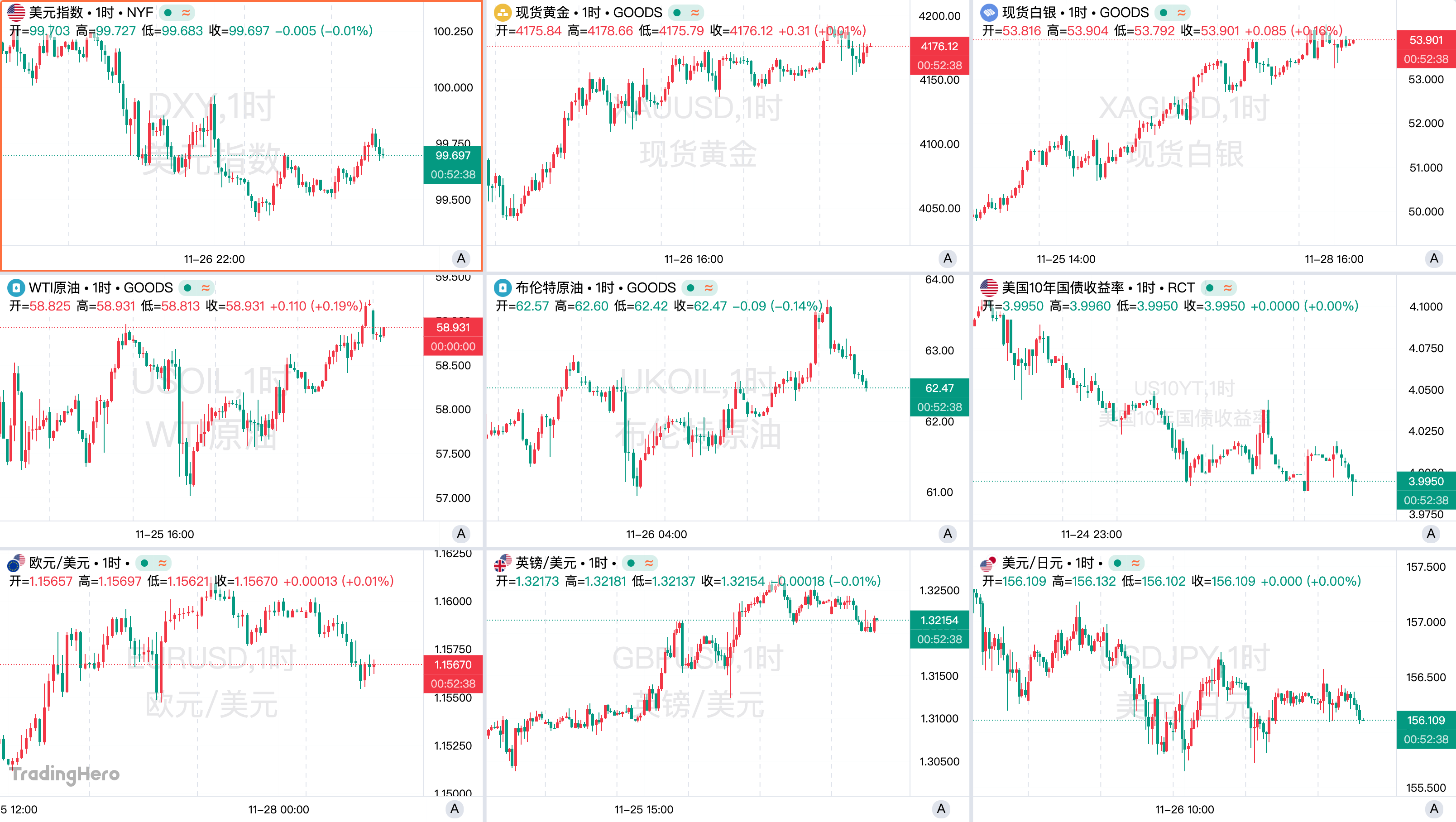
Market Overview - The US dollar index has experienced a decline, dropping below the 100 mark due to weaker-than-expected retail data and heightened expectations for Federal Reserve rate cuts, marking its worst weekly performance since July, currently at 99.70 [1] - US Treasury yields have generally decreased, with the 10-year yield dipping below 4%, indicating increased demand for safe-haven assets driven by interest rate outlooks [1] - Spot gold prices surged early in the week, rising nearly $100, and maintained high levels despite fluctuations, while silver showed stronger gains [1] - Non-US currencies strengthened against the dollar, with the euro, pound, yen, and Australian dollar all appreciating due to the dollar's weakness [1] - International crude oil prices fluctuated, initially pressured by positive signs from Russia-Ukraine peace talks but rebounding later in the week amid increased uncertainty [1] Stock Market Insights - US stocks showed overall strength, led by the technology sector, driven by enhanced expectations for interest rate cuts [2] - Nvidia faced significant pressure in the AI sector, while Alphabet, Google's parent company, reached new highs [2] CME Technical Issues - CME experienced a nine-hour outage due to a cooling system failure, affecting trading in various futures and options contracts, with implications for contracts worth trillions of dollars [5] - The outage severely impacted US Treasury futures trading, leading to sparse cash bond trading and a lack of hedging options for traders [5] - Gold futures and options trading on Comex was also disrupted, causing price dislocation with London spot prices [5] Investment Bank Perspectives - JPMorgan economists have adjusted their rate predictions, now expecting the Federal Reserve to continue rate cuts in December rather than waiting until January [7] - UBS analysts noted the potential for a delay in the Fed's meeting due to data considerations [7] - Several Wall Street institutions have forecasted the S&P 500 index for 2026, with Deutsche Bank predicting 8000 points, HSBC at 7500 points, and Morgan Stanley at 7800 points, driven by the ongoing AI boom [7] - Emerging markets are expected to rise in 2026, supported by a weak dollar and AI investment trends, with Morgan Stanley recommending long positions in emerging market local currency bonds [7] Major Events Summary - The Federal Reserve's dovish stance has led to a consensus around a potential rate cut in December, with expectations for a 25 basis point reduction rising to approximately 87% [8] - The new "19-point" peace plan between the US and Ukraine has been introduced, replacing the previous "28-point" plan, with key negotiations still pending [11] - The UK government announced a budget plan expected to generate an additional £26 billion in tax revenue by 2029/30, primarily through various tax adjustments [13][14] - Trump's "Genesis Project" aims to consolidate AI resources across federal and private sectors, likened to a modern "Manhattan Project" [16] - Nvidia's market position is under threat as Meta shifts to Google's TPU chips, reflecting competitive pressures in the AI hardware space [17][18]


Stock Market Rally Revives; Google, Broadcom, Kohl's Big Winners: Weekly Review
Investors· 2025-11-28 12:30
Related news The stock market made a big bullish move in a holiday-shortened trading week. Continuing the Oct. 21 bounce, the major indexes rebounded back above their 50-day moving averages, buoyed by Fed rate cut hopes. Leading stocks were strong, with many flashing buy signals. Google parent Alphabet (GOOGL) rose sharply on AI chip hopes, also lifting partner Broadcom (AVGO), though that… China's DeepSeek Releases New Open Source AI Model Amid Google's Gemini 3 Roll Out 11/28/2025China's DeepSeek has rele ...
MiniMax和月之暗面:中国AI创业公司的两种路径和共同难题
创业邦· 2025-11-28 10:14
Core Insights - The article discusses the competitive landscape of China's AI industry, focusing on two prominent companies, MiniMax and 月之暗面 (Moonlight), and their founders, 闫俊杰 (Yan Junjie) and 杨植麟 (Yang Zhilin) respectively [5][9][19]. Company Overview - MiniMax and 月之暗面 are positioned as leading players in the Chinese large model startup sector, with both companies having raised significant funding, totaling over 20 billion RMB [7][20]. - Both companies have experienced rapid growth and valuation increases, with MiniMax reaching a valuation of 2 billion USD and 月之暗面 achieving a valuation of 2.34 billion USD [19][20]. Competitive Dynamics - The companies face intense competition from tech giants like ByteDance and Alibaba, which have more resources and established market positions [7][36]. - Despite their successes, both companies struggle with the pressure of maintaining growth and innovation in a capital-intensive environment [21][36]. Strategic Decisions - MiniMax has adopted a "model-first" approach, focusing on enhancing its language model capabilities, while 月之暗面 has concentrated on developing its K2 model, which has shown promising results in various benchmarks [29][28]. - Both companies have shifted their strategies to prioritize core technological advancements over rapid user growth, reflecting lessons learned from previous experiences [28][29]. Funding and Valuation - The influx of capital has amplified the ambitions of both founders, with MiniMax aiming to achieve GPT-4 level technology and expand its user base significantly [22][20]. - Recent funding rounds have seen both companies secure substantial investments, with MiniMax receiving 6 billion USD from Alibaba and 月之暗面 obtaining 3 billion USD from Tencent and other investors [20][26]. Challenges and Future Outlook - The companies are navigating a challenging landscape where competition from larger firms and the need for continuous innovation are paramount [36][38]. - There is a growing concern about the sustainability of their business models in a market where larger competitors can offer similar products for free [36][38].

展望2026,AI行业有哪些创新机会?
3 6 Ke· 2025-11-28 08:37
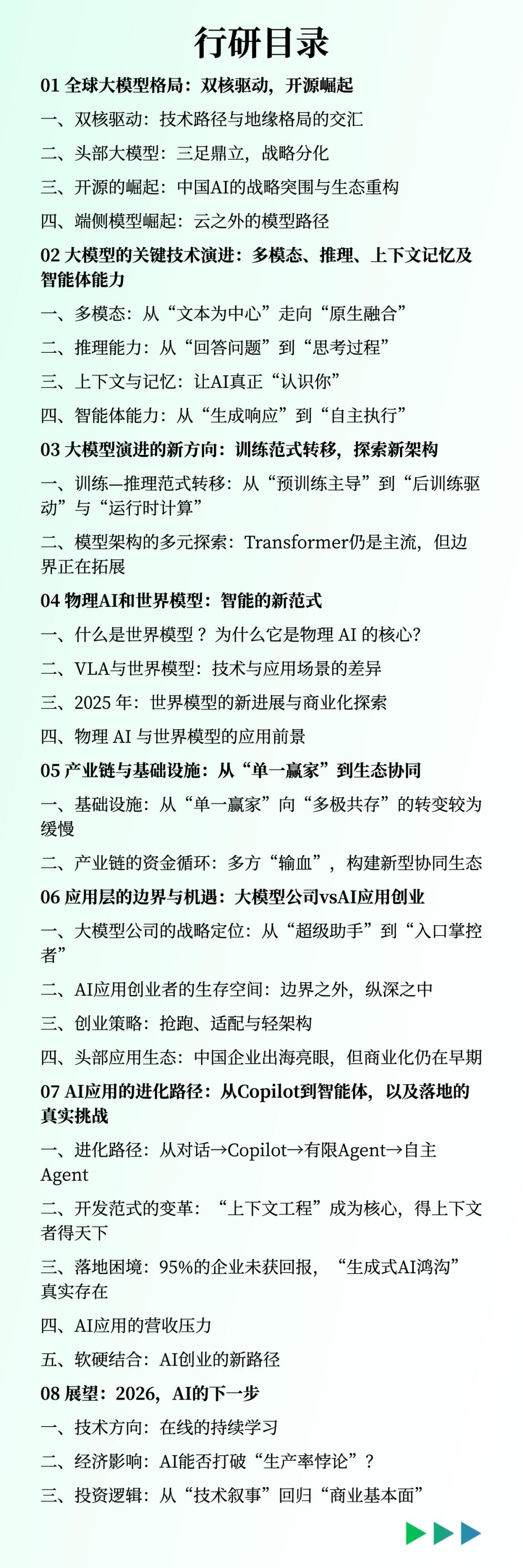
Core Insights - The AI industry is entering a rapid change cycle, with 2025 being a pivotal year for the development of large models, particularly with the emergence of DeepSeek, which is reshaping the global landscape and promoting open-source initiatives [1][10][18] - The dual-core driving force of AI development is characterized by the United States and China, each following distinct paths, with key technologies accelerating towards engineering applications [1][10][11] - Despite advancements in model capabilities, challenges in real-world application remain prevalent, indicating a shift in focus from "large models" to "AI+" [1][10][19] Group 1: Global Large Model Landscape - The global large model development is driven by a dual-core approach, with the U.S. leading in closed-source models and China focusing on open-source models [10][11][13] - OpenAI, Anthropic, and Google represent the leading trio in the large model arena, each adopting differentiated strategic paths [17] - DeepSeek's emergence marks a significant breakthrough for China's large model development, showcasing the potential of open-source models [18][19] Group 2: Key Technological Evolution - The evolution of large models is marked by four major technological trends: native multimodal integration, reasoning capabilities, long context memory, and agentic AI [22][24] - Native multimodal architectures are replacing text-centric models, allowing for seamless integration of various modalities [23] - Reasoning capabilities are becoming a core feature of advanced models, enabling them to demonstrate their thought processes [24][26] Group 3: Industry Chain and Infrastructure - The AI infrastructure is still dominated by Nvidia, with a slow transition towards a multi-polar ecosystem despite the emergence of alternatives like Google’s TPU and AMD’s chips [47][48] - The AI industry is shifting from reliance on a few cloud providers to a more collaborative funding model, with Nvidia and OpenAI acting as dual cores driving the ecosystem [51][52] Group 4: Application Layer Opportunities - Large model companies are positioning themselves as "super assistants" while also aiming to control user entry points through various products and services [53][54] - Independent application companies can find opportunities in vertical markets that require deep industry understanding and complex workflow integration [55][56] - The evolution of AI applications is moving towards intelligent agents capable of autonomous operation, indicating a significant shift in application development paradigms [61][62]

DeepSeek上新:开源模型首达IMO金牌水平,AI推理告别“死记硬背”
Guan Cha Zhe Wang· 2025-11-28 07:17
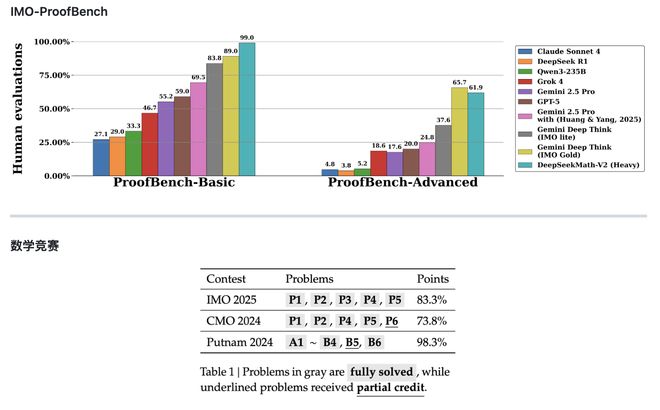
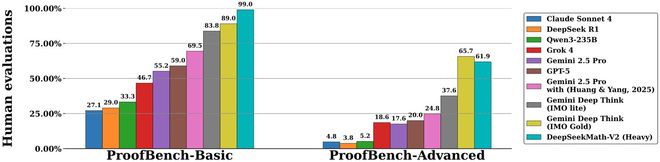
Core Insights - DeepSeek has released its latest technology achievement, DeepSeek-Math-V2, which focuses on enhancing mathematical reasoning and theorem proving capabilities in large language models, boasting 685 billion parameters [1][5] Performance Highlights - DeepSeek-Math-V2 achieved gold medal levels in the 2025 International Mathematical Olympiad (IMO) and the 2024 Chinese Mathematical Olympiad (CMO), and scored 118 out of 120 in the Putnam 2024 competition, surpassing the historical human record of approximately 90 points [1][3] - In the IMO-ProofBench benchmark, Math-V2 scored nearly 99% on the basic set, significantly outperforming Google's Gemini DeepThink, which scored 89%. On the advanced set, Math-V2 scored 61.9%, slightly below Gemini DeepThink's 65.7% [4] Technological Innovations - DeepSeek-Math-V2 addresses the "illusion of reasoning" problem highlighted by former OpenAI chief scientist Ilya Sutskever, moving beyond mere answer correctness to ensure rigorous logical reasoning [5][6] - The model employs a strict "process-focused" strategy, requiring clear and logical step-by-step derivations, and does not reward correct final answers if intermediate steps are flawed [6] - A unique multi-level "Meta-Verification" mechanism enhances the reliability of scoring, increasing the confidence level from 0.85 to 0.96 [9] Industry Impact - The release of DeepSeek-Math-V2 has generated significant buzz in the overseas developer community, marking a strong comeback for DeepSeek and breaking the long-standing dominance of closed-source models in top reasoning capabilities [11] - The model's success in mathematical reasoning is expected to influence the coding model space, potentially disrupting existing code assistance tools [11] - The global AI landscape is transitioning from "text generation" to "logical reasoning," with DeepSeek's approach providing a clear path for technological evolution through rigorous validation mechanisms rather than sheer computational power [11]

吊打谷歌!DeepSeek开源首个“奥数金牌”AI
Ge Long Hui· 2025-11-28 07:09
Core Insights - DeepSeek has launched a new model, DeepSeekMath-V2, which is the first open-source model to reach the International Mathematical Olympiad (IMO) gold medal level [2][4] - The model has shown superior performance in various benchmarks, outperforming Google's Gemini DeepThink series in some areas [2][4] Performance Metrics - In the Basic benchmark, DeepSeekMath-V2 scored nearly 99%, significantly higher than Gemini DeepThink's 89% [4] - In the Advanced subset, Math-V2 scored 61.9%, slightly lower than Gemini DeepThink's 65.7%, indicating competitive performance [4] - The model achieved gold medal level in IMO 2025 by solving 5 out of 6 problems, and also reached gold level in CMO 2024 and scored 118 in Putnam 2024, close to the maximum score of 120 [4][7] Technological Advancements - DeepSeekMath-V2 introduces a self-verifying mathematical reasoning approach, marking a significant milestone in AI mathematical reasoning [10] - The model features a new training mechanism that includes: 1. A reliable verifier that checks each step of theorem proofs for logical consistency [10] 2. A generator that learns to self-improve by identifying and correcting issues during the proof generation process [11] 3. An evolving verification capability that adapts as the generator improves, focusing on difficult-to-verify proofs for further training [11] Industry Impact - The release of DeepSeekMath-V2 is seen as a strategic move in a competitive landscape, coinciding with releases from other major players like OpenAI and Google [10] - The open-source nature of the model under the Apache 2.0 license allows global developers to explore and fine-tune the gold medal-level model, breaking the monopoly of closed-source models in top-tier mathematical reasoning [10]
不只是“做题家”!DeepSeek最新模型打破数学推理局限,部分性能超越Gemini DeepThink
Tai Mei Ti A P P· 2025-11-28 05:45
Core Insights - DeepSeek has released its latest mathematical model, DeepSeek Math-V2, which has generated significant excitement in the AI community due to its self-verifying capabilities in deep reasoning, particularly in mathematics [1][2]. Model Performance - Math-V2 demonstrates strong theorem-proving abilities, distinguishing itself from previous models that merely solved problems without rigorous reasoning [2]. - The model achieved gold medal-level results in the IMO 2025 and CMO 2024 competitions, and scored 118 out of 120 in the Putnam 2024 competition, showcasing its superior performance [2]. Benchmarking Results - In the IMO-Proof Bench evaluation, Math-V2 scored 99%, outperforming Google's Gemini Deep Think (89%) and GPT-5 (59%) [3]. - In advanced testing, Math-V2 scored 61.9%, just behind Gemini Deep Think's 65.7% [3]. Community Impact - The release of Math-V2 has sparked discussions across social media platforms and communities, highlighting its potential to automate verification-heavy tasks in programming languages [5][8]. - Experts in the AI field have praised DeepSeek's return and the significance of Math-V2, indicating a shift from "chatbot" to "reasoner" era in AI development [8][9].
第1个获得数学奥赛金牌的开源模型!DeepSeek新模型获网友盛赞:公开技术文件,了不起!
华尔街见闻· 2025-11-28 04:35
Core Insights - DeepSeek has launched its latest mathematical reasoning model, DeepSeekMath-V2, which has achieved gold medal status in the simulated 2025 International Mathematical Olympiad (IMO), marking a significant breakthrough in open-source AI's complex reasoning capabilities [1][2] - This achievement positions DeepSeekMath-V2 as the first open-source model to win a gold medal at the IMO level, drawing attention from the AI research and developer community [2] - Unlike closed-source models from Google and OpenAI, DeepSeekMath-V2's model weights are publicly available under the Apache 2.0 license, allowing for unrestricted access and exploration by users [3][5] Performance Highlights - DeepSeekMath-V2 solved 5 out of 6 problems in the IMO 2025 simulation, achieving gold medal status, which is a notable accomplishment given that only 72 out of 630 human participants received gold medals [4] - The model also demonstrated top-tier performance in other prestigious competitions, including achieving gold medal status in the Chinese Mathematical Olympiad (CMO) and scoring 118 out of 120 in the Putnam Mathematics Competition [4] Open-Source Advantage - The core appeal of DeepSeekMath-V2 lies in its complete openness, allowing users to freely download, fine-tune, and optimize the model without restrictions [5] - The release has been praised as a significant milestone for the open-source community, emphasizing the potential for open-source models to challenge the commercial strongholds of closed-source products [3][5] Innovative Training Framework - DeepSeekMath-V2 employs an innovative self-verification training framework, which includes a specialized verifier that assesses the quality of the proof process rather than just the final answer [10][11] - This mechanism encourages the model to identify and rectify issues in its reasoning chain before finalizing answers, enhancing the rigor of its mathematical reasoning [12] Dynamic Evolution Strategy - To prevent overfitting to its own verification mechanism, DeepSeek has implemented a dynamic evolution strategy that increases computational demands and automatically labels difficult proofs, ensuring the verifier and generator evolve in tandem [13] - This approach allows for the continuous optimization of performance and the creation of new training data, validating the feasibility of self-driven learning systems in tackling complex mathematical reasoning tasks [13]