微软

Search documents
海外科技行业2026年第1期:Meta并购、资本密集投入前沿Lab,行业进入价值兑现期
GUOTAI HAITONG SECURITIES· 2026-01-05 05:24
Investment Rating - The report maintains an "Overweight" rating for the industry, recommending investment in AI computing, cloud vendors, AI applications, and AI social networking sectors [4][6]. Core Insights - Meta's acquisition of Manus for over $2 billion signals a strong commitment to monetizing AI capabilities, with Manus achieving an annual recurring revenue (ARR) of $125 million through a subscription model for AI agents [2][7]. - Continuous capital investment in advanced AI models has led to a new phase of "ample funding + rapid iteration" for AI labs, with significant investments from SoftBank totaling $40 billion in OpenAI, raising its valuation to approximately $500 billion [8]. - OpenAI is venturing into AI hardware, expected to launch its first product, potentially a "smart pen" or wearable audio device, by 2026 or 2027, marking a shift towards an integrated software-hardware ecosystem [9]. Summary by Sections Weekly Overview - Meta's acquisition of Manus is highlighted as a pivotal move, emphasizing the transition from AI capability competition to a focus on mature products and cash flow [7]. Capital Investment Trends - The report notes that major investments in AI labs are alleviating financial pressures, allowing for accelerated technological iterations and product deployments [8]. AI Hardware Development - OpenAI's upcoming hardware project, produced by Hon Hai, aims to enhance user interaction with AI, indicating a strategic expansion into hardware [9]. Market Performance - The report provides a market performance overview, noting fluctuations in major indices and specific stock performances within the tech sector [10][12]. AI Industry News - Key developments include Baidu's submission of an IPO application for Kunlun Chip, signaling growth in China's semiconductor sector, and the launch of Tencent's translation model [22][24].
资讯日报:特朗普宣称将接管委内瑞拉直至完成权力过渡安排-20260105
Guoxin Securities Hongkong· 2026-01-05 05:11
Market Overview - On January 5, 2026, the Hang Seng Index closed at 26,338, up 2.76% for the day and 2.76% year-to-date[3] - The Hang Seng Technology Index surged 4.00% to close at 5,736, marking a strong start to the year[3] - The Nasdaq China Golden Dragon Index rose 4.38%, achieving its largest single-day gain since May 12, 2025[2] Sector Performance - Baidu Group's stock increased by over 9% following the announcement of its subsidiary Kunlun Chip's IPO application, with expected revenue of approximately 5 billion yuan for 2025[9] - Aerospace and defense stocks saw significant gains, with Asia Pacific Satellite rising 34.53% and Goldwind Technology up over 20%[9] - Semiconductor stocks performed strongly, with Hua Hong Semiconductor up over 9% and SMIC rising over 5%[9] Economic Indicators - The U.S. Federal Reserve President anticipates a moderation in inflation and stable employment, projecting economic growth around 2% for the year[13] - The Chinese government has adjusted the weight of the U.S. dollar, euro, and yen in the CFETS RMB exchange rate index effective January 1, 2026[13] Investment Trends - The tourism and leisure sector showed active performance, with Hong Kong Travel and Ctrip Group both rising over 5%[9] - Institutional forecasts suggest that the net profit growth rate for Hong Kong Stock Connect constituents is expected to reach high single digits in 2026, with technology and healthcare sectors leading the growth[9]
梦想蓝图与现实基石:微软AI战略的交响曲
Sou Hu Cai Jing· 2026-01-05 04:52
Core Insights - The AI industry is experiencing rapid growth, with a compound annual growth rate of 53%, and its applications span various sectors including finance, robotics, autonomous vehicles, healthcare, imaging, legal, energy systems, and education [1][12][37] - Major tech companies are gearing up for a competitive landscape in AI, indicating the onset of an AI ecosystem battle [1][12][39] Group 1: AI Ecosystem and Strategy - Establishing an AI ecosystem is crucial, and the development of effective strategies is a key focus for tech giants [3][14][39] - The AI field presents significant potential and challenges, making it difficult to decode the competitive strategies of major players [15][39] - Companies must have clear strategies to avoid failure in the AI ecosystem battle, which is a common challenge faced by IT giants and startups alike [15][39] Group 2: Microsoft's AI Development Plan - Microsoft has committed substantial resources to AI, with CEO Satya Nadella stating that AI is at the intersection of their ambitions [4][40] - The primary goal of Microsoft's AI strategy is to democratize AI, making it accessible to everyone and enhancing human-machine collaboration [5][29][41] - Microsoft has established a new department with over 5,000 computer scientists and engineers to implement a four-pronged approach to AI [6][31][42] Group 3: Four-Pronged Approach - The four directions of Microsoft's AI strategy include: - Agents: Developing intelligent assistants like Cortana to transform user interaction with computers [6][18][43] - Application Software: Infusing intelligence into applications across devices for seamless interaction [6][18][43] - Services: Providing AI technology to developers worldwide, focusing on cognitive capabilities [7][18][43] - Infrastructure: Utilizing Azure to create a powerful AI supercomputer, enhancing resource accessibility for businesses and individuals [7][19][44] Group 4: Conversational Platforms - Microsoft views "Conversations as a Platform" as a foundational element for future ecosystems, with chatbots being a significant focus [8][21][45] - The company is actively developing chatbots like Cortana and Xiaoice, which incorporate emotional computing frameworks [9][22][46] - Microsoft has acquired Wand Labs to enhance its chatbot and intelligent agent capabilities [9][22][46] Group 5: Collaboration and Competition - Major tech companies recognize the need for collaboration in addressing challenges such as security, legal, and privacy issues in AI [11][48] - Microsoft, along with other tech giants, has formed the Partnership on Artificial Intelligence to tackle these issues collectively [11][48] - Despite facing tough competition from mobile-first and cloud-first rivals, Microsoft is determined to seize opportunities in the AI market [11][49]



存储芯片概念爆发,兆易创新涨停,江波龙等大涨
Zheng Quan Shi Bao Wang· 2026-01-05 02:48
Industry Overview - The storage chip sector is experiencing significant activity, with companies like Cloud Han Chip City and others seeing stock price increases of over 10% [1] - Major North American cloud service providers (CSPs) such as Google, Meta, Microsoft, and Amazon AWS are expanding their investments in AI infrastructure, with total investments expected to reach a historical high of $600 billion by 2026 [1] Price Forecast - Strong demand for AI is projected to drive substantial increases in storage chip prices by 2025, with DDR4 16Gb prices expected to rise by 1800%, DDR5 16Gb by 500%, and 512Gb NAND flash by 300% [1] - Guojin Securities forecasts that global storage chips will remain in short supply throughout 2026, leading to continued price increases [2] Supply and Demand Dynamics - For 2026, DRAM bit supply is expected to grow by approximately 15% to 20%, while demand growth is anticipated to reach 20% to 25% [2] - NAND bit supply is projected to increase by 13% to 18%, with demand growth expected to be between 18% and 23% [2] - The consumption of DRAM and NAND flash in the server sector is predicted to surge by 40% to 50% year-on-year, with even faster growth in AI server applications [2] Price Increase Predictions - In Q1 2026, storage contract prices are expected to continue rising, with increases projected at 30% to 40% [2] - Prices for DDR5 RDIMM memory are anticipated to rise by over 40%, while NAND flash prices are expected to see double-digit percentage increases [2] - Enterprise-grade SSD prices are also forecasted to increase by 20% to 30% [2]


人工智能行业专题(14):大模型发展趋势复盘与展望
Guoxin Securities· 2026-01-05 01:16
Investment Rating - The report maintains an "Outperform" rating for the AI industry [1] Core Insights - The report reviews the stock price trends of major US tech companies over the past three years, highlighting the continuous evolution of AI narratives. In 2023, OpenAI led the global acceleration of AI, benefiting Microsoft through exclusive partnerships, resulting in a significant valuation increase. The narrative shifted in 2024 towards reasoning capabilities, with application companies seen as optimal investments, particularly Meta, which holds a monopoly in social media and advertising scenarios [2][11] - The report anticipates a 50% year-on-year increase in capital expenditures (Capex) for four major companies in 2025, with a sustained growth rate of over 30% expected in 2026. The report notes that the North American tech giants' Capex was revised upwards from an initial estimate of $320-330 billion to nearly $400 billion by year-end [2][18] - The evolution of model architectures continues, with the Scaling Law remaining relevant. The emergence of multi-modal and long-text capabilities is expected to provide a foundation for the explosion of agents. The report identifies two core pain points that need addressing: the computational and memory consumption bottlenecks during training and the limited memory capacity during inference [2][47] Summary by Sections Section 1: Stock Price and Capex Review - In 2023, major tech companies experienced a significant recovery in stock prices after a sharp decline in 2022, with OpenAI's advancements driving this trend [7][11] - The report predicts that the Capex for major companies will continue to grow, with Microsoft, Amazon, Google, and Meta all showing substantial year-on-year increases [18][19] Section 2: Demand for Reasoning Capabilities - The report highlights that the demand for reasoning capabilities is expected to explode, particularly in programming and agent applications. The growth of AI programming tools and agents is anticipated to drive significant revenue increases in these sectors [5][11] Section 3: Model Development Trends - The report discusses the ongoing evolution of model architectures, emphasizing the importance of addressing computational efficiency and memory limitations. It notes that the next generation of models will need to overcome these challenges to achieve significant advancements [33][47] - The report also mentions the competitive landscape among major model developers, with OpenAI, Google, and others vying for leadership in multi-modal capabilities and reasoning models [36][44] Section 4: Investment Recommendations - The report suggests focusing on companies involved in computational infrastructure, such as Alibaba, Baidu, NVIDIA, and Google, as well as major model developers like Alibaba, Google, and Tencent [5][11]
盘前必读丨上海再出新政发展低空经济;宇树科技澄清不实信息
Di Yi Cai Jing· 2026-01-04 23:20
机构认为,2025年12月下旬的上涨或许是本轮春季行情起点。 【财经日历】 国内航线燃油附加费下调 国新办就长江经济带发展十年工作进展和成效举行新闻发布会 | い) 盘前必读 | // 外盘怎么样 // | | | | --- | --- | --- | --- | | 名称 | 现价 | | 涨跌幅 | | 道琼斯工业平均 | 48382.39c 319.10 = | | 0.66% | | 纳斯达克指数 | 23235.63c -6.36 | | -0.03% | | 标普500 | 6858.47c 12.97 0.19% | | | 当地时间上周五,美股三大股指涨跌互现,截至收盘,道指涨0.66%,纳指跌0.03%,标普500指数涨0.19%。 日内龙头科技股以下跌为主,拖累纳指微幅收跌。奈飞收跌2.95%,微软跌2.21%,亚马逊跌1.87%,Meta跌1.47%,苹果跌0.31%,谷歌母公司Alphabet收高 0.69%。 另一方面,芯片股表现强劲。受益于存储芯片需求预测上调,费城半导体指数大涨4%。美光科技收涨10.52%,领涨芯片板块;荷兰光刻机巨头阿斯麦 (ASML)大涨8.78%,超威半 ...

微软CEO纳德拉开设个人博客,首篇文章聚焦AI文化及技术便捷
Sou Hu Cai Jing· 2026-01-04 23:13
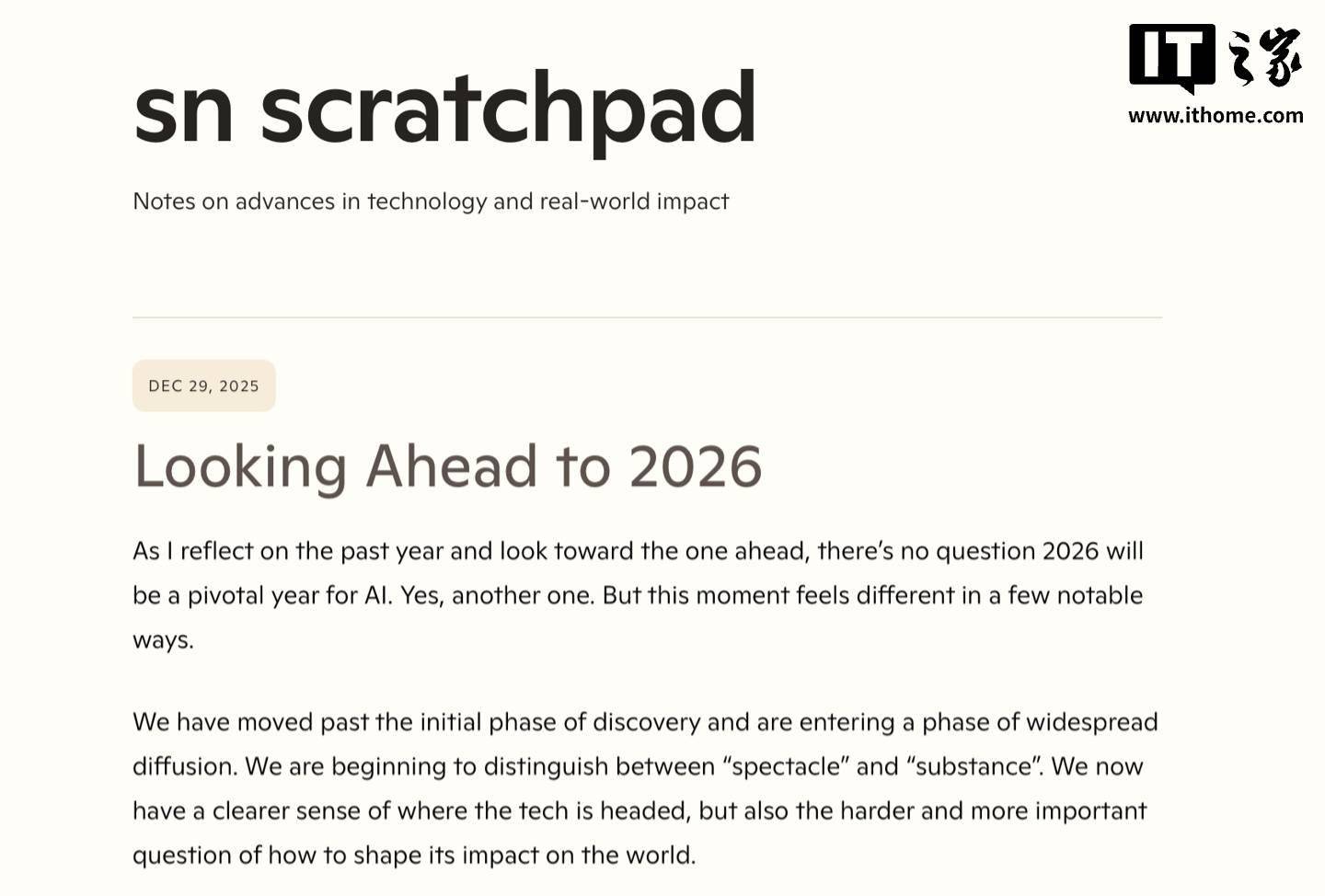
Core Insights - The debate surrounding AI as "garbage content" versus "high-end technology" is misdirected; the focus should be on how AI as a "cognitive amplifier" reshapes human understanding and thought processes [3] - Nadella defines 2026 as a watershed year for AI, marking the transition from an "exploration phase" to a "diffusion phase" in the industry [3] - The next stage of AI is not a competition among models from OpenAI, Google, or Anthropic, but a systemic challenge involving orchestration capabilities, safety, and social compliance [3] Industry Developments - Microsoft is embedding AI deeply into core products like Windows and Office, aiming for users to rely on AI as they do on Word and Excel [4] - Despite ambitious AI visions, many features remain conceptual, raising questions about Microsoft's execution capabilities [4] - The AI industry faces scrutiny regarding overhyped performance, sustainability of energy consumption, and the proliferation of low-quality generated content [4] Future Directions - Nadella emphasizes the importance of designing systems that create long-term societal value rather than merely addressing AI's shortcomings [4] - Microsoft has invested hundreds of billions in AI infrastructure and partnerships, but technical advantages alone are insufficient for success [4] - The historical context of computing has always been about empowering individuals and organizations, and AI must follow this path to become a significant computing wave [4] Ongoing Engagement - Nadella hints at continuing to update his blog with personal reflections on how Microsoft and the industry are transforming ambitious AI goals into clearer, commercially viable realities [5]
计算机周观察20260104:假期行业动态更新
CMS· 2026-01-04 13:01
Investment Rating - The industry investment rating is maintained as "Recommended" [2] Core Insights - The report highlights a divergence in technology market performance between US and Hong Kong stocks during the holiday period, with AI and commercial aerospace sectors showing frequent information catalysts, suggesting continued focus on core industry players [1][6] - The report emphasizes the importance of AI applications and the acceleration of large model iterations, recommending continued attention to companies like Alibaba, Kingsoft, and others in the AI infrastructure space [6] Summary by Sections Holiday Technology Dynamics - During the New Year holiday, US and Hong Kong stock markets exhibited divergent trends, with technology stocks being the main market drivers. Notably, AI and storage chips led the gains, with Micron Technology rising over 10% to reach a historical high, and significant increases in other tech stocks [9] - The Hong Kong market saw a "New Year rally," with the Hang Seng Index rising 2.76% and the Hang Seng Technology Index increasing by 4% [9] Market Performance Review - In the last week of 2025, the computer sector rose by 1.16%, with the top-performing stocks being Yuyin Co., Digital Certification, and others, while the report also lists the top gainers and losers in the market [24]




用了20+年的Windows激活方式,被一夜作废,Win11/Win10电话激活突然失效,微软没公告、没通知
3 6 Ke· 2026-01-04 12:14
Core Viewpoint - Microsoft has quietly discontinued the phone activation method for Windows, which has been a crucial offline activation option for many users, especially in secure environments where internet access is restricted [1][3][6]. Group 1: Activation Methods - Microsoft has traditionally offered two activation methods: online activation via the internet and phone activation for offline scenarios [3]. - Phone activation has been a reliable method since the Windows XP era, essential for organizations that cannot connect to the internet [3][10]. - The removal of the phone activation option effectively eliminates the last remaining offline activation method, following the previous removal of unofficial KMS activation [3][6]. Group 2: User Experience and Reactions - Users have reported that when attempting to use phone activation, they receive an automated message directing them to activate online instead [6]. - Despite the automated response, Microsoft's official support documentation still claims that phone activation is available, creating confusion among users [4][6]. - The discontinuation of phone activation has led to significant backlash from users, who feel that Microsoft is increasingly making the Windows operating system reliant on online services, detracting from its functionality as a local operating system [7][8]. Group 3: Impact on Specific Environments - The removal of phone activation poses a structural challenge for environments such as government units, industrial control systems, and other secure networks that cannot connect to the internet [10]. - These environments previously relied on a specific activation process that is now rendered obsolete, leading to operational difficulties [7][10].
微软纳德拉:别再纠结AI垃圾内容,2026年拼的是应用落地
Huan Qiu Wang Zi Xun· 2026-01-04 04:46
Core Insights - Microsoft CEO Satya Nadella has launched a personal blog titled "Thoughts and Notes," focusing on the development of the AI industry and urging the sector to move beyond the debate of "AI garbage content versus high-end experiences" to build a new consensus on AI applications [1][4] - Nadella's emphasis on AI strategy signals a significant shift in Microsoft's approach, particularly after appointing new executives to lead core business areas [1][4] Group 1 - Nadella proposes an upgrade to Steve Jobs' "bicycle for the mind" concept, advocating for a new cognitive framework for AI that considers its role as a "cognitive enhancement tool" and its impact on human interaction [4] - He highlights that 2026 will be a pivotal year for AI development, calling for a shift from "model-driven" to "system-driven" approaches, emphasizing the importance of AI's societal and environmental impacts, and the need for equitable distribution of scarce resources like energy and computing power [4] - Current challenges include the underperformance of Microsoft's AI products like Copilot, which are intended to replace traditional software such as Office and Windows, as the quality of AI-generated content remains inconsistent, leading to ongoing debates about "garbage content" and concerns from creators about AI encroaching on their livelihoods [4] Group 2 - Nadella, who was deeply involved in the AI model competition for 2025, now stresses the importance of the practical application and societal value of AI rather than getting caught up in technical debates [4] - He commits to sharing insights on technological advancements and their real-world impacts through his blog in 2026 [4]