信达生物

Search documents
摩根大通增持信达生物(01801)58.59万股 每股作价约79.23港元
Zhi Tong Cai Jing· 2026-02-12 11:40
Core Viewpoint - JPMorgan Chase increased its stake in Innovent Biologics (01801) by acquiring 585,900 shares at a price of approximately HKD 79.23 per share, totaling around HKD 46.42 million, resulting in a new holding of approximately 87.22 million shares, representing a 5.02% ownership stake [1] Group 1 - JPMorgan Chase's acquisition of 585,900 shares indicates a strategic investment in Innovent Biologics [1] - The purchase price of HKD 79.23 per share reflects the current market valuation of Innovent Biologics [1] - The total investment amount of HKD 46.42 million signifies JPMorgan's confidence in the company's future prospects [1] Group 2 - Following the acquisition, JPMorgan's total shareholding in Innovent Biologics reached approximately 87.22 million shares [1] - The updated ownership percentage of 5.02% positions JPMorgan as a significant stakeholder in Innovent Biologics [1]

摩根大通增持信达生物58.59万股 每股作价约79.23港元
Zhi Tong Cai Jing· 2026-02-12 11:25
Core Viewpoint - Morgan Stanley increased its stake in Innovent Biologics (01801) by purchasing 585,900 shares at a price of HKD 79.232 per share, totaling approximately HKD 46.422 million, raising its ownership to about 87.2176 million shares, which represents a 5.02% stake [1] Group 1 - Morgan Stanley's recent purchase of shares indicates a positive outlook on Innovent Biologics' future performance [1] - The total investment made by Morgan Stanley in this transaction is approximately HKD 46.422 million [1] - Following the acquisition, Morgan Stanley's total shareholding in Innovent Biologics is now approximately 87.2176 million shares [1]
医药行业周报:1-8批国采平稳接续扰动有限,机构加仓创新,持续看好低估创新标的-20260212
BOCOM International· 2026-02-12 11:21
Industry Rating - The report rates the pharmaceutical industry as "Leading" [1] Core Insights - The report highlights that the recent national procurement has been stable, with a high selection rate of 93%, indicating a positive outlook for innovative companies in the sector [4][5] - The market sentiment has improved, driven by significant business development (BD) transactions, suggesting a continuation of the positive trend in 2026 despite potential short-term volatility [4] - The report emphasizes the importance of focusing on fundamentals and valuations when selecting stocks, particularly undervalued innovative companies that have been overlooked during market fluctuations [4] Summary by Sections Market Performance - The Hang Seng Index rose by 1.3% and the Hang Seng Healthcare Index increased by 5.0%, outperforming the broader market [4][6] - Sub-sectors such as biopharmaceuticals and CXO both saw a growth of 7.4% [6] Institutional Holdings - As of February 10, 2026, domestic institutional holdings through Hong Kong Stock Connect slightly decreased to 22.2%, while foreign holdings increased to 39.7%, indicating a shift towards more positive sentiment among foreign investors [32] - Key increases in holdings were noted in leading CXO companies benefiting from demand recovery, such as Tigermed and WuXi AppTec [37][38] Valuation Overview - The report provides a valuation summary for various companies, with notable buy ratings for AstraZeneca, BeiGene, and others, indicating strong growth potential [3] - The average price-to-earnings (P/E) ratio for the healthcare sector is reported at 28.4 times, with specific segments like biopharmaceuticals at 13.1 times [16] Sales Trends - The report notes a 1% year-on-year decline in China's pharmaceutical market sales for 2025, with significant variations across different sales channels [5] - Public hospitals accounted for the largest market share but experienced a 2.1% decline, while retail pharmacies saw a 2.4% increase, driven by online sales growth [5] Procurement Insights - The recent national procurement round involved 316 commonly used drugs, with a high participation rate and diverse product offerings, ensuring stable clinical supply [5] - The procurement process has been refined to enhance quality and reliability, with stricter requirements for participating companies [5]
大健康风向标〡中国创新药破局之年,重磅产品重塑全球医药格局
Jing Ji Guan Cha Wang· 2026-02-12 10:00
Core Insights - 2025 marks a milestone year for China's innovative pharmaceuticals, with a significant increase in the number of approved drugs and vaccines, driven by supportive policies, international expansion, and expedited review processes [1][2] Group 1: Drug Approvals and Market Trends - In 2025, China approved 76 innovative drugs, surpassing the 48 approved in 2024, setting a historical record [1] - The number of approved innovative drugs in China exceeded that of the US FDA, which approved 46 new drugs in the same year [1] - China saw the approval of 11 First-in-class drugs, with 4 being independently developed domestically [1] - The total value of licensing transactions for innovative drugs exceeded $130 billion, with over 150 deals made, marking another historical high [1] Group 2: Breakthrough Therapies and Innovations - Among the 76 approved drugs, 17 were recognized as breakthrough therapies, with 13 focused on oncology [2] - Notable drug launches included the first stem cell therapy in China, marking a historic breakthrough in stem cell treatment [2] - The launch of targeted HER2 drugs for non-small cell lung cancer and cholangiocarcinoma signifies a new phase in precision treatment for solid tumors in China [2] Group 3: Disease-Specific Developments - In oncology, 34 new drugs were approved, with breast cancer treatments leading at 9 new drugs, followed by 6 for lung cancer and 8 for hematological malignancies [3] - Two CAR-T cell therapies targeting CD19 were approved, bringing the total number of domestic CAR-T therapies to 7 [3] Group 4: Innovations in Other Therapeutic Areas - In the influenza treatment sector, four new drugs were launched, addressing public health needs during peak flu seasons [4] - The innovative vaccine sector saw significant advancements, including the launch of China's first nine-valent HPV vaccine and a 13-valent pneumococcal conjugate vaccine [5] - The emergence of a serum-free rabies vaccine is expected to fill a market gap, showcasing China's growing capabilities in biopharmaceutical innovation [5]


国联民生证券:小核酸重构减肥逻辑 INHBE与ALK7靶点初步验证
智通财经网· 2026-02-12 06:43
Core Viewpoint - The report from Guolian Minsheng Securities highlights the synergistic effects of small nucleic acid drugs and GLP-1 class drugs in the weight loss sector, suggesting they could become a "golden duo" for weight management [1][4]. Group 1: Drug Efficacy and Development - Arrowhead has reported promising initial weight loss results from two small nucleic acid drugs targeting INHBE and ALK7, with ARO-INHBE showing an average fat reduction of 9.9% and liver fat reduction of up to 38.6%, alongside a 3.6% increase in lean tissue [1]. - ARO-ALK7 demonstrated a dose-dependent average reduction of ALK7 mRNA by 88%, confirming the TRiM platform's ability to inhibit fat cell gene expression [1]. - Wave Life's WVE-007 targeting liver INHBE showed a 9.4% reduction in visceral fat and a 4.5% overall fat reduction after three months, with a 3.2% increase in lean body mass [3]. Group 2: Market Trends and Collaborations - Major pharmaceutical companies are increasingly investing in small nucleic acid drugs, with Eli Lilly committing $1.2 billion in collaboration with Saint Inbiotech for RNAi candidate drug development for metabolic diseases [3]. - Eli Lilly also invested $1 billion in HAYA's lncRNA platform for obesity and related metabolic disease treatments, while Novo Nordisk partnered with Replicate Bioscience for a $550 million project targeting obesity and type 2 diabetes [3]. - The speed of Chinese pharmaceutical companies in developing small nucleic acid drugs for weight loss is nearly on par with international counterparts, with several companies like Hengrui Medicine and Innovent Biologics actively pursuing this area [5]. Group 3: Investment Recommendations - The report suggests focusing on companies involved in small nucleic acid weight loss targets, including Hengrui Medicine, Chengdu Xian Dao, China National Pharmaceutical Group, East China Pharmaceutical, and others [6].




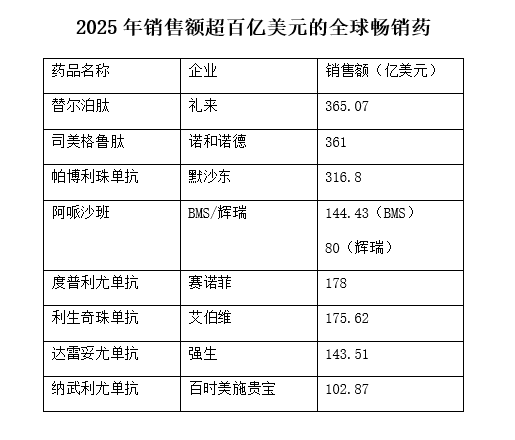
“药王”更迭 替尔泊肽年销售额超365亿美元登顶
Xin Jing Bao· 2026-02-12 04:54
Core Insights - The global pharmaceutical industry is witnessing a significant shift in the rankings of best-selling drugs, with several products surpassing $10 billion in sales for 2025 [1][2]. Group 1: Sales Performance - Novo Nordisk's semaglutide briefly topped the sales chart in Q1 2025 but was ultimately surpassed by Eli Lilly's tirzepatide, with both drugs exceeding $30 billion in sales [1][3]. - Tirzepatide achieved a remarkable year-on-year sales growth of 121%, while semaglutide's growth was only 13% [3]. - The sales figures for semaglutide in the first half of 2025 reached $16.683 billion, maintaining its position as a top-selling drug [3]. Group 2: Competitive Landscape - The GLP-1 drug class is experiencing intense competition, with both tirzepatide and semaglutide being key players [4][5]. - The market is dominated by Novo Nordisk and Eli Lilly, but Chinese pharmaceutical companies are also making significant strides in this area [5][6]. - New GLP-1 drugs are under development, including Novo Nordisk's CagriSema and Eli Lilly's retatrutide, which shows potential for greater weight loss than tirzepatide [5]. Group 3: Oncology and Autoimmune Drugs - The PD-1 inhibitor pembrolizumab (Keytruda) remains a top seller in oncology, with sales reaching $31.68 billion in 2025, despite falling to third place [7]. - Nivolumab (Opdivo) also crossed the $10 billion mark, achieving sales of $10.29 billion [8]. - In the autoimmune disease sector, drugs like dupilumab and risankizumab achieved sales of $17.8 billion and $17.562 billion, respectively [8]. Group 4: Anticoagulants - The anticoagulant apixaban continues to show strong sales growth, with BMS reporting $14.443 billion in sales, a year-on-year increase of 8% [9]. - Pfizer's reported revenue from apixaban reached $8 billion, making it their second-largest selling product [9].

“药王”更迭,替尔泊肽年销售额超365亿美元登顶
Bei Ke Cai Jing· 2026-02-12 04:38
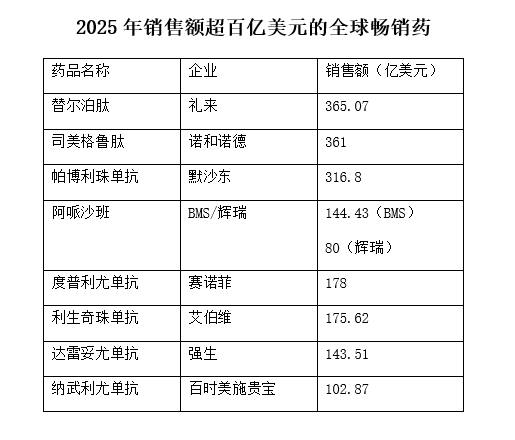
Core Insights - The pharmaceutical industry is witnessing a significant shift in the rankings of top-selling drugs, with several products surpassing $10 billion in sales for 2025 [1][2] - The competition in the GLP-1 drug category is intensifying, with new entrants like semaglutide and tirzepatide rapidly gaining market share [3][4] Group 1: Top-Selling Drugs - Tirzepatide from Eli Lilly has achieved sales of $365.07 billion, making it the top-selling drug of 2025 [2][3] - Semaglutide from Novo Nordisk follows closely with sales of $361 billion, having briefly surpassed Merck's pembrolizumab (Keytruda) in Q1 2025 [1][3] - Pembrolizumab (Keytruda) recorded sales of $316.8 billion, maintaining a strong position despite falling to third place [7][8] Group 2: Market Dynamics - The sales growth of tirzepatide is remarkable, with a year-on-year increase of 121%, while semaglutide's growth is only 13% [3] - The competitive landscape for GLP-1 drugs is evolving, with multiple companies, including domestic Chinese firms, entering the market with biosimilars and new formulations [4][6] - Novo Nordisk and Eli Lilly are both developing next-generation GLP-1 drugs, with Novo Nordisk's CagriSema and Eli Lilly's retatrutide showing promising clinical results [5] Group 3: Other Notable Drugs - Other significant drugs include nivolumab (Opdivo) from Bristol-Myers Squibb, which achieved sales of $102.87 billion, and daratumumab (Darzalex) with sales of $143.51 billion [8][9] - Apixaban (Eliquis), a leading anticoagulant, continues to grow, with Bristol-Myers Squibb reporting sales of $144.43 billion, reflecting an 8% increase [9]
信达生物(1801.HK):近90亿美元交易再次验证抗体平台 2026年催化剂丰富 维持买入
Ge Long Hui· 2026-02-12 03:03
Core Viewpoint - The collaboration between the company and Eli Lilly marks another significant licensing deal worth over $8.85 billion, reinforcing the strength of the company's antibody technology platform [1] Group 1: Collaboration Details - The company has entered into a strategic partnership with Eli Lilly to advance global R&D of innovative drugs in oncology and immunology [1] - The agreement includes an upfront payment of $350 million, potential milestone payments of up to $8.5 billion, and a tiered sales revenue sharing structure [1] - The company retains all rights in Greater China while Eli Lilly obtains exclusive global development and commercialization rights outside this region [1] Group 2: Financial Projections and Growth - The company anticipates a revenue growth of approximately 45% year-on-year in 2025, reaching around 11.9 billion RMB, with Q4 2025 expected to generate about 3.3 billion RMB [2] - The product pipeline, including IBI363, IBI343, and IBI324, is projected to drive significant revenue growth, with a combined potential market space exceeding $60 billion [2] - Management expects to generate 8-10 new molecules annually from its early-stage clinical pipeline starting in 2026, aiming to push five products into global Phase III trials by 2030 [2] Group 3: Target Price and Ratings - The target price is maintained at HKD 105, reflecting the potential contributions from the Eli Lilly collaboration and adjustments based on the latest management guidance regarding the Takeda collaboration [3]
龙头齐跌,港股通创新药ETF(520880)下探2%,吸筹良机?港股春节或迎独立行情
Xin Lang Ji Jin· 2026-02-12 02:57
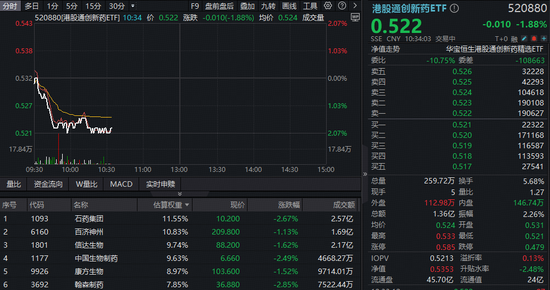
Group 1 - The Hong Kong stock market for innovative drugs experienced a decline, with the Hong Kong Stock Connect Innovative Drug ETF (520880) dropping by 2%, and major stocks like CSPC Pharmaceutical, China Biologic Products, and Hansoh Pharmaceutical falling over 2% [1] - The market is expected to see a traditional surge during the Chinese New Year holiday, with an average increase of 2% since 2021 [1] - CICC highlights four key sectors in the A-share market: dividends, internet, innovative drugs, and new consumption, which are considered to have long-term investment value [1] Group 2 - Chinese innovative drugs continue to gain traction internationally, with significant business development (BD) deals, including a partnership between Innovent Biologics and Eli Lilly worth up to $8.85 billion [2] - In January, CSPC Pharmaceutical announced a partnership with AstraZeneca valued at up to $18.5 billion, showcasing the global competitiveness of Chinese innovative drugs [2] Group 3 - The Chinese innovative drug sector is entering a commercialization phase, with over 70% of innovative drug companies reporting revenue growth, and companies like BeiGene achieving revenues exceeding 36 billion yuan [3] - Leading companies are starting to achieve profitability, with firms like Innovent Biologics and Rongchang Biologics reaching annual breakeven, and Elysium achieving over 2 billion yuan in net profit [3] - Open Source Securities expresses optimism about the innovative drug sector and its supply chain, as well as emerging industries like AI and biomanufacturing [3] Group 4 - The Hong Kong pharmaceutical sector has adjusted for nearly two quarters, presenting an attractive investment opportunity, particularly through ETFs for efficient capital allocation [3] - The Hong Kong Stock Connect Innovative Drug ETF (520880) focuses on innovative drug R&D companies, with the top ten holdings accounting for over 73% of the portfolio [3]
国信证券:医药生物行业关注低估值和业绩修复的服务及消费板块 创新药出海合作持续深化
Zhi Tong Cai Jing· 2026-02-12 02:08
Core Viewpoint - The report from Guosen Securities indicates that the medical services and consumer-related sectors have experienced long-term adjustments, resulting in valuations at historical lows. By 2026, improvements in supply structure, increased treatment volumes, and store optimization are expected to lead to a dual recovery in fundamentals and valuations, with AI empowerment providing new momentum for leading companies [1][2]. Group 1: Medical Services and Consumer Sectors - The medical services and consumer-related sectors are currently undervalued and poised for performance recovery, with a focus on specific sub-sectors [2]. - In medical services, improvements in supply structure and consumer environment are anticipated to gradually revive business, with stable customer spending and increased treatment volumes. Leading companies are expected to provide positive earnings guidance for 2026, indicating a potential dual recovery in fundamentals and valuations. AI-related business developments are also expected to drive new growth for leading medical service firms. Key companies to watch include Aier Eye Hospital (300015), Gushengtang, Tongce Medical (600763), and Haijia Medical [2]. - The pharmacy sector has shown significant marginal improvement in performance since Q3 2025, with leading companies improving same-store performance quarterly. Regulatory support from nine ministries emphasizes the long-term development direction of industry concentration and chain rate enhancement, with non-pharmaceutical adjustments and store structure optimization driving short-term performance improvements. Key companies include Yifeng Pharmacy (603939) and Dazhenglin (603233) [2]. Group 2: Home Medical Devices - The growth of home medical device companies is driven by increased product penetration and domestic production rates. Rapid growth is observed in products like Continuous Glucose Monitors (CGM) and sleep apnea machines, with leading domestic brands expanding internationally. Traditional categories like blood pressure monitors are increasingly focusing on the high-end market, with domestic brands steadily increasing market share. The combination of high domestic growth and new overseas markets is expected to contribute to sustained performance growth for home medical device companies. Key companies include Yuyue Medical (002223), Kefu Medical (301087), Sanofi Biological (300298), and Ruimaite (301367) [3]. Group 3: Innovative Drug Development - The collaboration for the international expansion of innovative drugs continues to deepen, with recent significant agreements between Shiyao Group and AstraZeneca, as well as Innovent Biologics and Eli Lilly. These collaborations highlight the growing recognition of China's innovative drug development capabilities by multinational pharmaceutical companies, showcasing the efficiency and cost advantages of Chinese innovative drugs [4]. Group 4: Investment Portfolio for 2026 - The investment portfolio for 2026 includes A-shares such as Mindray Medical (300760), United Imaging Healthcare, WuXi AppTec (603259), New Industry (300832), Meihua Medical (301363), Adebiotech (300685), Zhend Medical (603301), Yaokang Biological, Kingmed Diagnostics (603882), Aier Eye Hospital, Yuyue Medical, Yifeng Pharmacy, and Dazhenglin; H-shares include Kangfang Biologics, Kelun-Botai Biologics-B, Hutchison China MediTech, Kangnuo-B, Sanofi Biopharma, Gushengtang, and Aikang Medical [5].