雷鸟

Search documents
百度、阿里即将入局,AI眼镜“大战”升级
财联社· 2025-10-21 02:49
Core Viewpoint - The AI glasses market is experiencing significant growth, with multiple companies preparing to launch new products, driven by advancements in AI technology and increasing consumer demand [4][6][16]. Group 1: Upcoming Product Launches - Thunderbird glasses will launch the world's first HDR-supported smart viewing glasses on October 23 [4]. - Yingmu Technology has released the new generation AI smart glasses INMO GO3 and is collaborating with Tencent, Ant Group, and Zhipu AI to build an AI+AR content ecosystem [4]. - Alibaba's Quark AI glasses are in the process of ramping up production, with a pre-sale price of 9.9 yuan and additional benefits for early adopters [8][14]. Group 2: Market Growth and Competition - According to IDC, China's smart glasses shipments are expected to exceed 1 million units in the first half of 2025, marking a 64.2% year-on-year increase and capturing 26.6% of the global market share [6]. - The AI glasses market is becoming increasingly competitive, with major players like ByteDance, Alibaba, Baidu, and Meizu set to release AI-focused audio and video recording glasses [6][8]. Group 3: Industry Insights - The collaboration between Meta and Ray-Ban has demonstrated a viable commercialization path for smart glasses, focusing on user needs rather than excessive technological features [7]. - The integration of AI capabilities into products, such as navigation and payment systems, is expected to enhance user experience and drive market adoption [8][14]. Group 4: Supply Chain Challenges - The smart glasses industry faces supply chain and production challenges, including limited capacity for core components and high production costs due to complex manufacturing processes [16][17]. - Companies like Rokid have experienced delays in product delivery, highlighting the pressures on production and supply chain management in the rapidly expanding market [17].



与Meta正面“对抗”,苹果AI眼镜被曝加快开发进度
Xuan Gu Bao· 2025-10-13 23:36
Group 1 - Apple is developing at least two types of smart glasses, one without a display (code-named N50) for use with iPhone, and another with a display that may compete with Meta's recently released Ray-Ban Display smart glasses [1][3] - The smart glasses will run on the same visionOS operating system as Vision Pro, with compatibility for both iPhone and Mac systems, allowing for a full visionOS experience when paired with Mac and a lighter interface when connected to iPhone [1] - The industry is expected to enter a "mass production year" from 2H25 to 2027, with new product lines from companies like Meta, Apple, Xiaomi, ByteDance, and Alibaba [1][2] Group 2 - The AI smart glasses technology landscape is divided into three main camps: those focusing on light waveguide technology (like Thunder and Rokid), the "voice-first" approach from Meta and Huawei, and the mixed reality segment led by Google and Apple [2] - Companies like Rongqi Technology and GoerTek are actively involved in the smart glasses sector, with GoerTek being one of the deepest players in the field, collaborating with Xiaomi and maintaining a long-term partnership with Apple [3]

民生证券:互联网大厂云出海元年开启 海内外AI需求双轮驱动
智通财经网· 2025-09-26 07:24
Core Insights - Major domestic internet companies are launching cloud overseas strategies and utilizing debt financing to support these initiatives [1] - Alibaba Cloud plans to invest over 380 billion RMB in the next three years for cloud and AI hardware infrastructure, exceeding the total investment of the past decade [1] - Tencent Cloud has embraced internationalization, achieving high double-digit growth in international business over the past three years, with a doubling of overseas customer scale [2] Group 1: Cloud Overseas Strategies - Domestic internet giants are releasing cloud overseas strategic plans and leveraging debt financing to establish a foundation for these initiatives [1] - Alibaba Cloud aims to create a global cloud computing network covering China, Japan, South Korea, Southeast Asia, the Middle East, Europe, and the Americas, with a unified technical architecture and service platform [1] - Tencent Cloud has completed multiple product and function upgrades to adapt to the global technology ecosystem, with over 90% of internet companies and 95% of leading gaming companies choosing Tencent Cloud for their overseas ventures [2] Group 2: AI and Cloud Integration - The demand for AI overseas from internet giants is driving rapid expansion, with Tencent integrating models, computing power, and data across various sectors [2] - Alibaba is accelerating the deployment of AI applications to support numerous AI application enterprises [2] - ByteDance's overseas AI product matrix includes various fields such as chatbots, education, and emotional companionship, while Baidu is advancing its AI applications like Robotaxi and AI cameras [2][3] Group 3: Market Demand - There is a clear demand for AI and cloud solutions from Chinese enterprises, including industry leaders like BYD and Midea, as well as emerging unicorns like miHoYo [3] - The overseas market is experiencing significant growth in demand for localized AI applications, providing new business opportunities for internet giants [3] Group 4: Investment Recommendations - Suggested stocks include Alibaba Group-W (09988), Tencent Holdings (00700), and Baidu Group-SW (09888) in the cloud platform sector [4] - For computing power leasing, recommended stocks are Hongjing Technology (301396.SZ), Xiechuang Data (300857.SZ), and Youfang Technology (688159.SH) [4] - In the optical communication sector, notable companies include Dekeli (688205.SH), Shijia Photon (688313.SH), and Guangku Technology (300620.SZ) [5]

科技巨头战略卡位AR眼镜 “百镜大战”谁是王者?
Quan Jing Wang· 2025-09-22 01:35
Core Insights - The article discusses the potential of AR glasses as the next generation of smart computing platforms, following the slowdown in smartphone innovation, highlighting their unique portability and interaction with the real world [1] - The integration of AI, 5G, and spatial computing technologies is transforming human-computer interaction, positioning AR/AI glasses as a key area of future development, attracting major tech companies like Meta, Google, Alibaba, Xiaomi, GoerTek, and Thunderbird [1] Market Potential - According to Wellsenn XR data, global AR glasses sales are projected to reach 151,000 units in Q2 2025, a 40% year-on-year increase, with an expected total of 850,000 units for the year, representing a 70% growth [3] - By 2030, global shipments of AI glasses are anticipated to grow to 80 million units, driven by rapid advancements in AI technology and continuous upgrades in smart glasses hardware [3] Industry Chain Opportunities - The AR glasses industry presents opportunities across the entire value chain, from core components to application scenarios [3] - Micro LED technology is favored for its high resolution and low power consumption, expected to be adopted by multiple AR brands by 2025 [3] - SiC materials are becoming essential for power management in AR glasses due to their superior physical properties [3] Device Manufacturing - The core competitiveness of AR glasses is shifting towards "AI interaction experience," transforming them from passive display tools to active intelligent assistants through the integration of large model technologies [3] Application Scenarios - The demand for AR glasses is growing in both consumer and enterprise sectors, with applications in entertainment, lifestyle services, industrial, medical, and educational fields, demonstrating significant cost reduction and efficiency improvements [3] Micro LED Technology - Micro LED technology is crucial for AR glasses, offering high resolution and a wide color gamut, enhancing the visual experience and supporting the transformation of the display technology landscape [4] SiC Material Advantages - SiC is a new semiconductor material that addresses power supply issues and thermal management challenges, redefining the performance characteristics of AR glasses [6] - It features a high refractive index, allowing for larger field of view with thinner lenses, significantly reducing weight and improving visual clarity [6] - SiC also boasts excellent thermal conductivity and durability, ensuring stable operation and longevity of high-brightness light sources [6] Competitive Landscape - The integration of AR technology with AI is accelerating the penetration of AR glasses into the consumer electronics market, with SiC and Micro LED forming a powerful combination for innovation [8] - Sanan Optoelectronics has established a strong presence in both Micro LED and SiC components, positioning itself to drive the large-scale application of AR glasses [8] - The company has advanced capabilities in Micro LED chip miniaturization and efficiency, achieving industry-leading performance metrics [8] - In the SiC sector, Sanan has developed a vertically integrated manufacturing platform covering multiple stages of the supply chain [8][9] Future Outlook - The competition in the AR glasses market is intensifying, with a need for stable and efficient supply chains impacting product performance, cost, capacity, and delivery [11] - As AR/AI technologies rapidly evolve and application scenarios expand, industry players are exploring differentiated positioning and killer applications to build ecosystems and supply chains [11]

彩屏版Meta AI眼镜发布,国产玩家早已押注,显示成新共识
3 6 Ke· 2025-09-18 23:44
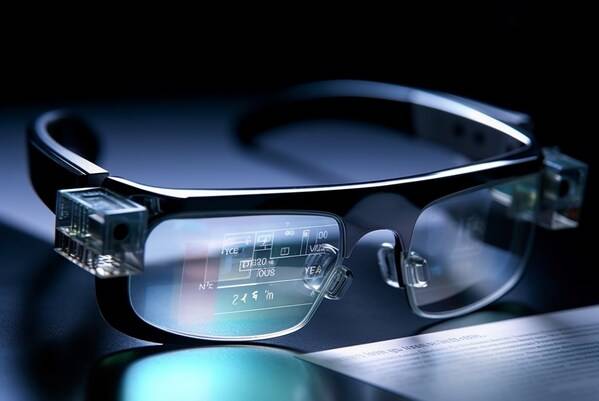
Core Insights - Meta has launched its new generation of AI glasses, the Meta Ray-Ban Display, which features a color display integrated into the familiar Wayfarer design, allowing users to see information directly through the glasses [1][3] - The pricing of the Meta Ray-Ban Display is set at $799, significantly higher than the previous Ray-Ban Meta at $299, but still cheaper than competitors like the Thunder X3 Pro priced at $8999 [3][4] - The introduction of the Meta Ray-Ban Display signifies a shift in the smart glasses market, emphasizing the importance of visual information display as a key feature for future personal computing devices [3][9] Product Features - The Meta Ray-Ban Display includes a 600x600 resolution color display with a 20° field of view, a refresh rate of 90Hz, and a maximum brightness of 5000 nits, designed for visibility even in bright conditions [5][6] - The device retains the Snapdragon AR1 Gen 1 chip and 12MP camera from its predecessor, but introduces features like 3X digital zoom and a preview display for photography [4][5] - A new accessory, the Meta Neural Band, allows for gesture-based interactions, enhancing user experience by enabling actions like menu navigation and message browsing without voice commands [6][7] Market Context - The launch of the Meta Ray-Ban Display occurs amidst increasing competition in the smart glasses market, with other companies like Rokid, Google, and Thunder also developing similar products [3][9] - The industry consensus is shifting towards the necessity of visual feedback in smart glasses, moving from passive audio notifications to active visual displays [9][10] - Different companies are adopting varied approaches to smart glasses design, with Meta focusing on a single-eye display, while competitors explore dual-eye configurations, impacting weight, battery life, and user experience [10][14] User Experience - The Meta Ray-Ban Display weighs 69g, which is heavier than its predecessor, and has a reduced battery life of 6 hours compared to over 8 hours for the previous model, indicating trade-offs in design for enhanced functionality [7][8] - The glasses aim to transform user interaction from auditory to visual, making information more accessible and intuitive, which could redefine the role of smart glasses in daily life [8][15] - Despite the advancements, challenges remain regarding weight, price, and overall usability, as the market continues to evaluate the practicality of smart glasses as a next-generation computing interface [15][16]

发布首款带屏AI眼镜,Meta踏入硬件“深水区”
2 1 Shi Ji Jing Ji Bao Dao· 2025-09-18 12:17
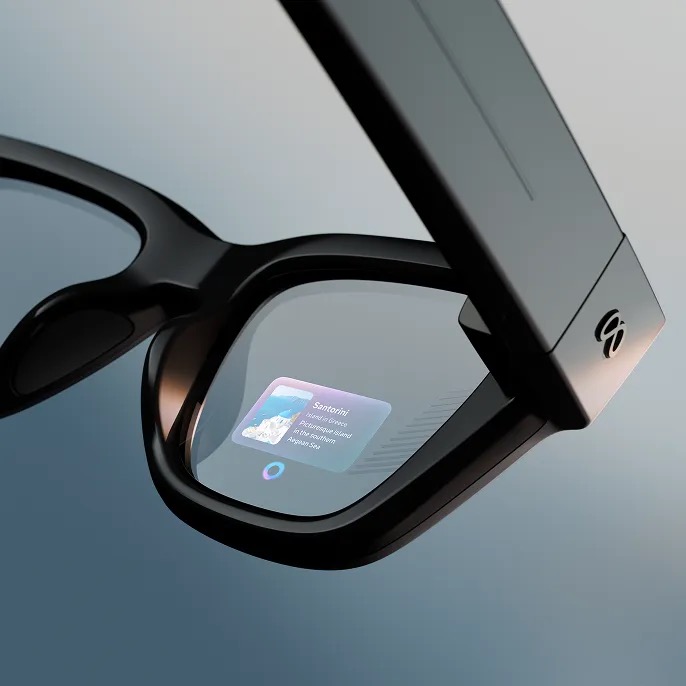
Core Insights - Meta has launched the Meta Ray-Ban Display smart glasses and Neural Band, emphasizing AI integration and innovative interaction methods [1][2][4] - The smart glasses are priced at $799 and will be available in the U.S. starting September 30, with plans for international expansion [1][4] - Meta's CEO Mark Zuckerberg highlighted the glasses as a form of "super personal intelligence," enhancing cognitive and communicative capabilities [2] Product Features - The Ray-Ban Display weighs 89 grams and features a single-color display with a resolution of 600x600 pixels and a refresh rate of up to 90Hz [4] - The display has a brightness of 5000 nits and less than 2% light leakage for privacy [4] - The glasses can operate for approximately 6 hours on a single charge, with a total of about 30 hours using a folding charging case [6] Interaction and Usability - The Neural Band allows control through surface electromyography (sEMG), enabling natural input methods for various scenarios [6] - Users can receive notifications, navigation, and real-time translations directly on the glasses, enhancing daily usability [6][7] - The glasses support third-party applications like Spotify and Google Calendar, broadening their functionality [7][8] Market Positioning - Meta aims to complete its AR/VR product line with the introduction of the Ray-Ban Display, targeting high-end market segments [8] - Analysts predict conservative production and sales expectations, estimating 150,000 to 200,000 units over two years [9] - The smart glasses market is expected to grow, with Meta remaining a key player, particularly in the U.S. and Western Europe [10] Industry Trends - The global smart glasses market is projected to see significant growth, with a 54.9% year-on-year increase expected by Q2 2025 [10] - In China, the market is diversifying with multiple manufacturers entering, leading to increased competition and innovation [10][11] - Challenges such as user experience and the need for unique applications remain barriers to widespread adoption [11][12]
机构:中国智能眼镜市场2025年二季度同比增长145.5%
Huan Qiu Wang· 2025-09-18 06:13
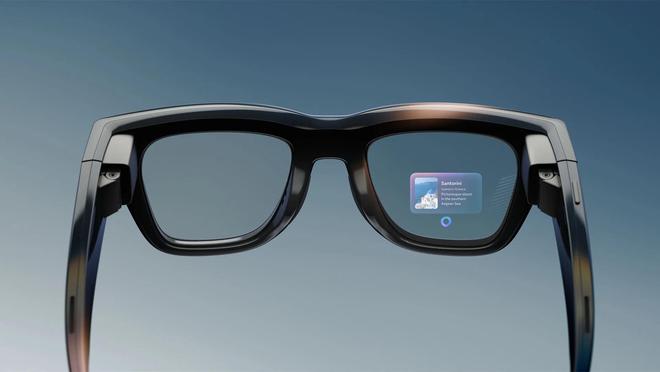
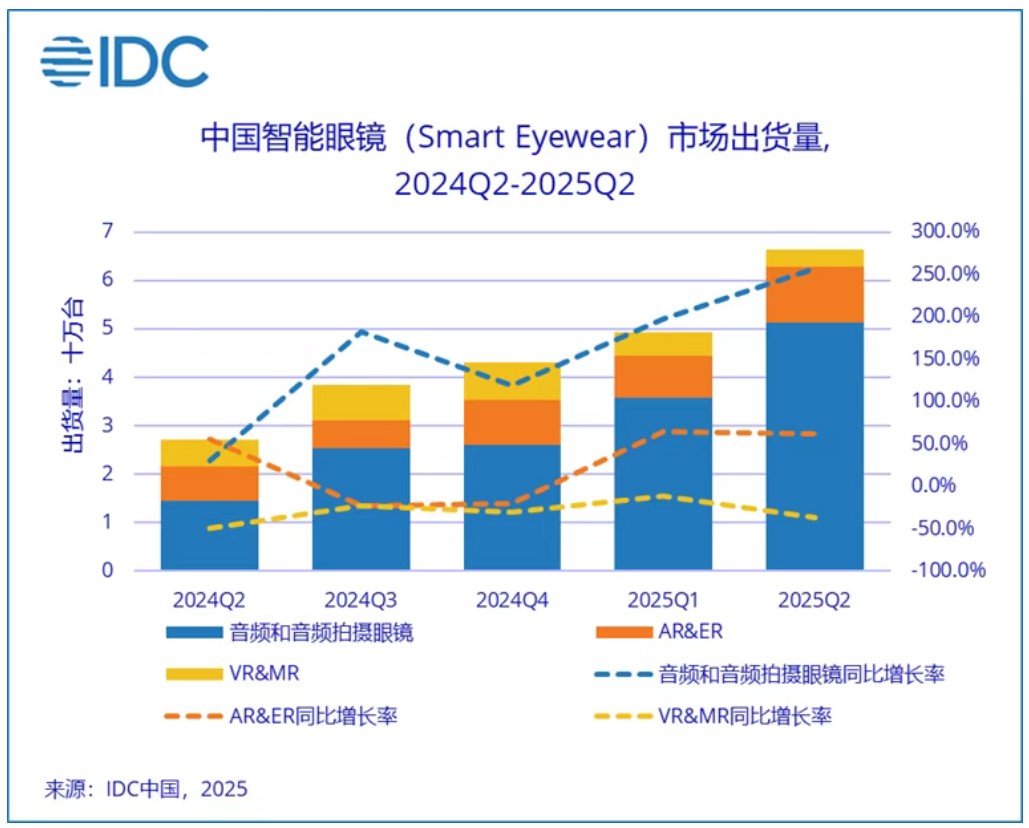
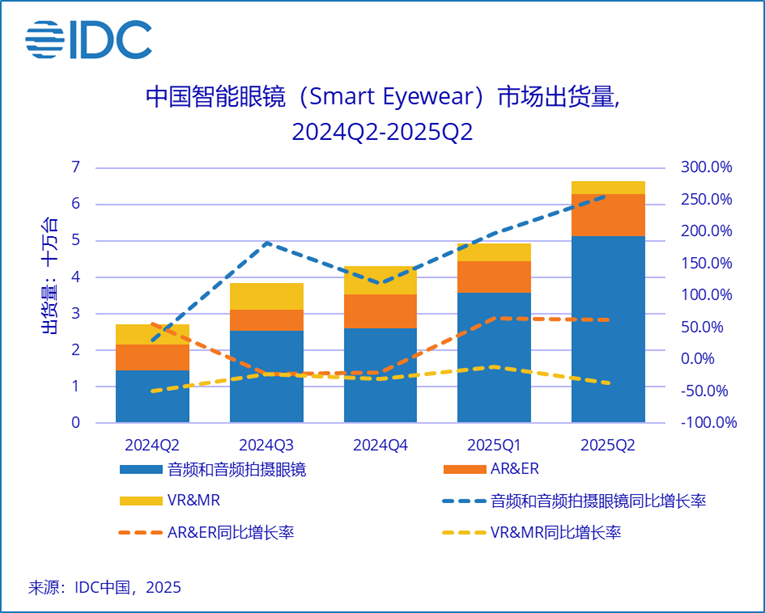
Core Insights - The Chinese audio and audio recording glasses market experienced significant growth in Q2 2025, driven by the launch of new products from Xiaomi, including the Xiaomi AI glasses and Thunderbird V3, leading to a market share increase to 19.7% [3]. Market Performance - In Q2 2025, the total shipment of smart glasses in China reached 664,000 units, marking a year-on-year increase of 145.5% [2]. - The audio and audio recording glasses segment saw shipments of 514,000 units, reflecting a remarkable year-on-year growth of 256.6% [3]. - The AR/VR market in China recorded shipments of 150,000 units in Q2 2025, with a year-on-year growth of 18.7% [3]. Market Segmentation - The AR & ER category significantly contributed to the growth, achieving a market share of 76.4% with a year-on-year increase of 61.8%, while the VR & MR segment faced a decline of 36.2% [3]. - The competitive landscape is shifting, with notable performances from products like the Thunderbird Air 3S and Xreal One, while Pico experienced a decline due to a product transition period [3]. Future Projections - The Chinese smart glasses market is projected to reach 2.846 million units by 2025, representing a year-on-year growth of 116.4%, with audio and audio recording glasses expected to account for 2.202 million units, growing by 183.2% [3]. - The AR/VR device shipments are anticipated to reach 644,000 units, reflecting a year-on-year growth of 19.8% [3]. Industry Trends - Analysts predict that the second half of 2025 will see a comprehensive deepening of the smart glasses market in China, with a focus on AI ecosystem integration, channel optimization, technological collaboration, and matching of scene demands [4].

IDC:2025年第二季度中国智能眼镜市场出货量66.4万台 同比增长145.5%
智通财经网· 2025-09-17 05:44
Core Insights - The global smart eyewear market is projected to ship 2.555 million units in Q2 2025, representing a year-on-year growth of 54.9% [1] - The audio and audio capture glasses segment is expected to see significant growth, with shipments reaching 1.618 million units, a remarkable increase of 256.8% [1] - The AR/VR market is experiencing a decline, with shipments of 937,000 units, down 21.6% year-on-year [1] Smart Eyewear Market Overview - In Q2 2025, China's smart eyewear market is expected to ship 664,000 units, marking a year-on-year growth of 145.5% [1] - The overall smart eyewear market in China is projected to reach 2.846 million units in 2025, reflecting a growth of 116.4% [5] Audio and Audio Capture Glasses Market - China's audio and audio capture glasses market is anticipated to ship 514,000 units in Q2 2025, with a year-on-year increase of 256.6% [2] - The launch of new products from Xiaomi, including AI glasses, has significantly contributed to market growth, increasing the market share to 19.7% [2] AR/VR Market Dynamics - China's AR/VR market is expected to ship 150,000 units in Q2 2025, showing a year-on-year growth of 18.7% [3] - The AR&ER category is driving growth, with a market share of 76.4%, up 61.8% year-on-year, while the VR&MR segment continues to decline [3] Market Channel Development - The smart eyewear market is shifting towards accelerated offline channel development, with retail channel shipments increasing by 4.0% year-on-year [7] - Major manufacturers are focusing on partnerships with traditional eyewear chains to enhance product availability in offline stores [7] International Expansion of Domestic Manufacturers - Domestic smart eyewear manufacturers are increasing their overseas market presence, with significant growth in North America, Europe, and Asia-Pacific [8] - Companies like Xreal and Xiaomi are forming strategic partnerships to enhance their global footprint and product offerings [8] Integration of AI Models - The adoption rate of smart eyewear products with AI model integration is expected to rise, with a year-on-year increase of 14.4% in Q2 2025 [9] - The market is entering a phase of deeper exploration and optimization in AI model adaptation and software collaboration [9][10]
希荻微(688173):H1亏损边际收窄 AI、汽车电子市场产品有望放量
Xin Lang Cai Jing· 2025-09-15 10:30
Core Viewpoint - The company reported significant revenue growth in the first half of 2025, driven by a recovery in the consumer electronics market and increased demand for high-performance power management chips, while also narrowing its losses compared to the previous year [1][2]. Financial Performance - In 2025H1, the company achieved revenue of 466 million yuan, a year-on-year increase of 102.7%, with a net loss attributable to shareholders of 45 million yuan, a reduction in loss of 73 million yuan year-on-year [1][2]. - The second quarter of 2025 saw revenue of 289 million yuan, a year-on-year increase of 169.4%, with a net loss attributable to shareholders of 17 million yuan, a reduction in loss of 51 million yuan year-on-year [1][2]. Product Performance - The revenue breakdown for 2025H1 includes: - Power management chips: 182 million yuan - Autofocus and optical image stabilization chips: 142 million yuan - Port protection and signal switching chips: 47 million yuan - Sensor chips and others: 96 million yuan [2]. - The overall gross margin for 2025H1 was 29.4%, a decrease of 5.34 percentage points year-on-year [2]. Market Expansion and Strategic Initiatives - The company is making strides in emerging markets such as AI and automotive electronics, with multiple breakthroughs in AI-related products and ongoing development of high-performance chips for smart devices and vehicles [3]. - The company is also pursuing acquisitions, with a focus on integrating the target company Chengxin Micro, which specializes in analog and mixed-signal products, into its supply chain to enhance its market position in consumer electronics [3]. Future Outlook - The company forecasts net profits attributable to shareholders for 2025-2027 to be -46 million, +18 million, and +54 million yuan, respectively, with corresponding price-to-earnings ratios of -141, +373, and +121 times [4].

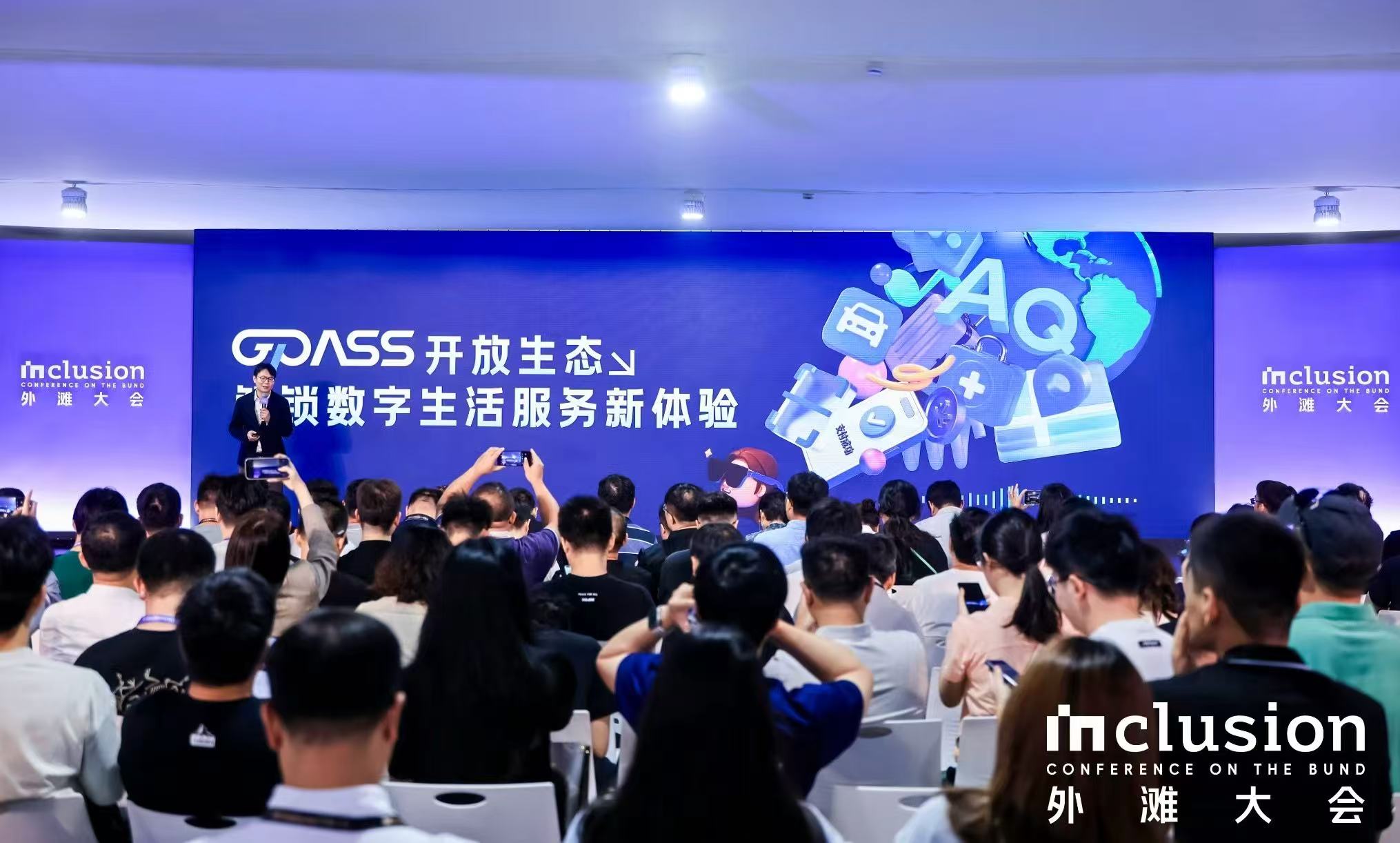
下一代“AI原生入口”之争,蚂蚁加码智能眼镜
Di Yi Cai Jing· 2025-09-12 09:41
Core Insights - The competition for the next generation "AI-native entry point" is intensifying, with Ant Group and smart glasses manufacturers accelerating their entry into the market [1][3] - Ant Group launched the gPass technology framework aimed at ensuring secure and trusted interactions between AI glasses and smart devices, positioning itself in the smart glasses market ahead of 2025, which is seen as the "year of AI glasses" [1][4] - The smart glasses market in China sold 494,000 units in Q1 of this year, reflecting a year-on-year growth of 116.1%, indicating a significant market potential [1] Industry Trends - The construction of a service ecosystem around AI glasses remains a key industry challenge, with Ant Group focusing on integrating secure identity verification technologies to enhance user interaction [1][4] - The "Look and Pay" feature, developed in collaboration with smart glasses manufacturers, allows users to make payments simply by looking at a QR code, showcasing the potential for seamless transactions through AI glasses [3][4] - Industry experts believe that the current enthusiasm for AI glasses is not just about hardware upgrades but also about redefining interaction paradigms, suggesting a shift towards wearable service entry points [4] Future Outlook - Ant Group aims to capture market share in payment, healthcare, and other sectors through strategic partnerships with smart glasses manufacturers [3][4] - The transition from "technical products" to "everyday tools" is crucial for smart glasses to become the next generation entry point, highlighting the need for improved design and functionality [4]