Replit

Search documents
从GPT-5到DeepSeek V3.1,顶尖AI大模型的新方向出现了!
华尔街见闻· 2025-08-31 13:07
Core Viewpoint - The AI industry is shifting its focus from "higher and stronger" to "smarter and more economical," as evidenced by the latest developments in mixed reasoning and adaptive computing [2][5]. Group 1: Innovations in AI Models - Meituan's LongCat-Flash model features a "zero computation" expert mechanism that intelligently identifies non-critical parts of input, significantly saving computational power [3]. - The rising complexity of reasoning models is leading to increased costs for AI applications, prompting a collective industry response towards mixed reasoning models [5][11]. Group 2: Cost Dynamics in AI - Despite a decrease in the cost per token, the subscription fees for top models continue to rise due to the increasing number of tokens required for complex tasks [7][8]. - The competition for the most intelligent models has transformed into a competition for the most expensive models, impacting the profitability of application-layer companies [10]. Group 3: Mixed Reasoning as a Solution - Mixed reasoning, or adaptive computing, has emerged as a consensus in the industry to address cost challenges, allowing AI systems to allocate computational resources based on task complexity [11][12]. - Major players like OpenAI and DeepSeek are implementing mechanisms that enable models to determine when to engage in deep thinking versus quick responses, achieving significant reductions in token consumption while maintaining output quality [12][13].




从GPT-5到DeepSeek V3.1,顶尖AI大模型的新方向出现了!
Hua Er Jie Jian Wen· 2025-08-31 02:26
Core Insights - The AI industry is shifting its focus from "higher and stronger" to "smarter and more economical" solutions, as evidenced by the latest developments in AI models like Meituan's LongCat-Flash and OpenAI's upcoming GPT-5 [1][3] - The rising costs associated with complex AI tasks are driving the need for innovative solutions, particularly in the realm of mixed reasoning and adaptive computing [1][2] Group 1: Industry Trends - Meituan's LongCat-Flash model features a "zero computation" expert mechanism that intelligently identifies non-critical parts of input, significantly reducing computational power usage [1] - The AI industry's response to increasing application costs is converging on mixed reasoning models, which allow AI systems to allocate computational resources based on task complexity [1][3] Group 2: Cost Dynamics - Despite a decrease in token costs, subscription fees for top models are rising due to the increasing number of tokens required for complex tasks, leading to a competitive landscape focused on the most advanced models [2] - Companies like Notion have experienced a decline in profit margins due to these cost pressures, prompting adjustments in pricing strategies among AI startups [2] Group 3: Technological Innovations - OpenAI's GPT-5 employs a routing mechanism to automatically select the appropriate model based on task complexity, achieving a reduction of 50-80% in output tokens while maintaining performance [3][4] - DeepSeek's V3.1 version integrates dialogue and reasoning capabilities into a single model, allowing users to switch between "thinking" and "non-thinking" modes, resulting in a 25-50% reduction in token consumption [4] Group 4: Future Directions - The trend towards mixed reasoning is becoming mainstream among leading players, with companies like Anthropic, Google, and domestic firms exploring their own adaptive reasoning solutions [4] - The next frontier in mixed reasoning is expected to involve more intelligent self-regulation, enabling AI models to assess task difficulty and initiate deep thinking autonomously at minimal computational cost [4]

全球最赚钱的50款AI应用是怎么做流量增长的? | Jinqiu Select
锦秋集· 2025-08-27 14:55
Core Insights - The article discusses the evolution of AI startups from "model frenzy" in 2023 to "growth competition" in 2025, emphasizing the importance of user acquisition and retention strategies for sustainable growth [1][2]. Group 1: Growth Strategies - Companies are increasingly focused on understanding their user acquisition sources, retention strategies, and future growth potential [2][3]. - The analysis highlights that transforming cold traffic into active users and revenue is crucial for securing future market positions [4]. Group 2: Traffic Sources and Analysis - A detailed analysis of the top 50 AI startups reveals that brand recognition is a key competitive barrier, with direct traffic being a significant indicator of consumer trust and habitual consumption [14]. - Search traffic serves as a foundational source for nearly all companies, with a focus on search engine optimization (SEO) being essential for low-cost and stable user growth [14]. - Companies with diverse traffic channels tend to have greater growth potential and resilience against market fluctuations [14]. Group 3: Company-Specific Traffic Insights - **OpenAI**: Dominated by organic search (58.89%), with direct access at 29.79% and referrals at 9.77%. Paid search is minimal at 0.06% [18][19]. - **Anthropic**: Balanced traffic sources with organic search at 42.25% and referrals at 11.04%. The company relies heavily on non-paid channels [32]. - **Grammarly**: Exhibits a diverse traffic structure with direct access at 43.94% and organic search at 42.25%, indicating a strong brand presence [34]. - **Midjourney**: Direct access is the primary source at 65.71%, with organic search contributing 26.84% [42]. - **Dialpad**: Direct access leads at 64.91%, followed by organic search at 24.32%, showcasing effective brand engagement [62]. Group 4: Paid and Referral Traffic - Paid search is a minor contributor across many companies, with **6sense** showing 6.54% from paid sources, indicating a reliance on organic and direct traffic for growth [106]. - Referral traffic varies significantly, with **Cleo** receiving 2.80% from referrals, highlighting the importance of partnerships and external visibility [79]. Group 5: Industry Trends - The analysis indicates a shift towards brands leveraging organic growth strategies over paid advertising, as companies seek sustainable user acquisition methods [14][4]. - The competitive landscape is characterized by a focus on brand loyalty and the ability to convert traffic into long-term users, which is becoming increasingly critical for success in the AI sector [4][14].

深度|Lovable CEO揭秘AI竞赛真相:争夺顶尖人才比资本更重要,7个月1亿ARR的AI创业增长密码
Z Potentials· 2025-08-27 12:08
Core Insights - The core competition in the AI industry is more about talent acquisition and brand influence rather than just capital investment [5][6][7] - The company aims to provide a platform that evolves into a comprehensive co-founder for users, focusing on creating immense value to retain users [12][33] - The company has achieved significant growth, reaching $100 million in ARR within seven months, with a user base primarily consisting of aspiring entrepreneurs [33][34] Talent Acquisition and Management - The competition for top talent is intense, with companies like Meta offering substantial salaries to attract engineers [5][6] - Identifying the right talent that can thrive in a collaborative environment is crucial, and the company employs unique evaluation methods to assess candidates [7][8] - The future of engineering roles will shift towards a more product-oriented approach, where engineers act as facilitators rather than just coders [6][55] Brand and User Experience - A strong brand is essential for building trust and retaining users, with Apple cited as a prime example of a brand that emphasizes detail and user experience [11] - The company believes that the key to user retention is to create a product that users find indispensable, thus forming a natural defense against competition [12][17] - The focus is on rapid execution and growth, with the idea that a strong user base will lead to a natural formation of a competitive moat over time [14][17] Financial Dynamics - The company acknowledges high operational costs associated with AI, particularly in terms of computational resources, but aims to shift towards a model where user lifetime value outweighs these costs [15][16] - There is a potential for profit through token sales and simplifying user experiences to enhance monetization [21][22] - The company is focused on long-term user engagement rather than immediate profit, aiming to build a loyal customer base that will drive future revenue [22][23] Future Outlook and Innovation - The company is committed to evolving its platform to integrate AI seamlessly into application development, aiming for a future where AI handles routine tasks while humans focus on higher-level design [40][43] - There is an emphasis on creating a more personalized user experience by leveraging AI to understand user context better [32] - The company is aware of the competitive landscape, particularly from established players like OpenAI, and is focused on delivering exceptional user experiences to maintain its edge [26][27] Market Positioning - The company targets a diverse user base, with a significant portion being entrepreneurs looking to build complex applications, while also catering to corporate users and hobbyists [33][34] - The strategy is to democratize access to powerful tools for aspiring entrepreneurs, enabling them to create without the need for extensive coding knowledge [36] - The company believes that its unique positioning and mission will allow it to capture a significant share of the market as it evolves [37][70]

AI应用开发商怨声载道:部署成本水涨船高
3 6 Ke· 2025-08-22 07:24
Group 1 - The core viewpoint of the articles highlights that the majority of companies investing in AI have not yet achieved profitability, and the trend of decreasing costs for deploying advanced AI is expected to stagnate by 2025 [1] - Major AI companies like OpenAI and Anthropic had previously reduced API call prices by over 90% in 2024, but the reality shows that costs for deploying AI have not significantly decreased since early this year [1][2] - Companies like Intuit are experiencing a rapid increase in AI-related expenses, with projected costs rising from $20 million to $30 million for Azure services supporting AI functionalities [2] Group 2 - Upstream model providers and cloud service companies are benefiting from the struggles of application developers, with Microsoft Azure reporting a 39% revenue growth in the last quarter, driven by a sevenfold increase in token generation related to AI [3] - OpenAI has achieved profitability through API sales, although this does not account for the high costs of AI training and personnel [3] - Developers are expressing concerns about the lack of price reductions for AI tools, questioning whether a monopoly has formed among large model developers [4] Group 3 - Independent developers are facing challenges with increased costs, as seen with a developer who experienced a rapid depletion of their usage limits after a price hike for a tool [5] - Companies like Anthropic justify their price increases by stating that customers are willing to pay more for measurable business outcomes, while OpenAI claims that the new GPT-5 model offers better value despite higher costs [6]

AI编程亏麻了,用亏损换增长,警惕“套壳产品”的规模化陷阱
3 6 Ke· 2025-08-21 11:35
Core Insights - The AI programming industry is facing significant losses due to high costs and low profit margins, with many companies relying on subscription models that do not adequately cover their expenses [1][3][4] - Despite rapid revenue growth in some companies, the underlying business models are often unsustainable, leading to concerns about long-term viability [2][4][10] Group 1: Financial Performance - Cursor achieved $100 million in annual recurring revenue (ARR) in just 21 months, with a current ARR of $500 million and revenue per employee at $3.2 million [2] - Replit grew from $10 million to $100 million ARR in only 6 months, while Lovable reached $100 million ARR in 8 months, with a projected ARR of $250 million by year-end [2] - Many AI programming companies exhibit high growth rates but have low or negative gross margins, indicating that growth is often at the expense of profitability [4][12] Group 2: Cost Structure and Pricing Challenges - AI programming companies face a mismatch between fixed subscription fees and variable costs associated with high usage, leading to significant financial strain [3][6][12] - Users can exploit subscription models to incur costs far exceeding their subscription fees, creating a situation where companies are effectively subsidizing heavy users [3][11] - Attempts to raise prices have met with backlash from users, highlighting the fragile customer retention rates in the industry [7][8] Group 3: Market Dynamics and Competition - The competitive landscape is intensifying, with traditional software companies entering the AI space, further complicating the market for AI programming firms [8][9] - High customer churn rates, estimated between 20% to 40%, pose a significant challenge for AI programming companies, making it difficult to maintain a stable revenue base [8][10] Group 4: Business Model Viability - The concept of Business Model and Product Fit (BMPF) is critical for the sustainability of AI programming companies, as many are currently operating under flawed business models [10][12] - Companies that fail to establish a clear path to profitability may find themselves in a "scale trap," where growth does not translate into financial health [12][13] - The reliance on subsidies to attract users is not a viable long-term strategy, as it masks underlying issues with profitability and market demand [12][13]
相信大模型成本会下降,才是业内最大的幻觉
Hu Xiu· 2025-08-21 02:55
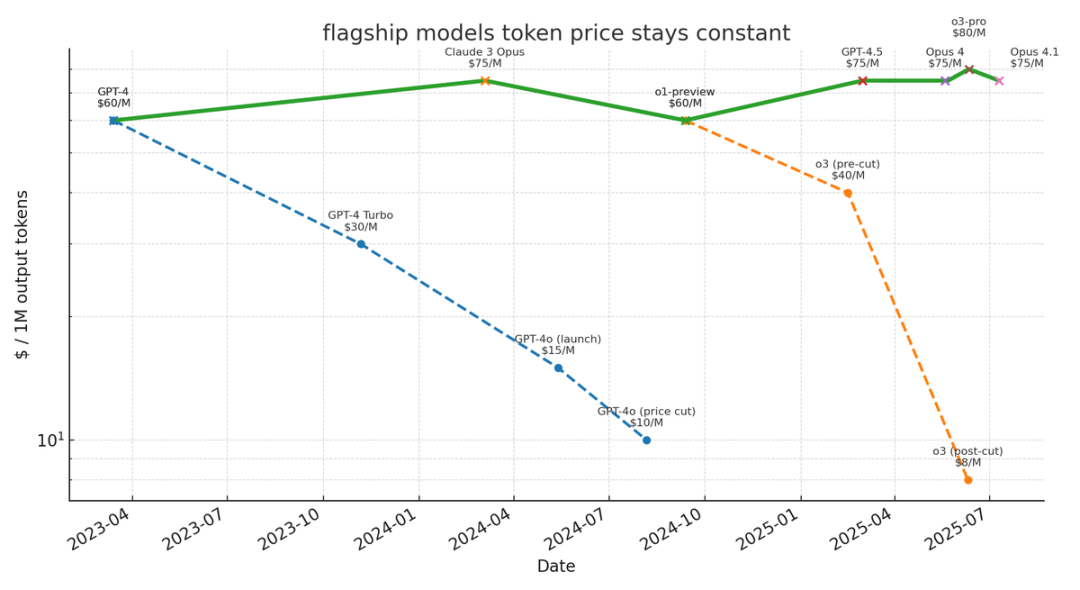
Core Viewpoint - The belief that AI model costs will continue to decrease is challenged, as the most advanced models maintain stable costs despite older models becoming cheaper [5][10][19]. Group 1: Cost Dynamics - AI entrepreneurs assume that as model costs decrease, their revenue situation will improve, allowing their businesses to continue [2][3]. - a16z claims that the cost of large language models (LLMs) is decreasing at a rate of 10 times per year, but this is primarily true for outdated models [4][5]. - The actual costs of the best models remain relatively unchanged, leading to a potential misalignment in business strategies for AI startups [19][40]. Group 2: Market Demand and Model Performance - Market demand consistently favors the best-performing models, which keeps their costs stable [19][21]. - When new models are released, consumer interest shifts almost entirely to these advanced models, regardless of the cost of older versions [12][16]. - The expectation for high-quality outputs drives users to prefer the latest models, further complicating the cost-reduction narrative [21]. Group 3: Token Consumption and Business Models - The consumption of tokens has increased dramatically, with tasks requiring significantly more tokens than before, leading to higher operational costs [23][29]. - The shift from simple interactions to complex tasks has resulted in a substantial rise in token usage, which is not accounted for in traditional subscription models [24][37]. - Companies adopting fixed-rate subscription models face challenges as token consumption outpaces revenue generation, leading to financial strain [33][40]. Group 4: Pricing Strategies and Market Competition - Many AI companies recognize the need for usage-based pricing but hesitate to implement it due to competitive pressures from fixed-rate models [41][42]. - The industry is caught in a "prisoner's dilemma," where companies opt for growth over sustainable pricing, risking long-term viability [44][45]. - Successful consumer subscription services typically rely on fixed-rate models, making it difficult for usage-based pricing to gain traction [47]. Group 5: Future Directions and Strategies - Companies are exploring various strategies to avoid the pitfalls of high token consumption, including vertical integration and creating high switching costs for customers [52][51]. - The emergence of "neocloud" providers may offer a path forward, focusing on sustainable business models that can adapt to changing cost structures [59]. - The industry must rethink its approach to pricing and service delivery to remain competitive and financially viable in the evolving landscape [56][58].
相信大模型成本会下降,才是业内最大的幻觉
Founder Park· 2025-08-19 08:01
Core Viewpoint - The belief among many AI entrepreneurs that model costs will decrease significantly is challenged by the reality that only older models see such reductions, while the best models maintain stable costs, impacting business models in the AI sector [6][20]. Group 1: Cost Dynamics - The cost of models like GPT-3.5 has decreased to one-tenth of its previous price, yet profit margins have worsened, indicating a disconnect between cost reduction and market demand for the best models [14][20]. - Market demand consistently shifts to the latest state-of-the-art models, leading to a scenario where older, cheaper models are largely ignored [15][16]. - The expectation that costs will drop significantly while maintaining high-quality service is flawed, as the best models' costs remain relatively unchanged [20][21]. Group 2: Token Consumption - The token consumption for tasks has increased dramatically, with AI models now requiring significantly more tokens for operations than before, leading to higher operational costs [24][26]. - Predictions suggest that as AI capabilities improve, the cost of running complex tasks will escalate, potentially reaching $72 per session by 2027, which is unsustainable under current subscription models [26][34]. - The increase in token consumption is likened to a situation where improved efficiency leads to higher overall resource usage, creating a liquidity squeeze for companies relying on fixed-rate subscriptions [27][34]. Group 3: Business Model Challenges - Companies are aware that usage-based pricing could alleviate financial pressures but hesitate to implement it due to competitive dynamics where fixed-rate models dominate [35][36]. - The industry faces a dilemma: adopting usage-based pricing could lead to stagnation in growth, as consumers prefer flat-rate subscriptions despite the potential for unexpected costs [39]. - Successful companies in the AI space are exploring alternative business models, such as vertical integration and using AI as a lead-in for other services, to capture value beyond just model usage [40][42]. Group 4: Future Outlook - The article emphasizes the need for AI startups to rethink their strategies in light of the evolving landscape, suggesting that merely relying on the expectation of future cost reductions is insufficient for sustainable growth [44][45]. - The concept of becoming a "new cloud vendor" is proposed as a potential path forward, focusing on integrating AI capabilities with broader service offerings [45].

AI Coding 产品的陷阱:有 PMF 但还没有做到 BMPF
投资实习所· 2025-08-18 06:22
Core Insights - AI Coding has emerged as the fastest-growing category in AI applications, with companies like Cursor, Claude Code, Lovable, and Replit experiencing rapid growth and new products continuously entering the market [1] - Lovable's ARR is projected to reach $250 million by the end of the year, with a potential to exceed $1 billion in the next 12 months [1] Group 1: Growth and Challenges - Despite the rapid growth in AI Coding, many companies are struggling to achieve profitability, with Replit's CEO noting that their previous fixed pricing model led to negative profits [2] - Replit has shifted to a usage-based pricing model, achieving a gross margin of around 23%, while targeting the enterprise market where margins can reach nearly 80% [2] - Heavy users of AI Coding products may lead to significant losses, with some companies reporting profit margins as low as -300% to -500% [2] Group 2: Business Model and Market Fit - The concept of Business Model-Product Fit (BMPF) is crucial, as it ensures that the value extracted from the product can sustainably exceed the costs of delivering that value [5] - Companies like Cursor have relied on subscription models that allow "unlimited" usage, leading to variable costs that can spiral out of control without proper pricing discipline [6] - The lack of pricing discipline can lead to a downward spiral similar to failed companies like MoviePass, where rapid growth obscures underlying profitability issues [6][8] Group 3: User Expectations and Pricing - Users expect top performance from AI coding products, which ties the cost of goods sold (COGS) to the pricing set by leading AI model providers like OpenAI and Anthropic [7] - If companies lower their model quality to reduce costs, they risk losing performance-focused users, while maintaining high-quality models without raising prices can lead to unsustainable costs [7] - The challenge lies in determining whether user demand is for the product itself or merely for the subsidies provided [11] Group 4: Future Outlook - The AI infrastructure layer, positioned between models and applications, is expected to be a significant winner, with some companies in this space achieving gross margins as high as 76% [13] - Recent funding rounds have seen valuations for these infrastructure companies soar from $3 billion to $9 billion within a year, indicating strong growth potential [13]

每个token都在亏钱,但ARR9个月破亿!从烧光现金、裁掉一半员工到反杀Cursor,Replit CEO曝一年内如何极限翻盘
AI前线· 2025-08-16 05:32
Core Insights - Replit's annual recurring revenue (ARR) grew from less than $10 million in early 2024 to over $100 million within nine months in 2025, indicating a rapid growth trajectory that has captured the attention of the developer community [2][41] - The growth of Replit is attributed not only to AI code generation but also to a systematic strategic design focused on platform integration and infrastructure capabilities [4][6] - The evolution of AI programming tools is shifting from mere code editors to comprehensive platforms that facilitate the entire application lifecycle, from code generation to deployment [6][24] Group 1 - Replit's strategy emphasizes backend services such as hosting, databases, deployment, and monitoring, allowing it to monetize through various stages of the application lifecycle [6][10] - The company has experienced a significant transformation, moving from a focus on teaching programming to enabling users to build applications independently, particularly benefiting product managers who can execute tasks without relying on engineers [24][25] - The introduction of Replit Agent has led to a 45% monthly compound growth rate since its launch, reflecting the platform's increasing adoption and user engagement [41][43] Group 2 - Replit aims to lower the barriers to programming, which has resulted in a diverse user base across various industries, including product managers and designers [24][34] - The platform's approach to security includes automatic integration of safety features for user applications, addressing common vulnerabilities associated with AI-generated code [27][29] - Future developments in AI and automation are expected to enhance the capabilities of Replit, allowing for more autonomous programming processes and potentially transforming the SaaS landscape [52][54] Group 3 - The company is focused on building a robust infrastructure that supports its long-term competitive advantage, emphasizing the importance of transactional systems that allow for safe experimentation and rollback capabilities [50][51] - Replit's vision is to become a "universal problem solver," enabling knowledge workers to leverage software solutions without needing extensive technical expertise [34][53] - The future of programming may involve a shift towards more abstract interfaces, where users interact with AI agents rather than directly manipulating code, enhancing accessibility and usability [36][37]