
华为

Search documents
中国企业出海的十大展望
Hua Xia Shi Bao· 2026-02-05 09:01
Group 1: Global Expansion of Chinese Manufacturing - The trend of Chinese manufacturing companies expanding globally is accelerating, particularly in tariff-sensitive sectors such as automotive, consumer electronics, and machinery, which are relocating production to countries with lower tariffs or favorable policies to reduce costs and mitigate trade risks [2][3] - Chinese manufacturers are diversifying their global supply chains by exploring emerging markets in Latin America, the Middle East, and Africa, thereby enhancing supply chain stability and risk resilience [2][3] - The implementation of regional economic cooperation mechanisms and free trade agreements, such as RCEP, is creating a more favorable policy environment for the globalization of Chinese manufacturing [3] Group 2: Overseas Mergers and Acquisitions - Chinese manufacturing companies are leveraging overseas mergers and acquisitions to transition from OEMs to self-owned brands, gaining market share, sales channels, and high-end brand images [3][4] - The focus of these acquisitions is shifting towards strategic alignment in brand, market, technology, and supply chain integration, enhancing global competitiveness [3][4] - Companies like Haier exemplify this trend by achieving breakthroughs in the European and American markets through acquisitions, thereby strengthening their global competitive advantage [3][4] Group 3: Labor-Intensive Industries and Cost Migration - Labor-intensive industries are increasingly relocating to low-cost regions such as Southeast Asia and South Asia, benefiting from local labor advantages and policy support [4][5] - The trend of regional industrial clusters is forming as companies seek to reduce costs and improve response efficiency through localized production [4][5] - The global supply chain is becoming more regionalized, with multinational companies establishing collaborative industrial clusters in emerging regions to enhance supply chain resilience [4][5] Group 4: Resource Sector Globalization - Chinese resource companies are accelerating their global expansion by constructing complete industrial chains from mining to processing and application, enhancing their control and influence in the global resource sector [6][7] - The focus is shifting from merely acquiring resources to deep integration of upstream and downstream operations, utilizing diverse cooperation methods such as equity investments and joint ventures [6][7] - Notable examples include the acquisition of cobalt mines in the Democratic Republic of Congo and lithium companies in Australia, showcasing the strategic foresight of Chinese enterprises [6][7] Group 5: Digital Transformation and Brand Value - Chinese companies are transitioning from low-cost manufacturing to brand value creation, utilizing digitalization to enhance brand building and global competitiveness [9][10] - Companies like Anker and Xiaomi are leveraging localized operations and digital marketing to establish strong brand identities and achieve significant sales growth [9][10] - The focus on digital transformation is enabling companies to create differentiated brand matrices and improve supply chain management, enhancing market competitiveness [9][10] Group 6: Compliance and Localization - Compliance and localized operations are becoming core competitive advantages for Chinese enterprises in international markets, with a focus on establishing robust global compliance systems [11][12] - Companies are actively building global compliance monitoring systems to ensure adherence to regulations in areas such as data security and environmental standards [11][12] - The ability to navigate compliance challenges is increasingly seen as integral to brand value and international market acceptance [11][12] Group 7: Policy Support for Globalization - Recent policy initiatives from the Chinese government are creating unprecedented opportunities for enterprises to expand internationally, emphasizing high-level openness and integration into the global economy [13][14] - The focus on developing new production capabilities and promoting the integration of the real economy with the digital economy is expected to provide clear guidance for companies in the new round of global competition [13][14] - Structural monetary policies are anticipated to offer targeted financial support to foreign trade enterprises, aiding their internationalization efforts [14] Group 8: Cultural and Ideological Export - Chinese enterprises are increasingly integrating cultural content with brand ideology to enhance cultural soft power and global brand value [18][19] - The growth of cultural consumption globally is driving the export of diverse cultural products, including games and films, with significant revenue growth reported [18][19] - The focus on building a robust IP ecosystem and localizing content production is crucial for enhancing global appeal and emotional resonance with audiences [18][19]




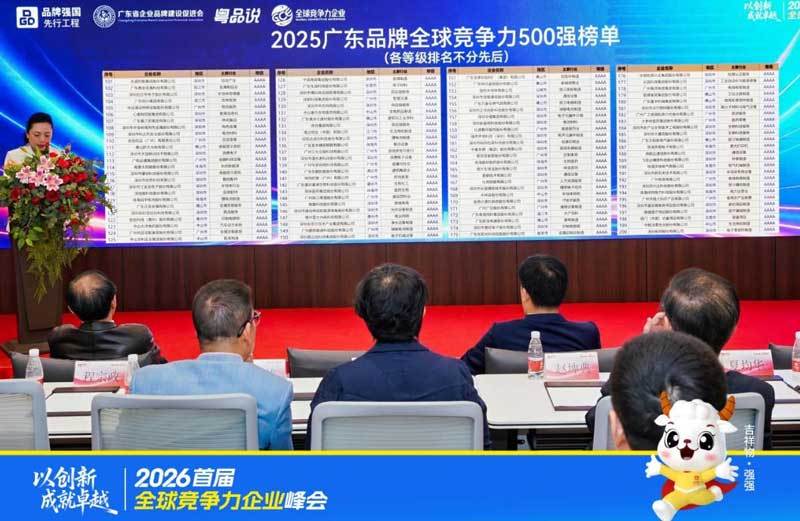
佛山新闻:2025广东品牌全球竞争力500强名单在佛山南海揭晓
Sou Hu Cai Jing· 2026-02-05 08:38
经过企业申报、大数据分析、实地调研及专家评审等多环节严格评定,华为、腾讯、比亚迪等500家AAA级及以上等级 企业成功入选500强,涵盖制造、科技、消费、金融等多个核心领域,集中展现了广东"制造业当家"的硬核实力与品牌 全球化潜力。其中,万孚健康、三思纵横等20家企业凭借在细分赛道的创新突破与全球化实践,获评首批"全球竞争力 企业",成为中国企业参与全球竞争的标杆力量。 | 序号 | 企业名称 | 地区 | 主要行业 | | --- | --- | --- | --- | | 11 | 广州万孚健康科技有限公司 | 广州市 | 体外诊断 | | 2 | 深圳三思纵横科技股份有限公司 | 深圳市 | 材料力学检测 | | 3 | 东莞市广隆食品有限公司 | 东莞市 | 烘焙食品 | | 4 | 广州原感珠宝有限公司 | 广州市 | 珠宝定制 | | 5 | 深圳市慧明眼镜有限公司 | 深圳市 | 光学与眼镜制造 | | 6 | 广州市铭汉科技股份有限公司 | 广州市 | 智能能源管理 | | 1 | 深圳市巍特环境科技股份有限公司 | 深圳市 | 环保工程与环境部 | | 8 | 深圳市永成光电子股份有限公司 ...

2026胡润中国高净值人群品质生活报告发布
Ge Long Hui· 2026-02-05 08:35
Group 1 - The average living area of high-net-worth individuals in China is 205 square meters, with an average of 4.1 people living in the household. They sleep an average of 6.7 hours per day and engage in over 2 hours of exercise weekly. The U25 demographic prefers fitness, while the U40 demographic enjoys golf. They spend an average of 6.3 days per month with family, favoring Cantonese cuisine for family meals and Japanese cuisine for dining with friends [1] - High-net-worth individuals have an average of 21 vacation days per year, traveling abroad an average of 5 times in the past year, including 2.1 times for leisure and 2.9 times for business. They work an average of 45 hours per week and travel for work 6.9 days per month. The most favored overseas cities are Hong Kong, Singapore, and New York City [1] - The average number of romantic partners before marriage for surveyed high-net-worth individuals is 5, while ultra-high-net-worth individuals average 6 partners [1] Group 2 - The preferred gifts for men have shifted from watches and high-end liquor to electronic products, while cosmetics remain the top choice for women. There is a significant rise in interest for experiential consumption and traditional Chinese medicine therapies. Enthusiasm for traditional luxury brands has declined, with a growing preference for Huawei's electric vehicles [2] - In terms of investment direction for the coming year, gold ranks first, followed by overseas investments such as US and Hong Kong stocks, funds, and insurance. The average proportion of overseas assets in investable assets is 15%, a slight decrease of 1.1%. Hong Kong remains the primary investment destination, followed by the US. Ultra-high-net-worth individuals have a 26% overseas asset proportion, while those with investable assets over 50 million have a 30% overseas asset proportion [2] - The most admired figures among high-net-worth individuals include parents, Elon Musk, Jack Ma, Warren Buffett, Lei Jun, Duan Yongping, and Steve Jobs. The song that has recently moved them the most is Faye Wong's "The World Gave Me," along with other popular songs [2] Group 3 - Over 70% of the U25 demographic uses Xiaohongshu and Douyin as their primary information sources, while the U40 and individuals over 45 prefer using video platforms. Professional investment software is mainly used by the U35 and U40 demographics. The top three financial bloggers followed by high-net-worth individuals are Wu Xiaobo Channel, Xiao Lin Says, and Ren Zeping [3] - The most commonly used AI assistants among surveyed high-net-worth individuals are DeepSeek and Doubao. The U25 demographic primarily uses ChatGPT, while DeepSeek is favored by U30, U35, U40, and U45 demographics. Individuals over 45 prefer using Doubao [3]
2025胡润中国500强榜单发布,小米超越华为排第八
Qi Lu Wan Bao· 2026-02-05 08:22
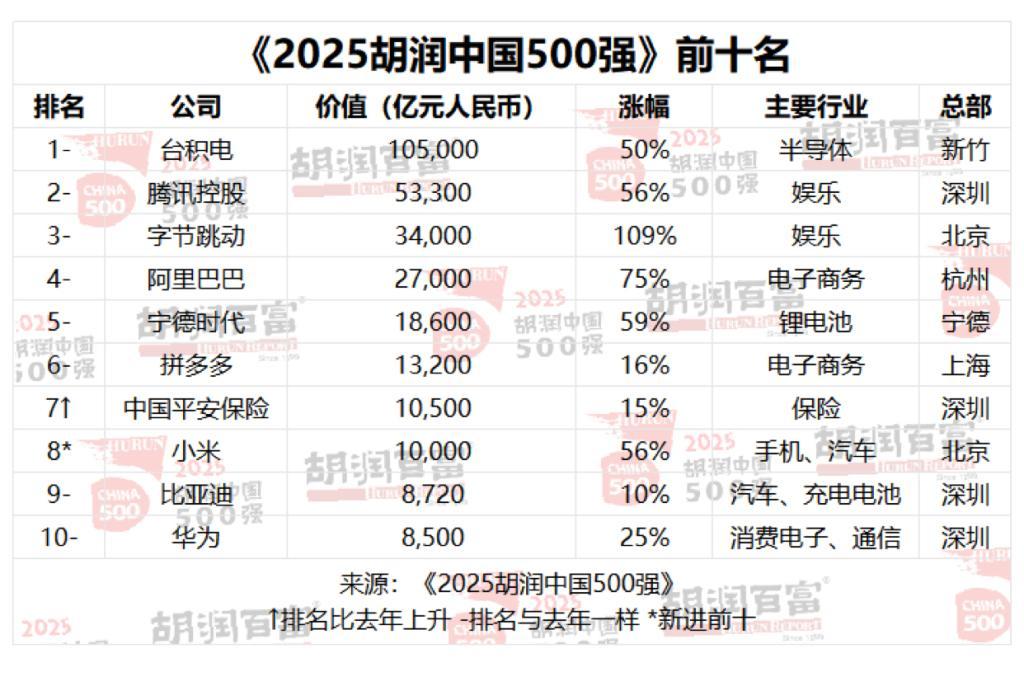
2月5日,胡润研究院发布《2025胡润中国500强》,列出了中国500强非国有企业,按照企业价值进行排名(注:上市公司市值按照2025年11月14 日的收盘价计算,非上市公司估值参考同行业上市公司或根据最新一轮融资情况进行估算)。这是胡润研究院连续第七次发布"胡润中国500强"。 榜单显示,台积电价值增长3.5万亿元,以10.5万亿元再度蝉联中国价值最高的民营企业;腾讯价值增长1.9万亿元,以5.3万亿元稳居第二;字节跳 动价值增长1.8万亿元,以3.4万亿元保持第三。 | | | 《2025胡润中国500强》 前十名 | | | | | --- | --- | --- | --- | --- | --- | | 排名 | 公司 | 价值(亿元人民币) | - 涨幅 | EEE 行y | | | | 台积电 | atten good and super lease le volus and service and the series of the series of the series and the series of the serie | 50% | | | | 2- | 腾讯控股 | 53,300 ...


阿治曼政府媒体办公室访问华为深圳总部
Shang Wu Bu Wang Zhan· 2026-02-05 08:20
Group 1 - The core focus of the visit by the Ajman government media office delegation to Huawei's headquarters in Shenzhen was to explore digital storage, communication networks, and smart media solutions [1] - Discussions centered around potential collaboration to enhance media work efficiency, information flow, and content quality, reflecting the proactive stance of the UAE local government towards digitalization and smart media development [1]
小米首进中国500强前十,台积电腾讯稳居前二
Bei Ke Cai Jing· 2026-02-05 07:49
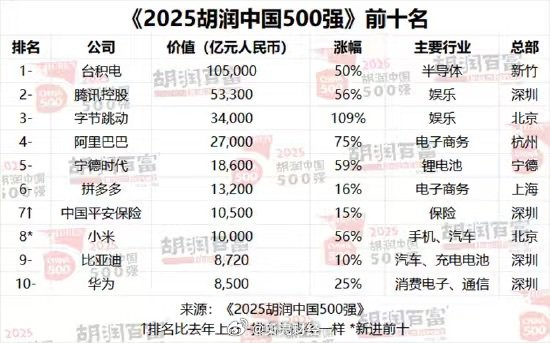
【#小米首次进入中国500强前十#】胡润研究院发布2月5日发布《2025胡润中国500强》,台积电价值增 长3.5万亿元,以10.5万亿元再度蝉联中国价值最高的民营企业。腾讯价值增长1.9万亿元,以5.3万亿元 稳居第二。字节跳动价值增长1.8万亿元,以3.4万亿元保持第三。小米新进前十,价值增长3570亿元, 以1万亿元位列第八。@新浪科技 | | | 《2025胡润中国500强》 前十名 | | | | | --- | --- | --- | --- | --- | --- | | 排名 | 公司 | 价值(亿元人民币) | 涨幅 | 主要行业 | | | 1- 1 | 台积电 | A C = | 50% | 半导体 | 新竹 | | 2- | 匿谓腔股 | 53,300 | 56%50 0.5% | 娱乐 | 深圳 | | 3- | 字节跳动 | 34,000 | 109% | 娱乐 | 北京 | | 4- | 阿里巴巴 | 27,000 | 75% | 电子商务 | 杭州 | | 175- | 宁德时代 | 18,600 | 59% 13 HE 134 | 锂电池 | 宁德 | | | 拼多多 | 1 ...
2025年AIGC发展研究报告4.0版
Sou Hu Cai Jing· 2026-02-05 07:38
Core Insights - The report focuses on the current state of AIGC and AGI development, highlighting a competitive landscape dominated by the US and China, with a shift towards multimodal integration and autonomous agents, making human-machine coexistence inevitable [1] Group 1: Technological Developments - Key breakthroughs in AGI are concentrated in four areas: long-term memory and controllable personality, physical interface integration, autonomous scientific hypothesis validation, and institutional restructuring [2] - Core technological trends include the emergence of text generation intelligence, 3D world simulation, and video generation spatiotemporal modeling [2] - The competition among large models has led to a dual-track system of open-source and closed-source models, with China's open-source ecosystem leading and the US's closed-source models outperforming by approximately 9 months [2] Group 2: Global Competition and Industry Landscape - In 50 key AI fields, the US leads in 26 areas focusing on foundational breakthroughs and principle innovation, while China leads in 13 areas excelling in application implementation and industry integration [3] - Eleven core companies dominate the market, with OpenAI and Google DeepMind leading the closed-source camp, while DeepSeek, Alibaba, and ByteDance drive the open-source ecosystem and application scenarios [3] - The development of models is shifting towards "personalization + specialization," with agentification and ecological embedding becoming mainstream [3] Group 3: Application Scenarios - In content production, AIGK achieves knowledge self-organization, with AI in literature, art, music, and video realizing large-scale creation [4] - Industry applications span education, healthcare, government, energy, and agriculture, with AI + education promoting personalized learning and AI + healthcare constructing multimodal models for cancer diagnosis [4] - The intelligent internet is accelerating, with social AI integration and AI socialization reshaping information retrieval logic, leading to a subtle integration of AI into daily life [4] Group 4: Challenges and Future Outlook - Current challenges include cumulative errors, long-term memory drift, and accountability attribution among nine technical challenges, with a gap between capital enthusiasm and technological reality [5] - Over the next decade, AGI will undergo four stages: toolification, scenario-based application, theoretical development, and embodiment, transitioning human-machine relationships from collaboration to coexistence [5] - The focus of human value will shift towards creativity, emotionality, and reflective value, with the economy moving from "scarcity economics" to "meaning economics," making intelligent capital a core production factor [5]

中国软件技术发展洞察和趋势预测研究报告2026
极客邦科技· 2026-02-05 07:26
Investment Rating - The report does not explicitly state an investment rating for the industry Core Insights - The artificial intelligence (AI) sector continues to dominate investment, accounting for 88.1% of total financing in the technology field in 2025, an increase of 5.3 percentage points from 2024 [21] - The humanoid robot sector has emerged as a significant area of investment, capturing 16.8% of the total technology financing [28] - The report highlights the rapid evolution of AI technologies, particularly in reasoning models and multimodal models, which are reshaping the landscape of AI applications [36][38] Summary by Sections 2025 Technology Market Review - In 2025, the technology sector saw a total financing of 738.4 billion yuan across 644 events, with AI leading the way [21] - Key developments included the rise of humanoid robots and advancements in AI models, such as the release of various reasoning models by major companies [19][36] 2026 Technology Trend Outlook - The report anticipates continued growth in AI and humanoid robotics, with significant investments expected in these areas [28] - The integration of AI into various applications is expected to accelerate, driven by advancements in multimodal models and reasoning capabilities [36][38] Financing Events and Trends - The AI sector experienced 212 financing events exceeding 100 million yuan, representing 88.7% of all such events in the technology field [29] - The report notes a shift towards more substantial financing rounds, with seed and A rounds making up 67.7% of total financing events [31] Key Companies and Innovations - Notable companies in the AI sector include Zhiyuan AI, Minimax, and Yuzhi Technology, which have raised significant funds in recent rounds [32] - The report highlights the emergence of new technologies and models, such as DeepSeek and various multimodal models, which are expected to drive future growth [36][38]
《2025胡润中国500强》发布,小米、比亚迪、华为进入前十
Jin Rong Jie· 2026-02-05 07:07
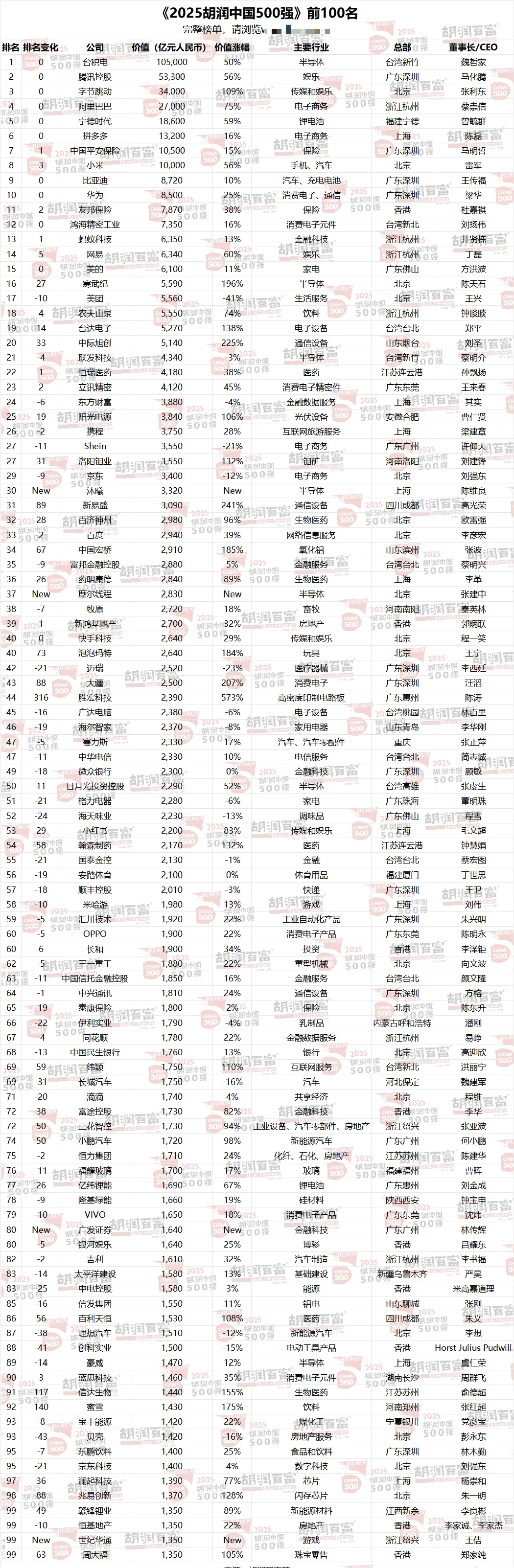
上榜的500家企业总价值为77万亿元,增加21万亿元,涨幅达38%,其中以台积电、寒武纪、联发科为代表的半导体行业增长最多。从企业所在城市 来看,北京、上海和深圳仍然是胡润中国500强企业数量最多的前三大城市,分别有59家、57家、49家,台北、香港、杭州分别以32家、30家、26家 排名第四至第六位。这六大城市所占中国500强企业的数量达到总数的50%。 本文源自:金融界汽车 作者:AI君 2月5日,胡润研究院发布了《2025胡润中国500强》,其中台积电以10.5万亿人民币价值蝉联榜首,价值涨幅达50%。腾讯控股、字节跳动、阿里巴 巴、宁德时代分列第二至第四位,价值分别为5.33万亿、3.4万亿、2.7万亿、1.86万亿。小米排名上升3位来到第八,价值为1万亿;比亚迪排名第九, 价值为8720亿元;华为排名第十,价值为8500亿元。 | | | | | | | | 《2025胡润中国500强》 前100名 | | | | | | --- | --- | --- | --- | --- | --- | --- | --- | --- | --- | --- | --- | | | | | | | | 完整榜 ...
东兴证券:全球超节点竞争格局尚未确立 建议关注发布国产超节点云厂商等
智通财经网· 2026-02-05 06:20
Core Viewpoint - Starting from 2025, supernodes will become a significant technological innovation direction in the AI computing network, with increasing competition among AI chip manufacturers in both chip performance and Scale up network [1][5]. Group 1: Supernode Development - Nvidia has launched mature supernode solutions, with plans to release GH200 NVL72, GB200/GB300 NVL72, and VR200 NVL72 from 2024 to 2026 [1][3]. - The Blackwell architecture standardizes Scale up with GB200 NVL72 stabilizing the scale at 72 GPUs per cabinet, consisting of 18 Compute Trays and 9 Switch Trays [2]. - The Rubin architecture will enhance bandwidth, with the NVLink 6 Switch increasing single GPU interconnect bandwidth to 3.6 TB/s, up from 1.8 TB/s [2]. Group 2: Nvidia's Competitive Advantage - Nvidia maintains a leading position in the supernode market, with a projected shipment of approximately 2,800 units of GB200/300 NVL72 by 2025 [3]. - Future plans include the introduction of Vera Rubin NVL144 and Rubin Ultra NVL576, expanding interconnected GPUs from 72 to 576 [3]. - Innovations such as NVLink and NVLink Switch are crucial for achieving high bandwidth and low latency in AI training clusters, with NVLink 5 Switch supporting a total bandwidth of 130 TB/s for 72 GPUs [4]. Group 3: Industry Landscape and Investment Strategy - The global supernode competition landscape is still being established, with Nvidia currently in a leading position [6]. - The report suggests monitoring Nvidia's supernode supply chain, including components like PCB backplanes, high-speed copper cables, optical modules, and cooling systems [6]. - Chinese manufacturers are actively participating in the supernode and Scale up network sectors, with potential for domestic firms to gain a competitive edge [6].

