腾讯

Search documents
高盛分析师:中国股票市场到2027年底有望再涨38%
Xin Lang Cai Jing· 2025-12-22 14:11
Core Viewpoint - The Chinese stock market is experiencing a strong rebound due to investor reassessment of the technology sector's value and increased household savings flowing into the stock market, with Goldman Sachs predicting continued growth through 2026 [1][2]. Group 1: Market Predictions - Goldman Sachs forecasts that the bull market for Chinese stocks will persist, although the pace of growth may slow down [1]. - The analysts predict a 14% growth in corporate earnings in China next year, followed by a 12% increase in 2027, with valuation expansion expected to be around 10% [1]. - By the end of 2027, Chinese stocks are projected to rise an additional 38% [1]. Group 2: Sector Insights - The growth in overseas revenue for listed companies is expected to contribute to a 1.5% annual increase in earnings for MSCI China index constituents by 2030 [1]. - The valuation of China's AI technology ecosystem has been reassessed, indicating that it remains relatively inexpensive compared to the U.S., given the potential for capital expenditure growth and emphasis on AI commercialization [1][2]. Group 3: Market Dynamics - The rise of AI-driven Chinese stocks is not seen as a bubble, as there is room for technology companies to enhance their valuations and earnings through a focus on AI applications [2]. - The shift of household savings into the stock market, driven by declining bank deposit rates, has further fueled the current market rally [2]. Group 4: Broader Market Sentiment - Major international banks, including Morgan Stanley, JPMorgan, and UBS, have recently expressed bullish views on the Chinese stock market, particularly regarding the technology sector [2]. - JPMorgan's stock strategy head for mainland China and Hong Kong suggests that the current economic and stock market conditions are in a "summer" phase, with a potential "spring sprint" expected in 2026 [3].
2026 AI 商业中场:从原生多模态到超级入口
晚点LatePost· 2025-12-22 13:39
Core Insights - The article discusses the evolution of AI technology and its commercialization potential, emphasizing the shift from text-based models to native multimodal models that can understand and process various types of data simultaneously [5][8][14]. Group 1: AI Technology Evolution - AI technology has faced challenges in finding practical applications, but advancements in models like DeepSeek and OpenAI's GPT-4o are reshaping user perceptions of AI's value [6][7]. - The introduction of native multimodal models, such as Baidu's Wenxin 5.0 and Google's Gemini 3, is expected to enhance AI's understanding of images, videos, and audio, thereby improving its commercial viability [12][14]. Group 2: Commercialization Challenges - The high cost of reasoning in AI models has been a barrier to widespread adoption, with predictions that reasoning tasks will consume over 50% of token usage by 2025 [17]. - Companies are focusing on reducing reasoning costs through full-stack optimization, which includes advancements in algorithms, architectures, and hardware [20][21]. Group 3: Competitive Landscape - The competition in the AI industry is evolving from merely scaling models to providing deeper intelligence at lower costs, with companies like Baidu and Google leading the charge [21][24]. - The concept of a "super entrance" is emerging, where companies are transitioning from traditional app-based platforms to intelligent multimodal assistants that can interact with users in more sophisticated ways [22][23]. Group 4: Strategic Developments - Baidu is leveraging its technological foundation to create a comprehensive ecosystem that integrates its AI capabilities with various applications, positioning itself as a leading player in the AI landscape [24]. - Tencent is also ramping up its AI efforts by establishing new departments and recruiting top talent to enhance its research and development capabilities [26].




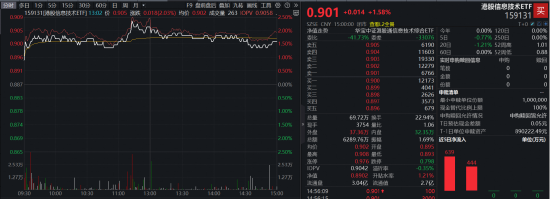
中国版OpenAI冲刺港交所!半导体芯片产业链大反攻,港股信息技术ETF(159131)收涨1.58%
Xin Lang Cai Jing· 2025-12-22 12:21
Core Viewpoint - The semiconductor chip industry is experiencing a strong rebound, highlighted by the performance of the first Hong Kong ETF focused on the chip sector, which saw a daily increase of 1.58% and a trading volume of 52.89 million yuan [1][8]. Group 1: ETF Performance - The Hong Kong Information Technology ETF (159131) opened high and closed with a gain of 1.58%, recovering its 5-day moving average [1][8]. - The ETF's underlying index has a price-to-earnings ratio of 33.23, which is at the 37.9% percentile over the past three years, indicating significant room for growth compared to its peak earlier in the year [3][10]. Group 2: Key Stocks Performance - Over 70% of the ETF's constituent stocks showed positive performance, with SenseTime-W leading with an increase of over 8%, followed by SMIC and Kinsus Interconnect Technology, both rising by 6% [4][11]. - The ETF is heavily weighted towards semiconductor and electronic companies, with SMIC holding a weight of 20.48% and Xiaomi Group-W at 9.53% [6][13]. Group 3: Technological Advancements - Researchers from Shanghai Jiao Tong University have made a breakthrough in optical computing chips, which could alleviate issues in the AI industry related to high costs, slow training, and energy consumption [2][9]. - The development of optical computing chips is expected to provide disruptive pathways for real-time AI, edge AI, and green AI applications, potentially transforming business and operational models in the AI sector [2][9]. Group 4: Market Trends and Future Outlook - The IPO of Zhizhu AI, regarded as the "Chinese version of OpenAI," signals a new phase in China's large model industry, focusing on technological strength and sustainable business models [3][10]. - The investment attractiveness of the Hong Kong chip sector is highlighted by its favorable valuation compared to other major tech indices, suggesting a strong potential for future growth [3][10].
北京跑出“全球大模型第一股”!CFO职位空缺,董秘负责财务管理
Sou Hu Cai Jing· 2025-12-22 11:08
Core Insights - The first large model IPO is set to take place in China, with the AI company Zhipu being the first among the "six small tigers" in the large model sector to initiate the IPO process [5][6] - Zhipu's listing will provide a quantifiable valuation reference for the long-lacking public market in the large model industry, marking a shift from a "technology race" to "capital validation" for China's AI sector [5][6] - Since its establishment in 2019, Zhipu has raised over 8 rounds of funding, accumulating over 8.3 billion RMB, with a pre-IPO valuation of 24.38 billion RMB [5][6] Company Overview - Zhipu is a leading AI company in China focused on developing advanced general large models, aiming for innovation in artificial general intelligence (AGI) [8] - The company provides general large model services to institutional clients and individual users, supporting over 8,000 institutional clients and approximately 80 million devices as of June 30, 2025 [7][8] - According to Frost & Sullivan, Zhipu ranks first among independent general large model developers in China, with a market share of 6.6% [7] Financial Performance - Zhipu's revenue has shown significant growth, with figures of 57.4 million RMB in 2022, 125 million RMB in 2023, and 312 million RMB in 2024, reflecting a compound annual growth rate of over 130% [7][8] - Despite revenue growth, the company reported substantial losses of 144 million RMB, 788 million RMB, 2.958 billion RMB, and 1.236 billion RMB for the years 2022, 2023, 2024, and the first half of 2025, respectively [7][8] Research and Development - Zhipu has made significant investments in R&D, with expenditures rising from 84.4 million RMB in 2022 to 529 million RMB in 2023, and further to 2.195 billion RMB in 2024 [8] - The company’s R&D spending for the first half of 2025 is projected to be 1.595 billion RMB, indicating an 85.6% increase from the previous period [8] Product Offerings - Zhipu's MaaS platform offers four types of models: language models, multimodal models, agent models, and code models, along with integrated tools for model fine-tuning and deployment [9][10] - The platform is designed to provide comprehensive model capabilities, extensive application scenarios, and adaptable computing infrastructure [9][10] Intellectual Property - As of the last feasible date, Zhipu holds 86 registered patents in China, with 84 being invention patents, and has filed 234 patent applications [10]

恒生科技也有圣诞行情?
Sou Hu Cai Jing· 2025-12-22 11:01
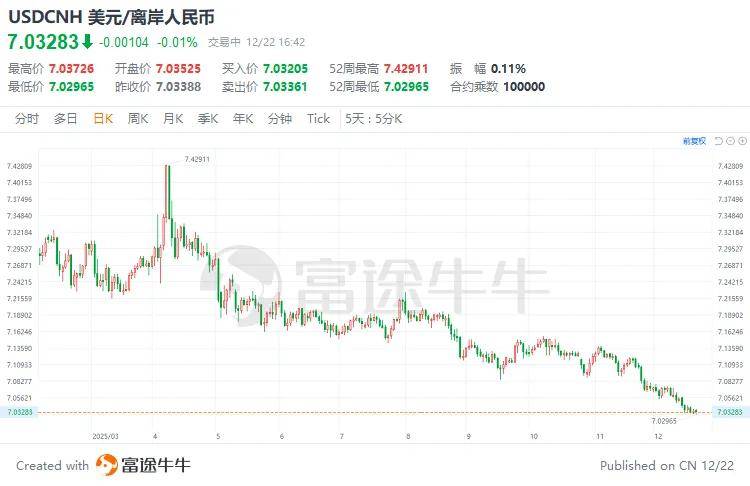
Core Viewpoint - The Bank of Japan's interest rate hike did not cause market turbulence, and its dovish guidance for future hikes has led to a rebound in U.S. stocks and risk assets, which is expected to positively impact the Hong Kong stock market as well [1][2]. Group 1: Market Reactions - The recent interest rate hike by the Bank of Japan was anticipated, and the market had already adjusted, allowing for a potential Christmas rally as liquidity conditions improve [1][5]. - The U.S. stock market experienced its highest trading volume on record last Friday, driven by short covering, which was influenced by strong performance and guidance from AI-related companies like Micron [2][3]. Group 2: Investment Opportunities - The Hang Seng Tech Index is expected to benefit directly from the anticipated market rebound, with a focus on the E Fund Hang Seng Tech ETF (513010) [2][14]. - Historical data suggests that when the U.S. market has a year-to-date gain of over 10% before Thanksgiving, the likelihood of a Christmas rally is high, with only five instances of declines in such years [4]. Group 3: Currency and Market Dynamics - The weakening of the U.S. dollar and Japanese yen, along with a strengthening Chinese yuan, is expected to improve liquidity and attract capital back to the Hong Kong market [5]. - Historical instances of a strong yuan coinciding with a weak stock market are rare, suggesting a higher likelihood of the stock market strengthening in the future [7][8]. Group 4: Valuation and Performance - The overall valuation of Hang Seng Tech stocks is currently between the mean and the 25th percentile, indicating potential for upward movement if companies exceed earnings expectations [9]. - Major companies within the sector, such as Tencent and NetEase, are now positioned within a reasonable PE range of 15-20x for 2026, suggesting a favorable environment for performance improvement [11]. Group 5: AI and Future Growth - The AI sector is still in a rapid growth phase, with domestic internet companies focusing on sustainable investments compared to aggressive capital expenditures by overseas tech giants [11]. - The overall fundamentals of the sector remain robust, with healthy growth in key areas like advertising and gaming, positioning companies like Tencent and Alibaba favorably for future gains [11].
刚刚,又一只10倍股诞生!
Ge Long Hui· 2025-12-22 10:39
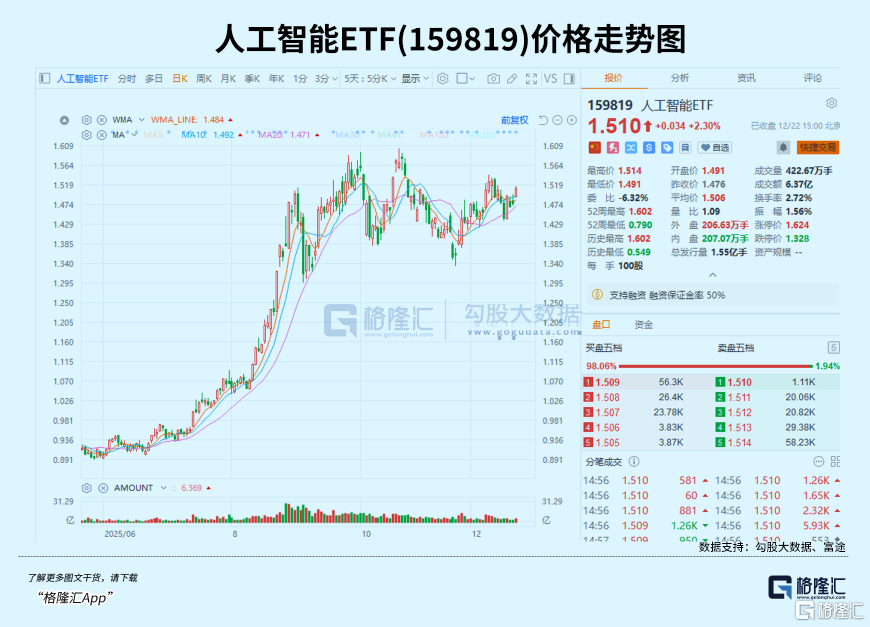
Core Insights - The AI sector has seen a significant rally despite skepticism surrounding an AI bubble, with major indices in the A-share market rising, particularly the ChiNext Index which surged by 2.23% [2][14] - Key segments within the AI technology chain, such as chips, semiconductors, and optical modules, have led the gains, with companies like NewEase achieving a tenfold increase in stock price since April [3][14] - In the US market, AI tech giants also experienced substantial gains, with Oracle and other companies seeing stock price increases of 6.63% to 222.64%, indicating strong investor confidence [5][6] Market Performance - The A-share market's AI stocks followed the upward trend seen in the US, with several companies in the semiconductor and AI infrastructure sectors experiencing significant price increases [10][11] - Notable performers include companies like Aisen Co., Shanghai Xinyang, and Lian Dong Technology, which saw stock price increases of over 10% [11][12] - The AI ETF (159819) rose by 2.30%, reflecting the overall positive sentiment in the AI sector [3] Strategic Developments - The U.S. Department of Energy launched the "Genesis Project" in collaboration with 24 tech giants, aiming to create a closed-loop AI experimental platform, signaling the strategic importance of AI to the U.S. economy [7][8] - This initiative highlights the integration of major players in the AI industry, including Nvidia, Microsoft, and Oracle, emphasizing the collective effort to advance AI technology [7][8] Investment Opportunities - The AI industry is in a growth phase, with significant potential for investment as evidenced by the increase in financing events and IPOs in the sector [17][18] - The market is witnessing a surge in AI-related IPOs, with 51 AI companies going public this year, a 143% increase from the previous year [18] - Companies in the AI supply chain, particularly those with high technical barriers, are expected to benefit from stable orders and strong customer loyalty, leading to faster revenue realization [24][25] Comparative Analysis - There is a notable disparity in market capitalization between U.S. and Chinese AI companies, with U.S. giants like Nvidia and TSMC having valuations significantly higher than their Chinese counterparts [15][16] - Despite the valuation gap, China's AI market holds substantial growth potential, and many Chinese companies are integrated into the supply chains of U.S. tech giants, allowing them to benefit from both domestic and international market opportunities [17][20] ETF Performance - The AI ETF (159819) has seen significant inflows, with over 5.7 billion yuan in capital this year, and has outperformed many peers with a 65.93% increase [31] - The semiconductor equipment ETF has also shown strong performance, indicating the critical role of semiconductor technology in the AI landscape [32] Future Outlook - The AI industry is expected to continue being a major investment opportunity, with a focus on companies that can leverage their technological advantages and secure stable supply chain relationships [24][25] - The ongoing developments in AI technology and infrastructure are likely to create a robust environment for growth and investment in the coming years [34][35]


数据中心供配电设备行业跟踪:AI与数据中心景气延续,电力设备需求持续高企
Shanghai Aijian Securities· 2025-12-22 10:03
Investment Rating - The report rates the industry as "Outperforming the Market" [3] Core Insights - The data center industry has become a core incremental application scenario for the power equipment sector, directly driving demand growth and technological iteration in power equipment [3][6] - The report emphasizes the need to incorporate multi-dimensional indicators from the AI industry to accurately assess the demand for power distribution equipment in data centers, given the capital expenditure scale and long investment return cycles in the data center sector [3][6] - The report outlines a three-part indicator system: 1. Demand side: Capital expenditure from leading cloud providers serves as a direct "weather vane" for short-term demand potential for power distribution equipment [3][6] 2. Supply chain: The investment rhythm in data centers is constrained by GPU supply, necessitating tracking of key supply chain data to validate demand progress [3][6] 3. AI application side: The development of AI applications directly impacts the strength and sustainability of capital expenditure cycles in data centers [3][6] Summary by Sections Demand Side: Sustained High Growth in Capital Expenditure - In Q3 2025, overseas cloud providers' capital expenditure reached $99.617 billion, a year-on-year increase of 80.39% and a quarter-on-quarter increase of 9.54% [8] - Alibaba's capital expenditure in Q3 2025 was 31,501 million yuan, a year-on-year increase of 80.10% but a quarter-on-quarter decrease of 18.55% [13] - Tencent's capital expenditure in Q3 2025 was 12,983 million yuan, a year-on-year decrease of 24.05% and a quarter-on-quarter decrease of 32.05% [13] Supply Chain: Revenue Growth for Key Players - NVIDIA's revenue in Q3 2025 reached 362.571 billion yuan, a historical peak with a quarter-on-quarter growth of 24.63% and a year-on-year growth of 62.49% [18] - TSMC's revenue in November 2025 was 343.614 billion New Taiwan dollars, a year-on-year increase of 24.5% [24] - The CPU price index in October 2025 was 98.20, showing a slight recovery from 96.15 in September, while DRAM spot prices surged over 200% from $12.85 to $38.76 [27] Application Side: Steady Growth in AI Models and Applications - The report notes a steady increase in the number of AI models and application deployments, which directly influence the capital expenditure cycles in data centers [29] - The token call volume on the OpenRouter platform reached 5.85 trillion from December 9 to December 15, reflecting a quarter-on-quarter growth of 1.21% [34] - The price of tokens for models scoring over 40 on the Artificial Analysis Intelligence Index dropped by over 50% in Q3 2025 [45]
清华实验室跑出一个超级IPO
Xin Lang Cai Jing· 2025-12-22 09:49
Core Viewpoint - The competition for the title of "first large model IPO" in China has intensified, with companies like Zhipu AI and MiniMax both passing the Hong Kong Stock Exchange's listing hearing and submitting their prospectuses almost simultaneously [4][29]. Group 1: Company Overview - Zhipu AI was founded in 2019 by a team of Tsinghua University graduates, including CEO Zhang Peng and Chairman Liu Debing [5][21]. - The company aims to be a leading artificial intelligence firm in China, focusing on the pursuit of Artificial General Intelligence (AGI) innovations [7][23]. - Zhipu AI has developed the GLM framework, China's first proprietary pre-trained large model framework, and has launched a model-as-a-service (MaaS) platform [7][23]. Group 2: Financial Performance - Zhipu AI's revenue has shown significant growth, with figures of 57.4 million yuan in 2022, 124.5 million yuan in 2023, and an estimated 312.4 million yuan in 2024, reflecting a compound annual growth rate of 130% [8][24]. - The company reported a revenue of 190.9 million yuan for the first half of 2025 [8][24]. - Despite the revenue growth, Zhipu AI has been operating at a loss, with net losses of 144 million yuan in 2022, 788 million yuan in 2023, and projected losses of 2.96 billion yuan in 2024 [9][25]. Group 3: Investment and Valuation - Zhipu AI has attracted significant investment, completing multiple funding rounds totaling over 8 billion yuan, with a post-money valuation of approximately 24.38 billion yuan [9][26]. - The company has received investments from notable firms including Meituan, Ant Group, Alibaba, Tencent, and Sequoia China [9][26]. - The competitive landscape is heating up, with the potential for a "two-tier" market where leading companies strengthen their technological barriers through IPOs, while smaller firms may face acquisition or exit pressures [30][31].

港股收盘 | 恒指收涨0.43% 光通信、半导体股表现亮眼 有色金属全天强势
Zhi Tong Cai Jing· 2025-12-22 08:52
Market Overview - The Hong Kong stock market experienced fluctuations, with the Hang Seng Index closing up 0.43% at 25,801.77 points and a total trading volume of HKD 169.77 billion [1] - The market is currently in a left-side layout phase, with strong expectations for a spring rally, although there are supply and demand pressures towards the end of the year [1] Blue Chip Performance - Semiconductor company SMIC (00981) led blue-chip gains, rising 5.92% to HKD 68.9, contributing 27.67 points to the Hang Seng Index [2] - Other notable blue-chip performers included Zijin Mining (02899) up 5.3% and Pop Mart (09992) up 4.61%, while WuXi AppTec (02359) and Hang Lung Properties (00101) saw declines [2] Sector Highlights - Large technology stocks generally rose, with Alibaba up 0.76% and Tencent up 0.08% [3] - The metals sector saw significant gains, with gold, silver, and copper prices rising sharply, and companies like Jiexin International Resources (03858) and Chalco International (02068) posting substantial increases [4] - The new consumption sector was active, with companies like Mixue Group (02097) and Pop Mart (09992) showing strong performance [5][6] Robotics and Autonomous Driving - Robotics stocks were active, with companies like Shou Cheng Holdings (00697) and UBTECH (09880) seeing gains, driven by positive media coverage and project wins [6] - The autonomous driving sector continued to gain momentum, with companies like Pony.ai (02026) and WeRide (00800) experiencing price increases following regulatory approvals for L3 autonomous vehicles [7] New Stock Listings - Four new stocks debuted on the Hong Kong market, all experiencing declines on their first day, with Ming Kee Hospital (02581) dropping 49.46% [8] - China Duty Free Group (01880) saw a strong performance, rising 15.77% following positive sales data from Hainan's duty-free shopping [9] Company-Specific Developments - Yujian (02432) faced downward pressure, dropping 4.84% amid upcoming share unlocks and a recent large-scale share placement [10]

港股收盘(12.22) | 恒指收涨0.43% 光通信、半导体股表现亮眼 有色金属全天强势
智通财经网· 2025-12-22 08:47
Market Overview - The Hong Kong stock market experienced fluctuations, with the Hang Seng Index closing up 0.43% at 25,801.77 points and a total trading volume of HKD 169.77 billion [1] - The market is currently in a left-side layout phase, with strong expectations for a spring rally, although there are supply and demand pressures towards the end of the year [1] Blue Chip Performance - Semiconductor company SMIC (00981) led blue-chip gains, rising 5.92% to HKD 68.9, contributing 27.67 points to the Hang Seng Index [2] - Other notable blue-chip performers included Zijin Mining (02899) up 5.3% and Pop Mart (09992) up 4.61%, while WuXi AppTec (02359) and Hang Lung Properties (00101) saw declines [2] Sector Highlights - Large technology stocks generally rose, with Alibaba up 0.76% and Tencent up 0.08% [3] - The metals sector saw significant gains, with gold prices surpassing USD 4,400 per ounce and LME copper prices nearing USD 12,000 per ton [4] - The new consumption sector was active, with companies like Mixue Group (02097) rising 10.13% following the opening of a new store in Los Angeles [6] Investment Opportunities - The storage and advanced process sectors are expected to see accelerated growth, benefiting domestic equipment manufacturers [5] - The AI and robotics sectors are gaining traction, with companies like Ubiquiti (09880) and others seeing increased orders and market interest [6][7] New Stock Listings - Four new stocks listed on the Hong Kong market faced significant declines on their debut, with Mindray Hospital (02581) dropping 49.46% [8] - China Duty Free Group (01880) saw a strong performance, rising 15.77% amid positive sales data from Hainan's duty-free shopping [9] Company-Specific Developments - Yujian (02432) faced downward pressure due to an upcoming lock-up expiration and a recent share placement [10]