国家电网

Search documents
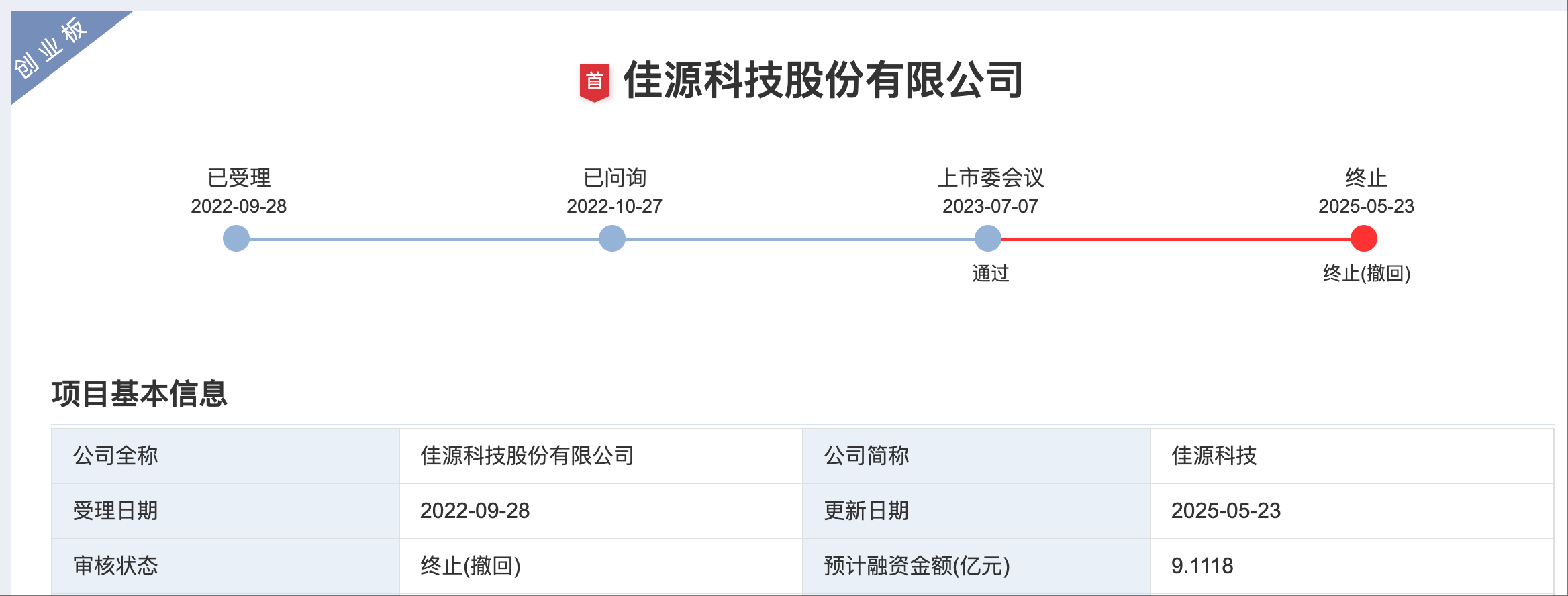
IPO过会近两年后 佳源科技撤回创业板上市
Zheng Quan Shi Bao Wang· 2025-05-25 11:13
Core Viewpoint - JiaYuan Technology Co., Ltd. has withdrawn its application for IPO, leading to the termination of its listing review by the Shenzhen Stock Exchange [1] Company Overview - JiaYuan Technology is a high-tech enterprise focused on providing IoT terminals and digital solutions in the smart power sector, enhancing the perception, communication, and data processing capabilities of power terminal devices and systems through IoT technologies [3] - The company primarily engages in the R&D, production, and sales of smart integrated terminals (TTU) and low-voltage branch monitoring units (LTU), along with offering digital solutions such as smart substations and remote intelligent inspections [3] Market Position - JiaYuan Technology has established a significant market position in digital solutions for substations, with 2,801 integrated service substations and 1,370 standalone gateway substations procured by State Grid Jiangsu Electric Power Co., Ltd. since 2020, representing 18.90% and 9.24% of the Jiangsu smart substation market, respectively [3] Sales and Revenue - From 2021 to Q1 2023, JiaYuan Technology reported revenues of 528 million yuan, 581 million yuan, and 71.76 million yuan, with net profits of 89.29 million yuan, 91.77 million yuan, and a loss of 7.75 million yuan [4] - The company has a high customer concentration, with sales to State Grid and its subsidiaries accounting for 75.31%, 63.35%, and 79.44% of total revenue from 2020 to 2022 [4] Accounts Receivable - JiaYuan Technology has a significant accounts receivable balance, which increased from 69.69 million yuan in 2020 to 276 million yuan in 2022, attributed to revenue growth and credit terms extended to reputable clients [5] IPO History - The company initially planned to raise 911 million yuan through its IPO to fund various projects, including R&D for smart power IoT terminals and communication modules, but ultimately withdrew its application after nearly two years post-approval [5]


(经济观察)多省份新能源“挑大梁” 中国多举措保障电力稳供
Zhong Guo Xin Wen Wang· 2025-05-21 13:18
Group 1 - New energy has become the primary power source in over ten provinces in China, with Xinjiang and Shandong having new energy installation ratios exceeding 50% [1] - Shandong's new energy and renewable energy installations reached 125 million kilowatts, accounting for over 51% of the total [1] - Xinjiang's total power installation surpassed 200 million kilowatts, with new energy installations at 112 million kilowatts, representing 55.72% of the total [1] - Nationwide, as of the end of March, China's cumulative installed capacity of wind and solar power reached 1.482 billion kilowatts, surpassing the total installed capacity of thermal power [1] Group 2 - In response to the challenges of high proportions of new energy operation, the State Grid has launched a large-scale new energy grid operation control system [2] - This system covers over 60,000 substations and hundreds of thousands of new energy stations, enabling rapid economic adjustment of power supply and demand under fluctuations of 360 million kilowatts [2] - The South China Grid has established a new energy scheduling management platform to monitor and analyze new energy operations across five provinces [2] Group 3 - Companies like Huawei are focusing on the application of artificial intelligence in new energy, enhancing the accuracy of weather and power forecasting models [3] - Huawei's AI-based forecasting solution achieved a 97.24% accuracy rate for 15-minute predictions and over 90% for 24-hour forecasts [3] - The Chinese government has initiated actions to build a new power system, enhancing the grid's capacity to accept and regulate clean energy [3]
3.8万亿“国家电网”资产整合!首选重组目标浮现,9省电力资产收购完成,随时停牌?
Sou Hu Cai Jing· 2025-05-21 11:05
Core Viewpoint - A strategic restructuring wave is reshaping the layout of state-owned capital in China, focusing on "three concentrations" as a core goal [1] Group 1: Characteristics of Current Mergers and Acquisitions - The current round of central enterprise mergers and acquisitions is characterized by three main features: strategic focus, market-oriented guidance, and deep integration of the industrial chain [3][4][5] - Over 80% of restructuring cases are concentrated in strategic emerging industries, with State Power Investment Corporation enhancing its coal power capacity from 48 million tons to 63 million tons through the integration of Baiyin Hwa coal power [3] - The integration model of "traditional energy supply + new energy transition" is becoming a benchmark for energy state-owned enterprises [3] Group 2: Policy Support for Mergers and Acquisitions - The regulatory environment is becoming more favorable, with the China Securities Regulatory Commission (CSRC) increasing valuation inclusivity for light asset technology companies [4] - Local policies are fostering competition, with Shanghai aiming to cultivate 10 leading enterprises and achieve a merger scale of 300 billion yuan over three years [7] - The CSRC has introduced a "small and fast" review mechanism, reducing the restructuring review cycle to 45 working days, a 60% reduction from traditional processes [7] Group 3: Notable Companies and Their Strategies - Yuan Da Environmental Protection, a subsidiary of State Power Investment Corporation, plans to acquire equity in Wiling Power and Changzhou Hydropower, potentially becoming a platform for integrating hydropower assets [8] - Datang Power, under Datang Group, is integrating coal power assets in Inner Mongolia and Shanxi, while promoting the synergy between coal power and new energy projects [9] - Hongdu Aviation is optimizing asset allocation within the Aviation Industry Group through asset swaps, positioning itself for future military asset integration [9] - Electric Power Investment Finance is set to acquire 100% equity in State Power Investment Nuclear Power Co., becoming a key player in the nuclear power sector's restructuring [9] Group 4: Major Asset Integration Targets - The 3.8 trillion yuan asset integration of the State Grid is highlighted as a primary restructuring target, with significant recent developments including the acquisition of energy-saving businesses and assets from nine provincial power companies [10] - Recent corporate governance changes, including the resignation of the chairman and amendments to the company charter, indicate strategic shifts within the company [10] - The stock has shown strong trading volume and net inflows, suggesting potential upward momentum in the near future [10]
中美对抗是假,美联储收割是真!逼卖矿山、电网?这在中国行不通
Sou Hu Cai Jing· 2025-05-21 09:02
Group 1 - The essence of the US-China conflict is a struggle for control over manufacturing industry chains and financial assets, rather than just a trade or technology war [1][3] - The core interests of the people in both countries are complementary, with the US relying on affordable Chinese goods and China needing US technology and markets [3][24] - The real issue arises from financial dynamics, particularly as China accumulates foreign exchange reserves and seeks to use the yuan for strategic resource transactions, challenging the foundation of US dollar hegemony [3][16] Group 2 - The Federal Reserve, while appearing to be a central bank, has deep connections with Wall Street, indicating a complex relationship that influences global financial dynamics [5][6] - The Fed's actions, such as dollar appreciation and interest rate adjustments, can lead to significant wealth transfers globally, often benefiting those with substantial cash reserves [8][10] - Historical patterns show that during financial crises, international capital often acquires undervalued assets, leading to a systematic "wealth transfer" [10][12] Group 3 - The Federal Reserve's primary goal is to maintain the purchasing power of the dollar and control inflation, which reveals the tool-like nature of the dollar in global finance [16][18] - The US capital groups aim to control global production resources and acquire high-quality assets that generate sustainable wealth, ensuring their dominance [16][18] - China's stronghold on critical national assets, such as energy and infrastructure, creates barriers for foreign capital, making it difficult for them to exert control [18][21] Group 4 - The resilience of China's industrial chain and advancements in high-tech sectors, such as new energy vehicles and 5G technology, have made it a formidable competitor [23][24] - The increasing prominence of the yuan in international markets has raised concerns among global capital players, who fear losing access to China's economic opportunities [24][26] - The ongoing global financial dynamics suggest that while challenges exist, there are also opportunities for value creation, emphasizing the importance of understanding tangible assets [26]

智能网联汽车ETF(159872)冲击4连涨,国家电网:我国自主研发的新能源大电网运控系统发布
Xin Lang Cai Jing· 2025-05-21 07:33
Group 1 - The China Internet of Vehicles Theme Index (930725) increased by 0.24% as of May 21, 2025, with significant gains from companies such as Jingwei Hirain (688326) up 11.51%, Tongda Electric (603390) up 9.98%, and others [1] - The Smart Connected Vehicle ETF (159872) rose by 0.43%, marking its fourth consecutive increase, driven by advancements in renewable energy grid control systems in China [2] - The release of the renewable energy grid operation control system is expected to enhance collaboration between grid companies and the smart connected vehicle industry, fostering new technological developments [2] Group 2 - As of April 30, 2025, the top ten weighted stocks in the China Internet of Vehicles Theme Index accounted for 51.42% of the index, including companies like BYD (002594) and Huichuan Technology (300124) [3] - The Smart Connected Vehicle ETF closely tracks the China Internet of Vehicles Theme Index, which includes various service providers, software developers, hardware manufacturers, and automotive companies [2]

开源证券:给予雅达股份增持评级
Zheng Quan Zhi Xing· 2025-05-21 05:48
Group 1: Company Performance - Yada Co., Ltd. achieved a revenue of 76 million yuan in Q1 2025, representing a year-on-year growth of 24.11% [1] - The net profit attributable to shareholders reached 6.23 million yuan, up 28.44% year-on-year [1] - The non-recurring net profit attributable to shareholders was 5.66 million yuan, showing a significant increase of 47.35% year-on-year [1] Group 2: Profit Forecasts - The profit forecasts for Yada Co., Ltd. have been adjusted downward for 2025 and 2026, with new projections for 2027 introduced [1] - Expected net profits for 2024, 2025, and 2026 are 34 million yuan (previously 46 million), 38 million yuan (previously 52 million), and 44 million yuan, respectively [1] - Corresponding EPS for these years are projected to be 0.21, 0.24, and 0.27 yuan per share, with PE ratios of 56.4, 49.7, and 43.4 times, respectively [1] Group 3: Industry Investment Trends - The State Grid plans to invest 350 billion USD (approximately 2.23 trillion yuan) during the 14th Five-Year Plan, averaging 446 billion yuan annually [2] - In 2024, the total investment in the power grid by the State Grid is expected to exceed 600 billion yuan, an increase of 71.1 billion yuan compared to 2023 [2] - The Southern Power Grid plans to invest 670 billion yuan during the 14th Five-Year Plan to accelerate the construction of a digital grid and modernize the power grid [2] Group 4: Technological Advancements - Yada Co., Ltd. possesses the capability for independent development of power monitoring system integration and is actively expanding into the data center sector [3] - The company has launched a series of products for data center power monitoring, environmental monitoring, and energy efficiency management, catering to major clients such as Tencent, Alibaba, Baidu, and ByteDance [3]
【财闻联播】这家公司即将从A股摘牌!国家电网最新发布,解决世界级难题
券商中国· 2025-05-20 11:16
Macro Dynamics - In the first four months of 2025, the national general public budget revenue reached 80,616 billion yuan, a year-on-year decrease of 0.4%, with the decline narrowing by 0.7 percentage points compared to the first quarter [1] - Central government revenue decreased by 3.8%, but in April, it saw a growth of 1.6%, marking the first month of positive growth this year [1] - Local government revenue increased by 2.2%, consistent with the growth rate in the first quarter [1] Automotive Industry - In the first four months of 2025, the top ten car manufacturers sold 2.502 million vehicles, accounting for 68.7% of total car sales [2] - Among these manufacturers, BYD, Geely, SAIC-GM-Wuling, and FAW saw varying degrees of sales growth compared to the same period last year, while other companies experienced declines [2] Financial Institutions - Several banks have lowered the interest rates on large-denomination time deposits, bringing them into the "1" era [5][6] - The recent trend of deposit rate cuts includes major banks like ICBC, BOC, and CCB, affecting various deposit products [6] Market Data - The Shanghai Composite Index rose by 0.38%, with significant activity in the consumer sector, leading to a surge in stock prices for beauty care, food and beverage, and pet economy sectors [8] - The total financing balance in the two markets increased by 35.43 billion yuan, with the Shanghai Stock Exchange reporting a balance of 9,096.57 billion yuan and the Shenzhen Stock Exchange at 8,833.67 billion yuan [9] Company Dynamics - State Grid has released a self-developed large-scale renewable energy grid operation control system, addressing the challenge of integrating large-scale renewable energy into the grid [11][12] - Yulong Co., Ltd. will have its stock delisted on May 27, 2025, without entering a delisting transition period [13] - Zhaoyi Innovation plans to issue H-shares and list on the Hong Kong Stock Exchange [14] - BYD and Shenzhou Car Rental signed a strategic cooperation agreement to promote sustainable development in green travel and car rental markets [15] - Vipshop reported Q1 2025 net revenue of 26.3 billion yuan, a year-on-year decline of approximately 5%, with a Non-GAAP net profit of 2.3 billion yuan [16]
国家电网:我国自主研发的新能源大电网运控系统发布
news flash· 2025-05-20 08:39
Core Viewpoint - The release of China's independently developed high-proportion renewable energy large power grid operation control system marks a significant achievement in addressing the global challenge of integrating large-scale renewable energy into the power grid [1] Group 1: System Development and Capabilities - The new system has been developed to ensure the safe and stable integration of large-scale renewable energy into the power grid, which currently has over 40% of its installed capacity from renewable sources [1] - It covers more than 60,000 substations and hundreds of thousands of renewable energy stations within the operational area of the State Grid [1] - The system can rapidly and economically dispatch up to 360 million kilowatts of renewable energy in a single day [1] Group 2: Industry Impact - This development supports the State Grid in becoming the largest power grid in the world for renewable energy consumption [1]
【环球财经】2025年大华巴西中资业务峰会在圣保罗举办
Zhong Guo Jin Rong Xin Xi Wang· 2025-05-20 05:32
Core Viewpoint - The "Cooperation and Win-Win - 2025 Dahuaba Brazil Chinese Business Summit" held in São Paulo highlighted the collaboration opportunities and localization strategies for Chinese enterprises in Brazil amid a complex international landscape [1][2]. Group 1: Company Initiatives - Dahuaba Brazil has been operating in Brazil since 2016, focusing on a "local deep cultivation" strategy, covering all 26 states and the federal district, and participating in significant projects like the Rio Olympics security system and the Three Gorges photovoltaic power station [1][4]. - The company aims to continue opening its technological ecosystem and sharing resources with Chinese partners for mutual development [1]. Group 2: Industry Collaboration - The summit featured specialized sessions on industry solutions and the Chinese business cooperation ecosystem, showcasing Dahuaba's "global technology + local adaptation" advantages through localized case studies [2]. - Dahuaba's sales director outlined three strategic pillars for serving Chinese enterprises: a "headquarters + local" dual-line collaboration mechanism, model projects with local standards, and an integrated service delivery chain with ecosystem partners [2]. Group 3: Networking and Future Prospects - The summit served as a platform for Chinese enterprises to exchange experiences and marked a new step in cooperation, with expectations for Dahuaba Brazil to assist in the "re-industrialization" process and promote high-quality Sino-Brazilian cooperation [3]. - Attendees visited the Dahuaba Experience Center to learn about advanced technologies such as thermal imaging security and smart city management platforms [3].


企业培训 | 未可知x上海电气:共探AI赋能电气行业新未来
未可知人工智能研究院· 2025-05-19 12:24
Core Viewpoint - The AI-themed advanced training course organized by the Unknown AI Research Institute and Shanghai Electric focused on cutting-edge AI technologies and their industrial applications, aiming to equip the management and technical staff of Shanghai Electric with in-depth AI knowledge to seize digital transformation opportunities [1][20]. Group 1: AI Training Course Overview - The training course was successfully held in Shanghai, emphasizing the importance of AI in the context of digital transformation for enterprises [1]. - Dr. Du Yu, a renowned expert in AI, delivered the course, providing insights into AI's core principles, innovative trends, and practical applications across various industries [3][4]. Group 2: AI Applications in the Electrical Industry - Dr. Du analyzed the current application status and development trends of AI technology in the electrical industry, highlighting unprecedented transformation opportunities due to the rise of generative AI [6]. - Several AI application cases in the electrical sector were presented, such as: - Shenzhen Power Supply Bureau's "Zhurong 2.0" model, which enhances inspection efficiency and safety [10]. - State Grid's "Bright Power Model," which significantly reduces the time for large power supply plan preparation from 10 hours to 10 minutes [10]. - Southern Power Grid's "Big Watt" AI model, capable of processing 100 images per minute and identifying 20 types of defects, achieving ten times the efficiency of traditional algorithms [10]. Group 3: Collaboration and Future Prospects - The collaboration between Shanghai Electric and the Unknown AI Research Institute reflects Shanghai Electric's commitment to embracing AI technology and exploring innovative development paths [20]. - The training provided participants with a deeper understanding of AI technology and its practical applications, enhancing the company's competitiveness and innovation capabilities [20][22]. - The Unknown AI Research Institute aims to continue promoting AI technology's popularization and application, collaborating with more enterprises to explore the limitless possibilities of AI [24].