中信银行

Search documents
中信银行(601998) - 中信银行股份有限公司内幕信息及内幕信息知情人管理工作制度
2025-12-26 10:16
第一章 总则 第一条 为规范中信银行股份有限公司(以下简称"本 行")内幕信息管理,加强内幕信息保密工作,确保信息 披露的公平公正,保护本行投资人及相关当事人的合法权 益,根据《中华人民共和国公司法》《中华人民共和国证 券法》《上市公司信息披露管理办法》《上市公司监管指 引第5号——上市公司内幕信息知情人登记管理制度》 《上海证券交易所上市公司自律监管指引第2号——信息 披露事务管理》等有关法律法规和证券交易所规则,以及 《中信银行股份有限公司章程》《中信银行股份有限公司 信息披露管理办法》《中信银行商业秘密管理办法》及其 他相关管理办法,结合本行实际情况,制定本工作制度。 第三条 董事会应当保证内幕信息知情人档案真实、 准确和完整,并按照上市地证券监督管理机构、证券交易 1 所有关监管规定以及本工作制度及时登记和报送。董事长 为主要责任人。董事会秘书负责办理本行内幕信息知情人 的登记入档及报送事宜。 第四条 董事会办公室为内幕信息及内幕信息知情人 管理的日常职能部门。 第五条 负责主办或牵头主办内幕信息事项的总行部 门、分支机构负责人是相关内幕信息和内幕信息知情人管 理的责任人。 第六条 各控股子公司及本行 ...
谁是银行贵金属之王?
Xin Lang Cai Jing· 2025-12-26 10:11
Core Viewpoint - The global market is experiencing a rare super cycle in precious metals, driven by a reassessment of the dollar's credibility and real demand from new industrial revolutions such as AI and hydrogen energy [2][24]. Group 1: Market Dynamics - As of December 24, spot gold reached $4500 per ounce, with international silver and platinum increasing over 140% for the year [2][24]. - The demand for precious metals has shifted from traditional safe-haven assets to being driven by monetary credit, geopolitical factors, and green technology [10][34]. Group 2: Banking Sector Adjustments - Major banks like ICBC, CCB, and CITIC are cleaning up personal precious metal accounts that have been inactive, indicating a strategic shift towards focusing on quality clients rather than quantity [3][26]. - This move is not a retreat but a strategic adjustment to enhance service quality, risk control, and long-term trust [27][36]. Group 3: Asset Growth and Competition - By Q3 2025, ICBC led the market with precious metal assets of 385.43 billion yuan, followed by Bank of China, China Construction Bank, Agricultural Bank of China, and Shanghai Pudong Development Bank, all surpassing 100 billion yuan [29][31]. - The growth in precious metal assets is built on a solid foundation from 2024, with ICBC showing consistent expansion from 254.30 billion yuan in Q1 to 385.43 billion yuan in Q3 2025 [32][33]. Group 4: Future Outlook - Goldman Sachs predicts that gold prices may reach $4900 per ounce by 2026, with several financial institutions forecasting gold to potentially hit $5000 per ounce [21][41]. - The competition in the precious metals sector will focus on compliance, customer trust, and long-term strategies, with the true "king of precious metals" being the bank that retains the most engaged and trusting clients after account clean-ups [42].





债券市场全景盘点:扩容提速、高波动并行,科创债引领新质生产力
Sou Hu Cai Jing· 2025-12-26 09:13
Core Insights - In 2025, China's bond market is expected to follow a development path that emphasizes both "scale expansion" and "structural optimization" amid multiple challenges and policy guidance [1] Group 1: Primary Market - The issuance scale of credit bonds reached a record high in the first half of 2025, with 11,077 bonds issued and a total issuance scale exceeding 10.16 trillion yuan, representing year-on-year growth of 6.75% and 4.39% respectively [3] - The issuance of technology innovation bonds (科创债) saw explosive growth, surpassing 1.7 trillion yuan by the end of 2025, becoming a "super engine" for direct financing of technology enterprises [3] - Local government special bonds also performed strongly, with a new issuance scale of 2.16 trillion yuan in the first half of 2025, a year-on-year increase of 44.7%, focusing on municipal infrastructure, green low-carbon projects, modern logistics, and advanced manufacturing [3] Group 2: Secondary Market - The bond market transitioned from a prolonged "bull market" to a high-volatility oscillation pattern in 2025, with a notable M-shaped yield curve [4] - The yield on 10-year government bonds fluctuated significantly, starting at approximately 1.6% at the beginning of the year, peaking at 1.9% in mid-March, and stabilizing around 1.81% by November [4] - Key factors influencing the bond market included shifts in monetary policy, ongoing U.S.-China trade tensions, and a strong performance in the equity market, particularly from July to September [4] Group 3: Regional Highlights - Henan province emerged as a leader in the central region's bond market, with corporate bond stock surpassing 500 billion yuan for the first time and maintaining annual financing above 100 billion yuan for four consecutive years [5] - The successful issuance of the first state-owned enterprise bond after a regional credit risk event demonstrated local credit recovery capabilities and financial resilience [6] Group 4: Future Outlook - For 2026, the bond market is expected to remain within a framework of "weak economic recovery + stable policy support," with projected yield fluctuations for 10-year government bonds between 1.5% and 1.8% [7] - Fiscal policy is anticipated to become more proactive, with continued emphasis on special bonds and policy financial tools, while innovation products like technology innovation bonds and green bonds will play a crucial role in supporting new productive forces and promoting high-quality development [7] - The bond market is evolving into a more diverse, efficient, and secure platform, increasingly serving as a conduit for national strategic implementation and providing essential financial support for China's economic transformation [7]

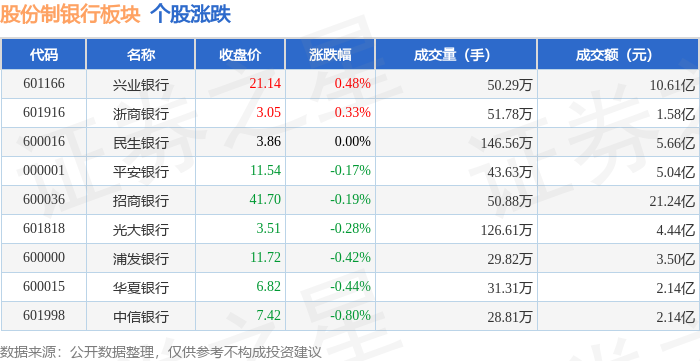
股份制银行板块12月26日跌0.18%,中信银行领跌,主力资金净流入4.48亿元
Zheng Xing Xing Ye Ri Bao· 2025-12-26 09:07
Market Overview - On December 26, the share price of the banking sector fell by 0.18% compared to the previous trading day, with CITIC Bank leading the decline [1] - The Shanghai Composite Index closed at 3963.68, up 0.1%, while the Shenzhen Component Index closed at 13603.89, up 0.54% [1] Individual Bank Performance - Industrial Bank (601166) closed at 21.14, up 0.48% with a trading volume of 502,900 shares and a transaction value of 1.061 billion [1] - Zhejiang Commercial Bank (601916) closed at 3.05, up 0.33% with a trading volume of 517,800 shares and a transaction value of 158 million [1] - Minsheng Bank (600016) closed at 3.86, unchanged with a trading volume of 1,465,600 shares and a transaction value of 566 million [1] - Ping An Bank (000001) closed at 11.54, down 0.17% with a trading volume of 436,300 shares and a transaction value of 504 million [1] - China Merchants Bank (600036) closed at 41.70, down 0.19% with a trading volume of 508,800 shares and a transaction value of 2.124 billion [1] - Everbright Bank (601818) closed at 3.51, down 0.28% with a trading volume of 1,266,100 shares and a transaction value of 444.1 million [1] - Shanghai Pudong Development Bank (600000) closed at 11.72, down 0.42% with a trading volume of 298,200 shares and a transaction value of 350 million [1] - Huaxia Bank (600015) closed at 6.82, down 0.44% with a trading volume of 313,100 shares and a transaction value of 214 million [1] - CITIC Bank (601998) closed at 7.42, down 0.80% with a trading volume of 288,100 shares and a transaction value of 214 million [1] Fund Flow Analysis - The banking sector saw a net inflow of 448 million from main funds, while retail funds experienced a net outflow of 231 million and 217 million respectively [1] - In terms of individual banks, China Merchants Bank had a main fund net inflow of 241 million, while retail funds saw a net outflow of 79.09 million [2] - Industrial Bank had a main fund net inflow of 159 million, with retail funds experiencing a net outflow of 108 million [2] - Shanghai Pudong Development Bank recorded a main fund net inflow of 62.09 million, while retail funds had a net outflow of 776,980 [2] - Everbright Bank had a main fund net inflow of 39.78 million, with retail funds seeing a net outflow of 1.45 million [2] - Ping An Bank had a main fund net inflow of 29.27 million, while retail funds experienced a net outflow of 4.01 million [2] - Minsheng Bank had a significant main fund net outflow of 67.19 million, but retail funds saw a net inflow of 27.19 million [2]




举牌、重组!银行业十大关键词→
证券时报· 2025-12-26 09:07
Core Viewpoint - In 2025, the Chinese banking industry is expected to demonstrate resilience amidst economic cycles, focusing on serving the real economy, embracing transformation, and maintaining a bottom line as a "certainty anchor" [1][2]. Group 1: Banking Industry Overview - The banking sector is navigating through challenges such as interest margin pressures, risk exposures, and customer behavior changes, leading to a collective reassessment of development strategies [1][4]. - The total assets of commercial banks are projected to grow from 380.52 trillion yuan at the end of 2024 to 409.63 trillion yuan by September 2025, with state-owned banks' assets increasing from 190.26 trillion yuan to 208.15 trillion yuan during the same period [3]. - The non-performing loan ratio is expected to fluctuate slightly, with estimates of 1.51% in March and 1.52% in September 2025 [3]. Group 2: Industry Trends - The concept of "anti-involution" has emerged as a consensus in the industry, shifting focus from aggressive scale expansion to a more sustainable and risk-aware approach [4][5]. - Regulatory measures have been implemented to curb unhealthy competition, including prohibiting high-interest deposit solicitation and blind low-price lending [4]. - The average net interest margin for commercial banks has dropped to a historical low of 1.42%, prompting banks to optimize asset allocation and diversify revenue sources [6][8]. Group 3: Deposit Trends - The trend of "deposit migration" has accelerated, with residents seeking better yield opportunities as deposit rates decline [11]. - The scale of bank wealth management products has increased from 30 trillion yuan to nearly 34 trillion yuan, indicating a shift from traditional deposit reliance to asset management [12]. Group 4: Mergers and Restructuring - Over 400 banking institutions are expected to exit the market through mergers, dissolutions, or cancellations, marking a significant increase compared to previous years [14]. - The restructuring efforts are characterized by a focus on quality improvement rather than mere reduction in numbers, with a systematic approach to governance [14]. Group 5: Technological Advancements - The banking sector is increasingly prioritizing technology finance, with a notable rise in specialized products for tech companies and a significant increase in tech loans, which accounted for 28.8% of new loans by August 2025 [15][30]. - The application of AI in banking has evolved from efficiency enhancement to a core driver of business growth and risk management, with banks investing in AI capabilities across various operational areas [30][31]. Group 6: Capital Increases - A notable "capital increase wave" is anticipated, with state-owned banks raising 520 billion yuan through stock issuance to bolster capital adequacy [18][20]. - Regulatory bodies are facilitating timely capital replenishment while ensuring that the capital is effectively utilized to enhance service capabilities [20]. Group 7: Shareholder Engagement - The banking sector has seen a surge in insurance capital participation, with seven banks receiving significant investments from insurance companies, reflecting the attractiveness of bank stocks [22]. - Major shareholders and executives have also been actively increasing their stakes in various banks, indicating confidence in the sector's prospects [22].

以赛为媒筑创新生态,中信银行济南分行赋能新材料产业高质量发展
Qi Lu Wan Bao· 2025-12-26 08:46
Group 1 - The sixth Shandong Province New Materials Industry Innovation and Entrepreneurship Competition concluded successfully in Jinan, organized by various provincial departments and institutions [1] - The competition aimed to stimulate innovation, promote high-quality development in the new materials industry, and cultivate new productive forces, serving as an efficient platform for industry innovation and financial empowerment [1] - Over a hundred innovative entrepreneurial teams participated, showcasing strong innovation capabilities in the new materials sector, with projects from companies like Shandong Daon Special Elastomers and Binzhou Huafang Engineering Research Institute winning top awards [1] Group 2 - China CITIC Bank Jinan Branch was the only cooperating bank and played a significant role throughout the competition, leveraging its comprehensive financial service platform to support participating enterprises [2] - The bank provided a comprehensive technology finance service plan covering policy adaptation, investment and financing support, and industry chain collaboration, establishing connections with several outstanding participating companies [2] - Moving forward, the bank aims to deepen the integration of finance, technology, and industry, using professional industry research as a driving force to support the development of new materials and strategic emerging industries in Shandong [2]
芦苇任中国邮政集团副总经理 或将接任邮储银行行长
Xi Niu Cai Jing· 2025-12-26 05:20
12月23日,"中国邮政"微信公众号发布公告称,中国邮政集团有限公司召开党组会议,宣布了中共中央组织部关于芦苇、刘建军的职务任免决定,芦苇任中 国邮政集团有限公司副总经理、党组成员,免去刘建军的中国邮政集团有限公司副总经理、党组成员职务。相关职务任免按有关法律规定办理。 据悉,刘建军已担任邮储银行党委书记、行长职位近4年半,目前已年满60岁。此前,有媒体报道称,芦苇或将接棒刘建军,赴邮储银行出任行长。 公开资料显示,2022年10月,因工作调整,芦苇辞任中信银行副行长,同时赴任中信信托,2023年3月起任中信信托总经理,2024年5月升任中信信托董事 长。2025年2月,芦苇回归中信银行,接任行长职位,中信银行原行长刘成则赴任中信建投证券出任董事长。 ...


关于新增长江证券股份有限公司为 建信旗下部分基金产品销售机构的公告
Zhong Guo Zheng Quan Bao - Zhong Zheng Wang· 2025-12-26 03:48
Group 1 - The announcement states that Changjiang Securities Co., Ltd. will start selling certain funds managed by Jianxin Fund Management Co., Ltd. from December 26, 2025 [1] - Investors can conduct business related to these funds at the sales outlets of the mentioned institutions, following their specific rules and processes [1] - Jianxin Fund Management Co., Ltd. has also signed a sales agreement with CITIC Bank, which will begin selling some of its funds on the same date [4] Group 2 - The announcement includes contact information for both Changjiang Securities and Jianxin Fund Management, providing customer service numbers and websites for further inquiries [2][5] - Investors are advised to read the relevant legal documents such as the fund contract and prospectus before investing [2][5]

举牌、重组!银行业十大关键词,看这里!
券商中国· 2025-12-26 03:37
Core Viewpoint - In 2025, the Chinese banking industry is characterized by resilience amidst economic challenges, focusing on serving the real economy, embracing transformation, and maintaining a balance between national strategy and sustainable development [1] Group 1: Regulatory Indicators - Total assets of commercial banks are projected to grow from 380.52 trillion yuan at the end of 2024 to 409.63 trillion yuan by September 2025 [2] - The non-performing loan ratio is expected to fluctuate slightly, starting at 1.50% in December 2024 and reaching 1.52% by September 2025 [2] - The core tier one capital adequacy ratio is anticipated to decrease from 11% in 2024 to around 10.87% by September 2025 [2] Group 2: Industry Trends - The banking sector is shifting from aggressive expansion to a more cautious approach, emphasizing the need to avoid "involution" or excessive competition [3] - Regulatory bodies are actively working to curb harmful competition, leading to a collective industry effort to reduce risks and improve operational efficiency [3] Group 3: Interest Margin Protection - The banking industry is facing significant pressure on net interest margins, prompting banks to optimize asset allocation and diversify revenue sources [7][9] - Banks are focusing on cost control by reducing deposit rates and managing high-cost long-term deposits [8] Group 4: Deposit Migration - A trend of "deposit migration" is emerging as residents seek better investment channels due to low deposit rates, with bank wealth management products seeing significant growth [10] - The shift in deposit behavior is driven by a "price comparison effect," leading to a decline in demand for traditional long-term deposits [10] Group 5: Mergers and Restructuring - Over 400 banking institutions are expected to exit the market through mergers, dissolutions, or consolidations, marking a significant increase compared to previous years [11] - The restructuring efforts are focused on improving the quality of financial services rather than merely reducing the number of institutions [13] Group 6: Technological Finance - The banking sector is prioritizing technological finance, with a focus on supporting innovation and providing tailored financial products for tech companies [14][15] - The proportion of technology loans in total new loans has reached 28.8%, indicating a strong push towards financing technology-driven enterprises [15] Group 7: Capital Increases - A notable "capital increase wave" is occurring, with major state-owned banks raising 520 billion yuan through stock issuance to bolster capital adequacy [17] - Smaller banks are also responding by exploring various capital-raising methods, including targeted issuance and local state-owned capital participation [17] Group 8: Shareholder Engagement - The banking sector has seen a surge in insurance capital participation, with several banks experiencing significant shareholding increases from insurance companies [18] - Asset management companies are also actively increasing their stakes in various banks, indicating strong investor interest in the banking sector [18] Group 9: Corporate Governance Changes - A significant shift in corporate governance is underway, with many banks abolishing or not establishing supervisory boards, transitioning to a single board system [21][22] - This change aims to enhance efficiency and reduce governance costs while maintaining oversight through audit committees [22][24] Group 10: AI Integration - The banking industry is undergoing a transformation driven by artificial intelligence, with major banks adopting an "AI-first" strategy to enhance their operations [25][26] - AI applications are expanding from customer service to core business processes, indicating a shift towards value creation through technology [26]


个人养老金缴存倒计时,金融机构出招冲刺
Sou Hu Cai Jing· 2025-12-25 14:59
Core Insights - The personal pension system in China began pilot programs in select cities at the end of 2022 and is set for nationwide rollout by the end of December 2024, with over 150 million accounts opened to date [1][2] Group 1: Personal Pension Contributions - As the year-end approaches, financial institutions are intensifying marketing efforts to boost personal pension contributions, which are a key part of China's multi-tiered pension system [2] - The tax benefits associated with personal pensions, including pre-tax deductions on contributions and low tax rates upon withdrawal, are encouraging residents to optimize their personal tax and enhance retirement savings [2] Group 2: Bank Marketing Strategies - Banks are implementing tiered rewards and differentiated products to attract customers for personal pension contributions, moving from broad marketing to more refined operations [3][4] - Various banks are offering unique incentives, such as cash rewards for account opening and contributions, with examples including Citic Bank's promotional activities and Industrial and Commercial Bank of China's multiple reward schemes [4][5][6] Group 3: Industry Trends and Customer Engagement - The focus of bank marketing has shifted from merely acquiring new accounts to enhancing customer engagement and activity, addressing the issue of inactive accounts post-opening [8] - Banks are innovating in deposit methods and creating a comprehensive pension financial ecosystem, including features like automatic deductions and integrating non-financial services to encourage ongoing contributions [8] Group 4: Investment Performance and Product Offerings - Over 98% of personal pension fund products have achieved positive returns, with an average yield exceeding 15%, highlighting the strong performance of available investment options [10][11] - The types of investable products include savings, funds, insurance, and wealth management products, with funds offering a wider range of options and higher potential returns [10][12] Group 5: Investment Strategy Recommendations - Investment strategies for personal pensions should vary by age and risk tolerance, with younger individuals advised to allocate a higher percentage to growth-oriented funds, while older individuals should prioritize safety and stability [12]