中国金茂

Search documents
北京百亿地王,网传草图太神准了
Sou Hu Cai Jing· 2025-08-20 02:06
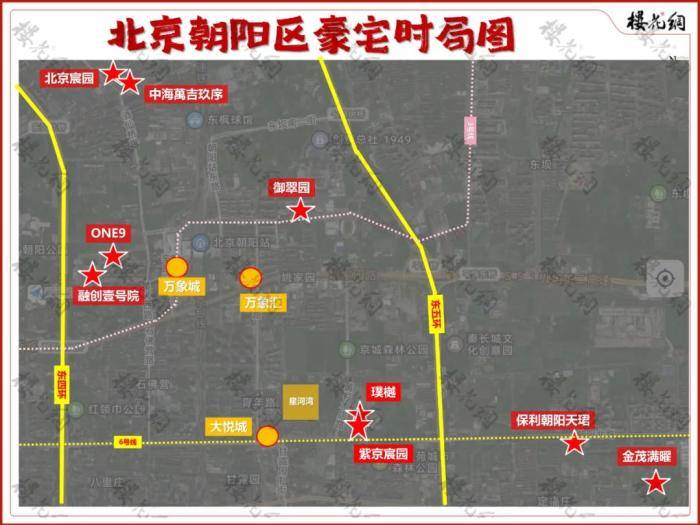
Core Insights - The article discusses the recent public announcement of the design plan for the Zijing Chenyuan project in Beijing's Chaoyang District, highlighting its significance in the competitive real estate market [3][4]. Group 1: Project Overview - The Zijing Chenyuan project is part of a larger land acquisition by a consortium including China State Construction, China Jinmao, and Yuexiu Real Estate, with a total investment of 12.6 billion yuan [3]. - The project covers an area of 5.43 hectares with a total above-ground construction area of 141,400 square meters, featuring 15 buildings ranging from 7 to 25 floors, totaling 815 units [17]. Group 2: Design and Layout - The design plan reveals key features such as a complete entrance, clubhouse, and central landscape system, with a two-entry gate structure [8][10]. - The project includes a north-south oriented street designed in an S-shape, which, while occupying more land, enhances the aesthetic appeal and serves as a fire rescue area [11]. Group 3: Unit Specifications - The average unit size is approximately 172 square meters, with expected prices around 100,000 yuan per square meter [17]. - The unit distribution includes various sizes, with 288 units of 166 square meters and 126 units of 230 square meters, among others [17]. Group 4: Market Context - The article notes that the public disclosure of the design plan for Zijing Chenyuan is part of a trend where real estate projects are increasingly revealing their plans ahead of official announcements, indicating a shift in market dynamics [22]. - The presence of high-voltage power lines near the project site is mentioned as a potential concern, although it is stated that the distance is safe for residents [20].


137只“翻倍基”出炉 公募基金赚钱效应显现
Zhong Guo Zheng Quan Bao· 2025-08-19 22:00
Core Insights - The recent market performance has been strong, with public funds demonstrating significant profit-making ability and excess returns, particularly in themes like Hong Kong securities, innovative pharmaceuticals, and new consumption [1][5] - As of August 18, over 130 funds have achieved returns exceeding 100% in the past year, with notable performances from technology-themed funds focusing on humanoid robots and AI [1][2] Fund Performance - Three North Exchange theme funds have reported returns over 200% in the past year, with specific funds showing returns of 249.27%, 225.42%, and 216.91% respectively [3][4] - A total of 137 funds have achieved returns over 100% in the past year, with many North Exchange theme funds also performing well, including several with returns exceeding 170% [3][4] Active Management and Benchmark Comparison - Actively managed equity funds in the North Exchange have shown significant excess returns compared to their benchmarks, with one fund reporting a return of 190.48% against a benchmark return of 28.64%, resulting in a 161.84 percentage point outperformance [4] Hong Kong Fund Performance - Hong Kong-related funds, particularly in the securities and innovative pharmaceuticals sectors, have also performed well, with one ETF achieving a return of 176% in the past year [5] - Several funds focused on Hong Kong innovative pharmaceuticals have reported impressive returns, with one fund achieving a return of 152.75% year-to-date [5] Technology Fund Performance - Technology-themed funds, particularly those focused on humanoid robots and AI, have also seen significant returns, with one fund reporting a return of 172.28% and another at 174.11% [6] New Consumption and Small Cap Funds - The fund "Guangfa Growth Leading" has achieved a return of 162.55% by capturing new consumption stocks, while some small-cap quantitative funds have also doubled their returns, although risks have been highlighted by several fund companies [7]
现金流暴增681%背后的战略转型 是奥雅股份一场“轻资产革命”的胜利宣言
智通财经网· 2025-08-19 13:51
Core Viewpoint - The financial report of Aoya Co., Ltd. for the first half of 2025 reveals a significant transformation in its business strategy, marked by a substantial increase in cash flow despite a decline in revenue, indicating a shift from traditional EPC contracting to urban value operation [2][7]. Group 1: Financial Performance - Aoya achieved a revenue of 197 million yuan in the first half of 2025, while the net cash flow from operating activities turned from a net outflow of over 90 million yuan in the same period last year to a net inflow of 527.6 million yuan, representing a year-on-year growth of 681.71% [2]. - The company’s strategic shift has resulted in over 500 million yuan in operating cash flow, which is not a one-time occurrence but a result of its ongoing transformation since 2024 [2][3]. Group 2: Strategic Transformation - Aoya is transitioning from a traditional "heavy asset EPC contractor" to a "city value operator" through its "O+EPC+IP+O" model, which integrates design, general contracting, branding, and operations [2][7]. - The company has successfully implemented innovative approaches in government-led projects, achieving high prepayment ratios through "operational pre-positioning + EPC general contracting + IP integration + long-term operation" [3]. Group 3: Core Business Adjustments - The two core businesses of Aoya, landscape design and comprehensive cultural tourism, experienced revenue declines of 41% and 983.3 million yuan respectively, yet maintained strong gross margins, with landscape design achieving a gross margin of 45.87% [3][5]. - Aoya has strategically chosen to abandon low-priced real estate landscaping in favor of urban renewal and public landscape projects, aligning with the industry's value creation logic [3]. Group 4: Alignment with National Policies - Aoya's strategic choices align with national policy directions, particularly the emphasis on urban renewal and improving living quality as outlined by the Ministry of Housing and Urban-Rural Development [4]. - The company has established deep collaborations with leading real estate firms to create benchmark projects that validate the effectiveness of its "design + operation" approach in enhancing real estate value [4]. Group 5: Cultural Tourism and IP Development - In the cultural tourism sector, Aoya's gross margin slightly decreased to 20.96%, yet it demonstrated resilience amid industry fluctuations, leveraging its brands to build a complete industry chain [5]. - The company is accelerating the nationwide replication of light-asset projects and has established JoyKey to focus on independent IP operation and commercialization, marking its evolution from a design service provider to a content operator in cultural tourism [5]. Group 6: Technological Innovation - Aoya is intensifying its investment in strategic emerging fields, particularly in the "AI + IP" dual-engine layout, with its self-developed UrbanFlow model being widely applied across multiple projects [6]. - The collaboration with Web3 technology company Qiyihuo to explore the tokenization of real-world assets (RWA) indicates a commitment to integrating digital assets with physical consumption [6]. Conclusion - Aoya's mid-2025 report reflects a balance of reductions in revenue and increases in cash flow and strategic clarity, positioning the company to thrive in urban renewal, IP operation, and AI innovation, moving towards becoming a creator of valuable urban experiences rather than relying solely on the real estate cycle [7].
中证香港300高贝塔指数报1274.62点,前十大权重包含中国金茂等
Jin Rong Jie· 2025-08-19 09:55
Core Points - The CSI Hong Kong 300 High Beta Index (H300HB) reported a value of 1274.62 points, with a monthly increase of 14.01%, a three-month increase of 35.04%, and a year-to-date increase of 45.66% [1][2] Group 1: Index Performance - The CSI Hong Kong 300 High Beta Index reflects the overall performance of securities listed on the Hong Kong Stock Exchange, with a base date of December 30, 2005, set at 1000.0 points [1] - The index's top ten holdings include Dongfang Zhenxuan (2.71%), InnoCare Pharma (2.34%), Sunac China (1.94%), China Merchants Securities (1.78%), FIT HON TENG (1.67%), China Cinda (1.63%), CICC (1.54%), China Galaxy (1.52%), Ping An Good Doctor (1.47%), and China Jinmao (1.45%) [1] Group 2: Sector Allocation - The sector allocation of the CSI Hong Kong 300 High Beta Index shows that finance accounts for 19.88%, consumer discretionary for 19.82%, information technology for 18.22%, healthcare for 12.38%, real estate for 11.38%, industrials for 6.66%, communication services for 5.86%, consumer staples for 2.93%, and materials for 2.87% [2] - The index sample is adjusted semi-annually, with adjustments occurring on the next trading day after the second Friday of June and December each year [2]
中证香港300内地高贝塔指数报1235.84点,前十大权重包含中国光大控股等
Jin Rong Jie· 2025-08-19 09:33
Core Insights - The China Securities Index Hong Kong 300 Mainland High Beta Index (H300CNHB) has shown significant growth, with a 15.44% increase over the past month, 36.85% over the past three months, and 46.81% year-to-date [1] Group 1: Index Performance - The index is currently reported at 1235.84 points [1] - The index is based on a starting point of 1000.0 points as of December 30, 2005 [1] Group 2: Index Holdings - The top ten weighted stocks in the index include: - Dongfang Zhenxuan (4.65%) - InnoCare Pharma (3.97%) - Sunac China (3.4%) - China Merchants Securities (3.09%) - China Cinda Asset Management (2.83%) - CICC (2.64%) - China Galaxy Securities (2.61%) - China Jinmao (2.51%) - CITIC Securities (2.41%) - China Everbright Holdings (2.37%) [1] Group 3: Sector Allocation - The index is fully composed of stocks listed on the Hong Kong Stock Exchange, with a 100% allocation [1] - Sector allocations within the index are as follows: - Financials: 27.97% - Information Technology: 18.42% - Healthcare: 17.55% - Real Estate: 15.64% - Consumer Discretionary: 11.74% - Communication Services: 5.49% - Industrials: 3.19% [1] Group 4: Index Adjustment Mechanism - The index samples are adjusted biannually, specifically on the next trading day after the second Friday of June and December [2] - Weight factors are generally fixed until the next scheduled adjustment, with special circumstances allowing for temporary adjustments [2]
四代宅冲击下,传统住宅更难卖了,怎么破?
3 6 Ke· 2025-08-19 02:33
Group 1 - The core viewpoint of the article highlights the challenges faced by traditional residential properties due to the emergence of new housing concepts like the "fourth generation" and "fifth generation" homes, which offer significant advantages in terms of usable space and design innovation [1][2][3] - Traditional homes are increasingly viewed as "outdated" as they struggle to compete with the higher efficiency and appeal of newer housing models, leading to a decline in their marketability [1][2] - The calculation of usable area in traditional homes is more stringent, resulting in lower effective space for buyers compared to newer models that utilize innovative design to maximize usable area [1][2][3] Group 2 - The fourth generation homes leverage design innovations such as "space gifting" to enhance usable area, allowing buyers to receive more space for the same price, thus appealing to consumer psychology [2][3] - These new homes not only provide more space but also incorporate ecological design elements, improving living quality and aligning with modern consumer preferences for health and sustainability [6][7] - The market value of fourth generation homes is higher due to their unique features, leading to shorter sales cycles and greater appeal to investors [6][7] Group 3 - Despite their advantages, fourth generation homes face challenges such as inconsistent regulatory standards across cities, which can complicate development and increase costs [7][8] - The construction costs for these homes are significantly higher, potentially limiting access for first-time buyers and increasing the overall price barrier [7][8] - Long-term maintenance costs and functional issues, such as privacy concerns and safety risks, are emerging as significant drawbacks for these new housing models [9][10] Group 4 - Traditional residential properties can still find opportunities by targeting specific market segments, such as budget-conscious buyers, and emphasizing their advantages in price and community stability [11][12] - Innovations in product design and marketing strategies can help traditional homes compete by improving space utilization and enhancing living quality [13][14] - Providing high-quality property management services can also enhance the appeal and value of traditional homes, creating a competitive edge in the market [16][21] Group 5 - The ongoing transformation in the real estate market presents both challenges and opportunities for traditional residential properties, necessitating adaptive strategies to meet diverse consumer needs [22][23] - Companies must remain agile and responsive to market changes to thrive in a competitive environment, emphasizing product innovation and customer service [22][23]
2只涨超200% 百余只基金近一年业绩翻倍!公募基金赚钱效应显现
Zhong Guo Zheng Quan Bao· 2025-08-19 01:16
Group 1 - The market is currently performing well, with public funds showing significant profit effects and the ability to achieve excess returns, particularly in the past year [1][2] - Two North Exchange theme funds have achieved returns exceeding 200% in the past year, significantly outperforming their performance benchmarks [2][3] - Over a hundred funds have recorded returns of over 100% in the past year, with a concentration in Hong Kong securities, innovative pharmaceuticals, and technology themes such as humanoid robots and AI [1][2] Group 2 - Actively managed equity funds in the North Exchange have shown significant excess returns compared to their performance benchmarks, with one fund achieving a return of 190.48%, surpassing its benchmark by 161.84 percentage points [3] - The Hong Kong fund sector, particularly in securities and innovative pharmaceuticals, has also seen strong performance, with one ETF tracking Hong Kong securities rising by 173.82% in the past year [3][4] - Several technology-themed funds have also performed well, with one fund focused on humanoid robots rising by 168.68% and another focused on AI rising by 166.36% in the past year [5]
10强房企“谁进谁退”?
3 6 Ke· 2025-08-18 06:13
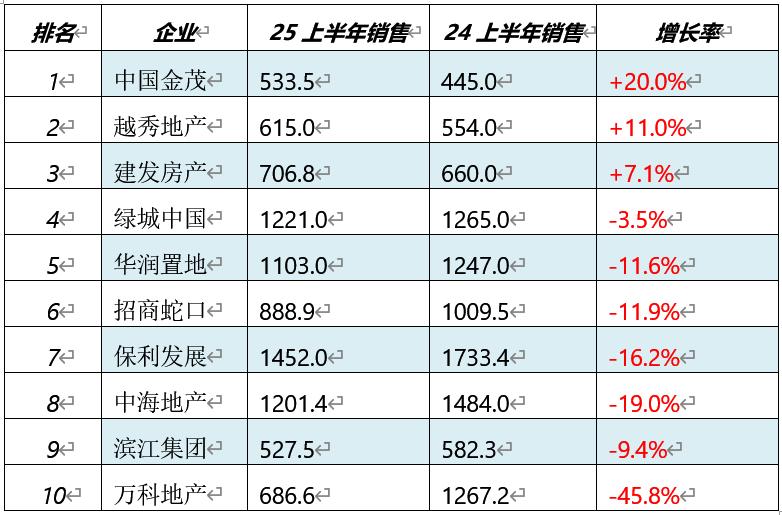
Core Viewpoint - The real estate industry in China is experiencing a significant shift, with the top 10 large enterprises becoming the "stabilizers" of the market as mid-sized companies face collapse. The future may see a consolidation into 5 to 7 dominant players [1][2]. Group 1: Sales Performance - The top 10 real estate companies are undergoing a "dual differentiation" in sales performance, with the leading firms experiencing a decline while the mid-tier companies are showing growth. For instance, only 3 out of the top 10 achieved positive growth, with China Jinmao at 19%, Yuexiu at 11%, and Jianfa at 7% [3][4]. - The head companies are collectively facing negative growth, with Vanke reporting a decline of 46%, and other major players like China Overseas, Poly, and China Merchants also showing significant drops [4][5]. - The average sales growth rate for the top 100 companies has decreased by 11.8%, indicating that even leading firms are not immune to the downturn [5]. Group 2: Land Acquisition Trends - The year 2025 is characterized as a "land acquisition year" for the top 10 companies, driven by improved sales and better land offerings from local governments compared to 2024 [6][7]. - There is a clear distinction between aggressive "Tiger" companies, which are acquiring land at a rapid pace (e.g., Poly's land acquisition increased by 276% to 414 billion, China Overseas by 228% to 393 billion), and the more cautious "Wolf" companies, which are growing at a slower rate [10][12]. - The "Tiger" companies are defined by high acquisition volumes (over 400 billion) and significant growth rates (100% to 300%), while the "Wolf" companies are characterized by lower volumes (below 300 billion) and growth rates under 40% [9][12]. Group 3: Company Classification - The top 10 companies can be categorized into three main groups based on their sales and land acquisition strategies: aggressive, cautious, and balanced [17][34]. - The aggressive group includes companies like Jinmao, China Merchants, China Overseas, and Poly, which exhibit high land acquisition and low sales [23][26]. - The cautious group, represented by companies like Vanke, is focused on maintaining sales while limiting land acquisition, with Vanke experiencing a 45.8% drop in sales and a 95% decrease in land acquisition [27][29]. - The balanced group includes companies like China Resources, Greentown, and Jianfa, which maintain a moderate approach to both sales and land acquisition [34][36]. Group 4: Market Concentration - The concentration of the top 10 companies is increasing, with their land acquisition intensity averaging 0.4, significantly higher than the 0.26 average of the top 100 companies [41][42]. - The top 10 companies now account for 73% of the new value added in the market, indicating a shift towards larger, financially robust firms [41][42]. - The ongoing market downturn is likely to further consolidate the industry, with smaller firms facing increasing challenges to survive due to insufficient land acquisition [42].



融合新路径 “影响力指数 2025博鳌风尚表现”授牌盛典成功举办!
Guan Cha Zhe Wang· 2025-08-18 03:53
Core Insights - The "Influence Index 2025 Boao Style Performance" event recognizes exemplary forces in various industries on the path to high-quality development [1] - The past year has seen significant trends in cross-industry integration, reshaping industrial structures and social life through resource sharing and complementary advantages [1] - Companies are actively exploring integration paths and embracing cross-border cooperation to innovate and create competitive new models and products [1] Industry Trends - The trend of cross-industry collaboration is breaking traditional barriers, leading to substantial potential through shared resources and innovative business models [1] - The development of diverse business formats is driven by innovation, expanding market boundaries to meet increasingly diverse consumer demands [1] - The vigorous growth of multi-faceted business formats not only provides new growth points for companies but also reshapes industry ecosystems towards higher quality and sustainability [1] Event Highlights - The "Influence Index 2025 Boao Style Performance" ceremony, hosted by the Viewpoint Agency, gathered industry elites to witness the limitless possibilities of integrated development [1] - Various awards were presented, including categories for influential commercial properties, logistics projects, and sustainable business initiatives [6][7][9][12][29]




地产及物管行业周报:北京新政效果显著,多省份部署止跌回稳-20250817
Shenwan Hongyuan Securities· 2025-08-17 13:44
Investment Rating - The report maintains a "Positive" rating for the real estate and property management sectors [2][3]. Core Insights - The report indicates that the broad housing demand in China has likely bottomed out, although the volume and price have not yet entered a positive cycle. It anticipates that the overall real estate market will continue to stabilize, with further policies expected to be introduced to support this trend. Core cities are expected to lead the recovery as they approach the bottom of the market [3][34]. - The report highlights significant policy changes, including the implementation of new regulations in Beijing that have led to a 20% increase in new home visits in areas outside the Fifth Ring Road. Additionally, various provinces are focusing on stabilizing the housing market and urban renewal tasks [3][34]. Industry Data Summary New Home Transaction Volume - In the week of August 9-15, 2025, new home transactions in 34 cities totaled 1.613 million square meters, a decrease of 9% week-on-week. The transaction volume for first and second-tier cities fell by 7.9%, while third and fourth-tier cities saw a decline of 23.5% [3][4]. - Year-on-year, new home transactions in August (up to August 15) decreased by 19.1%, with first and second-tier cities down by 17.6% and third and fourth-tier cities down by 35.5% [3][7]. Second-Hand Home Transaction Volume - In the week of August 9-15, 2025, second-hand home transactions in 13 cities totaled 999,000 square meters, a decrease of 3.6% week-on-week. Cumulatively, transactions in August were down 3% year-on-year [3][13]. Inventory and Supply - In the week of August 9-15, 2025, 76,000 square meters of new homes were launched in 15 cities, with a transaction volume of 65,000 square meters, resulting in a transaction-to-launch ratio of 0.86. The total available residential area in these cities was 89.15 million square meters, reflecting a slight increase of 0.1% [3][24]. Policy and News Tracking - The report notes that the National Bureau of Statistics reported a 12% year-on-year decline in real estate development investment for the first seven months of 2025, totaling 535.8 billion yuan. Various provinces are implementing measures to stabilize the housing market and promote urban renewal [3][34]. - Specific policies include a reduction in the down payment ratio for housing loans in Suzhou to 15% and the introduction of new measures to support the conversion of commercial properties to residential use in Shanghai [3][34]. Company Dynamics - Several real estate companies reported their sales figures for the first seven months of 2025, with China Resources Land at 123.6 billion yuan (-11.8%) and China Jinmao at 61.8 billion yuan (+23.0%). Dragon Lake Group forecasted a 70% decline in core earnings [3][34]. - Financing activities included the issuance of bonds by various companies, such as a 1.5 billion yuan medium-term note by Dayuecheng Holdings and a total of 1.4 billion yuan in bonds by Yuexiu Property [3][34].