荣耀

Search documents
全球折叠屏出货新高:三星独大,华为增长10%,vivo增长67%
Guan Cha Zhe Wang· 2025-12-03 05:56
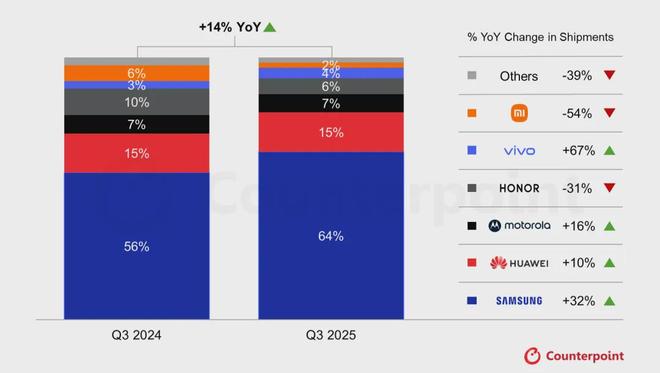
Core Insights - The global foldable smartphone market is projected to see a 14% year-on-year increase in shipments by Q3 2025, reaching a historical high for the category [1] - Samsung leads the market with a 64% share in Q3, showing a 32% increase compared to the same period last year [1] - Huawei holds the second position with a 15% market share, growing by 10% year-on-year [1] - Motorola ranks third with a 7% share, experiencing a 16% increase [1] - Vivo and Xiaomi follow in fourth and fifth places, with Vivo showing a significant growth of 67%, while Xiaomi's shipments declined by 54% year-on-year [1] Market Trends - Foldable smartphones now account for 2.5% of global smartphone shipments, driven by the popularity of book-style models and the launch of Samsung's Galaxy Z Fold7 and Huawei's Mate series [3] - The Galaxy Z series, particularly the Z Fold7, has enhanced its appeal in the high-end market due to its thinner design, lighter weight, and improved durability [3] - Motorola's competitive pricing and strong channel partnerships have effectively expanded its user base in the foldable segment [3] Future Projections - The foldable smartphone market is expected to close 2025 with a stable growth rate of around 16% year-on-year [4] - By 2026, the market is anticipated to enter a significant expansion phase, driven by improvements in durability, thinner designs, and enhanced AI-driven software experiences [4] - Apple is expected to enter the foldable market in the second half of 2026, potentially reshaping the competitive landscape [4][5] Technological Developments - Major smartphone brands are intensifying their focus on technological leadership and product differentiation, with foldable designs evolving beyond traditional book-style formats [5] - Samsung's new triple-foldable model is positioned as a pilot product to validate durability and software optimization before larger-scale commercialization [5] - The entry of Apple into the foldable market is anticipated to bring substantial changes to the competitive dynamics [5]



机构报告:Q3全球折叠屏手机出货量同比增长14%
Feng Huang Wang· 2025-12-03 05:14
Core Insights - The global foldable smartphone market is expected to see significant growth, with a projected 14% year-on-year increase in shipments by Q3 2025, reaching a historical quarterly high for this category [1] - The share of foldable smartphones in global smartphone shipments has risen to 2.5%, driven by technological maturity and increased penetration in the high-end market [1] Market Performance - The strong performance in the current quarter is attributed to product iterations from leading manufacturers, particularly Samsung's Galaxy Z7 series, which has improved in weight, thickness, and hinge durability [1] - Huawei's Mate series continues to show stable growth, while Motorola's Razr 60 series has gained market share through differentiated pricing strategies and channel expansion [1] - Other domestic brands have shown varied performance, with vivo's shipments increasing by 67%, while Xiaomi and Honor experienced declines of 54% and 31%, respectively [1] Future Outlook - The industry forecasts a year-on-year growth of approximately 16% in foldable smartphone shipments for the entire year of 2025 [1] - 2026 is anticipated to be a critical year for the foldable market, with expectations that Apple will enter the market with a foldable product, potentially initiating a new high-end replacement cycle due to its large user base [1] Competitive Landscape - Existing manufacturers are accelerating the exploration of multi-folding forms in response to potential competitive changes [2] - Samsung's recent launch of the Galaxy Z TriFold is positioned as a strategic pilot product, aimed at validating the durability and software adaptation of multi-folding architecture before full commercial deployment [2]
昔日“手机单反”陷品控争议:努比亚能靠“豆包AI”翻盘吗?
凤凰网财经· 2025-12-03 04:55
Core Viewpoint - The collaboration between ByteDance and ZTE to launch an AI smartphone has generated significant market interest, leading to a strong initial performance in the consumer electronics sector, but subsequent stock price corrections highlight ongoing challenges for ZTE and its Nubia brand [1][2]. Group 1: Market Reaction and Product Launch - On December 1, the AI smartphone concept sparked a surge in the consumer electronics sector, with ZTE's stock hitting the daily limit and trading volume exceeding 13.1 billion yuan [1]. - Following the initial excitement, ZTE's AH shares experienced a pullback, with H shares dropping over 6% [2]. - The Nubia M153, priced at 3,499 yuan, was launched with limited availability and quickly sold out, indicating strong initial demand [2]. Group 2: Industry Insights and Competitive Landscape - An industry insider noted that large model assistants may become standard in smartphones, but the competitive landscape will not provide unique advantages as various brands adopt different models [6]. - The integration of AI does not inherently resolve existing issues in smartphone performance, such as camera quality and battery life, which consumers should approach with realistic expectations [6]. Group 3: Nubia's Brand Challenges - Nubia, established in 2012, aimed to penetrate the high-end market but has struggled to maintain a significant market share, often hovering around 1% [7][8]. - Recent product launches have faced criticism for quality control and marketing issues, with the Nubia Z80 Ultra experiencing a problematic launch event [9][10]. - Nubia's high-end aspirations are hindered by a lack of differentiation and a narrow user base, making it difficult to compete against brands that dominate the mid-range market [15]. Group 4: Consumer Feedback and Quality Control Issues - User complaints highlight significant quality control issues, including camera focus problems and software bugs, leading to dissatisfaction with Nubia products [20][21]. - The Nubia Z80 Ultra has not resolved previous issues, with users reporting touch screen failures and overall poor performance [21][34]. - The brand's reputation is further damaged by negative feedback regarding customer service and warranty claims, with many users expressing frustration over unaddressed product defects [34].


【掘金行业龙头】电子皮肤+消费电子,公司材料业务拓展至触觉传感器,人形机器人上已有压阻式全掌触觉产品
财联社· 2025-12-03 04:42
电子皮肤+消费电子,材料业务拓展至触觉传感器,人形机器人上已有压阻式全掌触觉产品,与硅谷灵巧 手企业达成战略合作,折叠OCA产品已稳定量产,这家公司终端客户包括华为、oppo、荣耀等。 前言 《电报解读》是一款主打时效性和专业性的即时资讯解读产品。侧重于挖掘重要事件的投资价值、分析 产业链公司以及解读重磅政策的要点。即时为用户提供快讯信息对市场影响的投资参考,将信息的价值 用专业。 ...

锚定“人工智能+”,荣耀Magic8系列以自进化AI破局终端新赛道
Huan Qiu Wang Zi Xun· 2025-12-03 04:37
Core Insights - The article highlights the launch of the Honor Magic8 series as the first "self-evolving AI native smartphone," marking a significant innovation in the consumer electronics industry [1][2] - Honor's approach integrates user co-creation, an open ecosystem, and hardware AI empowerment, aligning with China's "Artificial Intelligence +" initiative, which aims for over 70% application penetration of new intelligent terminals by 2027 [1][2] Industry Overview - By 2025, the AI smartphone market in China is projected to reach 118 million units, reflecting a year-on-year growth of 59.8%, with a market share of 40.7% [2] - The shift from "parameter competition" to "experience revolution" is driving leading manufacturers to innovate continuously in the smart terminal sector [2] Product Innovation - The Honor Magic8 series is positioned as an "8848 peak flagship," introducing a self-evolving concept that reshapes user perceptions of smart devices and offers new insights for the global AI terminal industry [2][3] - The series features the MagicOS 10 self-evolving AI intelligent operating system, with the AI agent YOYO capable of evolving through user interactions, expanding its supported scenarios from over 200 to 3,000 in just three months [3][4] AI Capabilities - YOYO demonstrates impressive scene understanding, enabling seamless user interactions such as automatic Wi-Fi connections and real-time price comparisons during shopping events [4][5] - Honor has invested in a dedicated AI R&D team of 2,600 members and collaborated with Qualcomm to enhance AI deployment efficiency, addressing industry pain points like high latency and privacy risks associated with cloud AI [5][6] Hardware Integration - The self-evolving capabilities of the Magic8 series are built on a "growth-capable" hardware foundation, achieving breakthroughs in imaging, performance, battery life, communication, and security [6][7] - The Magic8 Pro features a 200MP ultra-night telephoto camera and an upgraded AiMAGE imaging system, enhancing the hardware's capabilities with advanced AI algorithms for superior photography [6][7] Performance Enhancements - The entire Magic8 series is powered by the fifth-generation Snapdragon 8 processor, significantly improving CPU, GPU, and AI computing power compared to previous generations [7] - The series includes a 7000mAh battery with dual fast charging capabilities, addressing user concerns about battery life while optimizing power consumption through AI management [7][8] Security Features - The Magic8 Pro incorporates dual 3D security unlocking and advanced AI fraud detection capabilities, ensuring user privacy and financial security [8][9] Ecosystem Development - Honor aims to redefine lifestyles in the AI era through the "Honor Alpha Strategy," which includes a five-year plan to invest $10 billion in building a leading AI terminal ecosystem [9][10] - The strategy focuses on breaking down barriers between different operating systems and devices, enabling seamless interaction across various platforms, including HarmonyOS and iOS [10][11] Conclusion - The Honor Magic8 series exemplifies the "Artificial Intelligence +" initiative in the consumer electronics sector, creating a virtuous cycle of technology development, user co-creation, and open ecosystems [11]
华为、京东、优必选等先后入局,AI玩具成AI硬件新蓝海?
Guo Ji Jin Rong Bao· 2025-12-03 04:09
Core Insights - The AI toy market is rapidly growing, with sales expected to increase sixfold in the first half of 2025 and a year-on-year growth rate exceeding 200% [1] - Major tech companies, including Huawei and JD.com, are entering the AI toy sector, launching products that aim to provide emotional companionship [3][4] - Despite the influx of products and investment, the market has yet to see a breakout hit, facing challenges such as product homogeneity and privacy concerns [2][7] Market Dynamics - The AI toy market is projected to exceed 100 billion yuan in China and reach a global market size of over 100 billion USD by 2030, with a compound annual growth rate (CAGR) of over 50% globally and over 70% domestically [5] - The profitability of AI toys varies significantly, with basic models priced at 300-400 yuan having a gross margin of 50%-65%, while high-end products can achieve margins of up to 90% [5] Product Development - New AI toys, such as "萌UU" and "智能憨憨," exhibit similar core logic in personality development, indicating a trend of product homogeneity [7] - User experiences reveal that while AI toys can provide companionship, they often fall short in emotional interaction and understanding [7][8] Investment Trends - The AI toy sector has seen over 30 financing events in 2024, attracting nearly 100 investment institutions, indicating strong capital interest [4] - Companies like JD.com and Honor are actively exploring collaborations to enhance their AI toy offerings, reflecting a competitive landscape [4] Technological Advancements - The rise of AI toys is supported by advancements in AI algorithms and hardware, enabling more personalized and emotionally aware interactions [6] - The integration of AI chips and multi-modal sensors is crucial for the development of effective emotional companionship products [6] Challenges and Opportunities - The industry faces significant challenges related to data privacy and ethical considerations, as AI toys require continuous data collection to function effectively [8] - There is potential for AI toys to evolve beyond hardware sales into subscription models, providing ongoing content and interaction services to enhance user engagement [9]

苹果iPad中国市场份额大跌14%
Xin Lang Cai Jing· 2025-12-03 03:20
Core Insights - The tablet market in mainland China continues to show strong momentum, with a year-on-year shipment increase of 9% to 8.8 million units in Q3 2025, but significant changes in brand dynamics are observed [2][3] Market Performance - Apple's iPad shipments fell sharply by 14% year-on-year to 2 million units, with its market share decreasing from 29% to 23% [2][3] - Huawei maintained its leading position with 2.7 million units shipped, capturing 31% of the market, a 21% increase year-on-year, widening its lead over Apple by 8 percentage points [2][3] - Lenovo topped the quarterly growth rate with a 71% year-on-year increase, matching Xiaomi's shipment of 900,000 units and raising its market share from 6% to 10% [2][3] Competitive Landscape - Domestic brands collectively hold 77% of the market share, up 5 percentage points from the previous year, indicating a clear divide where local brands are thriving while Apple is declining [2][3] - The decline in iPad sales is attributed to increased competition from domestic tablets in the 2000-3000 yuan price range, which offer superior specifications compared to the basic iPad model [3][4] Strategic Insights - Lenovo's growth strategy focuses on "niche scenarios and price penetration," targeting the education market with learning tablets and offering competitive pricing for its products [4] - Continuous discounting and direct subsidies from manufacturers have kept tablets highly attractive to Chinese consumers, with brands like Huawei, Xiaomi, and Lenovo diversifying their product offerings [4] Future Outlook - Omdia forecasts a 12% growth in the tablet market by the end of 2025, reaching 35 million units, driven by aggressive product launches and pricing strategies from domestic manufacturers [4] - However, a market adjustment is expected in 2026, with a projected 9% decline in shipments to 32 million units [4]

安凯微:拟3.26亿元收购物联网芯片公司思澈科技85.79%股权
Ju Chao Zi Xun· 2025-12-03 02:18
Core Viewpoint - Ankai Micro plans to acquire 85.79% equity of Siche Technology for a total consideration of approximately RMB 325.99 million, aiming to enhance its capabilities in low-power IoT chip design and expand its product offerings in various applications [5][6]. Group 1: Acquisition Details - The acquisition involves Siche Technology, a company specializing in innovative high-performance, ultra-low-power IoT chip design, with a registered capital of USD 339,215.03 [5]. - Siche Technology's products are utilized by well-known brands such as Xiaomi, Honor, Keep, OnePlus, Pebble, and Xiaoxun [5]. - The acquisition is expected to strengthen Ankai Micro's product series in IoT application processors and enhance its market presence in smart wearables, health devices, smart homes, and industrial instruments [6]. Group 2: Financial Performance - Siche Technology reported revenue of RMB 62.04 million and a net loss of RMB 48.64 million for 2024, with revenue of RMB 43.82 million and a loss of RMB 18.51 million for the first seven months of 2025 [6]. - As of September 30, 2025, Ankai Micro's total assets were RMB 1.58 billion, with net assets of RMB 1.35 billion and a debt-to-asset ratio of 14.61% [7]. Group 3: Strategic Synergies - The acquisition is expected to create synergies in product, technology, market, and supply chain aspects, enhancing overall technical strength and product competitiveness [6]. - Ankai Micro plans to leverage Siche Technology's core technologies in ultra-low power, Bluetooth communication, and power management to improve its existing capabilities [6]. Group 4: Financial Strategy - Ankai Micro intends to finance the acquisition through a combination of self-owned funds and bank loans, applying for medium to long-term loans to mitigate cash flow pressure [7].

Omdia:2025年第三季度联想平板出货量暴增超70% PC市占率再扩大
Zhi Tong Cai Jing· 2025-12-03 01:43
Core Insights - The Chinese PC market is experiencing a slowdown in growth, with a year-on-year increase of only 2% in Q3 2025, primarily due to reduced consumer subsidies [1][3] - Lenovo demonstrates strong resilience in this challenging market, achieving a significant year-on-year growth of 14% in shipment volume, reaching 4.4 million units and capturing 39% market share [3] - In contrast, major competitors like Huawei and Softcom Power are facing declines in shipment volumes, with Huawei's shipments down 7% and Softcom Power's down 13% [3] PC Market Performance - Total PC shipments in China reached 11.3 million units in Q3 2025, reflecting a 2% increase from the previous year [2][3] - Lenovo leads the market with 4.4 million units shipped, while Huawei and Softcom Power both shipped 1 million units [2][3] - Other competitors like Asus and HP show stagnant or minimal growth, with Asus maintaining 90,000 units and HP achieving a 2% increase but still around 100,000 units [3] Tablet Market Growth - The tablet market in China continues to thrive, with a year-on-year growth of 9%, reaching 8.8 million units in Q3 2025 [4] - Lenovo's tablet shipments surged by 71% to 900,000 units, increasing its market share to 10% [4][5] - In contrast, Apple experienced a 14% decline in tablet shipments, highlighting Lenovo's competitive edge in this segment [5] AI Integration and Future Outlook - The adoption of AI technology is accelerating in both consumer and commercial markets in China, with Lenovo integrating AI capabilities into its PC and tablet products [6] - Omdia forecasts that by 2025, 32% of PCs in the Greater China region will have AI capabilities, increasing to 46% by 2026 [6] - Despite anticipated declines in the PC and tablet markets in 2026, Lenovo's strong presence in the commercial sector and ongoing AI enhancements position it well to maintain its leadership [7]


吉利系 AI 终端进展曝光:首月速成 200 人团队,挖遍华为小米荣耀
Xin Lang Cai Jing· 2025-12-03 01:25
Group 1 - ByteDance and ZTE have launched an AI phone priced at 3499 yuan, featuring ByteDance's self-developed large model Agent service [1][21] - The phone integrates the Doubao mobile assistant technology, developed in collaboration with phone manufacturers at the operating system level [1][21] - ByteDance's primary focus is not on the AI phone itself but on the underlying AIOS software ecosystem [1][21] Group 2 - A new company named Zhiyue Qianli, established in August 2023, is gaining attention for its focus on AIOS [2][8] - Zhiyue Qianli is closely related to the Geely group, with key figures like Guo Jianguo involved in its establishment and management [3][22] - The company aims to reshape human-computer interaction and build an ecosystem for the AI terminal era [26][30] Group 3 - Zhiyue Qianli plans to develop both AI models and hardware products, including phones and XR glasses, distinguishing its strategy from ByteDance's [9][25] - The company has rapidly grown to nearly 200 employees within its first month, attracting talent from major tech firms like Huawei and Xiaomi [14][30] - The focus on AI terminals is expanding beyond traditional devices, potentially integrating into smart vehicles as central systems for human-machine collaboration [20][35] Group 4 - The concept of AI terminals is evolving, encompassing not just hardware but also software and new interaction models, breaking existing product definitions and competition logic [16][32] - Consumer-grade AI terminals are forming intelligent closed loops, with AI phones, PCs, and tablets becoming key entry points for connecting model capabilities with daily life [17][33] - The integration of AI terminals with smart cockpit technology is becoming a consensus in the automotive industry, aligning with strategies from major players like Huawei and Xiaomi [20][36]