
建行

Search documents
【年终盘点】港股IPO热下的退市潮:退市量大增,一半被“净化”!
Sou Hu Cai Jing· 2025-12-30 08:33
Group 1 - The core viewpoint of the article highlights the contrasting dynamics in the Hong Kong stock market in 2025, characterized by a significant rise in the Hang Seng Index by nearly 30% and a record IPO fundraising amount of approximately 278.7 billion HKD, while simultaneously experiencing a notable wave of delistings [2][3]. - A total of 62 companies were delisted from the Hong Kong Stock Exchange in 2025, marking a 26.5% increase from the previous year, where 49 companies were delisted [3]. - The delisting process in Hong Kong primarily follows two paths: voluntary privatization and forced delisting, with the latter often resulting from severe issues such as financial misconduct or prolonged trading suspensions [5]. Group 2 - The Hong Kong Stock Exchange has intensified its regulatory measures to enhance market quality, leading to 31 companies being forcibly delisted in 2025, which constitutes half of the total delistings [5]. - Notable companies among those forcibly delisted include China Evergrande, which faced severe financial difficulties and regulatory penalties, and Hong Jiu Fruit, which encountered multiple operational issues [7]. - The market is witnessing a liquidity divide, with approximately 80% of funds concentrated in 20% of high-quality stocks, resulting in low liquidity for many small-cap companies, prompting them to consider privatization [8]. Group 3 - The increase in delistings in 2025 reflects a self-purification process in the Hong Kong capital market, driven by liquidity disparities and a focus on high-growth sectors like AI and advanced manufacturing [9]. - Southbound capital inflows into Hong Kong stocks exceeded 1.4 trillion HKD in 2025, indicating a strong preference for large enterprises, which exacerbates challenges for smaller companies [9]. - As of November 28, 2025, there were 84 companies on the Hong Kong Stock Exchange that had been suspended for over three months, with 10 already approved for delisting [11]. Group 4 - Many companies on the "danger list" are struggling to meet financial reporting requirements, leading to potential delistings, particularly in the real estate sector, which has been significantly affected [13]. - The Hong Kong Stock Exchange's strict enforcement of delisting rules aims to maintain market health and long-term credibility, facilitating a "market cleansing" process that could attract more long-term value investors [13].


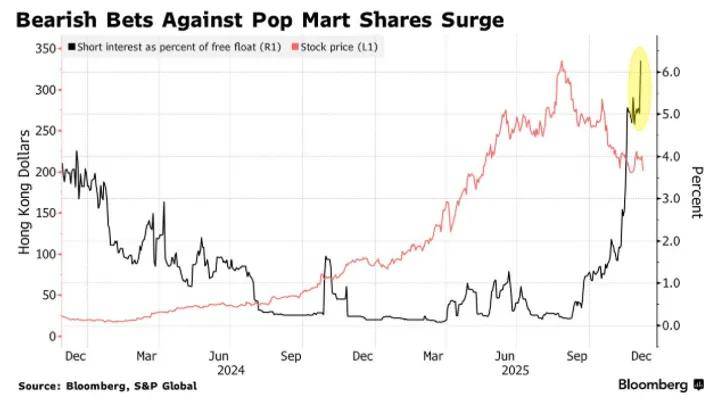
泡泡玛特大跌!做空新消费的人越来越多
Sou Hu Cai Jing· 2025-12-09 03:44
Core Viewpoint - The recent surge in short-selling funds against Pop Mart has led to a significant decline in its stock price, with the short-selling activity reaching a one-year high since September [1][4]. Group 1: Short-Selling Activity - The cumulative funds for short-selling Pop Mart have reached a new high over the past year, contributing to the continuous decline in its stock price [1]. - An increasing number of foreign institutions have published bearish views on Pop Mart, echoing concerns similar to those seen during the AI bubble, indicating a lack of immediate evidence to confirm or refute these views [4]. Group 2: Market Sentiment and Performance - The stock price of Pop Mart is expected to remain stagnant in the short term due to the absence of strong data supporting either bullish or bearish positions, leading to a stalemate [4]. - Concerns have been raised regarding the sustainability of high growth driven by the Labubu product, with fears of a high base effect impacting future performance [6][10]. Group 3: Future Outlook - The ideal time for bottom-fishing in Pop Mart would be when the premium expectations for Labubu diminish and market hopes for new hit products are low [5]. - Pop Mart is currently positioned between the expansion and peak phases of its product cycle, with market fears that it may soon transition into a downturn phase if new hit products are not developed [8][10].

构建生物多样性金融 多维度支撑体系
Jin Rong Shi Bao· 2025-10-28 00:36
Core Insights - The report titled "Natural and Biodiversity Finance: Theory and Practice" was released at the 2025 Bund Annual Conference, outlining China's achievements in financial support for biodiversity, establishing a multi-dimensional support system for global biodiversity governance [1] Group 1: Standard System Improvement - Biodiversity finance has been integrated into the sustainable finance framework, with the 2025 revised "Green Finance Support Project Directory" establishing a separate category for "Ecological Protection, Restoration, and Utilization," which supports activities related to nature and biodiversity [2] - Approximately 20% to 30% of green finance business is directed towards biodiversity-related activities, with the scale continuing to expand [2] - The People's Bank of China is developing specific biodiversity finance standards, resulting in a draft "Biodiversity Finance Directory" that includes 87 items across four categories, adding 24 new items compared to the previous directory [2] Group 2: Financial Product Innovation - Financial institutions in China are launching diverse products to attract social capital for biodiversity protection, integrating biodiversity into the green finance policy framework [3] - Innovative financial products include GEP pledge loans, wetland carbon credit loans, and biodiversity performance-linked loans, with breakthroughs in bond issuance for biodiversity-themed green bonds [3] - The ecological compensation mechanism is being advanced, with projects like the Yuanbao Maple project in Guizhou generating over 2000 yuan per mu in annual income, providing a replicable model for ecological project profitability [3] Group 3: Information Disclosure and Risk Assessment - Financial institutions and local governments are exploring assessment methods for nature-related financial risks, embedding biodiversity sensitivity into the entire credit process [4] - The 2025 "Sustainable Development Report Preparation Guidelines" released by the Shanghai and Shenzhen stock exchanges reference the international TNFD framework, laying the groundwork for nature-related information disclosure [4] - 33 companies, including Mengniu and CATL, have joined the TNFD pilot, gradually aligning with international standards [4] Group 4: International Cooperation - China's role in global biodiversity finance governance is evolving from a "participant" to a "co-builder," having chaired the COP15 and facilitated the "Kunming-Montreal Global Biodiversity Framework" [5] - The establishment of the Kunming Biodiversity Fund has projects covering 15 developing countries across six continents [5] - The People's Bank of China is promoting the inclusion of natural and biodiversity issues in G20 sustainable finance discussions, with bilateral cooperation deepening with countries like the UK, EU, and Singapore [6]
银行推动消费贷款财政贴息政策落地见效
Jin Rong Shi Bao· 2025-10-10 02:06
Core Insights - The consumption market in China experienced significant activity during the 8-day National Day and Mid-Autumn Festival holiday, driven by collaborative efforts from local governments and financial institutions to implement various promotional measures [1] - Personal consumption loan interest subsidy policies have been rapidly rolled out since September, with banks facilitating easier access to loans during the holiday period [1] - Financial support and favorable policies have injected vitality into domestic consumption, particularly during the holiday season, enhancing overall consumer activity for the second half of the year [1] Group 1 - Multiple banks have optimized their mobile banking apps to make the consumption loan interest subsidy more accessible, with features like direct search options and simplified application processes [2] - Banks are diversifying their consumer loan products to cater to various consumer needs, including specific offerings for different customer segments such as housing loans and retirement plans [2] Group 2 - Postal Savings Bank of China is exploring diverse channels to attract consumers, focusing on key areas supported by interest subsidy policies, such as automotive, education, and healthcare [3] - Several banks are enhancing their services in county areas, establishing financial service stations in key commercial zones to promote consumption through a combination of policies, finance, and consumer scenarios [3]

光大新鸿基每日策略-20250929
光大新鸿基· 2025-09-29 07:04
Market Overview - The Hang Seng Index closed at 26,128.20, down 1.35% for the day and up 30.25% year-to-date[5] - The Tech Index fell by 2.89%, with a year-to-date increase of 38.65%[5] - Total market turnover was HKD 323.67 billion, an increase of 2.8% from the previous day[7] Sector Performance - The Financial Index rose by 0.24%, with a year-to-date increase of 14.21%[5] - The Property Index increased by 0.39%, with a year-to-date rise of 8.70%[5] - The Industrial Index decreased by 2.24%, with a year-to-date increase of 12.96%[5] Key Company Updates - JD Health announced a leadership change, with a new CEO appointed effective September 29[7] - Lai Kai Pharmaceutical reported positive initial results from its obesity treatment study in China[7] Economic Indicators - U.S. inflation data met expectations, reducing concerns about delayed interest rate cuts by the Federal Reserve[7] - The U.S. Dow Jones Index rose by 0.65%, closing at 46,247 points[7] Commodity Prices - New York crude oil increased by 1.14%, closing at USD 65.72 per barrel[7] - Brent crude oil rose by 1.02%, closing at USD 70.13 per barrel[5]
国债下乡助振兴
Jin Rong Shi Bao· 2025-09-16 02:10
Core Insights - The People's Bank of China in Luliang is actively promoting the sale of government bonds in rural areas to enhance financial accessibility and support rural revitalization efforts [1][2][3] Group 1: Sales Performance - In the first half of the year, Luliang City sold a total of 388 million yuan in savings bonds, representing a year-on-year increase of 14.63% [1] - Sales in towns and below reached 175 million yuan, showing a significant year-on-year growth of 39.25%, with rural sales accounting for 42.53% of total sales, an increase of 5.44 percentage points compared to the previous year [1] Group 2: Management and Training Initiatives - The People's Bank of China in Luliang has implemented a comprehensive management strategy for government bonds, including participation in video conferences for bond issuance and on-site inspections of local institutions [1][2] - Specialized training for underwriting institution staff has been conducted to improve the operational standards and efficiency of bond sales in rural areas [2] Group 3: Community Engagement and Promotion - Various banks, including Agricultural Bank and Industrial and Commercial Bank, have initiated community-based programs to educate rural residents about government bonds, including setting up dedicated service points and conducting financial literacy classes [3] - Innovative promotional activities, such as using local dialect videos and face-to-face consultations, have been employed to enhance awareness and participation in government bond investments among rural residents [3]
港股收评:三大指数齐跌,半导体、基建、苹果概念跌幅明显,内银股逆势普涨
Ge Long Hui· 2025-09-02 08:29
Market Performance - The Hong Kong stock market indices collectively declined, failing to maintain the previous day's strong upward trend [1] - The Hang Seng Technology Index experienced a notable drop of 1.22%, while the Hang Seng Index and the National Enterprises Index also fell [1] Sector Performance - Major technology stocks generally declined, with Meituan and Alibaba both dropping nearly 2%, and Baidu and JD.com down by 1.5% [1] - Semiconductor and Apple-related stocks faced significant losses, with Hong Teng Precision plummeting nearly 10%, and both Qiu Tai Technology and Lens Technology falling over 6% [1] - Infrastructure-related stocks, including high-speed rail, building materials, and steel sectors, also saw declines, alongside cryptocurrency, domestic real estate, sports goods, and Chinese brokerage stocks [1] Positive Trends - The banking sector showed a marked improvement in performance during the first half of the year, attracting insurance capital inflows, leading to a collective rise in domestic bank stocks, with Agricultural Bank up nearly 3% and other major banks rising over 1% [1] - The automotive sector saw most stocks rise following the release of August delivery figures, while home appliance, new consumption, lithium battery, and photovoltaic stocks also generally experienced upward trends [1]
湖南 贴近“银发族” 金融有温度
Jin Rong Shi Bao· 2025-09-02 05:34
Core Viewpoint - The People's Bank of China Hunan Branch is actively promoting the "payment for the people" concept, focusing on enhancing payment services for the elderly, thereby improving their satisfaction and accessibility to financial services [1][2]. Group 1: Standardization and Infrastructure - The Hunan Branch has prioritized the construction of bank outlets as a key task for elderly payment services, guiding local banks to implement standardization in elderly-friendly facilities, with 9,230 bank outlets completing accessibility renovations [2]. - 55 bank outlets have been recognized as "Elderly Payment Service Demonstration Outlets" in the province [2]. - Various supportive facilities have been added, including green service channels, love service windows, and accessibility features like love seats and magnifying glasses [2][3]. Group 2: Service Enhancement and Community Integration - Banks are modifying self-service devices to include features like large print and voice reading to simplify operations for elderly customers [3]. - The Hunan Branch encourages collaboration between banks and government departments to enhance social security services, with initiatives like dedicated service areas for social security card applications [3]. - A total of 497 elderly-friendly payment service scenarios have been established, including 176 for elderly meal assistance and 250 for medical institutions [4][5]. Group 3: Digital Transformation and Online Services - The Hunan Branch is guiding banks to adapt online services for the elderly, addressing issues like visibility and ease of use, with the introduction of a "senior mode" in mobile banking apps [7]. - Features such as large fonts, voice navigation, and dedicated customer service for seniors have been implemented to enhance user experience [7]. - Banks are also providing home service options for elderly customers who cannot visit branches, ensuring they can access essential banking services [7]. Group 4: Awareness and Education - The Hunan Branch emphasizes financial literacy and risk prevention as part of its elderly service initiatives, promoting awareness through various channels [8]. - Banks are utilizing social media platforms to disseminate information and educate elderly customers about mobile payments and fraud prevention [8]. - Community outreach activities are being conducted to enhance the understanding of financial services among the elderly, using engaging methods like quizzes and live demonstrations [8].
点“石”成“金” 金融支持福建三明氟硅产业加快发展
Jin Rong Shi Bao· 2025-08-12 02:34
Core Insights - A new materials industry revolution centered around "fluorine" and "silicon" is emerging in Sanming, Fujian Province, with significant resource advantages in fluorite and quartz [1][3] - The fluorosilicon industry is becoming a key characteristic and focus industry chain for Sanming, with 72 fluorosilicon chemical enterprises currently operating, an increase of 20 over the past five years [1] - Financial institutions are actively supporting the development of the fluorosilicon industry through various financial products and policies, with a total credit of 4.6 billion yuan expected by June 2025 [1][3] Industry Development - Sanming has a fluorite reserve of 30 million tons and quartz reserve of 100 million tons, positioning it as a core area for fluorosilicon resources [1] - The industrial added value of the fluorosilicon industry in Sanming is projected to grow by over 16% in 2024 [1] - The region has seen the establishment of 72 fluorosilicon chemical enterprises, including 7 national high-tech enterprises and 6 "little giant" technology companies [1] Financial Support - The People's Bank of China in Sanming has implemented policies to support the high-quality development of county-level key industry chains, particularly in the fluorosilicon sector [3] - Financial institutions have provided significant credit support, with 1.728 billion yuan disbursed to fluorosilicon enterprises as of now [1][3] - Various financial products, including "technology loans" and "special loans for innovation," are being utilized to support technological upgrades and expansion projects in the industry [3][4] Infrastructure and Innovation - The Sanming industrial park focuses on the fluorosilicon industry, promoting a circular economy with 14 operational enterprises forming a closed-loop industrial chain [7] - Financial institutions are innovating loan products linked to environmental performance, such as loans with interest rates tied to carbon emission reductions [7] - A project aimed at improving production efficiency and reducing carbon emissions is supported by a 130 million yuan loan, expected to reduce carbon emissions by approximately 180,000 tons annually [7]
国证国际港股晨报-20250718
Guosen International· 2025-07-18 05:05
Group 1: Market Overview - The report indicates that concerns over economic recession have eased, with US stock markets reaching new highs, suggesting that Hong Kong stocks may follow suit [2][4] - The Hang Seng Index showed slight fluctuations, closing at 24,498 points, down 18 points or 0.08%, with trading volume decreasing to 236.4 billion HKD, an 8.7% drop from the previous day [2][3] - Northbound trading maintained a net inflow status, with a net inflow of 1.855 billion HKD, an increase of 15.7% from the previous day [2] Group 2: Sector Performance - Among the 12 Hang Seng Composite Industry Indices, 6 rose and 6 fell, with the healthcare sector leading with a significant increase of 5.17% [3] - Other sectors that performed well included consumer staples and industrials, with gains ranging from 0.67% to 0.21% [3] - The materials, energy, and financial sectors experienced declines, with losses between 1.00% and 0.31% [3] Group 3: Company Analysis - Derlin International (1126.HK) - Derlin International is a leading global toy manufacturer, established in 1992 and listed in Hong Kong in 2002, focusing on designing, developing, producing, and selling toys [6] - The company reported revenues of 27.66 billion HKD from plush toys (50.7% of total revenue) and 23.11 billion HKD from plastic models (42.4% of total revenue) for 2024 [6][8] - Derlin operates 27 factories with an average capacity utilization rate of 80.2% in 2024, with plans for further capacity expansion in Indonesia and Vietnam to meet diverse supply chain demands [7][9] Group 4: Financial Performance - Derlin's revenue over the past three years showed fluctuations: 62.53 billion HKD in 2022, 53.52 billion HKD in 2023, and 54.50 billion HKD in 2024, with a year-on-year growth of 30.27%, -14.40%, and 1.82% respectively [8] - The gross profit margins were 19.65%, 25.12%, and 23.01% for the same years, influenced by product mix changes [8] - The net profit figures were 6.87 billion HKD, 8.30 billion HKD, and 7.38 billion HKD, reflecting a growth of 255%, 20.78%, and a decline of 11.01% respectively [8] Group 5: Future Outlook - Derlin International is positioned to benefit from the trend of popular toys, supported by a strong design and R&D team, with four design centers and approximately 150 designers [9] - The company’s ownership of factories in China and Vietnam provides a competitive edge in the context of supply chain diversification [9] - The report anticipates that as the demand for trendy toys increases, Derlin will continue to expand its capacity and seize more business opportunities [9]