
比亚迪股份有限公司

Search documents
2026年中国电池液冷板行业产业链图谱、市场规模、重点企业经营情况及发展趋势分析:技术与需求共振,电池液冷板步入高质量增长通道[图]
Chan Ye Xin Xi Wang· 2026-02-26 01:23
Core Insights - The Chinese battery liquid cooling plate industry is entering a high-growth, high-competition phase driven by the booming electric vehicle (EV) market, with a projected market size of 12.433 billion yuan in 2024, representing an 8.73% year-on-year growth [1][10] - The growth is primarily fueled by downstream applications, particularly in the EV sector, which is expected to see nearly 30% year-on-year growth in production and sales by 2025 [1][8] - The energy storage system is another significant growth market, driven by the increasing installation of wind and solar power, leading to a rapid demand for standardized cooling plates [1] Industry Overview - Battery liquid cooling plates are critical components of liquid thermal management systems, designed to efficiently manage heat generated during battery charging and discharging [1] - The main types of battery liquid cooling plates include stamped, extruded, and accordion tube types, each with unique advantages and disadvantages [3] Industry Value Chain - The upstream of the battery liquid cooling plate industry includes raw materials such as aluminum alloy plates, copper materials, and production equipment [4] - The midstream involves the manufacturing of battery liquid cooling plates, while the downstream applications span across electric vehicles, energy storage systems, and data centers [4] Market Size - The market for battery liquid cooling plates is projected to reach 12.433 billion yuan in 2024, with growth driven by the EV market and energy storage systems [10] - The demand for battery liquid cooling plates is expected to surge as the EV market expands and technology becomes more widespread [1] Key Companies - Key players in the battery liquid cooling plate industry include Sanhua Intelligent Controls, Yinlun Machinery, and Nabucal, each leveraging their technological advantages to capture market share [11][12] - Sanhua has reported a revenue of 24.029 billion yuan in the first three quarters of 2025, with a year-on-year growth of 16.86% [13] - Yinlun Machinery achieved a revenue of 11.057 billion yuan in the same period, reflecting a year-on-year growth of 20.12% [15] Industry Development Trends 1. The industry is experiencing rapid technological upgrades, focusing on high integration and efficiency, with a shift towards integrated designs for battery packs [16] 2. The market is expanding beyond passenger vehicles into various applications, including energy storage systems and data centers, creating new growth opportunities [17] 3. Industry concentration is increasing, with leading companies dominating the market, while innovation in materials and processes is becoming crucial for competitive advantage [18]




易思维(688816) - 易思维首次公开发行股票并在科创板上市招股说明书
2026-02-05 11:16
易2思维(杭州)科技股份有限公司 Isvision(Hangzhou)Technology Co.,Ltd. (浙江省杭州市滨江区江南大道 1088 号) 首次公开发行股票并在科创板上市 招股说明书 绩不稳定、退市风险高等特点,投资者面临较大的市场风险。投资者应充分了解 科创板的投资风险及本公司所披露的风险因素,审慎作出投资决定。 (深圳市福田区福田街道福华一路 119 号安信金融大厦) 本次发行股票拟在科创板上市,科创板公司具有研发投入大、经营风险高、业 保荐人(主承销商) 易思维(杭州)科技股份有限公司 招股说明书 重要声明 易思维(杭州)科技股份有限公司 招股说明书 中国证监会、交易所对本次发行所作的任何决定或意见,均不表明其对发 行人注册申请文件及所披露信息的真实性、准确性、完整性作出保证,也不表 明其对发行人的盈利能力、投资价值或者对投资者的收益作出实质性判断或保 证。任何与之相反的声明均属虚假不实陈述。 根据《证券法》规定,股票依法发行后,发行人经营与收益的变化,由发 行人自行负责;投资者自主判断发行人的投资价值,自主作出投资决策,自行 承担股票依法发行后因发行人经营与收益变化或者股票价格变动引致 ...
安徽全省一盘棋发力汽车产业
Ren Min Ri Bao· 2026-02-03 07:45
Core Viewpoint - Anhui Province is rapidly developing its automotive industry, particularly in the electric vehicle sector, aiming for a production target of 3.6865 million vehicles by 2025, with 1.7941 million being electric vehicles, both leading the nation [2][3]. Group 1: Industry Growth and Development - The automotive industry in Anhui has grown significantly, with production increasing from 1.161 million vehicles in 2020 to a projected 3.6865 million in 2025, moving from eighth to first in national rankings [3][4]. - The province has attracted seven major vehicle manufacturers and over 3,000 automotive parts companies, with the automotive industry chain's revenue expected to exceed 1.5 trillion yuan in 2024, marking a continuous growth of over 20% for two consecutive years [6][8]. Group 2: Government Support and Investment - The local government has played a crucial role in supporting the automotive industry, exemplified by a 7 billion yuan investment in NIO to stabilize its funding and attract other manufacturers like BYD and Volkswagen [5][6]. - The establishment of the "Automobile Office" by the Anhui Provincial Development and Reform Commission aims to provide comprehensive support for the automotive industry, enhancing market efficiency through government initiatives [6][8]. Group 3: Collaborative Innovation - A framework agreement was signed among major local car manufacturers, including Chery and NIO, to promote collaborative innovation in vehicle and key component development, resource sharing, and localized chip development [9][11]. - Chery has established a global network of R&D centers and invests approximately 20 billion yuan annually in research, focusing on engine efficiency and innovation [10][11]. Group 4: Regional Development and Integration - The province is implementing a dual-core strategy with Hefei and Wuhu as the main hubs, while supporting other cities to develop complementary automotive industries, leading to a projected revenue of 20.26 billion yuan for the automotive industry in Huainan by 2025 [7][8]. - All 16 cities in Anhui have developed unique and competitive automotive parts clusters, contributing to the overall growth of the province's automotive industry [7][8].

海昌智能IPO,比亚迪是“战略低价客户”?国金证券保代周刘桥、解明如何看待“豁免披露”合理性?
Xin Lang Cai Jing· 2026-01-27 23:13
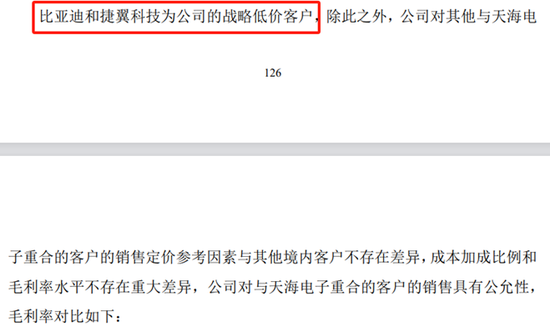
Core Viewpoint - The company Hebi Haichang Intelligent Technology Co., Ltd. is applying for an IPO on the Beijing Stock Exchange, with a focus on high-performance wiring harness equipment manufacturing, and has notable clients including BYD and Tianhai Electronics [1] Group 1: Company Overview - Hebi Haichang Intelligent Technology Co., Ltd. is primarily engaged in the manufacturing of high-performance wiring harness equipment, which is essential for wiring harness production [1] - The company’s largest client is Tianhai Electronics, which is also in the process of applying for an IPO, followed by significant clients such as BYD and Luxshare Precision [1] Group 2: Financial Performance - The company has shown steady revenue growth in recent years, indicating good growth potential; however, there is a trend of declining gross margins, recorded at 38.71% in 2023, 34.21% in 2024, and 33.36% in Q3 2025 [1] Group 3: Client Relationships - The relationship with BYD is particularly noteworthy, as the company has labeled BYD as a "strategic low-price customer," indicating a unique approach to pricing strategy [2] - Despite regulatory inquiries regarding the gross margin comparison between Tianhai Electronics and strategic low-price customers like BYD, the company has applied for a disclosure exemption, maintaining a firm stance on confidentiality [3] Group 4: Regulatory Context - The regulatory framework established by the China Securities Regulatory Commission outlines conditions under which companies can apply for disclosure exemptions, particularly concerning commercial secrets and competitive information [4][5] - The specific rationale for classifying BYD as a "strategic low-price customer" and the implications of this classification in terms of regulatory compliance remain unclear [5]

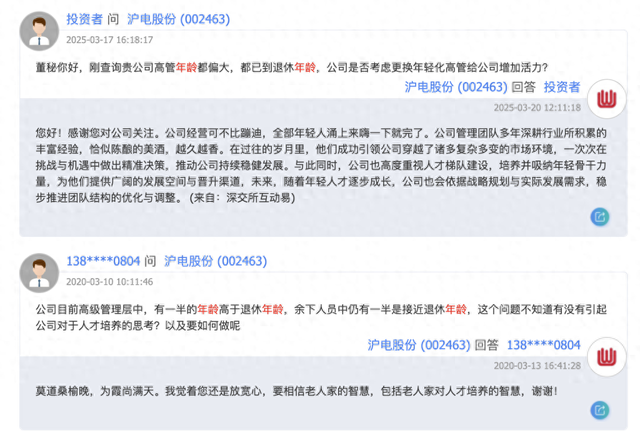
“调研不是请客吃饭,公司也不是开餐厅的” ,A股股民VS董秘:一个敢问一个敢答
Xin Lang Cai Jing· 2026-01-24 15:06
Group 1 - The core viewpoint of the article highlights the unique and humorous responses from company secretaries to investor inquiries, particularly regarding management age and company performance [2][3][7] - The company Huadian Electric (沪电股份) has faced scrutiny over the age of its management team, with the chairman being 79 years old, the general manager 54, and the secretary 68 [2] - The company secretary responded to concerns about management age by emphasizing the value of experience in navigating complex market environments and reassured investors about talent development [2][3] Group 2 - The company secretary has previously used humor to address similar concerns, stating that a management team composed entirely of young individuals would not be effective, comparing it to a party without substance [3] - In response to inquiries about stock price declines, the secretary of Tian Shun Wind Energy (天顺风能) stated that investment should focus on the company's fundamentals rather than short-term stock price fluctuations [7] - Sichuan Hebang Biotechnology (和邦生物) faced questions regarding its financial performance, with the secretary firmly denying any intention to manipulate financial results and attributing losses to market conditions and strategic adjustments [8][9] Group 3 - The company Tian Shun Wind Energy also addressed investor impatience regarding order stability, emphasizing the importance of patience in industrial growth and the long-term nature of business success [10] - BYD responded to inquiries about technological advancements by highlighting the gradual process of innovation and the importance of building a solid foundation for future success [11]


研判2025!中国汽车网关行业产业链、市场规模及未来趋势分析:架构跃迁与服务化转型叠加,奠定智能网联神经中枢地位[图]
Chan Ye Xin Xi Wang· 2026-01-06 01:24
Industry Overview - The automotive gateway serves as the core data interaction hub in the vehicle's electronic architecture, acting as the "nervous system" or "translator" for different networks [2] - The automotive gateway market in China is projected to reach approximately 7.7 billion yuan in 2024, with a year-on-year growth of 22.22% [1][5] - The industry is transitioning from a traditional distributed ECU architecture to a domain-centralized/area architecture, driven by the evolution of automotive electronic and electrical architecture [1][5] Industry Chain - The upstream of the automotive gateway industry chain includes essential components such as chips, microprocessors, and communication modules [4] - The midstream involves the production and manufacturing of automotive gateways, while the downstream primarily consists of automotive OEMs, which directly influence market size and technology routes [4] - Recent government policies have supported the integrated circuit industry, significantly reducing costs and stimulating capacity expansion [4] Market Size - The automotive gateway is crucial in the wave of automotive intelligence, with its market size expected to grow significantly as the demand for cross-domain communication and protocol conversion increases [1][5] - The demand for high-performance gateways is driven by the rise of new energy vehicles and the proliferation of intelligent driving technologies [5] Key Companies Performance - Neusoft Group has established itself as a leader in automotive electronic software and information security, with a focus on "software-defined security" [7] - Beijing Jingwei Hirain Technologies has become a dominant player in the automotive gateway industry, offering a comprehensive product line that supports various protocols and advanced features [8] - Both companies have shown significant revenue growth, with Neusoft Group reporting a revenue of 7.49 billion yuan in the first three quarters of 2025, while Jingwei Hirain reported 4.46 billion yuan, reflecting their competitive positions in the market [7][8] Industry Development Trends - The automotive gateway is evolving towards a "vehicle server," integrating stronger computing power and service-oriented architecture (SOA) capabilities [9] - There is a shift towards edge computing and high-bandwidth networks to meet the demands of higher-level autonomous driving, with vehicle Ethernet transitioning from gigabit to 10-gigabit speeds [9] - A comprehensive security system is being developed, moving beyond simple encryption to a multi-layered defense architecture that includes collaboration among automakers, chip manufacturers, software companies, and cloud service providers [10]


贝莱德对比亚迪股份有限公司H股的多头持仓比例从7.21%降至6.78%
Xin Lang Cai Jing· 2025-12-23 10:22
据 香港交易所 披露, 贝莱德 (BlackRock)对 比亚迪 股份有限公司- H股的多头持仓比例于2025年12 月18日从7.21%降至6.78%;对无 锡 药明康德 新药开发股份有限公司- H股的多头持仓比例于2025年12 月18日从5.1%降至4.67%;在 美的集团 H股的持股比例于12月18日从5.03%降至4.87%。 ...
摩根大通对比亚迪股份的多头持仓比例降至5.94%
Zhi Tong Cai Jing· 2025-11-27 09:43
据 香港交易所 披露,摩根大通对 比亚迪 股份有限公司- H股的多头持仓比例于2025年11月24日从6.12% 降至5.94%。 ...

中国电动汽车_2025 年独家调研,中国与国际车企电动汽车技术差距对比-China EV_ Proprietary survey 2025, Part 3. 10-year anniversary, Bonus edition – China vs. International OEMs‘ EV technology gap
2025-11-10 03:35
Summary of Key Points from the Conference Call Industry Overview - **Industry**: Chinese Electric Vehicle (EV) Market - **Focus**: Comparison between Chinese OEMs and international OEMs regarding EV technology and consumer preferences Core Insights 1. **Shift in Consumer Preferences**: Over the past decade, Chinese consumers have transitioned from favoring German and Japanese internal combustion engine (ICE) vehicles to embracing Chinese EVs, prioritizing value over brand loyalty [2][16][17] 2. **Value Definition**: Current consumer preference for Chinese brands is driven by perceived value for money, which includes build quality, energy efficiency, and advanced technologies like ADAS and smart cockpit systems [2][17] 3. **Upgrade Aspirations**: Chinese consumers are increasingly willing to raise their car budgets to purchase the best vehicle they can afford, with a strong focus on advanced EV technologies [3][18] 4. **Technology Adoption**: Chinese consumers have been early adopters of intelligent driving technologies, with a notable gap in product offerings from foreign OEMs due to their underestimation of the EV trend [4][20] 5. **Perceived Technological Leadership**: A survey indicates that Chinese OEMs are perceived to be five years ahead of Western peers in EV technology, particularly in battery technology and speed to market [5][6] 6. **Government Support**: The success of Chinese OEMs is attributed to strong government support, market competition, and a corporate culture that emphasizes agility and hard work [5][6] 7. **Competitive Landscape**: The competitive gap between Chinese and Western OEMs may be wider than perceived, with Western OEMs needing to focus on cost reduction and organizational restructuring to catch up [6] Market Projections 1. **Sales Growth**: China's auto sales in the first half of 2025 have exceeded expectations, with forecasts indicating an 8% growth in industry wholesale volumes, reaching approximately 29.5 million units [8] 2. **EV Sales Growth**: The long-term outlook for EVs remains strong, with expected sales growth of around 30% in 2025, driving EV penetration to 57% [9] Investment Implications 1. **Cautious Sector Outlook**: Despite positive trends, the sector is viewed cautiously due to potential pricing pressures and intense competition within the domestic market [8][9] 2. **Company Ratings**: BYD and Xiaomi are rated as Outperform, while XPeng, Li Auto, and NIO are rated as Market-Perform [9] Valuation Comparisons - A detailed valuation comps table shows various metrics for companies like BYD, XPeng, and NIO, indicating their market cap, EV/EBITDA, and P/E ratios, which reflect the competitive positioning of these companies in the market [10] Additional Insights 1. **Brand Building Challenges**: While Chinese OEMs are agile in technology adoption, they face challenges in building strong brands, which are essential for maintaining price premiums as technology commoditizes [4][21] 2. **Consumer Behavior**: The shorter history of car ownership in China makes vehicle purchases more discretionary, emphasizing lifestyle choices over necessity [19] This summary encapsulates the key points discussed in the conference call, highlighting the evolving landscape of the Chinese EV market and the implications for both consumers and investors.


中国股票策略 2025 年第三季度投资者持仓更新 - 外资本季度增持-China Equity Strategy 3Q25 investor positioning update - foreign funds added in the quarter
2025-11-10 03:34
Summary of Key Points from the Conference Call Industry Overview - The report focuses on the **Chinese equity market** and the positioning of **foreign institutional investors** in Chinese equities during **3Q25**. Core Insights and Arguments 1. **Increased Foreign Investment**: International investors increased their positions in Chinese equities, reducing their underweight from **-1.6% to -1.3%** during the quarter, marking the least underweight since **4Q22** [2][3] 2. **Sector Preferences**: The most significant additions by international investors were in the **healthcare, insurance, energy & materials, and internet sectors**, while positions in **auto and tech** were reduced [2][5] 3. **Stock Connect Activity**: Southbound inflows reached **US$56 billion**, matching the record level from **1Q25**, with net inflows across all sectors. The top sectors for southbound investment included **consumer discretionary, financials, and healthcare** [2][4] 4. **Northbound Outflows**: In contrast, northbound investments saw a net outflow of **US$18 billion** in **3Q25**, with significant sell-offs in **financials, staples, and utilities** [4][5] 5. **Active Fund Dynamics**: Approximately **800 active foreign funds** hold **US$270 billion** in Chinese stocks, with **145 funds** (AUM **US$212 billion**) not holding any Chinese equities as of **3Q25**, down from **167 funds** in **2Q25** [3][9] 6. **Crowding Observations**: Active foreign institutional investors favored growth sectors like **healthcare, insurance, and internet**, while selling off auto and tech stocks. The **crowding score** for sectors like **renewables and defensives** increased, while **banks, healthcare, and internet** saw declines [5][39] Additional Important Insights 1. **Top Bought Stocks**: Notable stocks with significant foreign inflows included **Alibaba Health Information Technology Ltd.** (7.5% increase), **Bilibili, Inc.** (4.7%), and **Zhongan Online P&C Insurance Co.** (4.3%) [17] 2. **Top Sold Stocks**: Stocks with the most significant outflows included **China Mengniu Dairy** (-2.0%), **Agile Group Holdings** (-2.1%), and **BYD Company** (-4.4%) [18] 3. **Risks Identified**: Potential risks for Chinese equities include a hard landing in the property market, capital outflows due to currency depreciation, and slow structural reforms. Inadequate government policies could exacerbate these risks [48] 4. **Valuation Methods**: Various valuation approaches are employed, including DCF models, Gordon growth model analysis, and relative valuation using multiples like PE, EV/EBITDA, and P/BV [47] This summary encapsulates the key points from the conference call, highlighting the dynamics of foreign investment in the Chinese equity market, sector preferences, and potential risks facing the market.