住房可负担性危机

Search documents
禁止大型投资机构炒房!国会出手,美国民众“购房难”有解了?
Di Yi Cai Jing· 2026-02-27 05:49
Group 1 - The core issue of the housing affordability crisis in the U.S. is a long-term supply shortage, despite potential short-term inventory release from restricting large investors [1][6] - A bipartisan group of senators introduced legislation to prohibit large institutional investors from purchasing single-family homes, responding to President Trump's call for such measures [1][2] - The proposed "Homes for American Families Act" targets real estate investment trusts (REITs) and other large entities, viewing their purchases as anti-competitive behavior under antitrust laws [2][3] Group 2 - The second proposed bill, an update to the "Hope for Homeownership Act," aims to impose a 15% consumption tax on hedge funds and similar entities with significant assets, encouraging them to divest from single-family homes [3] - Industry experts express concern that while limiting large investors may help some markets, the fundamental issue of housing affordability remains tied to supply constraints [6] - The concentration of institutional investors in certain regions significantly impacts local housing markets, despite their overall low national ownership percentage [4][6]
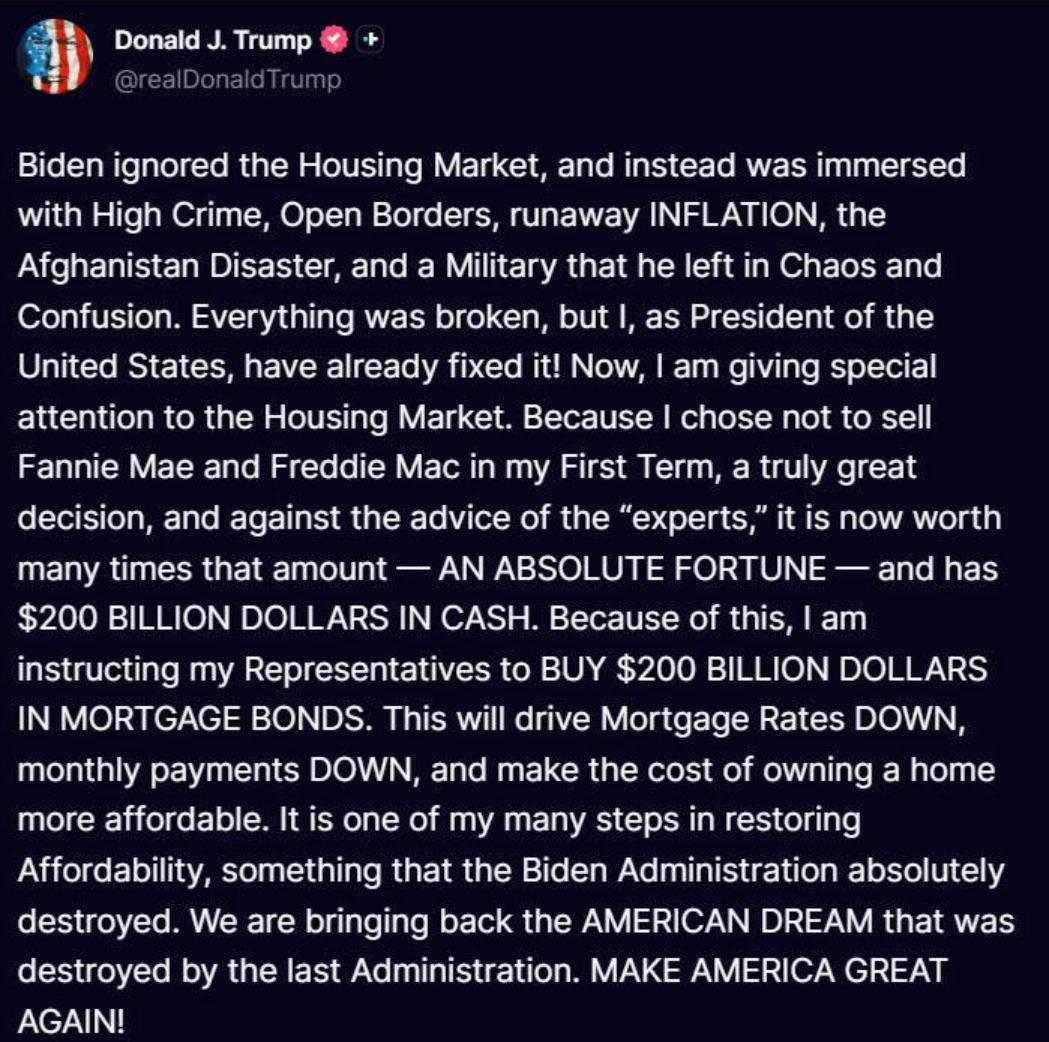
特朗普亲自“QE”:宣布2000亿美元抵押贷款债券购买计划!
Jin Shi Shu Ju· 2026-01-09 00:31
Core Viewpoint - The Trump administration is initiating a $200 billion mortgage bond purchase plan to lower mortgage rates and address the housing affordability crisis in the U.S. [2] Group 1: Government Actions - President Trump announced a plan to purchase $200 billion in mortgage bonds to reduce mortgage rates and improve housing affordability [2] - The initiative will be executed by Fannie Mae and Freddie Mac, which are government-sponsored enterprises responsible for acquiring and repackaging mortgage loans into mortgage-backed securities [3] - The bond purchase does not require Congressional approval, allowing for swift implementation [3] Group 2: Economic Context - The current average rate for a 30-year fixed mortgage is 6.16%, despite the Federal Reserve's previous rate cuts [4] - The housing affordability crisis has become a pressing challenge for U.S. lawmakers, exacerbated by rising living costs since the pandemic [3][4] - The proposed bond purchase plan mirrors the Federal Reserve's actions during the 2008 financial crisis, aimed at stabilizing the financial system and stimulating economic recovery [4] Group 3: Financial Capacity - Fannie Mae and Freddie Mac each have a limit of $225 billion on mortgage investments, with approximately $124 billion currently held, allowing for an additional $100 billion in mortgage-backed securities purchases [3] - The Trump administration claims that the decision not to sell Fannie Mae and Freddie Mac during his first term allowed these entities to accumulate $200 billion in cash, facilitating the current bond purchase plan [2]

Lennar(LEN) - 2025 Q4 - Earnings Call Transcript
2025-12-17 17:00
Financial Data and Key Metrics Changes - The company reported a gross margin of 17%, which is a decrease from previous expectations, attributed to market conditions and increased sales incentives [9][18] - The average sales price for homes was $386,000, with expectations for the first quarter of 2026 to be between $365,000 and $375,000 [18][34] - The company ended the quarter with $3.4 billion in cash and total liquidity of $6.5 billion, indicating a strong balance sheet [31][34] Business Line Data and Key Metrics Changes - The company started 18,443 homes, delivered 23,034 homes, and sold just over 20,000 homes, exceeding delivery expectations but only meeting the low end of sales expectations [17][18] - Sales incentives remained flat at 14%, contributing to a reduction in gross margin [18][29] - The company achieved a cycle time of 127 days for detached single-family homes, a reduction from 138 days a year ago [20][29] Market Data and Key Metrics Changes - The housing market remains challenging, with consumer confidence impacted by economic uncertainties and a government shutdown [11][12] - The supply of owned home sites decreased year-over-year to 0.1 years, while controlled home sites increased to 98% from 82% [30][32] - The company noted a significant supply shortage in the housing market, which has kept home prices high [13][14] Company Strategy and Development Direction - The company is focused on maintaining volume and even-flow production while managing costs to prepare for future market recovery [10][11] - An asset-light strategy has been implemented, reducing overall inventory from just under $20 billion to just under $12 billion [19][30] - The company aims to leverage its strong market position and efficient product offerings to meet pent-up demand as market conditions improve [10][25] Management's Comments on Operating Environment and Future Outlook - Management expressed optimism about future market conditions, anticipating that government actions may enhance affordability and stimulate demand [15][44] - The company is positioned to benefit from a potential recovery in the housing market, with expectations for margin improvement as incentives decrease [46][47] - Management acknowledged the ongoing challenges but emphasized the importance of operational efficiencies and technology investments to drive future growth [57][66] Other Important Information - The company completed the Millrose transaction, resulting in a non-cash repurchase of 8 million shares [21][33] - The leadership transition is underway as the co-CEO retires, with experienced professionals prepared to take on new roles [22][24] Q&A Session Summary Question: What is contributing to the continued pressure on margin? - Management noted unexpected headwinds from the government shutdown affecting consumer confidence, which impacted pricing stability [40][41] Question: Will government actions improve affordability in 2026? - Management believes that government focus on affordability is likely to result in actionable programs, although specifics remain uncertain [44][45] Question: How does the company envision recapturing margin as the market improves? - The company is focused on maintaining volume and leveraging operational efficiencies to improve margins as incentives decrease [46][47] Question: What are the expectations for share repurchases in 2026? - Management expressed enthusiasm for 2026, indicating that the asset-light model will allow for continued shareholder returns through repurchases and dividends [64][66]

美政府停摆影响经济数据发布,美联储或“无米下炊”
Sou Hu Cai Jing· 2025-10-24 05:50
Core Insights - The Federal Reserve is facing unprecedented challenges in guiding the economy amid a weak labor market and persistent inflation, exacerbated by the government shutdown [1] - The shutdown has disrupted the Fed's access to essential economic data, complicating its ability to make informed decisions regarding interest rates and economic policies [1][2] - The Fed is now relying on alternative data sources to assess labor market conditions and consumer spending, which are critical for balancing economic growth and price stability [1] Economic Data Dependency - The lack of government data is significantly hindering the Fed's decision-making process, as government statistics are considered the "gold standard" for measuring the U.S. economy [2] - The last time the Fed operated without key government economic data was during the 2018-2019 government shutdown, where it had to rely on credit card transactions and auto sales data [2] - Economists express concerns that private sector data cannot fully substitute for government data, especially since government data serves as a benchmark for many private sector metrics [2]
美联储戴利:美联储利率降至 3%的中性水平无法解决住房可负担性危机。
Sou Hu Cai Jing· 2025-09-25 20:14
Core Viewpoint - The Federal Reserve's interest rate reduction to a neutral level of 3% will not resolve the housing affordability crisis [1] Group 1 - The Federal Reserve, represented by Daly, emphasizes that simply lowering interest rates is insufficient to address the ongoing issues of housing affordability [1]
特朗普政府欲救房地产市场稳中期选举,美国房主却只想套现还债?
第一财经· 2025-09-02 10:10
Core Viewpoint - The article discusses the urgent measures being considered by the Trump administration to address the housing affordability crisis in the U.S., highlighting the increasing trend of homeowners opting for cash-out refinancing to pay off debts amid high inflation and personal debt levels [3][4][5]. Group 1: Housing Affordability Crisis - U.S. Treasury Secretary Becerra indicated that the Trump administration is contemplating declaring a national housing emergency this fall to tackle rising home prices and reduced supply [4]. - The government is exploring ways to simplify permits and encourage standardized local building and zoning regulations to boost housing supply and lower costs [4]. - The current housing market challenges have led to financial polarization, increasing rental costs and higher mortgage rates for potential homebuyers [4]. Group 2: Cash-Out Refinancing Trends - The proportion of cash-out refinancing transactions has risen to 59% of all refinancing in Q2, as homeowners seek to extract cash from their properties to pay off debts [7][8]. - A significant percentage (44% to 67%) of refinancing borrowers reported using the cash for debt repayment, reflecting the high levels of consumer debt, which reached a record $5.44 trillion by the end of June [7]. - Many homeowners are facing negative cash flow situations, prompting them to leverage their home equity despite the potential for higher mortgage rates [7][8]. Group 3: Financial Implications - Approximately 70% of recent cash-out refinancing borrowers are accepting higher mortgage rates, averaging an increase of 1.45 percentage points for $94,000 in cash [8]. - The decision to refinance is influenced by the higher rates of other loans, such as credit cards averaging 21% and personal loans at 12%, making cash-out refinancing a more appealing option despite the costs [8]. - Homeowners are prioritizing debt repayment over maintaining lower mortgage rates, as evidenced by a case where a homeowner refinanced to pay off $155,000 in consumer debt, resulting in a lower overall monthly payment despite losing a lower mortgage rate [8].

特朗普政府欲救房地产市场稳中期选举,美国房主却只想套现还债?
Di Yi Cai Jing· 2025-09-02 07:01
Core Insights - The Trump administration is planning to take new measures to address the housing affordability crisis in the U.S. in the coming weeks [1][3] - The government is considering declaring a national housing emergency this fall to tackle rising home prices and supply shortages [3][4] - The current housing market challenges are significant, with high mortgage rates and increased rental costs affecting potential homebuyers [3] Group 1: Government Actions - The administration is exploring ways to simplify permitting and encourage standardized local building and zoning regulations to boost housing supply [3] - There is a push for the Federal Reserve to lower interest rates to alleviate the financial burden on the housing market [3][6] Group 2: Homeowner Behavior - A growing number of homeowners are opting for cash-out refinancing to pay off debts, with this type of refinancing accounting for 59% of all refinancing transactions in Q2 [5][6] - The average cash-out refinancing transaction results in homeowners taking on higher mortgage rates, with about 70% of recent cash-out refinancers facing increased rates [7] Group 3: Financial Context - U.S. consumer non-mortgage debt reached a record $5.44 trillion, with significant increases in credit card and auto loan balances [6] - Homeowners are facing negative cash flow situations, prompting them to leverage home equity despite the potential for higher mortgage rates [6][7]

特朗普又准备宣布全国紧急状态?这次是针对住房
Xin Lang Cai Jing· 2025-09-02 04:16
Core Viewpoint - The Trump administration is considering declaring a "national housing emergency" to address the housing affordability crisis in the U.S. ahead of the 2026 midterm elections, with a focus on standardizing local building and zoning regulations and reducing housing transfer fees [1][2]. Group 1: Housing Affordability Crisis - The U.S. is facing a significant housing affordability crisis exacerbated by a shortage of housing supply, rising home prices, and high mortgage rates, particularly in California where the median home price exceeds $900,000 [1][2]. - The U.S. Chamber of Commerce reports a current housing supply gap of 4.5 million units, primarily due to long-term supply-demand imbalances [1][2]. Group 2: Contributing Factors - Complex permit applications, outdated zoning regulations, and rising construction material costs are contributing to insufficient housing construction [2]. - Tariffs imposed on trade partners are expected to further increase construction costs, impacting housing affordability [2]. Group 3: Market Trends - As of January this year, the average home price in the U.S. is $355,000, reflecting a 2.7% increase from the previous year, outpacing wage growth [5]. - Mortgage rates are at a 20-year high, discouraging potential first-time homebuyers, while rental prices have surged, with annual increases rising from 3% to 6.5% since the pandemic [5]. - In 2021, over 42 million U.S. households spent more than 30% of their income on housing, an increase of 4.9 million households compared to pre-pandemic levels [5]. Group 4: Political Implications - Addressing housing affordability is a key issue for Democratic presidential candidate Kamala Harris, who has proposed tax credits for entry-level housing construction and $25,000 subsidies for some homebuyers [5]. - Trump has called for the use of federal land for housing development and criticized the Federal Reserve for not lowering interest rates, which he believes harms the housing market [5].
专业对口!特朗普要“救美国楼市”
Hua Er Jie Jian Wen· 2025-09-02 00:39
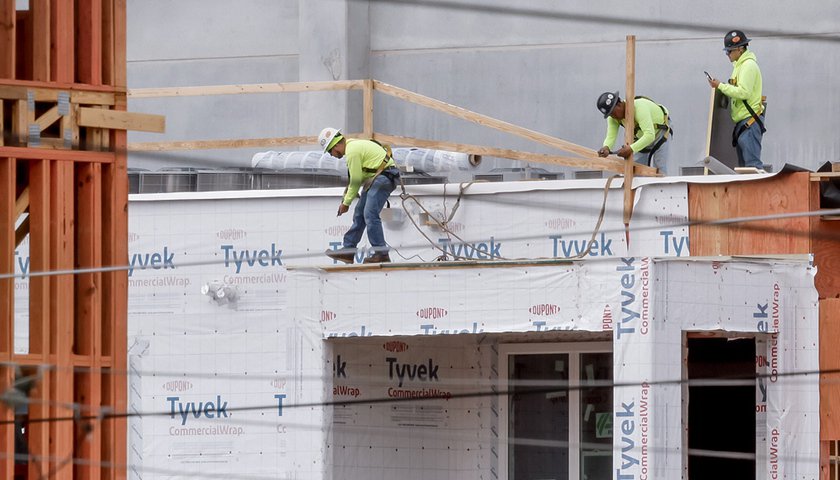
Core Viewpoint - The Trump administration is considering declaring a national housing emergency in response to the ongoing housing affordability crisis in the U.S. This move is also seen as a strategy to bolster support for the Republican Party ahead of the midterm elections in 2026 [1][2]. Group 1: Housing Crisis Response - U.S. Treasury Secretary Bessent indicated that the government is exploring actions to address the housing affordability crisis, potentially announcing a national emergency in the fall [1]. - The housing market faces significant challenges, exacerbated by the COVID-19 pandemic, which has increased rental costs and mortgage rates, impacting potential homebuyers [1][2]. - The Trump administration has previously used emergency declarations to bypass lengthy legislative processes, suggesting that a national housing emergency could be a tactical move to implement swift actions [1][2]. Group 2: Political Strategy - Housing affordability is defined as a "key pillar" of the Republican Party's campaign agenda for the 2026 midterm elections, with government officials researching ways to standardize local building and zoning regulations and reduce housing transaction costs [2]. - The issue of housing affordability was also a focal point in the 2024 presidential campaign, with promises from candidates to provide tax credits and down payment assistance to homebuyers [2]. - The potential declaration of a housing emergency is viewed as a strategy to attract midterm election voters and address public concerns regarding the housing crisis [2]. Group 3: Trump's Background in Real Estate - President Trump’s extensive background in the real estate industry positions him as knowledgeable about the current housing challenges, having built a career in real estate development since the 1970s [3]. - His experience includes significant projects and a deep understanding of the entire development process, from land acquisition to sales and marketing, along with established connections in various sectors [3].
布米普特拉北京投资基金管理有限公司:美国新屋开工数创五个月新高
Sou Hu Cai Jing· 2025-08-20 11:05
Core Insights - The U.S. residential construction market is showing a complex picture, with July new housing starts unexpectedly rising by 5.2%, reaching an annualized rate of 1.43 million units, the highest in five months, exceeding economists' expectations [1] Group 1: Housing Starts and Permits - The increase in housing starts is primarily driven by strong performance in multi-family housing, with July multi-family starts rising nearly 10% to an annualized rate of 489,000 units, marking the fastest construction pace of 2023 [3] - Single-family housing starts also saw stable growth, increasing by 2.8% to an annualized rate of 639,000 units [3] - However, building permits, a key indicator of future construction activity, declined by 2.8% in July to an annualized rate of 1.35 million units, the lowest level in five years [3] Group 2: Market Sentiment and Economic Impact - Builders remain cautious about the market outlook, as many homeowners choose to stay put due to doubled mortgage rates, leading to reduced liquidity in the real estate market [3] - The current market shows a clear divide, with single-family building permits rising for the first time since February, indicating potential moderate recovery, while multi-family permits are declining, reflecting developers' concerns about future demand for apartments and townhouses [3] - The complex dynamics in the residential construction market are expected to significantly impact the overall U.S. economy, as housing starts data is a key indicator for GDP predictions [6] Group 3: Future Outlook - Observers note that the surge in multi-family construction may indicate a deepening housing affordability crisis, as rising home prices and interest rates push more families towards renting or purchasing lower-priced condominiums and townhouses instead of single-family homes [6] - Despite some positive signals from July data, economists warn against overinterpreting single-month figures, as the residential construction market still faces significant challenges, including rising labor costs, land supply constraints, and an uncertain macroeconomic environment [8] - The performance of the U.S. real estate market in the coming months will largely depend on the trajectory of mortgage rates, with potential stabilization or slight declines possibly boosting consumer confidence and stimulating more home-buying activity [8]