
关税政策变动

Search documents
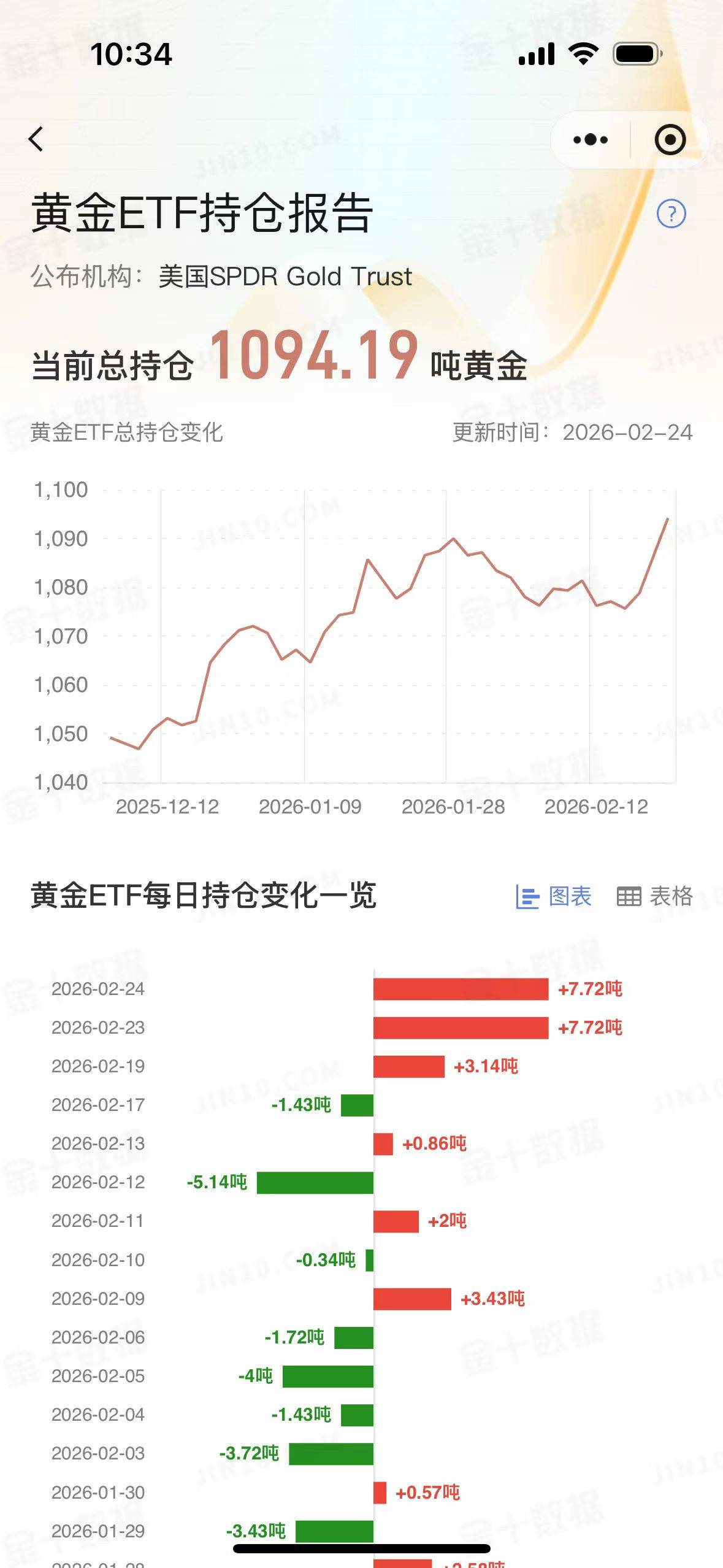
黄金ETF持仓量报告解读(2026-2-25)获利了结情绪升温 抑制金价
Sou Hu Cai Jing· 2026-02-25 08:22
Core Viewpoint - The SPDR Gold Trust, the world's largest gold ETF, reported a significant increase in holdings, reaching 1,094.19 tons, with a daily increase of 7.72 tons, indicating strong investor interest in gold amid fluctuating prices and geopolitical tensions [5]. Group 1: Gold ETF Holdings - As of February 24, the total holdings of SPDR Gold Trust stand at 1,094.19 tons, reflecting a substantial increase of 7.72 tons from the previous trading day [5]. - The cumulative increase in gold ETF holdings over the past week is nearly 20 tons, suggesting a growing demand for gold as a safe-haven asset [5]. Group 2: Gold Price Movements - On February 24, spot gold prices experienced a decline, dropping to below $5,100 per ounce, closing at $5,142.45, a decrease of $85.30 or 1.63% [5]. - The recent rise in gold prices has led to profit-taking, which has contributed to the downward pressure on prices [5]. Group 3: Economic and Geopolitical Factors - The Federal Reserve officials have expressed hawkish views, indicating that interest rates should remain unchanged due to inflation concerns, which may impact gold prices [6]. - Geopolitical tensions and fluctuating tariff policies are providing support for gold prices, with recent developments in U.S. tariffs contributing to market uncertainty [6][7]. Group 4: Market Outlook - Analysts predict that gold prices are likely to consolidate above the $5,000 level in the short term, with potential upward movements if geopolitical tensions escalate [7]. - Technical indicators suggest that the upward trend in gold prices remains intact, with key resistance levels at $5,200, $5,249, and $5,300, while support is noted at $5,093 and $5,000 [7].

集运指数(欧线):震荡思路对待
Guo Tai Jun An Qi Huo· 2026-02-25 01:32
Report Industry Investment Rating - The report does not explicitly mention the industry investment rating. Core Viewpoint - The freight index for European routes (EC) should be treated with a volatile mindset. The 2604 contract has a neutral valuation after yesterday's premium adjustment, with an expected trading range of 1150 - 1350 points and a strong resistance level at 1446 points. The 2606 contract should also be treated with a volatile mindset, with an expected trading range of 1500 - 1800 points and a strong resistance level around 1920 points. The 2610 contract follows the 2604 contract in the short - term, and short positions are recommended [10][13][14]. Summary by Relevant Catalogs 1. Fundamental Data of Freight Index (European Routes) - **Futures Contracts**: The EC2604 contract closed at 1320.6 points, up 6.84% with a trading volume of 50,698 and an open interest of 34,505, an increase of 8,660. The EC2606 contract closed at 1691.6 points, up 6.14% with a trading volume of 8,328 and an open interest of 15,857, an increase of 1,897. The ec2610 contract closed at 1,168.8 points, up 4.05% with a trading volume of 2,792 and an open interest of 8,726, an increase of 795 [1]. - **Freight Rate Index**: The SCFIS for European routes was 1,573.51 points, down 2.1% week - on - week; the SCFIS for US - West routes was 1,112.01 points, down 1.7% week - on - week. The SCFI for European routes was $1,361/TEU, down 3.0% bi - weekly; the SCFI for US - West routes was $1,787/FEU, down 0.8% bi - weekly [1]. - **Spot Freight Rates**: The spot freight rates for different carriers from Shanghai to Rotterdam vary. For example, Maersk's $/40'GP is 1950, and $/20'GP is 1225 [1]. 2. Supply - side Situation - **Capacity Changes during the Spring Festival**: In February, the capacity remained basically unchanged, with a weekly average capacity of around 275,000 TEU/week and 11 blank sailings. In March, the capacity was revised downwards, and in April, it was revised upwards. The Gemini Alliance's India - Pakistan - Mediterranean ME11 route plans to resume passing through the Suez Canal from mid - February 2026, while other major Asia - Europe routes are still under evaluation and continue to detour around the Cape of Good Hope [11]. 3. Demand - side Situation - **Short - term**: During the Spring Festival, the rolling levels of shipping companies vary. Generally, they can cover up to week 8, and some can cover up to week 10. In March 2026, the new rush to transport photovoltaic and battery products will bring a marginal increase in the loading rate [12]. - **Medium - to - long - term**: European import demand is resilient. In December 2025, Asia's export volume to Europe (North - West Europe + Mediterranean) was about 1.874 million TEU, with a year - on - year growth rate of 8.6%. From January to December 2025, the cumulative export volume was about 19.84 million TEU, a 9.2% increase compared to 2024 [12]. 4. Spot Freight Rates and Contract Analysis - **Spot Freight Rates**: From week 7 to 9, the overall FAK center of the market was determined at around $2060/FEU before the festival. In early March, the freight rate center changed little compared to late February. There are still GRI expectations in late March and April, but the implementation situation is unclear [13]. - **Contract Analysis**: - **2604 Contract**: After yesterday's premium adjustment, the contract's valuation is neutral. The possible resumption of late - February prices by some shipping companies in early March will put pressure on the contract. The contract is expected to be volatile, with a trading range of 1150 - 1350 points and a strong resistance level at 1446 points [13]. - **2606 Contract**: It should be treated with a volatile mindset, with a trading range of 1500 - 1800 points and a strong resistance level around 1920 points. It is a relatively good long - position contract in the short - term [14]. - **2610 Contract**: It follows the 2604 contract in the short - term, with a relatively small amplitude. Short positions are recommended [14]. 5. Trend Intensity - The trend intensity of the freight index for European routes is 0, indicating a neutral trend [15].
贵属策略日报:?价?位回落,?银震荡偏强-20260225
Zhong Xin Qi Huo· 2026-02-25 00:27
Group 1: Report Industry Investment Rating - No investment rating information provided in the report Group 2: Core Views of the Report - Gold is expected to show a volatile and slightly stronger trend in the short term, and the long - term upward support logic remains unchanged [2] - Silver is expected to gradually shift to a volatile and slightly stronger trend after price stabilization, and the long - term bullish support is still strong [3] Group 3: Summary by Related Content Gold - During the Spring Festival holiday, the external precious metals rebounded after low - level oscillations, supported by factors such as the differentiation of US economic data, the escalation of the US - Iran geopolitical situation, and changes in US tariff policies. The intraday COMEX gold price fell by nearly 1% after reaching a high, ending the previous four - day consecutive rise, due to factors such as partial profit - taking by investors and a slight rebound in the US dollar index [1] - The short - term gold price is supported by the uncertainty of US tariffs, the repetition of US - Iran negotiations, and the Middle - East geopolitical situation. However, there are also suppressions, such as the differentiation of US economic data and the postponement of the Fed's first rate - cut expectation this year. Key events to focus on include the US - Iran Geneva negotiation on the 26th, the release of January PPI data on the 27th, next week's non - farm payroll data, and Sino - US interactions [2] Silver - The intraday COMEX silver showed a "V - shaped" volatile trend with a gain of over 1%, and SHFE silver also showed a volatile and slightly stronger operation. The macro - driving factors of silver are consistent with those of gold. The impact of tariff policy changes is generally positive, while the postponement of the Fed's rate cut and the possibility of a US visit to China suppress the price. The spot - end driving factors of silver are still positive, with the risk of spot tightness in March remaining. Key events to focus on include the fermentation of spot tightness in March [3] Commodity Index - The comprehensive index of CITICS Futures commodities on February 24, 2026 includes special indices such as the commodity index, the commodity 20 index, the industrial products index, and the PPI commodity index, with corresponding increases of 1.86%, 2.23%, 1.14%, and 0.67% respectively [45] - The precious metals index on February 24, 2026 had a daily increase of 6.03%, a 5 - day increase of 3.79%, a 1 - month increase of 0.11%, and a year - to - date increase of 15.64% [46]
家得宝(HD.US) Q4 可比销售额超预期增0.4% 经济“寒潮”下家装需求仍显韧性
Zhi Tong Cai Jing· 2026-02-24 12:57
Core Viewpoint - Home Depot's key sales metrics exceeded expectations due to steady demand, but macro challenges remain [1] Group 1: Financial Performance - In Q4, Home Depot reported revenue of $38.2 billion, a year-over-year decline of 3.8%, but exceeded expectations by $1 billion [1] - Adjusted earnings per share were $2.72, surpassing expectations by $0.20 [1] - Same-store sales increased by 0.4%, outperforming average expectations [1] Group 2: Market Conditions - Despite high interest rates and ongoing inflation concerns, demand for home renovation projects remains stable [1] - The company gained market share, with e-commerce achieving double-digit growth for three consecutive quarters [1] - There are early positive signs in the housing market, such as a decrease in mortgage rates and stable median home prices over the past year [1] Group 3: Future Outlook - Home Depot projects total sales growth of approximately 2.5% to 4.5% for FY2026, lower than the previous estimate of 4.06% [1] - Same-store sales growth is expected to be between 0% and 2.0% [1] - CFO Richard McPhail noted that customers have been hesitant to invest in large renovation projects for three years due to increasing uncertainty regarding housing affordability and layoff risks [1] Group 4: Strategic Initiatives - Home Depot is focusing on its faster-growing professional contractor business, which has higher spending than regular customers [3] - The company is expanding its digital business and enhancing shopping experiences with artificial intelligence [3] - To address tariff impacts, Home Depot is implementing a sourcing diversification strategy [3] Group 5: Competitive Landscape - Home Depot is the latest large retailer to report earnings in the current reporting season, with major competitor Lowe's set to release its earnings soon [3] - Walmart provided a cautious outlook, citing a fluid economic backdrop, but noted that consumer spending habits remain consistent [3]

未知机构:出口链关税变化利于终端销售海外产能依然具有超额优势对等芬太尼关税无效最-20260224
未知机构· 2026-02-24 05:05
Summary of Key Points from the Conference Call Industry Overview - The discussion revolves around the export chain, particularly focusing on the impact of tariff changes on terminal sales and the competitive advantage of overseas production capacity [1] Core Insights and Arguments - The Supreme Court declared the global reciprocal tariffs and fentanyl tariffs imposed by Trump under the International Emergency Economic Powers Act (IEEPA) as invalid [1] - Trump announced a temporary import tariff of 10% on certain goods, effective February 24, lasting for 150 days [1] - Tariff impacts vary across different product categories: - For light industrial home goods, Southeast Asian tariffs remain at 25%, while domestic tariffs will decrease from 60% to 50% - For light industrial non-home goods, Southeast Asian tariffs will drop from 20% to 10%, and domestic tariffs will change from a combination of 20% plus the 301 tariffs (ranging from 7.5% to 25%) to 10% plus the 301 tariffs [2] - Overall, the reduction in tariffs is expected to lower terminal prices, which will benefit export demand [2] - The competitive landscape remains stable, with a slight narrowing of the tariff gap for home goods between domestic and Southeast Asian products (10%), while the Southeast Asian advantage for non-home goods remains unchanged [2] Additional Important Content - Cross-border e-commerce costs are expected to be directly optimized due to the tariff changes, with the Southeast Asian transfer ratio for large light industrial goods in cross-border e-commerce being between 50% to 80%. The 10% reduction in domestic tariffs will directly lower costs for leading companies in this sector [2]
港股异动 | 中国中免(01880)重挫逾10% 美国关税被判违法 关税政策变动扰动市场情绪
智通财经网· 2026-02-23 07:58
Group 1 - China Duty Free Group (01880) experienced a significant decline of over 10%, with a current drop of 9.42%, trading at HKD 91.25 and a transaction volume of HKD 350 million [1] - The U.S. Customs and Border Protection announced it will stop imposing tariffs based on the International Emergency Economic Powers Act (IEEPA) starting Tuesday at 12:01 AM Eastern Time, following a Supreme Court ruling deeming these tariffs illegal [1] - Former President Trump plans to implement a 15% tariff globally in response to the Supreme Court's ruling, aiming to maintain his trade agenda [1] Group 2 - Last April, China retaliated against the U.S. government's announcement of "reciprocal tariffs," with Guotai Junan Securities noting that mutual tariffs between China and the U.S. could widen the price gap between taxed and duty-free goods, potentially shifting sales of mid-to-high-end imported products towards duty-free channels [1] - The recent ruling on U.S. tariff policy has disturbed market sentiment, leading to increased attention on the subsequent changes in tariff policies across countries [1]

东航物流(601156):受关税政策冲击 Q3业绩小幅回落
Xin Lang Cai Jing· 2025-11-01 00:27
Core Viewpoint - Eastern Airlines Logistics reported a decline in revenue and net profit for Q3 2025, primarily due to the impact of tariff changes on its comprehensive logistics solutions [1][2]. Financial Performance - For the first three quarters of 2025, the company achieved operating revenue of 17.25 billion yuan, a year-on-year decrease of 2.4%, and a net profit attributable to shareholders of 2 billion yuan, down 3.2% [1]. - In Q3 2025, the company recorded operating revenue of 5.99 billion yuan, a decline of 6.2% year-on-year, and a net profit of 710 million yuan, down 9.8% [1]. - The gross profit margin for Q3 was 22%, an increase of 2 percentage points year-on-year, driven by ground comprehensive services [2]. Business Segment Analysis - **Air Express**: Revenue reached 2.8 billion yuan, up 23% year-on-year, despite a 5.5% decline in the Q3 TAC freight rate index [2]. - **Ground Comprehensive Services**: Revenue was 700 million yuan, a 9% increase year-on-year [2]. - **Comprehensive Logistics Solutions**: Revenue fell to 2.5 billion yuan, a decrease of 28% year-on-year, mainly due to the U.S. cancellation of the small package tax exemption policy [2]. Cost and Profitability - The company's expense ratio increased to 3.8%, up 1.6 percentage points year-on-year, primarily due to rising management and financial expense ratios [2]. - Other income decreased by 93% year-on-year, contributing to a slight decline in net profit margin to 11.9%, down 0.5 percentage points [2]. Strategic Initiatives - The company is actively opening new flight routes and enhancing strategic partnerships to adapt to changing tariff policies [3]. - New international cargo transport routes were successfully launched, including "Hangzhou-Taiyuan-Kuala Lumpur" and "Xi'an-Kunming-Kuala Lumpur" [3]. - A strategic cooperation agreement was signed with SF Airlines to leverage both companies' resources and capabilities for improved logistics services [3]. Profit Forecast and Valuation - The company maintains its net profit forecasts for 2025-2027 at 2.6 billion, 3 billion, and 3.3 billion yuan, respectively, and continues to hold a "buy" rating [4].

泛远国际(02516)发盈警 预计中期股东应占亏损约1000万元至2000万元
智通财经网· 2025-08-15 08:54
Core Viewpoint - The company anticipates a significant decline in revenue for the six months ending June 30, 2025, primarily due to changes in U.S. tariff policies affecting shipments to the U.S. [1] Revenue Forecast - The expected revenue for the six months ending June 30, 2025, is projected to be between RMB 700 million and RMB 900 million, representing a decrease of approximately 51% to 37% compared to the same period in 2024 [1] Profitability Outlook - The company expects to incur a loss attributable to owners ranging from RMB 10 million to RMB 20 million, a reversal from a profit of approximately RMB 38 million in the same period of 2024 [1] Impairment Losses - The anticipated losses are attributed to the decrease in total revenue, an increase in impairment losses on trade and other receivables, and an increase in goodwill impairment losses from wholly-owned subsidiaries during the period compared to the previous year [1]
伟星股份(002003) - 2025年6月3日投资者关系活动记录表
2025-06-04 07:56
Group 1: Market Conditions and Challenges - The overall industry is cautious due to uncertainties from tariff policies and weak end-consumer demand, leading to short-term order pressure [2] - The global apparel industry has a mature supply chain, making it difficult to cultivate new large-scale suppliers despite increased competition from tariff changes [3] - The apparel consumption remains relatively inelastic, with strong demand for essential goods, favoring companies with strong international capabilities [3] Group 2: Company Positioning and Competitive Advantages - The company primarily serves mid-to-high-end apparel brands, offering a range of products including buttons, zippers, and other accessories, applicable across various sectors [2] - The company is one of the largest button manufacturers globally, holding approximately 20% of the domestic mid-to-high-end market [4] - The company emphasizes a "product + service" business model, focusing on quality products and comprehensive service, which differentiates it from competitors like YKK [3] Group 3: Customer Sensitivity and Product Pricing - The cost of buttons and zippers constitutes a small portion of the overall garment cost, making price sensitivity lower among downstream customers [5] - Customers increasingly prioritize suppliers' product development capabilities, delivery times, and overall service quality over pricing [5] Group 4: Production Efficiency and International Expansion - The company is enhancing its Vietnam industrial park with advanced equipment and skilled personnel, leading to improved production efficiency [6] - The Bangladesh industrial park is undergoing upgrades to align with current manufacturing standards, with a focus on increasing overseas capacity [6] - The company anticipates significant revenue growth in 2025 due to improved order trends and capacity utilization in its Vietnam facility [6] Group 5: Corporate Culture and Management Strengths - The company's core competitiveness lies in its corporate culture and experienced management team, which is grounded in sustainable development and a commitment to steady progress [7] - The management team is characterized by diligence, innovation, and strong industry insight, contributing to the company's long-term health and growth [7]

据央视新闻报道,美国联邦巡回上诉法院批准特朗普政府的请求
Sou Hu Cai Jing· 2025-06-02 04:39
Group 1 - The U.S. Court of Appeals has temporarily suspended the previous ruling by the U.S. International Trade Court that deemed the Trump administration's tariff measures illegal, creating uncertainty in the cross-border e-commerce sector [1][2] - The Trump administration's tariff policies have significantly impacted global trade dynamics, particularly affecting the cost structure and profit margins of cross-border e-commerce businesses [2][6] - The upcoming 2025 Yiwu E-commerce Expo, scheduled for June 21-23, presents a valuable opportunity for industry players to adapt to changes and explore new business avenues [4][6] Group 2 - Yiwu, known as the "World's Small Commodity Capital," serves as a crucial hub for global small commodity trade, offering a wide range of products across various categories [6][7] - The expo will feature numerous industry forums and seminars aimed at discussing the latest trends and strategies in the cross-border e-commerce sector, particularly in light of the evolving tariff policies [6][7] - The event will facilitate face-to-face interactions between businesses and global partners, enabling them to establish new collaborations and optimize logistics to mitigate the impact of tariff changes [7][8]
