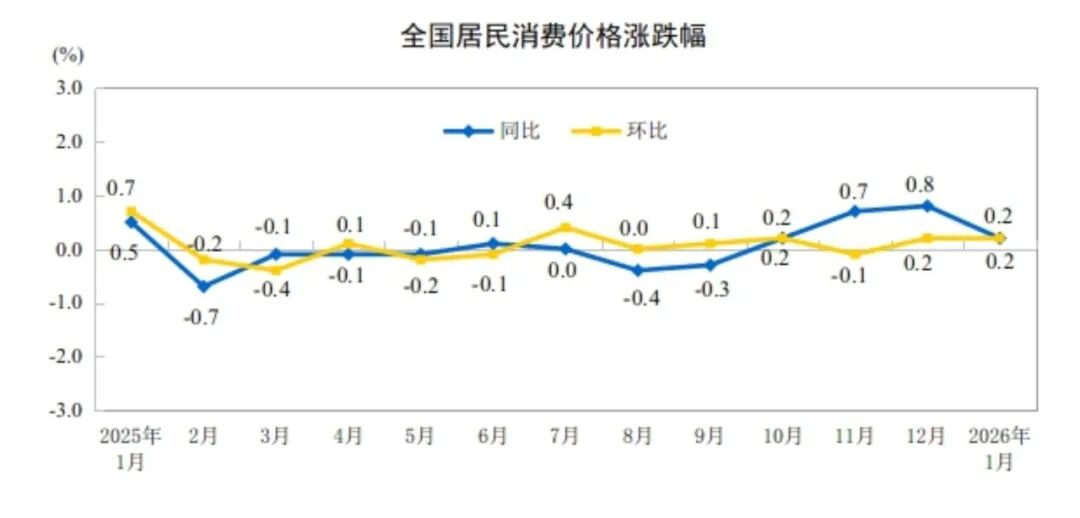
工业生产者出厂价格指数(PPI)

Search documents
2月CPI环比同比涨幅均创新高,释放什么信号?
券商中国· 2026-03-09 10:20
Core Viewpoint - The article highlights a significant increase in the Consumer Price Index (CPI) and Producer Price Index (PPI) in February, indicating a recovery in the domestic economy driven by various factors, including seasonal consumption patterns and international commodity price trends [1][4][5]. CPI Analysis - The CPI increased by 1.0% month-on-month and 1.3% year-on-year, marking the highest growth in nearly three years [1][3]. - The core CPI, excluding food and energy, rose by 1.8% year-on-year [3]. - Service prices were a major contributor to the CPI increase, with notable rises in airfare (31.1%), vehicle rental (24.7%), travel agency fees (15.8%), and hotel accommodation (7.3%), collectively accounting for over 30% of the CPI's total increase [3][4]. - The average CPI for January and February was up 0.8% year-on-year, indicating a continuation of the recovery trend observed since the second half of 2022 [4]. PPI Analysis - The PPI rose by 0.4% month-on-month, marking the fifth consecutive month of increase, while the year-on-year decline narrowed to 0.9% [1][7]. - Factors contributing to the PPI increase include rising international oil prices and a strong upward trend in the semiconductor industry, with specific price increases in electronic components and materials [7][8]. - The article anticipates that the PPI may turn positive year-on-year in March due to ongoing international tensions affecting oil prices, which could lead to increased domestic inflationary pressures [5][7]. Economic Outlook - Analysts expect the upward trend in CPI to continue, supported by government initiatives aimed at boosting consumer spending and addressing supply chain issues [5]. - The article suggests that while current prices are low, there is potential for further increases as consumer demand strengthens post-holiday [4][5].


【数据发布】2026年2月份工业生产者出厂价格同比降幅收窄 环比继续上涨
中汽协会数据· 2026-03-09 03:06
Core Viewpoint - The article discusses the changes in the Producer Price Index (PPI) for industrial producers in February 2026, highlighting a year-on-year decline in both the ex-factory prices and purchase prices, while also noting month-on-month fluctuations in these prices [1][9]. Group 1: Year-on-Year Changes - In February 2026, the ex-factory prices of industrial producers decreased by 0.9% year-on-year, a reduction of 0.5 percentage points compared to the previous month [1]. - The purchase prices for industrial producers fell by 0.7% year-on-year, with a decrease of 0.7 percentage points from the previous month [1]. - For the average of January and February, the ex-factory prices dropped by 1.2% compared to the same period last year, while the purchase prices decreased by 1.1% [1]. Group 2: Month-on-Month Changes - In February, the ex-factory prices of industrial producers increased by 0.4% month-on-month, remaining unchanged from the previous month [1][6]. - The purchase prices for industrial producers rose by 0.7% month-on-month, an increase of 0.2 percentage points compared to the previous month [1][6]. - The production material prices saw a month-on-month increase of 0.5%, while the living material prices remained stable [6]. Group 3: Breakdown of Price Changes - Among the ex-factory prices, production materials saw a decline of 0.7% year-on-year, with significant drops in the mining industry (5.3%) and raw materials (1.9%), while processing industries experienced a slight increase of 0.3% [3][8]. - Living materials prices decreased by 1.6% year-on-year, with food prices down by 1.8% and clothing prices down by 1.0% [3][8]. - In the purchase prices, fuel and power prices fell by 8.4%, while prices for non-ferrous metals and wires surged by 21.3% [5][8].
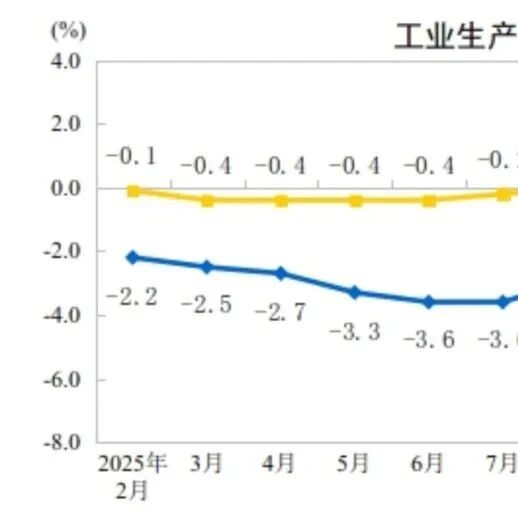
原木:低到港低库存,震荡偏强
Guo Tai Jun An Qi Huo· 2026-02-24 01:19
Report Summary 1. Investment Rating - No investment rating for the industry is provided in the report. 2. Core View - The log market is characterized by low arrivals and low inventories, showing a volatile and slightly upward trend [1]. 3. Summary by Directory 3.1 Fundamental Tracking - **Futures Contracts**: For the 2603 contract, the closing price on February 13, 2026, was 787.5, with a daily increase of 1.0% and a weekly increase of 1.6%. The trading volume was 2277, down 40.0% daily and 70% weekly. The open interest was 2449, down 22.1% daily and 54% weekly. Similar data is presented for the 2605 and 2607 contracts [1]. - **Price Spreads**: The spreads between different contracts and between spot and futures contracts are provided, such as the spot - 2603 spread being -37.5 on February 13, 2026, with a daily increase of 27.1% and a weekly increase of 50% [1]. - **Spot Market**: The prices of various types of logs and wood squares in different markets (Shandong and Jiangsu) remained stable with 0.0% daily and weekly changes, including 3.9 - meter and 5.9 - meter radiation pine, 11.8 - meter spruce, 4 - meter K - material, etc. [1]. 3.2 Macro and Industry News - In January, the consumer price index (CPI) rose 0.2% month - on - month and 0.2% year - on - year. The core CPI excluding food and energy prices rose 0.8% year - on - year. The producer price index (PPI) rose 0.4% month - on - month and fell 1.4% year - on - year [3]. - China's RatingDog manufacturing PMI in January was 50.3, in line with expectations and up from the previous value of 50.1 [3]. 3.3 Trend Intensity - The log trend intensity is 0, indicating a neutral trend, with the range of trend intensity being [-2, 2] [3].
A股市场点评资源类板块表现突出
Zhongshan Securities· 2026-02-22 06:35
Market Performance - On February 11, the Shanghai Composite Index increased by 0.09%, while the Shenzhen Component Index decreased by 0.35%[3] - The resource sector showed strong performance, with the top-performing industries including construction materials (+3.29%) and non-ferrous metals (+2.39%) while the communication sector fell by 2.17%[3] Economic Indicators - The Consumer Price Index (CPI) rose by 0.2% month-on-month and year-on-year, with the core CPI (excluding food and energy) increasing by 0.8%[6] - The Producer Price Index (PPI) increased by 0.4% month-on-month but decreased by 1.4% year-on-year, indicating a weak overall price level[6] Government Initiatives - The Chinese government announced a budget of 20.5 billion yuan for consumer incentives during the Spring Festival, including vouchers and subsidies[5] - An additional 625 billion yuan in national subsidies has been allocated to support local consumer spending during the holiday period[5] Market Outlook - The market is expected to continue a volatile consolidation pattern, with trading activity likely to decrease as the Spring Festival approaches[7] - Systemic risks in the market are considered limited due to government policies aimed at maintaining stability and positive consumer expectations[9]
铁矿石:需求预期转弱,震荡下行
Guo Tai Jun An Qi Huo· 2026-02-13 02:32
Report Industry Investment Rating - Not provided in the given content Core View of the Report - The demand expectation of iron ore is weakening, and the price is expected to decline in a volatile manner [1] Summary According to Relevant Catalogs Fundamental Tracking - **Futures Data**: The closing price of I2605 is 762.0 yuan/ton, with a decrease of 0.5 yuan/ton and a decline rate of 0.07%. The持仓 is 497,918 hands, with a decrease of 9,039 hands [1] - **Spot Price**: The prices of various types of iron ore (including imported and domestic) remained unchanged compared to the previous day [1] - **Basis**: The basis of I2605 against Jinbuba increased by 0.5 yuan/ton to 71.1 yuan/ton, and against Chaote increased by 0.5 yuan/ton to 94.5 yuan/ton [1] - **Price Spread**: The spread of I2605 - I2609 decreased by 0.5 yuan/ton to 17.0 yuan/ton, while the spread of I2609 - I2701 remained unchanged at 11.5 yuan/ton. Other price spreads also remained unchanged [1] Macro and Industry News - In January, the CPI increased by 0.2% month - on - month and 0.2% year - on - year, and the core CPI increased by 0.8% year - on - year. The PPI increased by 0.4% month - on - month and decreased by 1.4% year - on - year [1] - China's RatingDog manufacturing PMI in January was 50.3, in line with expectations and higher than the previous value of 50.1 [1] Trend Intensity - The trend intensity of iron ore is -1, indicating a bearish view [1]
1月居民消费价格指数同比上涨0.2%
Ren Min Ri Bao· 2026-02-11 22:35
Group 1 - In January 2026, the Consumer Price Index (CPI) increased by 0.2% month-on-month and year-on-year, while the core CPI, excluding food and energy, rose by 0.8% year-on-year [1] - The Producer Price Index (PPI) rose by 0.4% month-on-month, marking the fourth consecutive month of increase, with the growth rate expanding by 0.2 percentage points compared to the previous month, although it decreased by 1.4% year-on-year [1] - The year-on-year decline in CPI was attributed to two main factors: the high base effect from the previous year's Spring Festival and a significant drop in energy prices, which fell by 5.0% in January, contributing to a 0.34 percentage point decrease in the CPI [1] Group 2 - The month-on-month increase in PPI was driven by three main factors: the ongoing construction of a unified national market leading to price increases in certain industries, increased demand boosting prices in sectors like artificial intelligence and winter clothing, and input factors causing price divergence across industries [2] - Specific industries such as cement manufacturing and lithium-ion battery production saw a month-on-month price increase of 0.1%, continuing a four-month upward trend [2] - The demand for winter clothing, including cold-resistant garments and down processing, increased prices by 0.9% and 0.8% respectively [2]
1月国内CPI环比上涨0.2%
Qi Huo Ri Bao Wang· 2026-02-11 16:21
Group 1 - The core viewpoint of the articles indicates a recovery in consumer demand in January, with the Consumer Price Index (CPI) rising by 0.2% month-on-month and the Producer Price Index (PPI) increasing by 0.4% month-on-month, while the PPI decreased by 1.4% year-on-year [1] - The core CPI, which excludes food and energy prices, rose by 0.3% month-on-month, marking the highest increase in six months, driven by significant price increases in airline tickets (5.7%) and travel agency fees (2.0%) [1] - The year-on-year increase in industrial consumer goods prices, excluding energy, expanded to 2.6%, with a notable rise in gold jewelry prices by 77.4% year-on-year [1] Group 2 - Factors influencing the CPI slowdown include the timing of the Spring Festival, which affects the base for year-on-year comparisons, and the impact of declining international oil prices from late last year to early this year [2] - The PPI is expected to continue narrowing its decline, supported by the rebound in global commodity prices and policies aimed at reducing competition, with a significant possibility of positive year-on-year growth in PPI by the second quarter [2] - The upcoming base year rotation for CPI and PPI, starting in 2026, is projected to have a minimal impact on the monthly year-on-year indices, averaging around 0.06 and 0.08 percentage points respectively [2]
1月核心CPI“温和上涨”
Bei Jing Shang Bao· 2026-02-11 16:21
Group 1: Consumer Price Index (CPI) Insights - In January, the national consumer price index (CPI) increased by 0.2% year-on-year, with a core CPI (excluding food and energy) rising by 0.8% [1][2] - The CPI year-on-year growth rate has decreased due to the impact of the Spring Festival timing and a significant drop in energy prices influenced by international oil price fluctuations [2][3] - Food prices fell by 0.7%, contributing to a decrease of approximately 0.11 percentage points in the CPI year-on-year, while service prices increased by 0.1%, adding about 0.05 percentage points to the CPI [2][3] Group 2: Producer Price Index (PPI) Insights - In January, the producer price index (PPI) for industrial producers decreased by 1.4% year-on-year but increased by 0.4% month-on-month, marking the fourth consecutive month of month-on-month increases [4][5] - The increase in PPI is attributed to the ongoing construction of a unified national market, increased demand in certain industries, and the transmission of international commodity prices [4][5] - Specific sectors such as cement manufacturing and lithium-ion battery production saw a month-on-month price increase of 0.1%, while prices for photovoltaic equipment and basic chemical raw materials also turned positive [4] Group 3: Changes in Statistical Base Year - The National Bureau of Statistics has released CPI and PPI data based on a new base year of 2025, marking the first data release following this base year adjustment [6][7] - The average impact of this base year adjustment on the month-on-month CPI and PPI indices is approximately 0.06 and 0.08 percentage points, respectively, which is considered relatively minor [7] - The adjustment aims to enhance the representativeness of the price indices by reflecting the latest changes in consumer spending patterns, including the addition of new categories such as home security devices and internet medical services [7][8]
国家统计局:1月份CPI环比上涨0.2% PPI同比下降1.4%
Guo Jia Tong Ji Ju· 2026-02-11 12:51
Group 1: CPI Analysis - In January, the Consumer Price Index (CPI) increased by 0.2% month-on-month and year-on-year, with the core CPI (excluding food and energy) rising by 0.8% year-on-year [1][4] - The year-on-year CPI growth rate declined mainly due to the high base effect from the previous year's Spring Festival, with food prices decreasing by 0.7%, impacting the CPI by approximately 0.11 percentage points [1][6] - Energy prices fell by 5.0% in January, contributing to a 0.34 percentage point decrease in the year-on-year CPI, with gasoline prices down 11.4% [1][6] Group 2: Core CPI and Consumer Demand - The core CPI continued to rise, with a month-on-month increase of 0.3%, the highest in six months, driven by higher prices for air tickets and travel services [2] - Prices for essential consumer goods remained stable, with fresh vegetable prices down 4.8% and pork prices up 1.2% [2][8] - The demand for various services, including household services and entertainment, showed moderate price increases, indicating a recovery in consumer demand [2][8] Group 3: PPI Analysis - The Producer Price Index (PPI) rose by 0.4% month-on-month, marking the fourth consecutive month of increases, while the year-on-year decline narrowed to 1.4% [3][11] - The increase in PPI was influenced by the ongoing development of a unified national market, leading to price rises in sectors such as cement and lithium-ion battery manufacturing [2][3] - Input factors, including international metal prices, significantly affected domestic prices, with non-ferrous metal mining prices up 22.7% year-on-year [3][18] Group 4: Price Changes by Category - In January, food and beverage prices decreased by 0.2% year-on-year, with significant declines in egg and meat prices impacting the CPI [6][11] - Other categories showed mixed results, with prices for household goods and services rising by 2.6% year-on-year, while transportation and communication prices fell by 3.4% [6][11] - The prices of industrial producer goods varied, with production materials experiencing a year-on-year decline of 1.3%, while living materials saw a decrease of 1.7% [13][15]
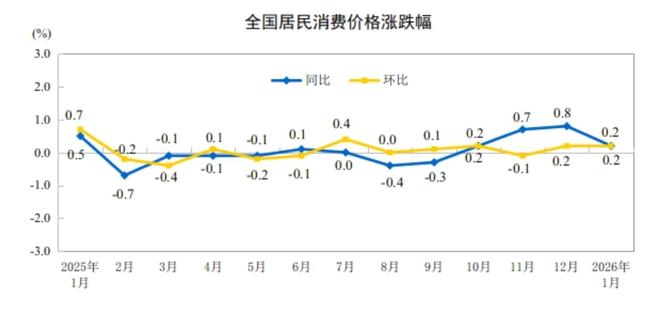
1月CPI、PPI环比均上涨!
Jin Rong Shi Bao· 2026-02-11 11:46
Group 1: Consumer Price Index (CPI) Insights - In January, the CPI increased by 0.2% month-on-month and year-on-year, with the core CPI (excluding food and energy) rising by 0.8% year-on-year, indicating a continued recovery in consumer demand [1][3] - The CPI's month-on-month increase was driven by a 0.2% rise in both urban and rural areas, with non-food prices also increasing by 0.2% [3] - The core CPI's month-on-month increase of 0.3% is the highest in six months, influenced by rising prices for air tickets and travel agency fees, which increased by 5.7% and 2.0% respectively [3] Group 2: Producer Price Index (PPI) Insights - The PPI increased by 0.4% month-on-month in January but decreased by 1.4% year-on-year, marking the second consecutive month of narrowing decline [1][5] - Key factors for the PPI increase include the ongoing construction of a unified national market and rising demand in certain sectors, such as artificial intelligence and digital technologies, which led to price increases in electronic semiconductor materials and external storage devices by 5.9% and 4.0% respectively [5] - The month-on-month increase in industrial purchase prices was 0.5%, with a year-on-year decline of 1.4%, indicating a narrowing of the decline by 0.7 percentage points compared to the previous month [6] Group 3: CPI and PPI Base Period Rotation - The January CPI and PPI data represent the first release after the base period rotation, which is conducted every five years to ensure the price index reflects current consumer behavior [8][9] - The rotation includes adjustments to the "fixed basket" of goods and services, incorporating new categories such as electric vehicle power and internet medical services to better represent current consumption patterns [9][11] - The average impact of the base period rotation on the month-on-month CPI and PPI indices is approximately 0.06 and 0.08 percentage points, respectively, indicating a relatively minor effect [11]