
市场出清

Search documents
刘珺:人工智能时代的金融创新与创新金融
Xin Lang Cai Jing· 2026-02-11 09:19
Group 1 - The core viewpoint emphasizes that financial innovation in the era of artificial intelligence goes beyond mere support and application of technology; it is crucial to redefine financial paradigms through technological innovation [2][19][33] - The future direction of finance is not just "financial innovation" but "innovative finance," accompanied by more disruptive methodologies and system integrations [2][19][33] Group 2 - Digital transformation is leading to qualitative changes in economic paradigms, with China's digital economy expected to reach nearly 50 trillion yuan by 2025, accounting for about 35% of GDP [3][20] - The digital economy exhibits five distinct characteristics: geometric increase in complexity, significant improvement in precision, breaking of supply-demand temporal boundaries, notable wide-area connectivity, and profound adjustments in innovative division of labor [3][20][21][22] Group 3 - The relationship between science and technology is being restructured, with artificial intelligence potentially redefining existing academic classifications and fostering a multidimensional innovation direction [6][23][24] - By the end of 2025, China is projected to have 280,000 enterprises holding 1.764 million high-value invention patents, with enterprises accounting for over 77% of these patents [24] Group 4 - The digital economy necessitates effective market clearing mechanisms to provide a robust launchpad for cutting-edge technological innovation, with significant increases in R&D investment required [8][25] - In 2024, the total R&D investment on the STAR Market is expected to reach 168.078 billion yuan, exceeding net profits by 2.5 times, with a year-on-year growth of 6.4% [25] Group 5 - The concept of "long board" thinking replaces the "short board" mindset in the digital economy, focusing on investing in frontier and alternative technologies rather than merely filling existing gaps [10][27][28] - The investment in short board technologies often leads to unsustainable financial states and resource wastage, while investing in cutting-edge technologies can yield significantly different benefits [10][27] Group 6 - Technological breakthroughs must align with economic and social development to realize their true value, with projected global AI infrastructure capital expenditures reaching 1.4 trillion USD from 2025 to 2027 [12][29] - The mismatch between technological advancement and economic performance has been evident, with total factor productivity declining since 2015, indicating insufficient conversion of technological progress into economic benefits [12][30] Group 7 - True digital transformation requires a fundamental rethinking of underlying logic and methodologies, moving from mere improvements to structural innovations [14][32] - The financial sector should view the implications of Fintech as a transformative force, where technology is not just a tool but a core driver of business restructuring [14][32][33]


茅台跌出机会了吗?
Ge Long Hui· 2026-01-31 09:16
Group 1 - The recent surge in the liquor sector, particularly in the baijiu market, saw an overall increase of over 9% on January 29, with notable gains from companies like Kweichow Moutai and Luzhou Laojiao, while some smaller firms hit their daily limit [1] - The increase in demand for Feitian Moutai, especially as the Spring Festival approaches, has led to a rise in its wholesale price, which recently jumped by 1,000 yuan to exceed 1,700 yuan per bottle [1] - Despite the recent price surge, the fundamentals of the baijiu sector have not fully reversed, with the industry facing significant challenges over the past year, including a decline in the stock price index and numerous companies reporting profit warnings [4][6] Group 2 - The baijiu industry has experienced a significant downturn, with the total production of major baijiu companies halving from 2019 to 2024, while sales revenue has paradoxically increased from 561.8 billion yuan to 796.4 billion yuan, indicating a compound annual growth rate of over 7% [7] - The market sentiment has reached a low point, with only 21.1% of surveyed companies reporting an increase in customer numbers, reflecting a shrinking consumer base [9] - The ongoing price inversion phenomenon highlights the supply-demand imbalance and increasing channel pressures within the industry [12] Group 3 - The historical significance of baijiu as a cultural symbol is being challenged by recent market adjustments, which are shifting focus back to its consumption attributes [17][18] - The competitive landscape is evolving, with a concentration of market share among leading companies, as evidenced by the CR6 firms' profit share rising from 55% in 2014 to 86% in 2024 [15] - The direct sales model adopted by Kweichow Moutai through its iMoutai app is reshaping consumer engagement and pricing strategies, potentially increasing the company's profit margins [20][34] Group 4 - The recent price adjustments and direct sales strategies by Kweichow Moutai are aimed at stabilizing its pricing system while maintaining a degree of premium pricing for older vintages [26][28] - The pressure on other baijiu companies is expected to increase as Moutai's pricing strategies may disrupt the competitive landscape, particularly affecting those in the same price range [41] - The overall outlook for the baijiu industry remains cautious, with expectations for gradual recovery contingent on broader consumer environment improvements [44][45]


助贷平台刮骨疗毒
Bei Jing Shang Bao· 2026-01-15 16:32
Core Insights - The online lending industry is undergoing significant tightening due to regulatory pressures, leading to a drastic reduction in funding availability for lending platforms [1][3][11] - Financial institutions are collectively raising the bar for cooperation with lending platforms, resulting in a clear divide between top-tier and lower-tier platforms [3][4][5] - The market is experiencing a structural tightening where quality assets attract funding while lower-quality platforms struggle to secure capital [7][9][10] Regulatory Changes - Regulatory bodies have mandated that banks and other financial institutions reduce their lending business balances significantly, with some local banks required to cut their lending business by 50% by the end of the year [3][4] - New regulations have led to a significant decrease in the average financing cost for consumer finance companies, with a target of keeping it below 20% starting in Q1 2026 [5][11] - The introduction of a "white list" system for cooperation has resulted in a concentration of resources towards financially robust and compliant lending platforms [11][12] Market Dynamics - The funding landscape is characterized by a rapid decline in loan issuance, with some platforms seeing monthly loan volumes drop from over 17 billion yuan to less than 3 billion yuan [1][7] - There is a notable shift in the funding strategy, where top-tier platforms are favored, while mid-tier and lower-tier platforms face severe funding challenges [6][9] - The overall market is experiencing a supply-demand imbalance, with many platforms unable to meet the funding needs due to regulatory constraints and asset quality concerns [8][10] Industry Outlook - Despite the current turmoil, there is a sense of hope among industry insiders that some lending platforms can survive by differentiating themselves from banks and consumer finance companies [1][12] - The industry is moving towards a more compliant and quality-focused model, with a clear trend towards reducing high-interest loans and focusing on sustainable business practices [11][12] - The potential for new opportunities exists as the market adjusts to the new regulations, with a shift towards lower-risk assets and a focus on operational profitability [12]

资金“断供”,单月放贷从超170亿到不足30亿,助贷平台“刮骨疗毒”
Bei Jing Shang Bao· 2026-01-15 04:21
Core Viewpoint - The online lending industry is undergoing significant tightening due to regulatory pressures, leading to a drastic reduction in funding and operational challenges for many platforms [1][3][11]. Group 1: Regulatory Changes - Financial institutions, including banks and trust companies, are collectively tightening the thresholds for cooperation in online lending, with some local banks required to halt lending activities entirely [3][4]. - A "white list" system has been implemented, resulting in a clear bifurcation in funding availability, favoring compliant and well-capitalized platforms while restricting access for others [3][11]. - New regulations mandate that consumer finance companies reduce their average financing costs to below 20% by Q1 2026, further tightening the lending landscape [5][6]. Group 2: Market Dynamics - The funding market is experiencing structural tightening, with a significant drop in loan issuance from peak levels, particularly among mid-tier platforms [7][8]. - The average monthly loan issuance for some platforms has plummeted from over 17 billion to less than 3 billion [7]. - There is a noticeable shift in funding towards high-quality assets, with lower-tier platforms struggling to secure financing [8][10]. Group 3: Industry Adaptation - The industry is transitioning from a focus on rapid growth to a more sustainable model that emphasizes compliance and quality over quantity [11][12]. - Platforms are exploring new operational strategies, including focusing on lower-risk assets with annual interest rates around 20% to differentiate from traditional banks and consumer finance companies [12]. - Enhanced scrutiny of partner platforms is leading to a more cautious approach in selecting collaborators, with a focus on risk management and compliance [6][10]. Group 4: Future Outlook - Despite current challenges, there is a belief that some platforms can survive by adapting to new regulations and focusing on operational efficiency and customer retention [12][13]. - The industry is expected to complete a transition from "regulatory arbitrage" to "compliance-driven" development, necessitating a reevaluation of business models for smaller institutions [12][13].

2025年德国企业破产数量升至20年来最高水平
Sou Hu Cai Jing· 2026-01-09 00:10
Core Insights - The number of corporate bankruptcies in Germany is projected to reach its highest level in 20 years by 2025, indicating significant economic challenges faced by the country [1][2] Group 1: Bankruptcy Statistics - In 2025, Germany recorded 17,604 corporate bankruptcies, which is approximately 5% higher than the peak during the global financial crisis in 2009 [1] - December 2025 alone saw 1,519 companies declare bankruptcy, representing a 75% increase compared to the average from 2016 to 2019, prior to the pandemic [1] - The hospitality and restaurant sectors experienced a notable rise in bankruptcies, alongside significant failures in the construction industry and project developers [1] Group 2: Large Enterprises - The number of bankruptcies among large enterprises, defined as those with annual revenues exceeding 10 million euros, increased by about 25% in 2025, totaling 471 bankruptcies [1] - Affected industries for large enterprises include metal products manufacturing, automotive parts, electrical engineering, and interior decoration [1] - Since 2021, the number of bankruptcies among large enterprises has nearly doubled [1] Group 3: Economic Implications - The high number of bankruptcies cannot be solely attributed to post-pandemic recovery effects or changes in interest rate policies, but rather reflects the ongoing economic challenges in Germany [2] - Corporate bankruptcies may facilitate necessary market clearing, allowing space for more competitive businesses to emerge [2]
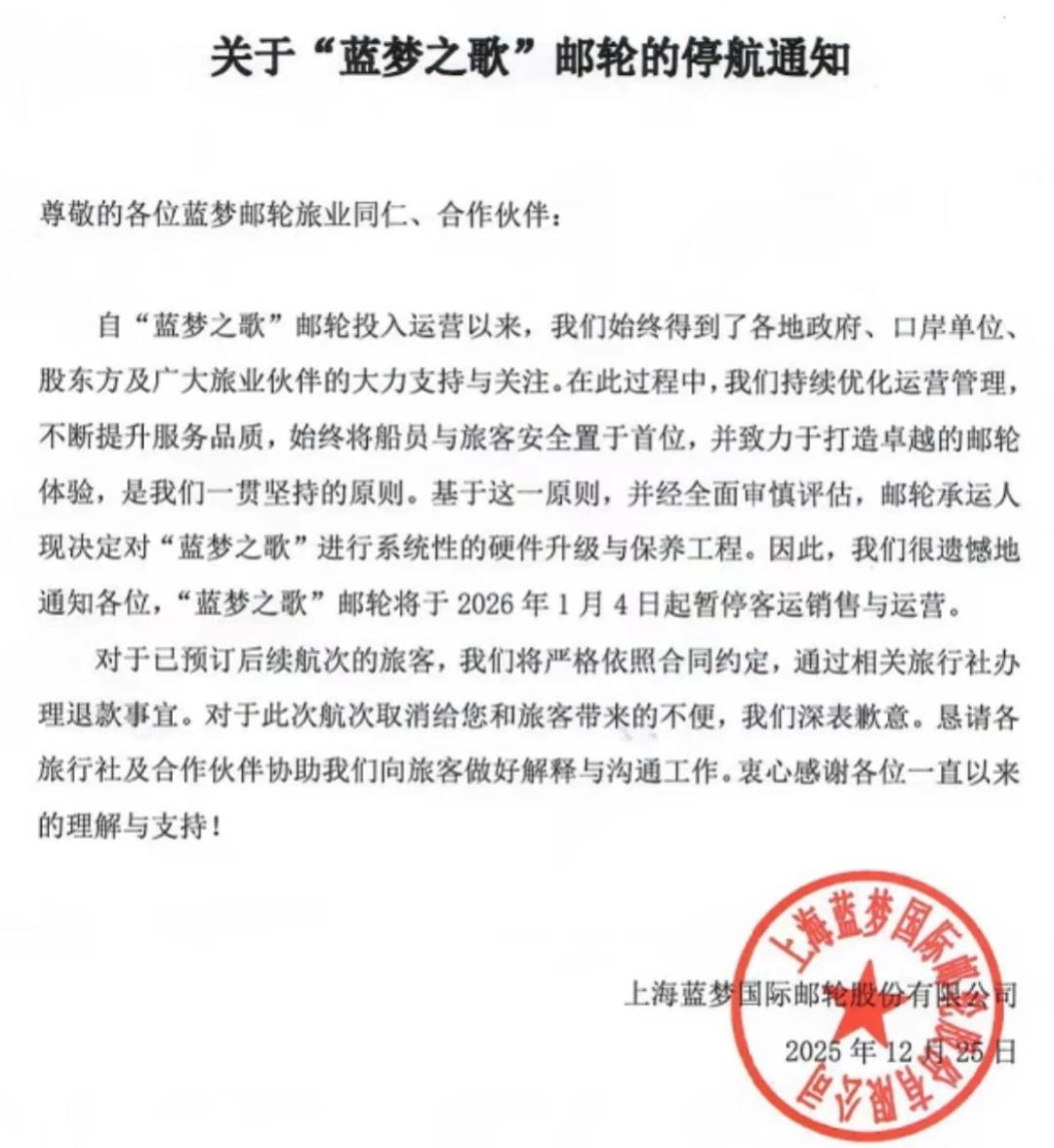
第一艘停业的国内母港邮轮出现了
3 6 Ke· 2025-12-26 03:31
Core Viewpoint - Blue Dream Cruise has announced a systematic hardware upgrade and maintenance project for its ship, Blue Dream Song, leading to the cancellation of upcoming voyages and refunds for booked passengers, indicating potential operational challenges within the company [1][4]. Company Overview - Blue Dream Cruise operates two ships: Blue Dream Star, a small vessel with a displacement of 25,000 tons, and Blue Dream Song, a second-hand ship with a displacement of 42,000 tons and a capacity of approximately 1,200 passengers [5][8]. - The company has faced difficulties due to its limited fleet and resources, leading to the cessation of operations for Blue Dream Star since November of the previous year [6][12]. Market Context - The cruise industry in China is experiencing significant challenges, particularly for smaller operators like Blue Dream, which struggle to compete against larger vessels that offer superior experiences and amenities [13][20]. - The pricing strategy of Blue Dream, which includes extremely low ticket prices, has resulted in a lack of profitability and limited market appeal, especially during peak seasons [26][27]. Financial Implications - The company is facing a cash flow crisis, exacerbated by geopolitical factors affecting short-haul routes, which are crucial for maintaining operational liquidity [32][34]. - Industry experts predict that Blue Dream is likely heading towards bankruptcy restructuring due to its inability to generate revenue from its aging fleet [38][40]. Industry Trends - The Chinese cruise market is shifting towards larger, more capital-intensive operators that can provide enhanced experiences, leaving smaller companies like Blue Dream at a disadvantage [44][48]. - The current market dynamics suggest a harsh culling of weaker players, with only those backed by substantial capital and advanced operational capabilities likely to survive [49].
一次性信用修复政策宽严相济 为诚实者正名也为社会增信心
Mei Ri Jing Ji Xin Wen· 2025-12-23 13:15
Core Viewpoint - The People's Bank of China has introduced a one-time credit repair policy aimed at individuals with damaged credit who have actively fulfilled their repayment obligations, balancing leniency and strictness in governance [1][2][4] Group 1: Policy Intent and Design - The policy aims to provide a "reset" opportunity for individuals who have defaulted due to force majeure events, such as the COVID-19 pandemic, and have since repaid their debts [1][3] - It allows all eligible individuals to benefit from the policy without differentiation between loan institutions or types, implementing an "automatic recognition" mechanism to simplify the process [1][2] Group 2: Strictness and Limitations - The policy strictly defines the timeframe from January 1, 2020, to December 31, 2025, focusing on defaults caused by the pandemic and its aftermath [2] - A cap of 10,000 yuan on single overdue amounts is set to cover common small overdue situations while preventing large-scale malicious defaults from evading restrictions [2] Group 3: Social and Economic Implications - The policy reinforces the value orientation of the credit system, ensuring that honest individuals who have made timely remedies are not penalized, thus fostering a positive credit ecosystem [3][4] - By allowing eligible individuals to regain access to financial services, the policy aims to stimulate consumption and investment, thereby injecting vitality into the economy [3][4]
贷款逾期的记录,有机会一次性“重置”了!央行新政为诚实者正名,也为社会增信心
Mei Ri Jing Ji Xin Wen· 2025-12-22 11:51
Group 1 - The People's Bank of China has officially released a notification regarding the implementation of a one-time credit repair policy aimed at individuals with damaged credit who are actively fulfilling their obligations [1] - The policy is designed to provide a "reset" opportunity for individuals who have experienced non-malicious defaults due to uncontrollable circumstances, such as the COVID-19 pandemic, allowing them to recover from temporary credit issues [2][3] - The policy includes a time frame from January 1, 2020, to December 31, 2025, specifically targeting defaults caused by the pandemic, and sets a limit of 10,000 yuan for single overdue amounts to prevent abuse by malicious defaulters [3] Group 2 - The one-time credit repair policy is expected to facilitate market clearing by allowing eligible individuals to regain access to financial services, which can stimulate consumption and investment, thereby supporting economic growth [4] - The policy balances relief for individuals with the need to maintain the integrity of the credit system, ensuring that those who have not intentionally defaulted and have remedied their situations are not penalized long-term [3][4] - By enabling individuals to access loans for housing, consumption, and business, the policy aims to inject vitality into the economy and enhance the overall functioning of the credit system [4]

茅台集团紧急打响“价格保卫战”
Sou Hu Cai Jing· 2025-12-12 11:06
Core Viewpoint - The recent decline in the price of Feitian Moutai below 1500 yuan, high inventory levels among distributors, and fluctuating stock prices have raised concerns about the end of the "liquid gold" myth. However, the company is undergoing a necessary value reassessment and market clearing, which is essential for healthier and more sustainable development [1]. Group 1: Price and Value - A price correction does not equate to a collapse in value. The current batch price around 1500 yuan has decreased nearly 30% from the peak in early 2025 but remains close to the official guidance price of 1499 yuan, indicating a shift from "financial speculation" to "real consumption" [4]. - The previous years saw a price bubble driven by non-consumption demand, which overstretched long-term potential. The current market correction opens reasonable entry points for genuine consumers, benefiting the core user base and enhancing the opening rate, which is vital for high-end liquor [4]. Group 2: Brand Resilience and Strategy - Moutai's fundamentals remain robust, supported by its unique production area, five-year base liquor storage cycle, and strategic capacity control. Even amid weak consumption, Moutai remains an irreplaceable "social currency" during traditional peak seasons like Mid-Autumn and National Day [4]. - The company has initiated a "stability strategy" to limit supply to low-price channels, strengthen e-commerce cooperation, and combat counterfeit products, effectively curbing disorderly price declines. Historical data shows that Moutai has consistently returned to a stable trajectory after deep corrections due to its strong channel management [4]. Group 3: Growth and Brand Development - The company is actively exploring new growth drivers, optimizing direct sales through the iMoutai digital platform, launching premium products, and expanding into cultural tourism and IP development to enhance brand depth. Moutai is no longer solely reliant on the Feitian product line [6]. - By 2025, the direct sales ratio is expected to exceed 45%, significantly reducing the impact of fluctuations in the traditional distributor system. The government's support for high-quality national brands remains strong, with Moutai recognized as a symbol of Chinese manufacturing and cultural export [6]. - Despite challenges from changing drinking habits among younger consumers and economic cycles, true luxury brands maintain their status through time and quality rather than short-term speculation. The current correction is viewed as a new starting point rather than an endpoint [6].

新乡化纤20251127
2025-11-28 01:42
Summary of Conference Call Notes Industry Overview - The viscose filament market is currently balanced in supply and demand, with stable prices benefiting from increased demand driven by the new national style. It is expected that there will be an annual demand increase of 10,000 to 20,000 tons over the next 3-5 years, allowing the industry to maintain high operational levels [2][3] - The spandex industry is nearing the end of market clearing, with a year-on-year sales growth of 17.8% in the first three quarters of 2025. Prices are stable, and gross margins are at breakeven [2][4] Key Points on Spandex Industry - New spandex capacity additions are close to completion, with very few new capacities expected in 2026 and almost none in 2027. The industry is cautious about new supply [2][6] - Current spandex prices are around 23,000 RMB per ton, down from 24,000-25,000 RMB earlier in the year. Some companies are facing significant operational pressures, such as Xiaoxin Chemical, which has a high debt ratio of 175% [2][7] - The average industry operating rate is between 70% and 80%, with a clear differentiation between leading and trailing companies. Leading companies maintain high operating rates, while trailing companies face greater operational pressures [2][9][10] - The growth in spandex demand is primarily driven by increased penetration in the textile industry, which currently stands at only 1.7%. There is significant room for growth, with a long-term expectation of 8% annual demand growth [2][12] Company Performance - The company reported an 18% year-on-year sales growth, outperforming third-party statistics, as customers prefer products from leading companies. However, gross margins are nearly flat, and net profit may incur a loss of around 500 RMB [2][13][15] - The company is currently operating at full capacity, similar to Huafeng, and is responding to market demand with stable pricing strategies. However, rising costs due to the withdrawal of government subsidies for utilities are a concern [2][11] Future Plans and Projects - The company is in the early stages of the mushroom grass pulp project, with an expected increase in planting area by 20,000 to 30,000 mu annually over the next 3-5 years, which will help reduce raw material costs [2][5][21] - The company has paused a 30,000-ton capacity expansion due to strict air quality controls but plans to build new capacity in Xinjiang as a contingency [2][16] - The company’s inventory level is approximately 25 days, which is lower than the industry average of 35 days, indicating strong global demand growth [2][23] - The strategic focus for 2026 will be on mushroom grass planting, with cautious expansion in spandex production contingent on clear market signals [2][24] Additional Insights - The viscose filament market is expected to remain stable in terms of price and volume in 2026, with no significant fluctuations anticipated [2][17] - The impact of US-China trade relations on viscose filament exports is limited, as the market has already begun replenishing stock since 2024 [2][18][19] - The company is collaborating with brands like Jie Rou, Hong Dou, and Qi Pi Lang for the mushroom grass project, although expansion is currently limited by agricultural planting area [2][20][22]
