平台责任

Search documents
首设四条通道加快好药新药上市
Xin Lang Cai Jing· 2026-02-24 19:18
Core Viewpoint - The newly revised "Regulations for the Implementation of the Drug Administration Law of the People's Republic of China" will officially take effect on May 15, marking the first comprehensive revision in 23 years since its initial implementation [1] Group 1: Encouragement of Drug Innovation - The revision emphasizes encouraging drug research and innovation, supporting the development of new drugs based on clinical value, and improving the quality and efficacy of generic drugs [2] - The regulations establish a fast-track review process for drug approvals, including breakthrough therapies and conditional approvals, to expedite the market entry of new drugs [2] Group 2: Protection of Drug Intellectual Property - A key focus of the revision is to strengthen the protection of drug intellectual property, encouraging continuous research and innovation by enterprises [3] - The introduction of market exclusivity periods for pediatric and orphan drugs aims to promote drug development and better meet clinical needs [4] Group 3: Responsibilities of Online Drug Platforms - The revised regulations clarify the responsibilities of online drug trading platforms, emphasizing the need for strict management and oversight of drug sales on these platforms [5] - Platforms are required to establish dedicated institutions and personnel to manage and audit the qualifications of merchants selling drugs [5] Group 4: Production and Quality Management - The regulations encourage the implementation of quality management standards for traditional Chinese medicine production and set specific standards for the production of traditional Chinese medicine pieces [6] - The revision allows for segmented contract manufacturing of drugs, facilitating the production of innovative drugs that require various technologies and equipment [7]
明确平台责任 畅通维权渠道
Xin Lang Cai Jing· 2026-02-01 19:22
Core Viewpoint - The rapid expansion of shared bicycles and electric bicycles has led to an increase in consumer disputes and safety incidents, highlighting the need for clearer responsibility boundaries and improved consumer protection mechanisms in the industry [1][5]. Group 1: Consumer Disputes - Common disputes include excessive charges due to system errors or vehicle malfunctions, with consumers often facing challenges in reclaiming small amounts, leading to a reluctance to pursue claims [2][3]. - Many platforms cite "system records as the sole billing basis," which allows them to evade responsibility for system failures, leaving users with minimal recourse [2][3]. - The costs associated with pursuing small claims often outweigh the amounts in dispute, resulting in consumer frustration and disengagement from the claims process [2][3]. Group 2: Safety Incidents - Incidents of personal injury and property damage due to vehicle defects are becoming more frequent, with platforms often responding inadequately to claims for compensation [3][5]. - Consumers have reported significant discrepancies between actual damages and compensation offered by platforms, indicating a lack of accountability [3][5]. - The need for platforms to take responsibility for vehicle maintenance and safety is emphasized, with legal experts stating that platforms must compensate users for damages caused by vehicle defects [3][5]. Group 3: Expert Recommendations - Experts suggest that platforms should establish clearer responsibility for vehicle quality and safety, and improve their complaint handling processes [5]. - Recommendations include implementing a "one-click reporting" system for users to report issues, enhancing maintenance checks, and utilizing technology for real-time fault detection [5]. - Legal experts advocate for a tiered approach to dispute resolution, encouraging consumers to utilize available complaint channels before resorting to legal action [5].
新华解码|事关平台规则和直播电商监管 两部新规提出哪些新举措?
Xin Hua She· 2026-01-07 10:32
Core Viewpoint - The new regulations introduced by the State Administration for Market Regulation and the National Internet Information Office aim to enhance the supervision of online trading platforms and live e-commerce, focusing on platform responsibilities and consumer rights protection. Group 1: New Regulatory Measures - The "Live E-commerce Supervision Measures" include traffic control and the regulation of AI-generated content, such as digital human anchors, to prevent the misuse of new technologies for spreading false information [2] - The measures require live e-commerce platforms to take actions against violations by operators, including warnings, limiting functions, and account closures [2] Group 2: Specific Prohibitions - The "Network Trading Platform Rules Supervision Measures" detail prohibitions against practices like "only refunds," "forced choices," and "big data discrimination," ensuring fair treatment of platform operators and consumers [3] - The regulations specify that platforms cannot impose unreasonable restrictions or fees on operators, thereby safeguarding their autonomy and consumer rights [3] Group 3: Transparency and Accountability - The new regulations emphasize the need for platforms to maintain transparency in their rules, ensuring that they are clear and accessible to both operators and consumers [4] - Platforms are required to inform users about any changes in membership rules and provide clear reasons and channels for appeals when negative actions are taken against them [5]
骑手摔餐折射平台责任缺失
Xin Lang Cai Jing· 2026-01-04 22:08
Core Viewpoint - Recent delivery disputes highlight the imbalance in platform rules, leading to conflicts between delivery riders and consumers, with riders bearing the brunt of penalties for delays caused by various uncontrollable factors [1] Group 1: Issues Faced by Delivery Riders - Delivery riders face penalties for delays, which can include deductions from delivery fees and service ratings, as well as potential fines [1] - The reasons for delays are often beyond the riders' control, including slow food preparation by restaurants, complex community registration processes, and unexpected traffic conditions [1] Group 2: Consumer Rights and Platform Responsibilities - Consumers have the right to refuse late deliveries, which is intended to ensure service quality; however, the platform lacks a corresponding mechanism for negotiation and buffer space [1] - The current system can lead to consumers inadvertently penalizing riders for exercising their rights, highlighting a failure in the platform's responsibility [1] Group 3: Regulatory Developments and Industry Reforms - The recently implemented "Basic Requirements for Delivery Platform Service Management" outlines criteria for calculating delivery times and mandates that orders should not be pushed after four hours [2] - Some platforms are beginning to pilot reforms such as eliminating late penalties, establishing income guarantees, and differentiating responsibility among parties, indicating a positive direction for the industry [2] Group 4: Recommendations for Sustainable Development - The industry needs a scientific rule system that moves away from punitive measures and towards a fair evaluation framework [2] - Platforms should consider real-world variables in their models, allowing riders reasonable flexibility in delivery times [2] - Establishing efficient communication and complaint mechanisms, along with robust occupational injury protection for riders, is essential for their support and security [2]
美欧数字监管冲突升级,进一步加深跨大西洋关系裂痕
Xin Lang Cai Jing· 2026-01-03 03:47
Core Viewpoint - The EU's enforcement of the Digital Services Act has escalated tensions between the US and Europe, with the US imposing travel restrictions on EU officials in response to a significant fine levied against Musk's platform X [1][3][5]. Group 1: Regulatory Context - The EU's Digital Services Act, passed in 2022, mandates large internet platforms to prevent the spread of illegal content and hate speech, impacting major US tech companies like Apple, Google, and X [3][5]. - The first fine under this act was imposed on X, amounting to €120 million (approximately $130 million), which has drawn strong discontent from the US [3][5]. Group 2: Political Implications - The US sanctions against EU officials are seen as a challenge to the EU's digital governance authority, indicating a shift from mere policy disagreements to a deeper political conflict [3][6]. - The US government has previously threatened retaliation against the EU's digital regulations, using them as leverage in trade negotiations [6][7]. Group 3: Internal Pressures - Both the US and EU face internal pressures to adopt more aggressive stances in their digital regulatory disputes, with US lawmakers advocating for harsher measures against EU officials [7][10]. - The EU Commission's cautious response to US sanctions has sparked debate within Europe, with some leaders calling for a stronger stance against US actions [10][12]. Group 4: Future Outlook - The ongoing digital dispute reflects fundamental differences in governance philosophies between the US and EU, with potential for further escalation as both sides prepare for future regulatory actions [15][16]. - The EU's ability to assert its digital sovereignty and respond effectively to US pressures will be critical in shaping the future of transatlantic relations [16].



“避雷”难倒小红书
3 6 Ke· 2025-12-25 02:56
Core Viewpoint - The incident involving the "avoidance posts" on Xiaohongshu has raised significant concerns regarding the platform's responsibility in content moderation and the impact of user-generated content (UGC) on businesses in the tourism sector [1][2][3]. Group 1: Incident Overview - The Cultural and Tourism Bureau of Lijiang City publicly requested Xiaohongshu to enhance its information auditing and monitoring in the wedding photography sector, citing inadequate platform responsibility [1]. - The bureau reported that over 1 million yuan in refunds and indirect losses exceeding 5 million yuan were incurred by businesses due to false avoidance posts [1][3]. - The Lijiang Wedding Photography Industry Association has refused further negotiations with Xiaohongshu and is preparing for a collective public lawsuit against the platform [3]. Group 2: User Reactions and Content Types - The discussion around "avoidance posts" has polarized users, with some viewing them as necessary consumer protection while others fear excessive regulation may stifle genuine sharing [2]. - "Avoidance posts" on Xiaohongshu can be categorized into three types: service-related complaints, experience discrepancies, and clickbait posts [4][5]. - The first type focuses on service irregularities, the second on the gap between expectations and reality, and the third aims to attract attention but often misrepresents the content [4][5]. Group 3: Platform Dynamics and Challenges - Xiaohongshu's community is built on UGC, which has fostered a high level of trust among its 350 million monthly active users, but the line between genuine feedback and marketing content has blurred [5][6]. - The platform faces challenges in distinguishing between legitimate user feedback and malicious posts, leading to potential reputational damage for businesses [9][11]. - The legal implications of "avoidance posts" are significant, as they can lead to accusations of defamation or malicious intent if they lack factual basis [12][13][16]. Group 4: Legal and Ethical Considerations - Legal experts emphasize that distinguishing between genuine avoidance and malicious defamation hinges on factual accuracy and intent [13][16]. - Platforms like Xiaohongshu may not be liable for all content but have a responsibility to act on complaints and evidence of false information [16][17]. - The ongoing conflict highlights the need for clearer guidelines and mechanisms for content moderation to protect both consumers and businesses [17][18].

650万元牛奶羊奶驼奶全是“狠活” 平台失察纵容,难辞其咎
Mei Ri Jing Ji Xin Wen· 2025-12-02 13:39
Core Viewpoint - The recent investigation by CCTV has exposed a fraudulent milk powder production chain, revealing the alarming presence of counterfeit dairy products in the market, which has raised significant concerns about food safety in China [1][4]. Group 1: Fraudulent Production and Distribution - The counterfeit milk powder was produced in unsanitary conditions, using low-cost ingredients like vegetable fat and maltodextrin, and was falsely marketed as high-quality imported products [1]. - The scale of the fraud involved over 6 million yuan, with more than 6,000 boxes of fake milk powder distributed nationwide through e-commerce and social media platforms [1]. - The profit margins for the counterfeiters exceeded 10 times, with production costs ranging from 2 to 4 yuan, while retail prices on e-commerce platforms reached 30 to 88 yuan [1]. Group 2: Role of E-commerce Platforms - E-commerce platforms facilitated the distribution of counterfeit products through precise algorithmic targeting, reaching health-conscious consumers and price-sensitive groups [2]. - The low-cost, wide-reaching distribution model allowed small-scale producers to access a national market without the need for physical storefronts, significantly enhancing the scale of fraud [2]. - Trust in these platforms was manipulated by influencers promoting the products as "overseas direct supply" and "duty-free specials," which misled consumers and created a false sense of security [2]. Group 3: Regulatory and Legal Implications - Existing laws, such as the Food Safety Law and the E-commerce Law, clearly define the responsibilities of e-commerce platforms in ensuring food safety and holding them accountable for counterfeit products [3]. - The involved platforms failed to verify essential documentation for the counterfeit products, indicating a serious neglect of their regulatory responsibilities [3]. - The legal framework emphasizes that platforms cannot evade responsibility by claiming non-self-operated sales, and regulatory bodies must enhance accountability measures against negligent platforms [4].
650万元牛奶羊奶驼奶全是“狠活”没有奶,平台失察纵容也难辞其咎
Mei Ri Jing Ji Xin Wen· 2025-12-01 10:27
Core Viewpoint - The recent investigation by CCTV has exposed a fraudulent milk powder industry chain, revealing the production of fake milk powder that is marketed as high-quality products but contains no real milk, leading to significant consumer deception and financial losses [1][2]. Group 1: Fraudulent Production and Sales - The fake milk powder was produced in a poor-quality environment using low-cost ingredients, with production costs ranging from 2 to 4 yuan, while retail prices on e-commerce platforms reached between 30 to 88 yuan, resulting in profits exceeding ten times the cost [1][2]. - Over 6,000 boxes of counterfeit milk powder were distributed nationwide through e-commerce and social media platforms, with the total amount involved exceeding 6.5 million yuan [1]. Group 2: Role of E-commerce Platforms - E-commerce platforms facilitated the distribution of counterfeit products through precise algorithmic targeting, reaching health-conscious consumers and price-sensitive groups [2]. - The lack of physical storefronts allowed for low-cost, widespread distribution of fake milk powder, which traditional sales methods could not achieve [2]. - Trust was falsely constructed by influencers using marketing tactics that misled consumers, combined with the platforms' perceived reliability, which contributed to the ease of selling counterfeit products [2]. Group 3: Regulatory and Legal Framework - China's food safety laws clearly define the responsibilities of e-commerce platforms, mandating them to verify the credentials of food sellers and hold them accountable for consumer harm [3]. - The involved platforms failed to verify essential documentation for the so-called "imported milk powder," allowing false advertising to proliferate without scrutiny [3]. - Regulatory authorities are urged to enhance accountability measures against platforms that neglect their responsibilities, emphasizing that both production and distribution channels must be addressed to eliminate food safety risks [4].

每经热评|650万元牛奶羊奶驼奶全是“狠活”没有奶 平台失察纵容也难辞其咎
Mei Ri Jing Ji Xin Wen· 2025-12-01 09:11
Core Viewpoint - A recent investigation revealed a counterfeit milk powder industry in China, highlighting significant issues in food safety and platform accountability [1][3]. Group 1: Counterfeit Milk Powder Case - The counterfeit milk powder operation involved mixing plant-based ingredients and industrial flavoring to create fake products marketed as high-end milk powders, with a total case value exceeding 6.5 million yuan [1]. - Over 6,000 boxes of counterfeit milk powder were distributed nationwide through e-commerce and social media platforms, deceiving many consumers [1]. - The profit margin for counterfeiters exceeded 10 times, with production costs as low as 2 to 4 yuan, while retail prices ranged from 30 to 88 yuan [1]. Group 2: Role of Platforms - Platforms facilitated the distribution of counterfeit products through precise algorithmic targeting, reaching health-conscious consumers and price-sensitive groups [2]. - The low-cost, wide-reaching nature of online sales allowed a small workshop in Henan to cover the entire national market without physical storefronts [2]. - Trust was falsely constructed by influencers using marketing tactics that misled consumers about the legitimacy of the products, leading to a false sense of security regarding platform integrity [2]. Group 3: Regulatory and Accountability Issues - Existing laws, such as the Food Safety Law and E-commerce Law, clearly define the responsibilities of e-commerce platforms in ensuring food safety and holding them accountable for counterfeit products [3]. - The involved platforms failed to verify essential documentation for the counterfeit milk powder, indicating a serious neglect of their regulatory responsibilities [3]. - The need for stricter enforcement of platform accountability is emphasized, as merely punishing producers is insufficient to eliminate food safety risks [4].
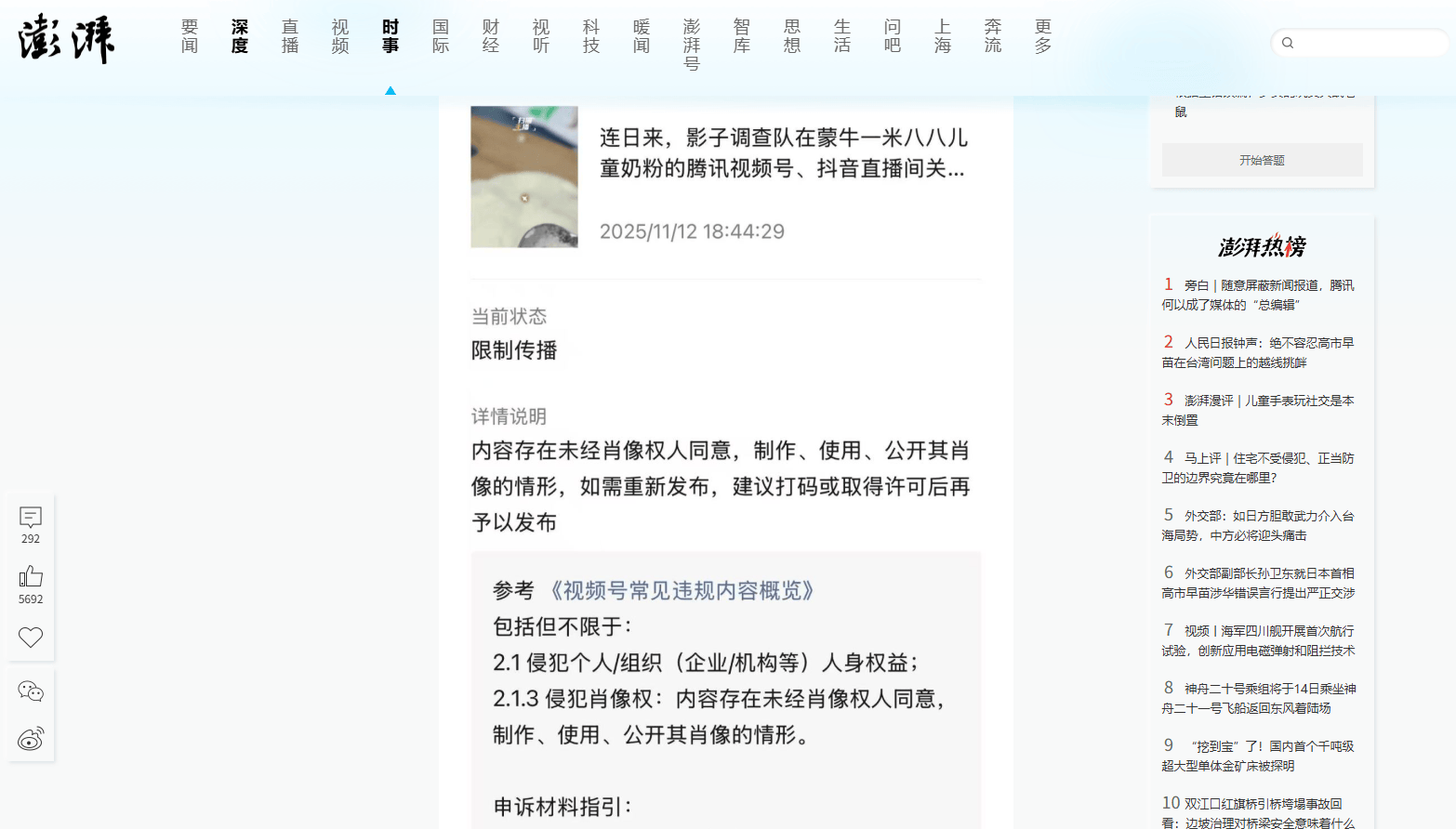
澎湃没有惯着腾讯
Sou Hu Cai Jing· 2025-11-14 12:11
Core Viewpoint - Tencent faces criticism from the media outlet 澎湃 for its decision to block a news report, raising concerns about the role of information aggregation platforms in media censorship [2][6]. Group 1: Incident Overview - 澎湃's investigation team reported on a live-streaming host making false claims about height increase, which was subsequently blocked by Tencent after a complaint was received [3][5]. - This incident marks the second time the investigation team's content has been blocked since its launch [5]. Group 2: Legal and Ethical Concerns - 澎湃 argues that Tencent's actions violate the principles outlined in the Civil Code and the Internet News Information Service Management Regulations, questioning the legitimacy of blocking news based on a single complaint [6]. - The outlet criticizes Tencent for allowing the misuse of the complaint mechanism, which could lead to undue interference in news reporting [6]. Group 3: Broader Implications - Many media professionals support 澎湃's stance, expressing frustration over the lack of recourse against such platform actions, emphasizing that complaints should be based on evidence and thorough investigation [8][10]. - The situation reflects a broader concern about the power dynamics between platforms and media, with calls for platforms to not act as the "editor-in-chief" of news content [7][12].