成长股

Search documents
Descartes Systems (DSGX) is an Incredible Growth Stock: 3 Reasons Why
ZACKS· 2026-02-20 18:46
Growth stocks are attractive to many investors, as above-average financial growth helps these stocks easily grab the market's attention and produce exceptional returns. However, it isn't easy to find a great growth stock.That's because, these stocks usually carry above-average risk and volatility. In fact, betting on a stock for which the growth story is actually over or nearing its end could lead to significant loss.However, the task of finding cutting-edge growth stocks is made easy with the help of the Z ...



星巴克需要你在下午买一杯冰萃饮品
Xin Lang Cai Jing· 2026-02-20 15:25
Core Viewpoint - Starbucks is regaining morning customers but must capture the afternoon market to win back investor favor [2][12] Revenue Structure - Over half of the sales (approximately $12 billion annually) at U.S. company-operated stores occur before 11 AM [2][12] - After the morning caffeine peak, customer traffic significantly declines, leading to a low-traffic period [2][12] CEO's Strategy - CEO Brian Niccol aims to improve afternoon efficiency to match the peak morning hours from 7 AM to 9:30 AM, which could enhance store profitability and revive stagnant stock [2][12] Investor Sentiment - Investors are currently optimistic, with the stock rising 14% this year due to strong early performance signals [5][14] - Starbucks reported its strongest same-store sales growth in two years, indicating improved operational efficiency and transaction volume [5][14] - The company projects revenue growth of 5% or higher by fiscal year 2028 [5][14] Valuation Concerns - The stock's expected price-to-earnings ratio is around 37, significantly higher than competitors like McDonald's [5][14] - To justify this high valuation, Starbucks must not only recover morning traffic but also drive internal growth [5][14] Afternoon Market Opportunity - The afternoon period presents a significant opportunity, but it is challenging to develop [6][14] - Starbucks has been attempting to create a true consumption peak in the afternoon, investing in staff, faster equipment, and redesigned seating to enhance store appeal [6][14] Industry Comparisons - Successful turnarounds in the restaurant industry often come from expanding consumption into new time slots, as seen with McDonald's breakfast offerings [6][15] Brand Strategy - Starbucks is attempting to transform into a true all-day snack and beverage brand, which presents strategic contradictions [7][16] - The company is reviving its core brand identity and promoting a cozy café atmosphere while also offering a range of afternoon products [7][16] Consumer Trends - As the day progresses, consumers tend to shift towards sparkling drinks, iced teas, or cold brew energy drinks, indicating a need for Starbucks to adapt [7][16] - Starbucks must balance restoring its classic café vibe while promoting a full suite of afternoon offerings [8][16] Product Innovations - The company is implementing electronic menu boards to highlight afternoon products like matcha drinks and protein energy balls [8][17] - New beverage platforms are being introduced, allowing customers to customize sweetness and caffeine levels, which aligns with health trends [9][17] Afternoon Business Growth - Starbucks' afternoon business is already substantial, but filling the gap between morning lattes and afternoon energy boosts is essential for growth [9][18]


高盛:全球市场“巨变”:“实体”回归,“科技”分化
美股IPO· 2026-02-13 03:27
Core Viewpoint - Goldman Sachs indicates that the global bull market is not over, but the driving forces have shifted from crowded US tech stocks to emerging markets, commodities, and value stocks [1][3] Group 1: Market Dynamics - Funds are moving from over-congested US tech stocks to emerging markets (EM), commodities, and "old economy" value stocks [3] - The MSCI Emerging Markets Index has risen from 100 to nearly 120 relative to developed markets since the beginning of 2025, indicating a significant revaluation [7] - Despite geopolitical uncertainties, the stock market shows resilience, largely due to strong fundamentals and improved macro and micro drivers [9][8] Group 2: AI and Technology Sector - AI capital expenditure is projected to reach $659 billion, but concerns over return on investment (ROI) are rising, leading to significant differentiation among the "Magnificent Seven" tech stocks [4][14] - The software sector is experiencing a crisis as AI innovations threaten traditional SaaS models, resulting in a sharp decline in software valuations [5][16] - The correlation among the "Magnificent Seven" has sharply decreased, with varying returns; for instance, Google's return is around 66%, while others like Apple and Amazon lag behind [14][16] Group 3: Value Stocks and Old Economy - There is a revival of interest in value stocks, which were previously seen as "value traps," as some are successfully transforming into "value creators" by generating higher cash flows [18][19] - Capital expenditures in traditional sectors like utilities and telecommunications are increasing, driven by the need for infrastructure to support tech growth [17] - The performance of financial assets has reversed, with gold, emerging markets, and value stocks outperforming tech stocks, marking a significant shift in market dynamics [20] Group 4: Diversification and Future Outlook - The era of diversification is emerging, as the sources of growth are expanding beyond large tech stocks, with strong earnings growth across various sectors [22][23] - Analysts have raised earnings forecasts for 2026 unusually early, particularly for emerging markets, indicating a shift in investment opportunities [12][23] - Investors are encouraged to reassess long-standing allocation habits and diversify across regions, sectors, and styles to capitalize on the changing market landscape [23]


全球市场“巨变”:“实体”回归,“科技”分化
Hua Er Jie Jian Wen· 2026-02-12 12:57
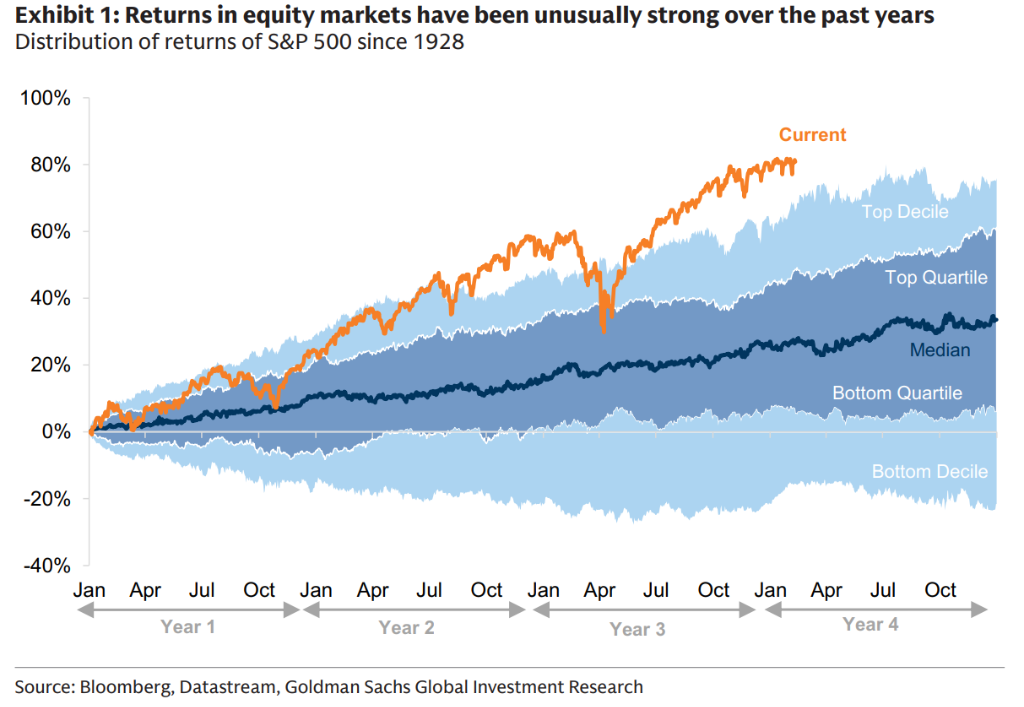
如果你还在盲目迷信"美股科技独大"的叙事,是时候醒醒了。高盛最新的全球战略报告揭示了一个正在发生的范式转变:虽然牛市尚未终结,但 驱动引擎已经彻底更换。 据追风交易台,高盛分析师Peter Oppenheimer及其团队发布研报指出,长久以来"金融资产"碾压"实物资产"的时代正在逆转,2025年美国市场首 次落后全球其他主要市场,新兴市场强势回归。全球市场正处于一个明显的周期晚期"乐观"阶段,但内部正在发生剧烈的分化: 资产轮动: 资金正在从过度拥挤的美国科技股流向新兴市场(EM)、大宗商品和"旧经济"价值股。 AI祛魅与分化: AI资本支出虽高达6590亿美元,但投资回报率(ROI)焦虑开始蔓延,Mag7不再齐涨共跌,内部表现剧烈分化。 软件业危机: AI代理的出现被视为对传统SaaS模式的颠覆,导致软件板块估值大幅杀跌。 实物为王: 虚拟世界的增长现在受制于物理世界(能源、数据中心),导致公用事业和资本密集型行业的资本支出(Capex)激增, 推高了实物资产的价值。 全球牛市延续,但美股不再是唯一主角 2025年,一个历史性的转变悄然发生。尽管标普500指数表现依然强劲,但美国市场在本地货币和美元计价下均 ...
美股轮动风暴背后,竟是2001年与2022年的崩盘魅影!
Jin Shi Shu Ju· 2026-02-04 12:48
Core Viewpoint - The recent decline in U.S. tech stocks has led to a relative strength in value stocks, indicating a potential shift in market dynamics that may just be beginning [1][2]. Group 1: Market Trends - The Russell 1000 Value Index has risen by 8.6% since early November last year, outperforming its growth counterpart by 14 percentage points, which historically suggests further gains for value stocks [1]. - The recent outperformance of value stocks has raised concerns, as similar patterns preceded significant market downturns in 2022 and 2001 [1]. - A consensus is forming on Wall Street that the era dominated by large tech stocks may be nearing its end, as evidenced by a recent sell-off in tech stocks following declines in software manufacturers [1]. Group 2: Analyst Insights - Andrew Greenebaum from Jefferies believes the rotation towards value stocks is just beginning, with significant room for value stocks to outperform growth stocks over a longer time frame [2]. - Historical analysis indicates that periods of value stock outperformance often coincide with economic recovery phases or GDP growth acceleration [2]. - Doug Beath from Wells Fargo notes that since late October, investors have increasingly favored cyclical stocks, often at the expense of large-cap growth stocks [3]. Group 3: Valuation Dynamics - The current market environment has created a significant valuation gap between growth and value stocks, making value stocks particularly attractive [4]. - The past 15 years have seen growth stocks outperform value stocks by an average of 7% annually, but this trend may be reversing as high valuations and strong profit growth are already priced in for growth stocks [4]. - Greenebaum highlights that low market expectations for value stocks provide room for price increases, even with average performance [5]. Group 4: Future Projections - Despite the positive outlook for value stocks, there are concerns regarding profit growth, with projected earnings growth for value stocks at 6.4% compared to 27.1% for growth stocks by 2026 [5]. - Noah Weisberger from BCA Research suggests that as the bull market matures, overall stock market returns will likely be more closely tied to earnings growth rather than valuation increases [5][6]. - Weisberger also notes that while relative valuations may signal a rotation, the leading sectors may not change entirely, indicating a potential convergence between lagging and leading sectors [6].
特斯拉Q4财报解读:灾难性的一季
美股研究社· 2026-01-29 12:09
Core Viewpoint - Tesla's recent quarterly earnings report slightly exceeded market expectations, but the actual operational data is underwhelming, leading analysts to conclude that Tesla currently lacks investment value [2][3]. Financial Performance - Revenue and profit metrics slightly surpassed market consensus, but the overall performance is disappointing, with a year-over-year revenue decline in Q4 [3]. - Q4 revenue dropped 11% year-over-year, with a more significant 17% decline quarter-over-quarter, primarily due to weak automotive sales [3][6]. - Adjusted EBITDA margin fell from 16.9% to 16.7%, indicating a continuous decline in profit margins [7]. - Q4 earnings per share (EPS) dropped 60% year-over-year under GAAP, and adjusted EPS fell 17% [7]. Cash Flow and Capital Expenditure - Operating cash flow for Q4 was $3.8 billion, down over 20% year-over-year, while free cash flow decreased by 30% to $1.4 billion [8]. - The projected annual free cash flow is between $5 billion and $6 billion, resulting in a historical free cash flow P/E ratio of approximately 250 times [8][10]. - Despite a year-over-year decrease in capital expenditures, free cash flow still declined, raising concerns about the sustainability of growth plans [9]. Market Position and Valuation - Tesla's automotive revenue is declining while the energy business, which grew 25% year-over-year, is too small to offset the automotive downturn [6][10]. - Analysts believe Tesla is significantly overvalued, with a historical free cash flow P/E ratio of 250 times and a P/E ratio of about 400 times based on the last 12 months' earnings [10]. - The company's future growth is heavily reliant on the autonomous taxi and robotics sectors, where it lags behind competitors like Waymo [10][11]. Analyst Sentiment - Analysts maintain a bearish outlook on Tesla, citing the struggles in its core automotive business and the lack of progress in its future ventures as reasons for skepticism [12].


未知机构:交易台高盛中国市场总结上证指数001科创501-20260121
未知机构· 2026-01-21 02:20
Summary of Key Points from Conference Call Industry Overview - The report focuses on the Chinese stock market, specifically the performance of various indices including the Shanghai Composite Index, ChiNext Index, and others [1][2][4]. Core Insights and Arguments - The Shanghai Composite Index decreased by 0.01%, while the ChiNext Index fell by 1.58% [1][2]. - The Shanghai 50 Index dropped by 0.17%, and the CSI 300 Index declined by 0.33% [1][2]. - Total trading volume reached 2.80 trillion RMB, reflecting a 2.5% increase from the previous day [1][2]. - A-shares experienced a slight decline, primarily due to weakness in growth stocks [1][2]. Sector Performance - The memory sector showed relative resilience due to a sustained supply shortage cycle [2][3]. - The banking and insurance sectors outperformed the market as funds rotated from growth stocks to value stocks [4]. - Real estate stocks gained traction amid speculation of upcoming housing policies from the National Development and Reform Commission, with Poly Developments reporting better-than-expected preliminary annual net profits, boosting market sentiment [5]. - The building materials and home appliance sectors also rose, driven by the strength in the real estate sector [6]. Additional Important Insights - The first effective day for margin ratio adjustments was noted, with financing balances decreasing by 8.4 billion RMB, ending a previous trend of continuous growth [7]. - The proportion of financing transactions in the total trading volume of A-shares fell to 9.82%, marking the first time it has been below 10% since mid-December of the previous year [7]. - The report indicates a strategic positioning where the firm is a buyer in the chemicals, tourism, and storage sectors, while being a seller in consumer electronics, metals, and machinery sectors [8].
花旗发布2026年投资展望:美股成长股仍有增长空间,美联储政策利率或降至2.5%以下,大宗商品看好铝价中期表现
Sou Hu Cai Jing· 2026-01-19 01:55
Core Insights - Citigroup has released its "2026 Global Investment Outlook," providing predictions for key market indicators in 2026 [1] Market Performance - Growth stocks are expected to continue performing well, with an anticipated return of approximately 17%, while the S&P 600 small-cap value stocks, which have relatively low valuations and cyclical resilience, are projected to yield a return of 21% [3] Monetary Policy - The U.S. monetary policy still has room for easing, with the Federal Reserve potentially lowering the policy rate to below 2.5% by 2026; in contrast, the European Central Bank is expected to maintain its policy rate at around 2% at least until 2027 [3] Inflation Trends - The overall consumer price index in the U.S. may approach zero growth in 2026, while core personal consumption expenditure inflation is expected to gradually decline; however, medium to long-term inflation risk premiums may still rise, indicating ongoing uncertainty regarding future inflation [3] Commodity Prices - The outlook for aluminum prices is positive, with a target range of $3,500 to $4,000 per ton; the natural gas market is facing supply pressures, with European TTF natural gas prices projected to be around €22 per megawatt-hour by 2027 [3] Foreign Exchange Market - The U.S. dollar is likely to remain relatively strong in the first half of 2026, with the euro to dollar exchange rate potentially falling to 1.1; in a relatively stable global risk environment, currencies with high interest rate differentials are expected to perform notably well [3]

高盛闭门会-美股2026展望看好顺周期板块-ai交易从资本支出到生产力提升
Goldman Sachs· 2026-01-16 02:53
Investment Rating - The report maintains a positive outlook on the cyclical sectors and anticipates a strong growth trajectory for the S&P 500 index, targeting a level of 7,600 points by 2026 with a total return rate of 12% [1][3]. Core Insights - The S&P 500 index is expected to achieve a total return of 18% in 2025, driven primarily by earnings growth, with a projected 12% earnings growth leading to an EPS target of $305 [3]. - The report highlights the importance of healthy economic fundamentals, strong profitability of large-cap stocks, and the incremental profits from AI applications as key drivers of market performance [1][3]. - Despite high current market valuations, the report argues that high-profitability stocks deserve higher valuations, and there are no significant signs of speculative bubbles [1][4]. Summary by Sections Economic Outlook - The U.S. economy is projected to grow at nearly 3% this year, with a slight slowdown expected in the second half of the year [3][6]. - The report emphasizes that while there may be fluctuations due to interest rate changes, the overall economic cycle is unlikely to end soon [5][6]. Market Valuation - Current market valuations are high, but the report suggests that this is not a barrier to future performance, as high-profitability stocks are justified in their valuations [4][7]. - The concentration risk in the market is deemed manageable, with the top ten stocks accounting for 31% of earnings, and their valuations, while above average, remain below historical peaks [7]. Sector Recommendations - The cyclical sectors are expected to benefit from favorable economic conditions, with particular attention on the middle-income consumer segment and non-residential construction [1][8]. - The report suggests that healthcare and consumer staples are undervalued and recommends allocating defensive assets to balance risk [2][11]. AI and Capital Expenditure - AI-related transactions are anticipated to continue evolving, with significant capital expenditures expected to rise to approximately $540 billion in 2026, despite a slowdown in growth rate [9][10]. - The report categorizes AI-related investments into four stages, highlighting the potential for differentiation among companies within the AI space [9]. Specific Investment Strategies - The report outlines three specific investment strategies: focusing on companies that have demonstrated AI productivity gains, targeting cyclical sectors benefiting from infrastructure investments, and identifying consumer companies likely to benefit from tax refund spending [13][14].
投资笔记:科技无法改变的、选准和拿住、对成长的误解
Sou Hu Cai Jing· 2026-01-11 12:50
Group 1 - The core insight is that high technology cannot change certain fundamental human experiences, such as the taste of chewing gum, which should be considered when selecting investment targets [3] - Companies that possess characteristics that remain unaffected by technological advancements are deemed important for long-term investment [3][4] - Industries related to basic human needs, such as food and health, are highlighted as areas that will always have demand regardless of technological changes [3] Group 2 - The difficulty in investing lies not only in selecting stocks but also in holding them, with many investors failing to achieve satisfactory returns due to challenges in both areas [5] - Identifying strong companies among the over 5,000 listed in the market is feasible, as many excellent companies are transparent and well-known [5] - The ability to hold stocks is more challenging and tests an investor's temperament, risk tolerance, and adherence to investment philosophy [5][6] Group 3 - There is a common misunderstanding of "growth stocks," which are often perceived as companies with short-term explosive potential or those that maintain high growth rates [7][8] - The correct definition of growth stocks, according to investment master Fisher, emphasizes long-term sustainability and strong operational efficiency rather than just short-term profit maximization [8][9] - Companies that focus on long-term health and development, rather than solely on profit, are the true growth stocks that investors should seek [9]