
现代化产业体系建设

Search documents
中信证券朱烨辛:中国资产的全球吸引力持续上升
Xin Lang Cai Jing· 2026-03-20 03:26
Group 1 - The core viewpoint emphasizes the strong strategic resonance between Chinese enterprises going global and the internationalization of the Renminbi, which opens up vast imagination space for the systematic revaluation of Chinese assets [1] - The external environment is increasingly impacted by international economic and trade conflicts, geopolitical tensions, and a volatile financial environment, which collectively weaken the resilience and growth potential of the global economy [1] - China's economy is positioned as a stable anchor and main engine for global economic growth, with a projected GDP growth target of 4.5%-5% for 2026, reflecting a focus on economic quality and structural adjustments [1] Group 2 - The implementation of a more proactive fiscal policy and moderately loose monetary policy is expected to release strong signals for stable growth and reform, with a fiscal deficit target set at around 4% and plans to issue long-term special bonds totaling 1.3 trillion yuan [2] - The macroeconomic policy will emphasize collaboration between fiscal and financial measures, directing funds towards consumption, employment stability, and technological advancement [2] - The transformation of old and new growth drivers is anticipated to lead to a qualitative leap, reshaping the pricing logic of core Chinese assets through the construction of a modern industrial system and the globalization of Chinese enterprises [2] Group 3 - The capital market ecosystem is improving, enhancing the attractiveness of Chinese assets, with a focus on stabilizing the market and developing a long-term investment environment [3] - Regulatory measures are being strengthened to combat financial fraud and insider trading, alongside the enforcement of mandatory delisting rules, which purify the market environment [3] - The multi-tiered capital market system is becoming more inclusive, with reforms in the ChiNext board and optimized refinancing mechanisms to support new industries and technological innovation [3]

2月通胀点评:输入性因素的影响或放大
Bank of China Securities· 2026-03-09 07:39
Inflation Overview - February CPI increased by 1.3% year-on-year, the highest in nearly three years, driven significantly by food prices which contributed approximately 0.30 percentage points to the CPI increase[7] - February CPI rose by 1.0% month-on-month, marking the highest growth in two years, with food prices contributing about 0.33 percentage points[7] - Core CPI in February grew by 1.8% year-on-year, up 1.0 percentage points from January[4] Price Contributions - Service prices increased by 1.6% year-on-year, contributing approximately 0.75 percentage points to the CPI[7] - In February, the combined impact of airfares, transportation rentals, travel agency fees, and hotel accommodation accounted for about 0.32 percentage points of the CPI increase[6] - The prices of aquatic products, fresh fruits, pork, lamb, beef, eggs, and poultry collectively influenced the CPI to rise by approximately 0.34 percentage points[5] PPI Trends - February PPI increased by 0.4% month-on-month, with production materials rising by 0.5%[18] - Year-on-year, February PPI decreased by 0.9%, but the decline is narrowing, indicating a potential upward trend in PPI throughout the year[25] - The increase in PPI is influenced by rising international prices of non-ferrous metals and crude oil, which have led to price increases in related domestic industries[24] Risks and Outlook - The report highlights risks of a second wave of global inflation and potential rapid economic downturns in Europe and the U.S.[37] - The ongoing geopolitical tensions in the Middle East have caused international oil prices to rise sharply, which may further impact domestic inflation in March[7]
未知机构:华泰晨报0306两会行稳致远名义增长5CPI2就业目标5-20260306
未知机构· 2026-03-06 02:20
Summary of Key Points from Conference Call Records Industry or Company Involved - **Industry**: Energy, Technology, Public Utilities, Automotive - **Companies Mentioned**: 银轮股份 (Yinlun), 比亚迪 (BYD), 东方电气 (Dongfang Electric), 杰克科技 (Jack Technology), 哔哩 (Bilibili) Core Insights and Arguments - **Economic Indicators**: The nominal growth target is set at 5%, with a CPI of 2% and an employment target of 5.5%. The deficit ratio is at 4%, and there is a slight decrease in bank injections into special government bonds, indicating a flexible monetary policy [1][3] - **Yinlun's Growth Potential**: Yinlun has secured a new gas engine exhaust emission point, with expected annual sales of $130 million and a target net profit margin of 20%. The company has a strong order backlog of approximately 6,000 to 7,000 gas engines, with potential for higher pricing in future contracts [7] - **BYD's Battery Advancements**: BYD has achieved significant breakthroughs in battery performance, including a charging time of 5 minutes from 10% to 70% and improved energy density by 5%. The company anticipates increased battery demand, particularly in northern regions [8] - **Public Utilities Valuation**: The public utilities sector is seeing a bottoming out in valuations, with energy prices expected to rise. Coal prices are a major determinant of electricity prices, accounting for 70%-90% of costs [9] - **Dongfang Electric's Market Position**: Dongfang Electric is experiencing strong domestic demand, supporting double-digit growth. The company has secured orders for gas turbines in North America, indicating recognition of its products in international markets [10] - **Jack Technology's Pricing Strategy**: Jack Technology announced a 10% price increase across its systems, projecting a growth of 20-30% in 2026 with profits estimated at 1.1 to 1.2 billion [11] - **Bilibili's Advertising Growth**: Bilibili's Q4 advertising revenue exceeded expectations, with a guidance of over 25% growth for Q1. The company is optimistic about its advertising capabilities driven by AI applications and a strong gaming year [11] Other Important but Possibly Overlooked Content - **Energy Transition**: There is a focus on energy transition towards safety and self-sufficiency, with a high reliance on LNG in the short term and a shift towards green hydrogen and methanol in the medium to long term [10] - **Market Sentiment**: Despite some negative feedback regarding AI investments impacting short-term profitability, there is a belief in improved commercial capabilities and user engagement in the mid-term [11]




两会热点·一图看懂丨十四届全国人大四次会议首场“部长通道”要点速览
证券时报· 2026-03-05 13:25
Group 1 - The Ministry of Industry and Information Technology (MIIT) will promote the dual development of artificial intelligence (AI) and manufacturing, aiming to produce more world-class intelligent products in China by 2026 [6][7] - The MIIT plans to implement a new round of ten key industries for stable growth, focusing on attracting advanced technology, talent, and capital to the manufacturing sector [6][7] - The MIIT emphasizes the importance of modern governance in building a modern industrial system, advocating for legal governance and industry self-discipline to create a better business environment [6][7] Group 2 - The Ministry of Science and Technology reports that China's innovation index has risen to 10th globally, with R&D investment expected to exceed 3.92 trillion yuan by 2025, achieving a research intensity of 2.8% [8][10] - The ministry aims to align technological innovation with industrial needs, promoting a cohesive approach to technology and industry development, and enhancing the role of enterprises in innovation [10] - There is a focus on efficient application of technological achievements, encouraging local initiatives to leverage regional resources for innovation [10] Group 3 - The State-owned Assets Supervision and Administration Commission (SASAC) indicates that the total assets of central enterprises have consistently increased, surpassing 90 trillion yuan during the 14th Five-Year Plan period, with profit levels rising by 56.2% compared to the previous five years [11] - SASAC aims to concentrate state-owned assets in key industries related to national security and public services, while also reforming mechanisms to enhance the effectiveness of state-owned enterprises [11] - The commission emphasizes the need for effective regulation that balances flexibility and control in managing state-owned enterprises [11]

2025年国务院各部门采纳代表委员意见建议4900余条
Xin Lang Cai Jing· 2026-02-28 00:39
Group 1 - In 2025, the State Council handled a total of 8,754 suggestions from National People's Congress representatives and 4,868 proposals from the Chinese People's Political Consultative Conference, achieving completion rates of 95.6% and 97.3% respectively [1] - The State Council adopted over 4,900 opinions and suggestions from representatives and committee members, resulting in the issuance of more than 2,200 related policy measures aimed at optimizing national development strategies and enhancing the modern industrial system [1] - The Ministry of Science and Technology handled 901 suggestions and proposals, with 176 related to the transformation of scientific and technological achievements, focusing on enhancing the role of enterprises in innovation and improving financial support for technology transformation [1] Group 2 - The Ministry of Agriculture and Rural Affairs processed 1,449 suggestions and proposals, with key topics including food security, new agricultural productivity, and rural talent revitalization, which accounted for 40% of the total [2] - The Ministry of Commerce completed 1,020 suggestions and proposals, including 27 key suggestions and 28 key proposals, and adopted 161 opinions from representatives, implementing 46 policy measures [2] - The State Administration for Market Regulation handled 1,084 suggestions and proposals, including 730 from the National People's Congress and 354 from the Chinese People's Political Consultative Conference, focusing on market order regulation and safety risk management [2]
(全国两会)2025年中国国务院各部门采纳代表委员意见建议4900余条
Xin Lang Cai Jing· 2026-02-27 12:13
Group 1 - In 2025, the State Council of China adopted over 4,900 suggestions from representatives and implemented 2,200 related policy measures [1] - The State Council handled 8,754 suggestions from the National People's Congress and 4,868 proposals from the Chinese People's Political Consultative Conference, achieving a completion rate of 95.6% and 97.3% respectively [1] - The policies introduced aimed at optimizing national development strategies, supporting the construction of a modern industrial system, and addressing key issues in people's livelihoods [1] Group 2 - The Ministry of Science and Technology reported that by the end of 2025, loans to technology-based small and medium-sized enterprises reached 3.63 trillion RMB, reflecting a year-on-year growth of 19.8% [1] - The Ministry of Commerce announced initiatives to boost consumption, with consumption contributing 52% to economic growth, an increase of 5 percentage points from the previous year [1] - The Ministry of Agriculture and Rural Affairs aims for the agricultural technology progress contribution rate to exceed 64% by 2025, focusing on organized research and application of significant technological achievements [2] Group 3 - The State Administration for Market Regulation is working on revising the Anti-Unfair Competition Law and has released several regulatory documents to guide platform enterprises in compliant operations [2]
四个聚焦、三个导向, 山东出台25条新举措吸引人才来鲁
Feng Huang Wang Cai Jing· 2026-02-27 00:07
Core Viewpoint - The implementation of the "Measures for More Actively Opening Up and Effectively Utilizing Talent Policies" aims to strengthen the strategic position of talent in driving development and to better attract and guide talent for the construction of a modernized strong province in Shandong [1][2]. Group 1: Four Focus Areas - Focus on strengthening support for the construction of a modern industrial system, with strategic deployments to enhance traditional industries and cultivate emerging industries, while accelerating the gathering of talent in new fields [3][4]. - Focus on guiding talent to better play an innovative leading role, establishing a dual-driven policy system that supports innovation and promotes talent mobility [4][5]. - Focus on establishing a global talent utilization perspective, enhancing cooperation channels with key countries and regions, and supporting the establishment of "talent outposts" outside the province [5][6]. - Focus on creating a nurturing talent development ecosystem, emphasizing care for young talent and building a supportive environment for their growth [5][6]. Group 2: Three Guiding Principles - Emphasis on collaborative advancement, integrating talent policies with education, technology, and industry policies [6]. - Emphasis on open innovation, addressing the impacts of rapid technological advancements, particularly in artificial intelligence, on talent and innovation ecosystems [6]. - Emphasis on market orientation, guiding market entities such as employers and financial institutions to play a better role in talent recruitment and utilization [6].
他们,将影响你的生意和生活丨国家市场监管管理总局党组书记、局长罗文
Jing Ji Guan Cha Bao· 2026-02-25 11:48
Core Viewpoint - The article emphasizes the importance of balancing market vitality and regulation to enhance the efficiency of China's market, while also focusing on safety standards and quality infrastructure [1][2]. Group 1: Market Regulation and Competition - The market regulatory authorities aim to better coordinate the relationship between vitality and order, ensuring both "release vitality" and "manage well" to amplify the scale and agglomeration effects of the Chinese market [2]. - Continuous efforts will be made to deepen fair competition governance, eliminate administrative monopolies, and address "involution" competition [3]. - The 2026 market regulatory work meeting prioritizes the deepening of fair competition governance, indicating a strong focus on antitrust and anti-involution measures [5]. Group 2: Quality and Safety Standards - There is a push to enhance the quality of business entities, improve market access and exit systems, and strengthen the protection of intellectual property and trade secrets [3]. - The article highlights the importance of quality in promoting enterprise growth, supporting industrial development, and ensuring sustainable urban development [4]. Group 3: Platform Economy Regulation - The regulatory approach towards the platform economy is becoming more stringent, with authorities holding discussions with major internet platforms like Ctrip, Huolala, Taobao, and Meituan [6]. - The regulatory framework will focus on enforcing platform responsibilities, improving regulatory mechanisms, and enhancing enforcement capabilities to maintain fair competition [6]. Group 4: International Cooperation and Technological Support - There is an ongoing effort to deepen international exchanges and cooperation, enhancing the interconnectivity of rules and standards to support Chinese enterprises in global markets [4]. - The article mentions the need to strengthen the foundational aspects of market regulation, improve technical support, and advance smart regulatory capabilities [4].
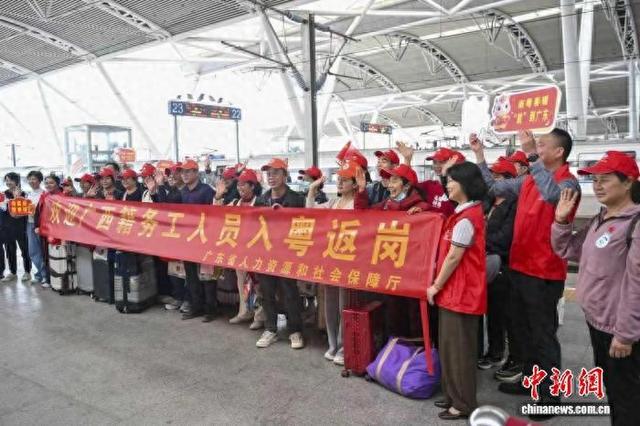
务工人员返粤 首趟省级返岗专列抵达广州
Xin Lang Cai Jing· 2026-02-24 13:12
Group 1 - The core viewpoint of the article highlights the organized return of workers to Guangdong province, with a focus on enhancing employment opportunities and supporting the province's high-quality development [1][3][5] - Guangdong's human resources and social security department anticipates that nearly 90% of migrant workers will return to Guangdong for work after the Spring Festival, injecting continuous human resources into the province's development [3][5] - The province plans to organize 20 return trains for workers this year, aligning labor supply with the needs of modern industrial development in key sectors such as advanced manufacturing and emerging industries [5][6] Group 2 - Various cities in Guangdong are implementing public employment services, with Guangzhou planning over 330 recruitment events in the first quarter to match job seekers with available positions [5] - Shenzhen is launching over 400 targeted recruitment activities and innovating with a "recruitment + training" model to enhance job matching and support for workers [5] - The "Nanyue Spring Warmth" initiative will host over 2,500 recruitment events from January to March, aiming to connect enterprise labor demands with the employment intentions of workers [5][6]
经济新方位丨春节我在岗,为产业向新向优作贡献
Ren Min Ri Bao· 2026-02-24 03:49
Group 1: Steel Industry - The unconventional steel production at Benxi Steel is continuously breaking through design capacity, with a target of exceeding 6 million tons annually by 2025 [2][3] - The production process involves precise control of parameters and material dimensions to successfully roll out ultra-thick and ultra-wide steel products, with over 90% of the output being unconventional steel types used in major engineering projects and the new energy vehicle industry [2][3] Group 2: Green Energy - The Qiuzi Substation in Gansu is a key node for national projects like "East Data West Computing," integrating distributed green energy resources to supply power to data centers and reduce transmission losses through voltage elevation [4][5] - The substation operates with 200 sets of equipment, marking the first use of such technology locally, and emphasizes the importance of continuous monitoring and learning during operations [6] Group 3: Robotics Industry - The performance of humanoid robots at the Spring Festival Gala showcased significant advancements in dynamic and collaborative control, moving from mechanical execution to intelligent self-adaptation [7][8] - The preparation for the robot performance involved extensive software development and algorithm validation, allowing for real-time self-monitoring and quick adjustments during the show [8]
