资产负债表修复

Search documents
基金经理投资笔记 | 锚定三重闭环,拥抱基本面慢牛
Sou Hu Cai Jing· 2026-01-26 03:04
Group 1: Core Views - The narrative trading trend in the market has shown signs of fatigue, with a return to a fundamentals-driven slow bull market logic [1] - Regulatory measures on online information management aim to curb the risks associated with narrative trading, which can lead to significant market fluctuations [1] - The government's guidance for investors to shift from narrative trading to fundamentals trading is seen as a necessary response to market failures [1] Group 2: Positioning and Functions of the Stock Market - The Chinese stock market has evolved beyond a simple financing and trading platform, becoming a core hub connecting public welfare, industrial upgrades, and national strategy [2] - The core functions of the stock market can be summarized as "balance sheet repair, financing for technological growth, and market-based pricing of existing assets" [2] Group 3: Balance Sheet Repair Function - The health of household balance sheets directly influences consumption and economic resilience, with the stock market providing a means for wealth appreciation through a profit-driven slow bull market [3] - This function aims to ensure that financial market returns benefit households, thereby supporting the micro-foundation of common prosperity [3] Group 4: Financing for Technological Growth - The stock market plays a crucial role in providing long-term capital for strategic sectors such as hard technology and high-end manufacturing through market-based pricing and governance improvements [4] - This function embodies the principle of "finance serving the real economy," transforming capital into a long-term partner for innovation [4] Group 5: Market-Based Pricing of Existing Assets - The stock market's public pricing mechanism allows for the revaluation and circulation of existing assets, enhancing operational efficiency and governance structures [5] - This function emphasizes the market's decisive role in resource allocation, breaking away from traditional administrative valuations [5] Group 6: Current Functionality Assessment - As of early 2026, the A-share market shows an uneven performance in its three core functions, highlighting the need for government intervention to address market failures [8] - The asset balance sheet repair function has lagged, with household stock assets accounting for less than 10% of total wealth, compared to 20%-30% in developed countries [8] - The financing function for technological growth has been more robust, with over 1,200 hard technology companies raising more than 1.5 trillion yuan, but narrative trading still poses risks [8] - The market-based pricing function for state-owned assets faces challenges, with low valuations for state-owned enterprises indicating a lack of market recognition for existing asset values [9] Group 7: Historical Lessons from Market Volatility - Historical lessons indicate that the stock market must remain anchored to its core functions to avoid falling into cycles of policy-driven speculation and bubble bursts [11] - Past market booms have often led to significant wealth losses for households, emphasizing the unsustainability of trends detached from real economic support [11] Group 8: Government Intervention - Government intervention is deemed necessary to correct market failures, ensuring that the stock market continues to serve its three core functions effectively [13] - The government aims to protect household wealth, maintain industrial upgrades, and ensure the strategic value of state-owned assets through appropriate interventions [14] Group 9: Asset Allocation Insights - In the context of China's modernization, asset allocation should focus on the three core functions of the stock market, emphasizing long-term stable growth rather than short-term speculation [16] - Investors are encouraged to prioritize broad-based assets that can enhance wealth effects and support household balance sheet repair [17] - Strategic allocations should target hard technology and new productive forces, with a focus on companies with genuine technological barriers [17] - Attention should also be given to the revaluation opportunities of quality existing assets as market pricing mechanisms evolve [17]


创金合信基金魏凤春:锚定三重闭环,拥抱基本面慢牛
Xin Lang Cai Jing· 2026-01-26 02:13
Group 1 - The core function of the Chinese stock market has evolved beyond a simple financing and trading platform to become a crucial hub connecting public welfare, industrial upgrading, and national strategy, encapsulated in the threefold framework of "balance sheet repair, technology growth financing, and market-based pricing of existing assets" [2][17] - The "balance sheet repair" function is essential for enhancing consumer confidence and economic resilience, allowing stock market gains to return to households and supporting the activation of domestic demand [3][18] - The "technology growth financing and corporate governance empowerment" function is vital for the transition to new economic drivers, providing long-term capital support for strategic sectors like hard technology and high-end manufacturing [4][19][20] Group 2 - As of early 2026, the A-share market shows an uneven performance in the three core functions, indicating a need for government intervention to address market failures [7][23] - The progress in balance sheet repair has been relatively slow, with household stock assets accounting for less than 10% of total wealth, significantly lower than the 20%-30% seen in developed countries [7][23][24] - The market's pricing mechanism for state-owned assets faces challenges, with the valuation of state-owned enterprises generally low, reflecting a lack of market recognition for existing asset values [8][24] Group 3 - Historical lessons from the Chinese stock market highlight the importance of anchoring market operations to the core functions of serving the real economy, avoiding cycles of policy-driven speculation and bubble bursts [9][25][26] - The necessity for government intervention arises from the public good nature of the stock market, which is essential for achieving national strategic goals and addressing market failures [11][27][28] - Government actions are expected to focus on safeguarding the balance sheet repair function, ensuring long-term capital flows into technology sectors, and maintaining the strategic value of state-owned assets [12][28] Group 4 - The analysis emphasizes that asset allocation should be anchored in fundamentals, advocating for a balanced portfolio of broad-based assets, technology growth, and state-owned enterprise value [13][30][31] - The focus on broad-based ETFs and "fixed income plus" strategies is recommended to stabilize wealth and enhance consumer confidence during a slow bull market [14][30] - Investors are encouraged to prioritize quality existing assets for revaluation opportunities as market pricing mechanisms evolve [15][30]

全国人均存款逼近12万元,多省公布数据
21世纪经济报道· 2026-01-21 13:39
Group 1 - The core viewpoint of the article indicates that while household deposits are increasing, loan amounts are decreasing, reflecting a cautious consumer sentiment regarding spending and home purchases [1][2][7] - As of the end of 2025, the total household deposits in China reached 167 trillion yuan, with a year-on-year growth of 9.71%, translating to an average of approximately 118,900 yuan per person [2][4] - In Guangdong province, the total loan balance was 29.9 trillion yuan, with a deposit balance of 38.7 trillion yuan, maintaining the highest financial volume in the country [2][4] Group 2 - In 2025, household deposits in Zhejiang province reached 11.85 trillion yuan, showing a year-on-year increase of nearly 10%, while non-financial enterprise deposits grew by 4.2% [4] - Jiangsu province reported a significant increase in household deposits, with a year-on-year growth of 11.48%, making it the province with the highest growth rate among those reported [4][5] - The increase in household deposits is attributed to heightened precautionary savings, a shift from riskier assets to safer bank deposits, and efforts to repair personal balance sheets [5][6] Group 3 - The structure of loans has changed, with household loans in Guangdong decreasing by 47.18 billion yuan, while corporate loans have seen a notable increase [7][8] - In December, corporate loans in Guangdong increased by 5.36% year-on-year, with significant growth in both short-term and long-term loans [7][9] - Analysts suggest that the increase in corporate loans is supported by policy-driven financial tools and a recovering manufacturing sector, as indicated by the PMI returning to expansion territory [8][9]

人均存款逼近12万元,多省公布金融统计数据
2 1 Shi Ji Jing Ji Bao Dao· 2026-01-21 11:49
Group 1 - The core viewpoint of the article indicates that while household deposits are increasing, loans are decreasing, reflecting a cautious consumer sentiment despite a rise in household savings [1][4][8] - As of the end of 2025, the total household deposits in China reached 167 trillion yuan, with a year-on-year growth of 9.71%, translating to an average deposit of approximately 118,900 yuan per person [3][4] - In Guangdong province, household deposits grew by 8% to 9%, with a total balance of 38.7 trillion yuan, while in Zhejiang, household deposits increased by nearly 10% to 11.85 trillion yuan [4][5] Group 2 - The structure of loans has changed, with household loans decreasing while corporate loans have shown significant growth, indicating a shift in financial behavior [8][10] - In Guangdong, household loans decreased by 4.7 billion yuan, while corporate loans increased by 107 billion yuan, reflecting a more robust corporate borrowing environment [8][10] - Analysts suggest that the increase in corporate loans is supported by new policy financial tools and a recovering economic environment, as indicated by a PMI returning to the expansion zone [10]

中信证券:房地产市场供需已有所改善 预计2026年市场有止跌回稳基础
Xin Lang Cai Jing· 2026-01-19 00:54
Group 1 - The real estate market supply and demand have shown improvement, with sufficient adjustments made, indicating a potential stabilization by 2026, marking a critical year for real estate companies to repair their balance sheets [1] - In a low-interest-rate environment, long-term capital continues to allocate towards commercial real estate, suggesting rapid growth in the commercial management industry [1] - Leading companies in the construction and building materials sector have enhanced their market share and optimized sales channels through five years of adjustments, demonstrating the ability to navigate through cycles, with performance inflection points expected for some companies in 2026 [1] Group 2 - In the public utilities and environmental protection sector, water and electricity companies are preferred for their strong anti-cyclical capabilities and attractive dividend yields [1] - Gas companies are expected to gradually recover their performance as gas prices decline and demand rebounds [1] - Waste-to-energy companies are anticipated to successfully expand overseas, breaking through growth constraints [1]

明年会有多少钱能流向楼市
Sou Hu Cai Jing· 2026-01-10 16:12
Core Viewpoint - The future of the real estate market is characterized by using today's money to repay past debts [1] Group 1: Economic Indicators - As of October 2025, the total social financing stock is 437.72 trillion yuan, with a year-on-year growth of 8.5% [2] - The ratio of total social financing stock to GDP reached 302.68% in 2024, indicating that 3 yuan of debt is needed to generate 1 yuan of GDP [5] - The profit of industrial enterprises above designated size only grew by 0.1% year-on-year from January to November 2025, with significant declines in coal mining and oil extraction profits [7] Group 2: Real Estate Market Dynamics - The previous monetary policies led to a significant portion of released funds being fixed in real estate, creating a cycle where rising prices must eventually correct [3] - Since 2021, the increment of social financing has stagnated, leading to a peak and subsequent decline in housing prices [9] - Predictions indicate that the real estate market will remain sluggish in 2026, with first-hand housing sales expected to drop by 8% year-on-year [10] Group 3: Policy and Market Response - Current policies focus on stabilizing the real estate market and encouraging the acquisition of existing homes for affordable housing, contrasting with past strategies aimed at price increases [10][11] - The need for residents and businesses to repair their balance sheets is critical for future economic recovery, but this process is expected to be lengthy and challenging [12] Group 4: Inventory and Market Outlook - The inventory pressure is significant, with over 50 million second-hand homes transacted since 2016, and a de-stocking cycle of 27.4 months for new residential properties in major cities [12] - The real estate market in 2026 is anticipated to face declines, with the focus shifting from whether prices will rise or fall to how much they will decline [13]
银行大动作!这类大额存单利率,跌破1%
Zhong Guo Ji Jin Bao· 2026-01-10 04:59
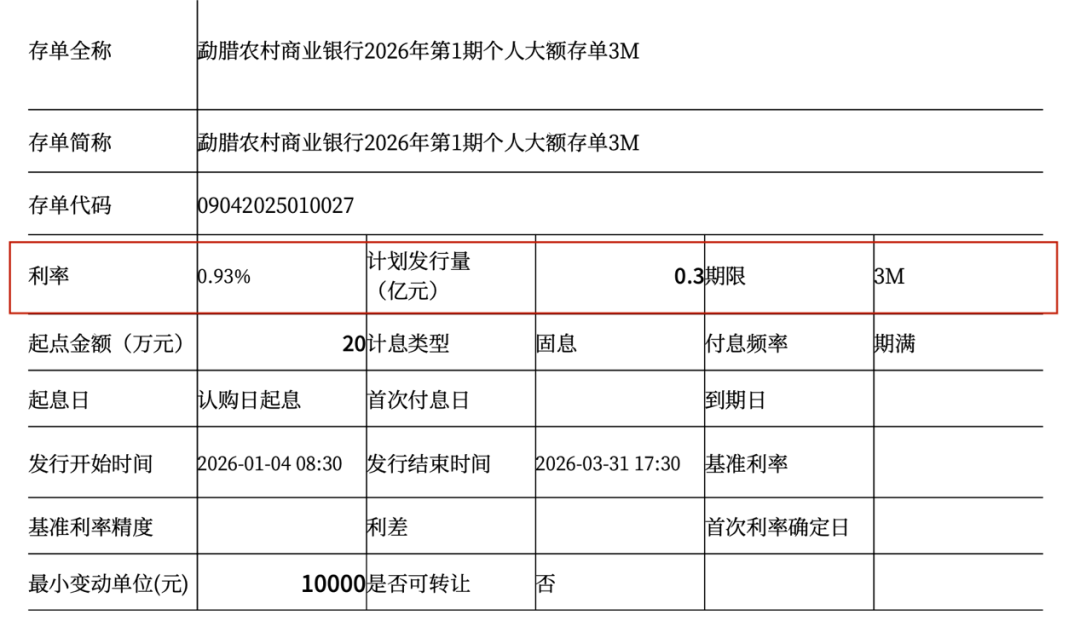
Core Viewpoint - The interest rates for large time deposits at small and medium-sized banks in China have dropped below 1% for 3-month terms, indicating a shift in the deposit market as banks respond to narrowing net interest margins and aim for stable operations [1][2][8]. Group 1: Interest Rate Changes - Several small and medium-sized banks have begun to lower their deposit rates, with Anhui Xin'an Bank reducing its 2-year fixed deposit rate by 10 basis points to 2.25% [3]. - The 3-month large time deposit rates at some rural commercial banks have fallen below 1%, with Mengla Rural Commercial Bank offering a rate of 0.93% for its 3-month deposit [3][4]. - Other banks, such as Yunnan Tengchong Rural Commercial Bank and Longyang Rural Commercial Bank, are also offering 3-month deposits at rates of 0.95% [5][6]. Group 2: Economic Context - The decline in deposit rates reflects a broader transformation in the banking sector, characterized by a "balance sheet repair" process amid insufficient loan demand and persistently low interest rates [8][9]. - The overall net interest margin for commercial banks was reported at 1.42% as of Q3 2025, with large banks at 1.31%, indicating pressure on banks to lower deposit costs to maintain margins [9]. Group 3: Implications for Investors - Investors are advised to shift their financial strategies from seeking absolute high interest rates to constructing optimal risk-return portfolios, as the era of "easy money" is coming to an end [1][10]. - Recommendations for investors include accepting a new standard of "steady returns," embracing diversified financial products, and considering long-term investments in high-dividend assets or broad market indices [10][11].
银行大动作!这类大额存单利率,跌破1%
中国基金报· 2026-01-10 04:28
Core Viewpoint - The article highlights a significant decline in deposit rates among small and medium-sized banks in China, with some three-month large-denomination certificates of deposit (CDs) dropping below 1%. This trend indicates a shift away from the "high-interest savings" era, prompting individual investors to rethink their investment strategies towards diversified asset allocation rather than solely pursuing high interest rates [2][10][11]. Summary by Sections Deposit Rate Changes - Several small and medium-sized banks have begun to lower their deposit rates, with Anhui Xin'an Bank reducing its two-year fixed deposit rate by 10 basis points to 2.25% and Puyang Zhongyuan Village Bank cutting rates by 30 basis points across various terms [4]. - As of January 8, over 30 banks announced the issuance of large-denomination CDs for 2026, with most having terms of one year or less. Notably, some rural commercial banks have seen their three-month CD rates fall below 1%, such as Mengla Rural Commercial Bank offering a rate of 0.93% [4][5][6]. Market Trends and Implications - The decline in deposit rates is attributed to a combination of factors, including a shrinking net interest margin for banks and the need to support the real economy by lowering funding costs [10][11]. - The overall net interest margin for commercial banks was reported at 1.42% as of Q3 2025, with large banks at 1.31%, indicating a challenging environment for maintaining profitability [10]. Investor Guidance - Investors are advised to adapt their financial strategies in response to the changing landscape. The focus should shift from seeking absolute high interest to constructing optimal risk-return portfolios [10][12]. - Specific recommendations include accepting a new standard of "stable returns," embracing "fixed income plus" products for higher returns with manageable volatility, and utilizing dollar-cost averaging for long-term investments in high-dividend assets or broad market indices [11][12].

创金合信基金魏凤春:结构性主线清晰 市场风格偏向AI+硬科技
Xin Lang Cai Jing· 2026-01-06 01:28
Group 1 - The article emphasizes the shift from theoretical discussions to practical actions in investment strategies post-New Year, highlighting the need for timely adjustments based on market changes [1][18] - It notes that the investment landscape is evolving towards a diversified asset system that balances risk and return, moving away from a singular focus on leveraging assets for high returns [1][18] - The article suggests that short-term considerations are becoming more important than long-term trends, integrating trend, structure, and timing into investment decisions [1][18] Group 2 - The A-share market has shown a structural trend with growth stocks outperforming value stocks, as evidenced by the Shanghai Composite Index reaching 4000 points and a notable 12 consecutive days of gains [3][20] - The article warns of potential risks associated with the 12-day winning streak, including profit-taking, increased sector divergence, and external market volatility [3][20] - The macroeconomic indicators, such as the PMI data, indicate a recovery in manufacturing, with the December 2025 PMI reaching 50.1%, signaling expansion and improved business sentiment [7][23] Group 3 - The construction sector is also showing signs of recovery, with the construction PMI rising to 52.8%, reflecting effective investment efforts and a shift in market perception towards stabilizing expectations in real estate [8][24] - The article discusses the implications of global oil price declines, which can lower energy and raw material costs, thereby supporting profit recovery in manufacturing [9][25] - The appreciation of the Chinese yuan against the US dollar is identified as a key factor in the revaluation of Chinese assets, maintaining the current investment logic [10][26] Group 4 - The article highlights the strategic importance of silver in industries such as photovoltaics and semiconductors, with new export controls aimed at ensuring domestic supply chain security [14][31] - It mentions the potential for enhanced cooperation between China and South Korea in sectors like semiconductors and new energy, focusing on stabilizing supply chains and expanding market opportunities [15][32] - Breakthroughs in brain-computer interfaces and autonomous driving technologies are expected to redefine investment themes, marking a significant shift towards AI-driven applications in various sectors [16][32]
贸易顺差超过1万亿美元,为何体感不明显?
首席商业评论· 2025-12-26 12:00
Group 1: Trade Surplus Overview - In the first 11 months of 2025, China's goods trade surplus reached $1.08 trillion, marking the first time any country has surpassed the $1 trillion mark in trade surplus [2] - The strong export performance is driven by key categories such as electromechanical products, which account for approximately 59% of total exports, and new growth areas like electric vehicles and lithium batteries, which continue to see double-digit growth [3][4] - The import demand in 2025 is weak, with nearly zero growth (0.2%), contributing to the maximum trade surplus [4] Group 2: Factors Affecting Perception of Surplus - The perception of the surplus not translating into noticeable benefits for the public can be attributed to several factors, including the "external circulation" of funds where companies are hesitant to convert foreign earnings into RMB [5] - A portion of profits is used to pay off debts rather than being reinvested domestically, indicating a deleveraging trend in the manufacturing sector [5] - Price wars in certain industries lead to profit dilution, making it difficult for companies to significantly increase employee wages despite high export volumes [5] Group 3: Sector-Specific Insights - The automotive sector is highlighted as a profitable area, with a mid-range electric vehicle sold in Europe generating significant revenue for Chinese manufacturers, despite various costs such as tariffs and logistics [5] - The future potential for higher-value exports, particularly in sectors like semiconductors, could lead to more substantial profits for Chinese companies [6] Group 4: Service Trade Developments - China's service trade has historically shown a significant deficit, but in 2025, the deficit narrowed to approximately $108 billion, a reduction of about 26% year-on-year [12][13] - Knowledge-intensive service trade constitutes about 38% of the total, with rapid growth in exports driven by international travel demand and foreign tourists visiting China [13] - The overall trend suggests that service trade may move towards a more balanced state in the future [14] Group 5: Economic Implications - The $1 trillion trade surplus reflects the efficiency of the production system and external structures rather than a direct increase in household income [15] - A portion of the foreign exchange earnings is allocated for stabilizing the currency, addressing external sanctions, and supporting essential imports, which delays immediate benefits to the domestic economy [15]