
食品安全抽检

Search documents
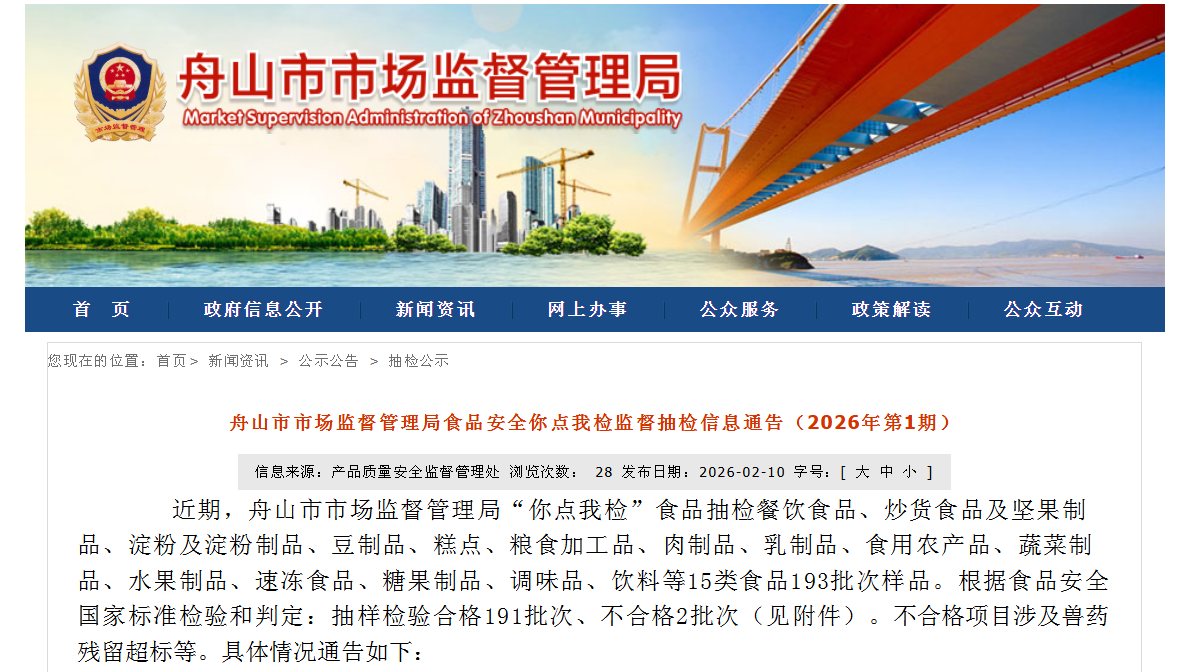
浙江省舟山市市场监督管理局食品安全你点我检监督抽检信息通告(2026年第1期)
Xin Lang Cai Jing· 2026-02-14 05:06
Core Viewpoint - The recent food safety inspection in Zhoushan revealed that out of 193 food samples tested, 191 passed while 2 were found to be non-compliant due to excessive veterinary drug residues [3][4]. Group 1: Inspection Results - A total of 193 food samples were tested across 15 categories including restaurant food, nuts, starch products, and dairy [3]. - 191 samples were compliant with national food safety standards, while 2 samples were non-compliant [3]. Group 2: Non-compliance Details - The non-compliant products included: - Hairy yam sold by Lexing Supermarket (Zhejiang) Co., Ltd., which contained residues of amprolium and amprolium manganese salt exceeding safety standards [4]. - Snow peas sold by the same supermarket, which contained residues of pyraclostrobin exceeding safety standards [4]. Group 3: Regulatory Actions - The Zhoushan Market Supervision Administration has mandated local market regulatory departments to take immediate actions such as removing the non-compliant products from shelves [4]. - The involved units are required to disclose risk control measures within 7 days of the announcement and report the situation to the Zhoushan Market Supervision Administration within 3 months [4].

春节热销食品抽检公布合格率为98.38%
Xin Lang Cai Jing· 2026-02-10 21:07
Core Viewpoint - The overall food safety situation in China is good, with a high compliance rate of 98.38% from a special inspection of 67,000 batches of popular food items conducted by the State Administration for Market Regulation before the Spring Festival [1] Group 1: Inspection Overview - The special inspection covered 31 provinces, focusing on high-traffic areas such as tourist attractions, large supermarkets, highway service areas, and train stations, as well as 23 online platforms including JD.com, Taobao, and Meituan [1] - Key food items inspected included pastries, nuts, candies, and meat products, with a focus on food additives, microorganisms, quality indicators, and pesticide residues [1] Group 2: Inspection Results - No non-compliant samples were found in nine categories of food, including dairy products, convenience foods, and canned goods [1] - However, issues were noted with excessive use of food additives in fruits and seasonings, as well as pesticide residues in agricultural products [1] Group 3: Regulatory Actions - The State Administration for Market Regulation has urged local regulatory departments to conduct investigations and take action regarding the non-compliant samples identified during the inspection [1]
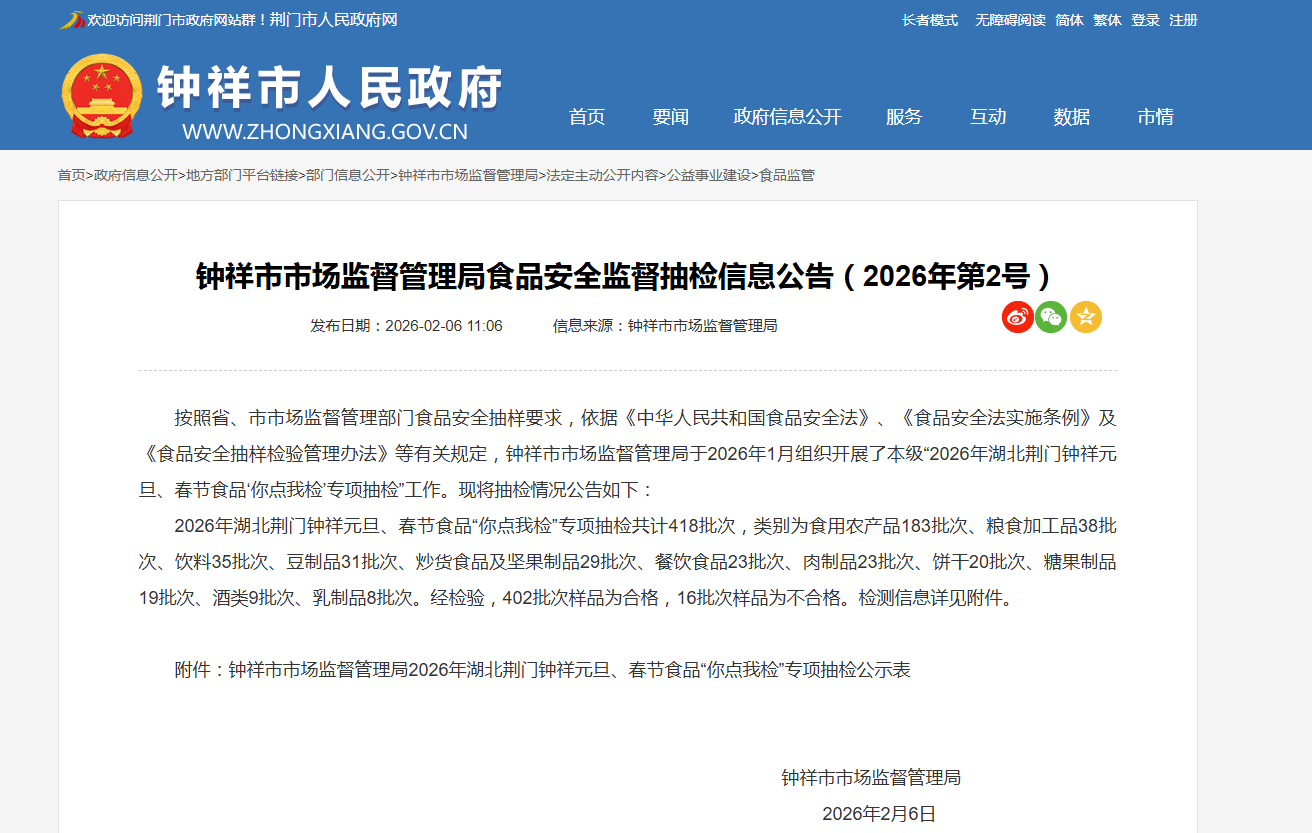
湖北省钟祥市市场监督管理局食品安全监督抽检信息公告(2026年第2号)
Xin Lang Cai Jing· 2026-02-06 08:35
Group 1 - The core viewpoint of the article is the announcement of the food safety inspection results conducted by the Zhongxiang City Market Supervision Administration for the New Year and Spring Festival in 2026, highlighting the compliance and non-compliance rates of various food products [3] Group 2 - A total of 418 batches of food products were inspected, categorized into various types including 183 batches of edible agricultural products, 38 batches of grain processing products, 35 batches of beverages, and others [3] - Out of the 418 batches, 402 were found to be compliant, while 16 batches were deemed non-compliant, indicating a high compliance rate of approximately 96.2% [3] - The inspection covered a wide range of food categories, including but not limited to meat products, dairy products, snacks, and alcoholic beverages, reflecting a comprehensive approach to food safety [3]
江苏太仓最新食品抽检结果出炉,这些不合格
Xin Lang Cai Jing· 2026-02-02 08:43
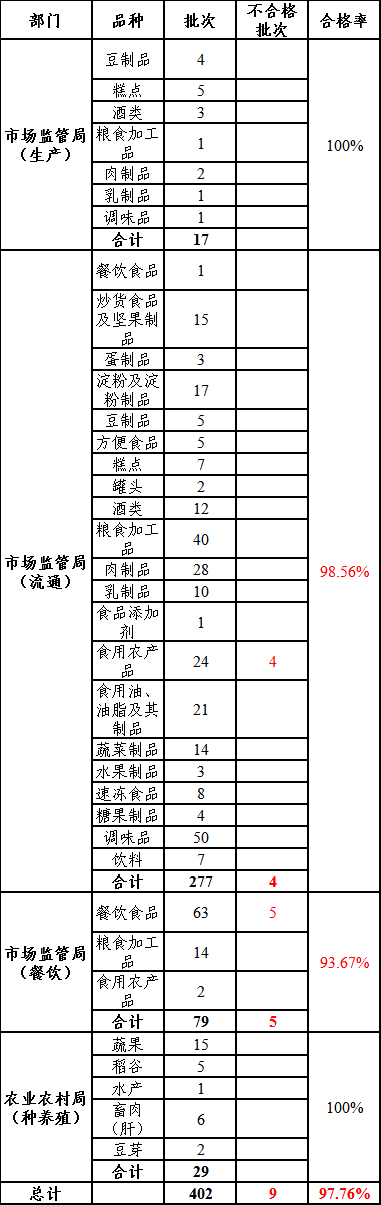
Core Insights - The food safety inspection results for December 2025 in Taicang show a high compliance rate of 97.76%, with 393 out of 402 food samples passing the tests [2][5] - Specific non-compliance issues were identified in 9 samples, including pesticide residues and bacterial contamination [3][6] Group 1: Inspection Results - A total of 402 food samples were tested, with 393 passing, resulting in a compliance rate of 97.76% [2][5] - The inspection covered various categories, including edible agricultural products, processed foods, and beverages [1] Group 2: Non-compliance Details - Non-compliant items included 4 batches of edible agricultural products and 5 batches of catering food, with issues related to pesticide residues such as bifenthrin and bacterial contamination [3][6] - Specific non-compliance cases included pesticide residues exceeding the maximum limits set by national food safety standards [8][9] Group 3: Compliance by Category - The compliance rates varied by category, with the highest being 100% for tofu products and 98.56% for meat products [4][5] - The inspection results indicate that while most categories performed well, certain food types like catering products had a lower compliance rate of 93.67% [5]
上海市市场监督管理局2026年第2期省级食品安全抽检信息
Zhong Guo Zhi Liang Xin Wen Wang· 2026-01-15 08:26
Summary of Key Points Core Viewpoint - The Shanghai Municipal Market Supervision Administration has released the results of its food safety sampling inspections, indicating a high compliance rate with 675 out of 680 samples passing the tests, while 5 samples were found to be non-compliant [1]. Group 1: Inspection Results - A total of 680 food samples were tested across 7 categories, including starch and starch products, grain processing products, edible agricultural products, frozen foods, condiments, special dietary foods, and beverages [1]. - Out of the 680 samples, 675 were compliant, resulting in a compliance rate of approximately 99.26% [1]. - The non-compliant samples included: - 1 batch of edible agricultural products (pesticide residue: chlorpyrifos) - 1 batch of frozen food (peroxide value exceeding the standard) - 1 batch of special dietary food (deficiency in vitamins B1 and B2) - 2 batches of condiments (sulfur dioxide residue) [1]. Group 2: Actions Taken - The administration has mandated local market supervision bureaus to investigate and handle the non-compliant products and their producers, ensuring legal actions are taken against violations [1]. - The findings will be recorded in the food safety credit archives of the food producers and operators, with the investigation results to be publicly disclosed by the responsible local market supervision bureau [1]. Group 3: Consumer Advisory - Consumers are advised to report any instances of purchasing or encountering the listed non-compliant products by calling the food safety complaint hotline at 12315 [1].
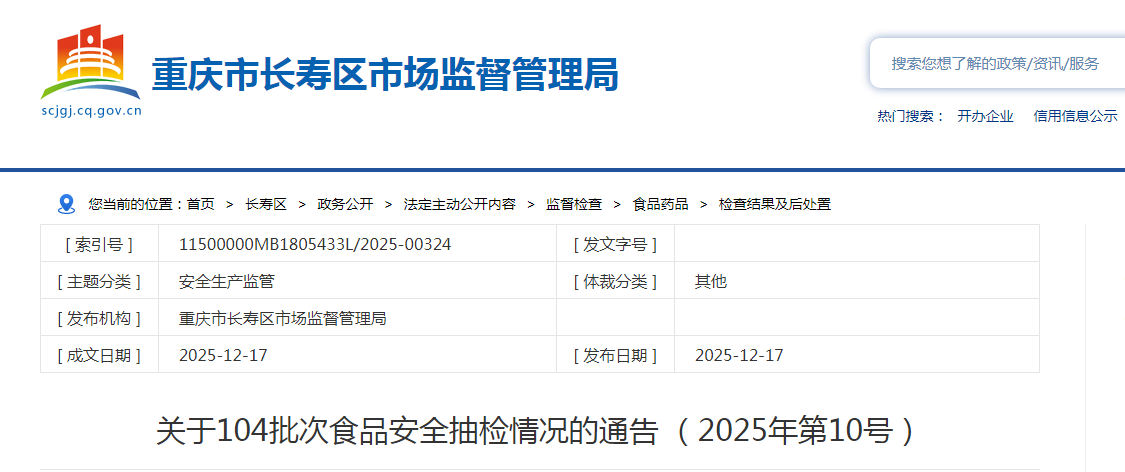
重庆市长寿区市场监督管理局关于104批次食品安全抽检情况的通告(2025年第10号)
Zhong Guo Zhi Liang Xin Wen Wang· 2026-01-13 07:45
Summary of Key Points Core Viewpoint - The Chongqing Changshou District Market Supervision Administration conducted a food safety inspection of 104 batches of various food products, revealing that 100 batches met safety standards while 4 batches were found to be non-compliant [2]. Group 1: Inspection Results - A total of 104 food samples were tested, covering 12 categories including restaurant food, starch products, seasonings, and alcoholic beverages [2]. - Out of the 104 samples, 100 were compliant with national food safety standards, while 4 samples were deemed non-compliant [2]. - The non-compliant products were subjected to legal actions as per the Food Safety Law of the People's Republic of China, including recall and removal from shelves [2]. Group 2: Non-Compliant Products - Specific non-compliant products included: - Fried dough sticks with aluminum residue at 957 mg/kg, exceeding the limit of 100 mg/kg [4]. - Steamed buns containing sweeteners at 1.83 g/kg, which are prohibited [4]. - Longan with sulfur dioxide residue at 0.138 g/kg, exceeding the permissible limit of 0.05 g/kg [4]. - Another longan sample with sulfur dioxide residue at 0.115 g/kg, also exceeding the limit [4]. Group 3: Compliance Actions - The local market supervision department initiated investigations into the non-compliant products, tracing their distribution and implementing risk control measures [2]. - Actions taken included product recalls and corrective measures to address the reasons for non-compliance [2].
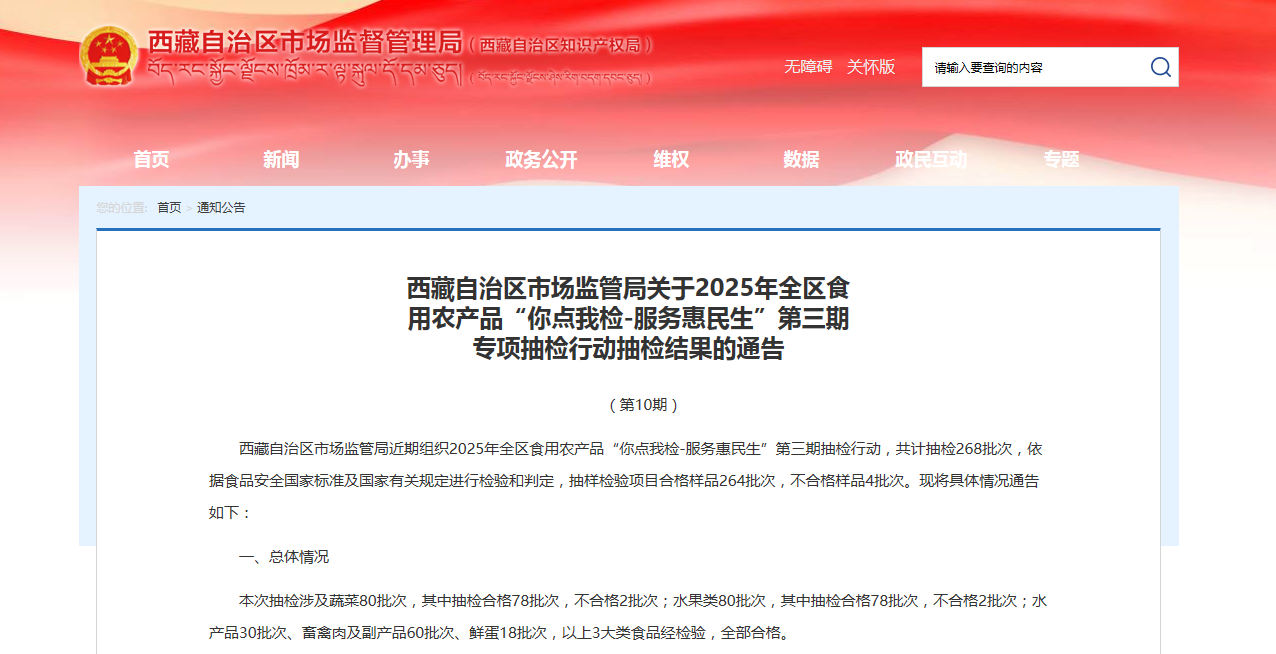
西藏市场监管局关于2025年全区食用农产品“你点我检-服务惠民生”第三期专项抽检行动抽检结果的通告(第10期)
Zhong Guo Zhi Liang Xin Wen Wang· 2025-12-05 06:46
Overall Situation - The Tibet Autonomous Region Market Supervision Administration conducted the third phase of the 2025 food safety sampling inspection for edible agricultural products, involving a total of 268 batches, with 264 passing and 4 failing the tests [1]. - The inspection included 80 batches of vegetables, 80 batches of fruits, 30 batches of aquatic products, 60 batches of livestock and poultry meat and by-products, and 18 batches of fresh eggs, with all samples from the last three categories passing [1]. Non-compliant Products - Four non-compliant products were identified during the inspection: 1. "Jingpin Potato" from Longzi County Yijia Life Supermarket failed due to the presence of dichlorvos [1]. 2. "Shui Mi Tao" (Honey Peach) from Li Kui Dried Fruit Store failed due to the presence of fluopyram [1]. 3. "Ye Cheng" (Leaf Orange) from Linzhi City Bayi District Urban-Rural Supply and Marketing Supermarket failed due to the presence of bifenthrin [1]. 4. "Carrot" from Changdu City Karuo District Fumanduo Life Supermarket failed due to the presence of phosmet [1]. Regulatory Actions - The Market Supervision Administration has mandated local regulatory departments to take immediate action to address the non-compliant products, including tracing product distribution, urging companies to remove and recall the non-compliant products, and investigating the causes to eliminate risks [1].

市场监管总局开展食品安全抽检“指南针”行动 提高精准发现风险能力
Zhong Guo Zhi Liang Xin Wen Wang· 2025-12-02 05:56
Core Insights - The State Administration for Market Regulation (SAMR) has initiated the "Compass" action to enhance food safety inspections across various food categories, aiming to improve risk detection capabilities [1][2][4] Group 1: Action Overview - The "Compass" action began on July 1, 2023, and is set to continue until June 30, 2026, with a total of approximately 3,000 inspection batches planned [1] - The action focuses on a wide range of food products, including grains, oils, seasonings, meat, dairy, beverages, and more, with additional inspections for infant formula and special dietary foods as needed [1] Group 2: Implementation and Coordination - The Shanghai Quality Supervision and Inspection Technology Research Institute, Beijing Food Inspection Research Institute, and Sichuan Food Inspection Research Institute have been designated to carry out the inspections [2] - A specialized working group has been established by the Shanghai Quality Institute to ensure efficient progress, including subgroups for public opinion, technology, inspections, and reporting [2] Group 3: Technical and Analytical Support - The Beijing Food Inspection Institute has developed a rapid response mechanism to address food safety issues, completing inspection processes within seven working days [3] - The Sichuan Food Inspection Institute has taken the lead on nine special tasks and participated in ten others, establishing a dedicated mechanism for task coordination and prioritization [3]
全链条抽检守护“舌尖安全”
Jing Ji Ri Bao· 2025-12-02 02:02
Core Insights - Food safety inspections are crucial for identifying issues and mitigating risks in the food supply chain, with a total of 5.7 million batches inspected and a non-compliance rate of 2.74% as of mid-November this year [1] Group 1: Inspection Coverage and Effectiveness - The food safety inspection system has expanded its reach from production to consumption, covering various sales channels and food types, resulting in a nearly 50% decrease in the number of companies with multiple non-compliance cases since 2020 [2] - The inspection has encompassed 39 categories of food and 2066 testing indicators, ensuring comprehensive coverage of daily consumer food [2] Group 2: Collaborative Regulatory Efforts - Multiple government departments, including the Market Supervision Administration and the Ministry of Agriculture, have collaborated to enhance inspection efforts, leading to over 60,000 batches of non-compliant food identified this year [3] Group 3: Targeted Risk Focus - Inspections are strategically focused on vulnerable groups and high-risk areas, such as infant formula and school food services, with 100% coverage of infant formula production enterprises and bi-weekly inspections of school canteens [4] Group 4: Agricultural Product Monitoring - The Ministry of Agriculture conducts quarterly risk monitoring of key agricultural products, ensuring comprehensive coverage across various production and distribution points [5] Group 5: Technological Advancements in Inspections - The regulatory body has developed 106 supplementary testing methods to address food adulteration issues, significantly enhancing detection capabilities [7] - A total of 1725 national standards have been established to support the inspection process, ensuring that regulations are based on solid benchmarks [7]
全链条抽检守护“舌尖安全” 截至11月中旬完成抽检570万批次
Jing Ji Ri Bao· 2025-12-02 00:47
Core Insights - Food safety inspections are crucial for identifying issues and mitigating risks in the food supply chain, with a total of 5.7026 million batches inspected and a non-compliance rate of 2.74% as of mid-November this year [1] Group 1: Inspection Coverage and Effectiveness - The food safety inspection system has expanded its reach from production to consumption, covering various sales channels and food types, resulting in a nearly 50% decrease in the number of non-compliant enterprises since 2020, with a 57.47% year-on-year decline in the first three quarters of this year [2] - Inspections now encompass 39 categories of food, including fruits, vegetables, and processed products, with 2,066 testing indicators to ensure reliable results [2] Group 2: Collaborative Regulatory Efforts - Multiple regulatory bodies, including the Market Supervision Administration and the Ministry of Agriculture, are collaborating to enhance inspection efforts, particularly for key products like bulk food and school canteen supplies, leading to over 60,000 batches of non-compliant food identified this year [3] Group 3: Targeted Risk Management - Inspections are focused on high-risk areas, such as infant formula and school food services, with 100% coverage of infant formula production and bi-weekly inspections of school canteens to ensure safety [4] - The inspection strategy also targets previously problematic food categories and responds to public complaints, enhancing risk assessment and monitoring [4] Group 4: Technological Advancements in Inspections - The regulatory authorities are addressing challenges in food safety detection by developing 106 supplementary testing methods to identify adulterated food products, significantly improving detection capabilities [7] - A total of 1,725 national standards have been established to support the inspection process, ensuring that regulations are comprehensive and enforceable [7] Group 5: Innovation in Detection Techniques - The "reveal and take charge" model has been adopted to leverage societal research capabilities for breakthroughs in detection technology, with nearly 100 proposals received for enhancing food safety monitoring [8]