
301条款

Search documents
有的15%,有的更多?美国贸易代表这话啥意思
Di Yi Cai Jing· 2026-02-26 09:23
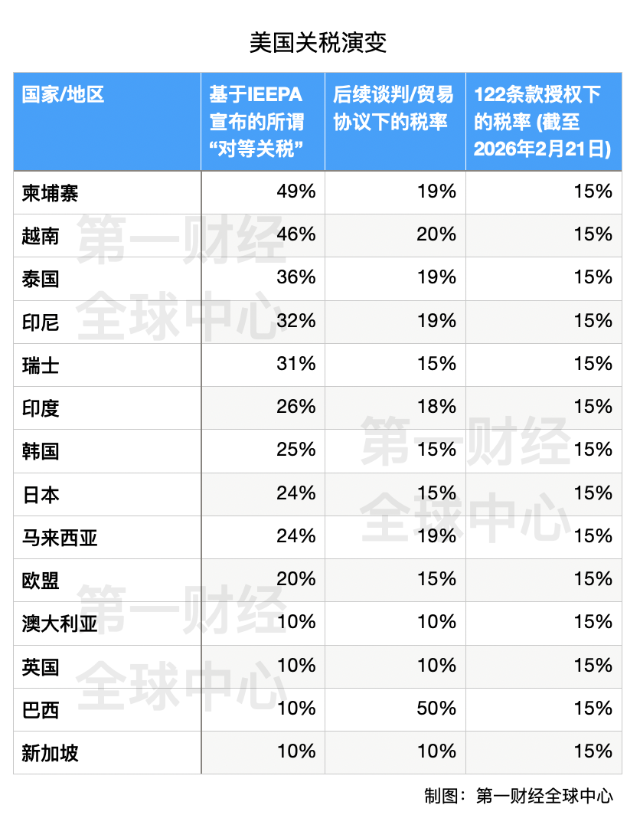
Group 1 - The U.S. government is preparing to increase temporary tariffs from 10% to 15% or higher on certain countries and regions, with a focus on maintaining pressure while not affecting existing trade agreements [2][3] - The Oxford Economics Institute's simulations suggest that even with a 15% global tariff, the macroeconomic impact would be minimal, but industry-level effects could be significant [3][7] - If the global tariff rate is set at 15%, it would be lower than the previous "countervailing duties" faced by certain Asian economies, which were between 19% and 20% [4][6] Group 2 - The U.S. Trade Representative indicated that the core of the new tariff plan will involve investigations under Section 301 to address unfair trade practices, particularly targeting countries that discriminate against U.S. technology companies [8][9] - The potential increase in tariffs could lead to fluctuations in actual tariff rates in the second half of the year, as the U.S. may switch between different legal provisions for imposing tariffs [7][9] - The U.S. is expected to rely more on tariffs imposed under Section 301, which allows for investigations into foreign trade practices that harm U.S. interests, as a primary source of tariff revenue [7][8]

特朗普遭遇重大打击,日本面临天赐良机,却不敢动手?
Sou Hu Cai Jing· 2026-02-25 07:42
Group 1 - The U.S. Supreme Court's ruling invalidating the tariffs imposed by the Trump administration has not led Japan to terminate the U.S.-Japan investment agreement, which was signed at a cost of $550 billion [1][3] - Japan's automotive industry, which accounts for over 30% of its total exports and supports approximately 5.5 million jobs, remains under pressure due to the potential for tariffs under Section 232, which is still in effect [3][5] - The investment agreement is seen as a means for Japan to maintain U.S. support, which is crucial for political stability and military cooperation, especially in light of Japan's reliance on U.S. technology for its defense capabilities [7][9] Group 2 - Japan's cautious approach is influenced by its historical relationship with Trump and the need to avoid political backlash, as any move to terminate the agreement could be perceived as undermining U.S. relations [5][9] - The $550 billion investment is viewed as a "toll" that Japan pays to ensure U.S. leniency in its military and economic endeavors, highlighting the intertwined interests of both nations [7] - Japan's political landscape has shifted towards the right, but any significant changes in military policy require U.S. approval, making the investment agreement a critical factor in Japan's defense strategy [7][9]

北美观察丨最高法院裁决“关税”越权 美贸易战“快捷键”失灵
Xin Lang Cai Jing· 2026-02-21 02:48
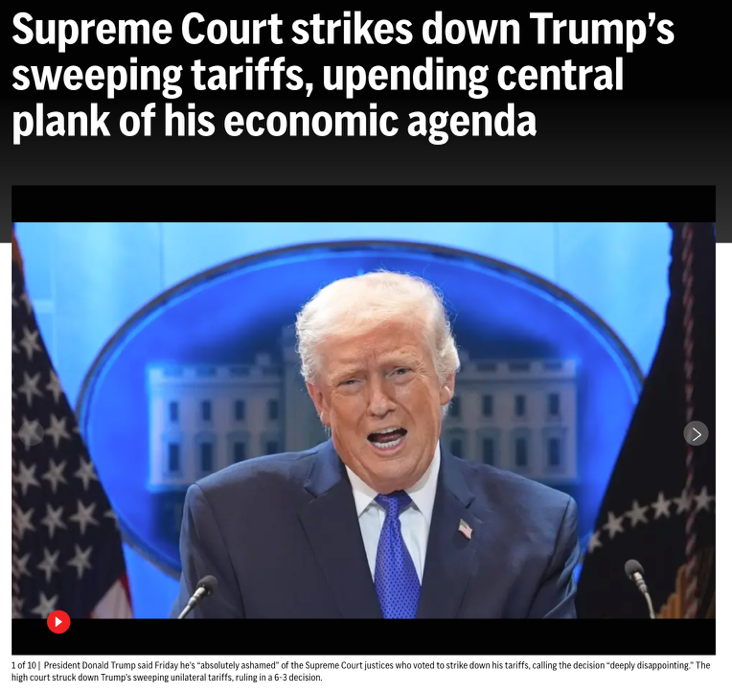
Core Viewpoint - The U.S. Supreme Court ruled against Trump's comprehensive tariff policy, stating that the tariffs imposed under the International Emergency Economic Powers Act (IEEPA) lacked legal basis and were invalid from the start, significantly impacting Trump's economic agenda and future presidential powers [2][12][16] Group 1: Legal Basis and Implications - The Supreme Court's decision emphasized that the IEEPA was intended for sanctions and not for imposing global tariffs, highlighting the absence of terms like "tariff" or "tariff rates" in the law [6][9] - The ruling reinforces that the power to levy taxes, including tariffs, is constitutionally assigned to Congress, and any delegation of this power must be explicit [10][11] - The court's majority opinion indicates that if Congress intends to grant the president the authority to impose tariffs, it must do so with clear and specific language, rather than vague terms [10][11] Group 2: Impact on Trump's Economic Agenda - The ruling is seen as a significant setback for Trump's economic strategy, which relied heavily on tariffs as a tool for negotiation and revenue generation [12][14] - The decision raises questions about the legality of tariffs already collected, with potential claims for refunds amounting to hundreds of billions of dollars, impacting fiscal revenue [13] - The ruling constrains future presidents' use of emergency powers for large-scale economic policies, requiring more caution in invoking such powers [13][14] Group 3: Future Actions and Strategies - In response to the ruling, Trump announced plans to impose a new 10% global tariff using a different legal framework, indicating a shift in strategy rather than a retreat [14][16] - The administration is expected to rely more on established trade tools like Section 232 and Section 301 of the Trade Act, which provide clearer legal grounds for imposing tariffs but involve more complex procedures [14][15] - The government may also explore non-tariff measures to influence trade and investment flows, such as stricter export controls and adjustments to procurement rules, to maintain pressure on foreign entities [15][16]
Top Charts | 如果“对等关税”被判违法?
申万宏源证券上海北京西路营业部· 2025-11-21 02:08
Group 1 - The article discusses the potential legal outcomes regarding the "reciprocal tariffs" in the U.S., with a high probability of being deemed illegal but possibly delayed in effect to avoid public disorder [4][20]. - The Supreme Court's debate shows a split opinion, with 6 justices leaning towards declaring the tariffs illegal and 3 supporting their legality, citing reasons such as the authority of Congress over tariffs and the original intent of the IEEPA legislation [4][20]. - Three possible scenarios for the Supreme Court's ruling are outlined: a high probability of ruling illegal with a delay, a moderate probability of partial illegality, and a low probability of upholding the legality of the tariffs [6][20]. Group 2 - If the reciprocal tariffs are invalidated, Trump may resort to other tariff provisions such as Sections 232, 301, and 338, with a short-term transition using Section 122 global tariffs [9][21]. - The current investigations under Section 232 cover an import scale of $544.4 billion, with most reports expected in the first half of next year [9][21]. - The likelihood of comprehensive tariff refunds is low, while targeted refunds are more probable, as judicial remedies must align with the harm suffered by plaintiffs [21]. Group 3 - The current tariff structure shows reciprocal tariffs accounting for 45%, Section 301 tariffs for 18%, Section 232 tariffs for 17%, and base tariffs for 19% [11][22]. - For the fiscal year 2025, the expected revenue from reciprocal tariffs is $89 billion, with significant contributions from fentanyl tariffs and Section 301 tariffs [11][22]. - If reciprocal tariffs are deemed illegal, the overall tariff levels may decrease by 25%, with potential revenue dropping to $255.4 billion [22].

热点思考 | 如果“对等关税”被判违法?——美国最高法关税辩论分析(申万宏观·赵伟团队)
赵伟宏观探索· 2025-11-13 17:18
Group 1 - The U.S. Supreme Court is debating the legality of Trump's IEEPA reciprocal tariffs, with a majority of justices (6 out of 9) leaning towards declaring them illegal, citing that tariff authority belongs to Congress and that the IEEPA was intended to limit presidential power rather than expand it [1][6][34] - Three potential outcomes of the Supreme Court's ruling are anticipated: a high probability of declaring the tariffs illegal but possibly delaying the ruling's effect to allow the government time to adjust; a moderate probability of declaring some tariffs illegal while allowing others, such as those on fentanyl; and a low probability of upholding the legality of the tariffs [11][12][34] - If the reciprocal tariffs are deemed illegal, the overall tariff structure in the U.S. may decline significantly, with a potential 25% reduction in tariff revenue, impacting the trade policy landscape [3][19][29] Group 2 - In response to a potential ruling against the reciprocal tariffs, Trump may resort to existing tariff laws such as Sections 232, 301, and 338, with a short-term reliance on Section 122 for global tariffs [2][35] - The likelihood of comprehensive tariff refunds is low, with targeted refunds being more feasible, as legal principles dictate that remedies must align with the harm suffered by the plaintiffs [18][35] - The current tariff revenue structure shows that reciprocal tariffs account for 45% of total tariff income, with significant contributions from Section 301 and Section 232 tariffs, indicating a complex interplay of tariffs that may be affected by the court's decision [3][19][27] Group 3 - The U.S. effective tariff rate stands at 9.75%, with the highest rates applied to Chinese imports at 40.4%, indicating a significant reliance on tariffs for revenue generation [27][19] - If the reciprocal tariffs are invalidated, the U.S. may struggle to maintain similar levels of tariff revenue, with projections suggesting a drop to approximately $2.554 trillion in annual tariff income [29][31] - The ongoing investigations into Section 232 tariffs cover an import scale of $544.4 billion, with reports expected in the coming months, which could influence future tariff strategies [2][17][35]

热点思考 | 如果“对等关税”被判违法?——美国最高法关税辩论分析(申万宏观·赵伟团队)
申万宏源宏观· 2025-11-12 16:04
Group 1 - The U.S. Supreme Court held oral arguments on November 5 regarding Trump's IEEPA reciprocal tariffs, with a majority of justices (6 out of 9) leaning towards declaring the tariffs illegal, raising concerns about the future of U.S. trade policy and capital markets [1][6][34] - The likelihood of the reciprocal tariffs being ruled illegal has increased, with potential outcomes including a ruling of illegality with delayed implementation to allow for government adjustment, partial illegality focusing on specific tariffs like those on fentanyl, or a ruling upholding the legality of the tariffs [6][11][12] Group 2 - If the reciprocal tariffs are deemed illegal, Trump may resort to existing tariff laws such as Sections 232, 301, and 338, with a low probability of widespread tax refunds and a higher chance of targeted refunds [2][35] - The current tariff structure shows that reciprocal tariffs account for 45% of U.S. tariff revenue, with projections indicating a potential 25% decrease in tariff revenue if the reciprocal tariffs are invalidated [3][19][29] Group 3 - The U.S. effective tariff rate stands at 9.75%, with the highest rates applied to Chinese imports at 40.4%, and if the reciprocal tariffs are ruled illegal, the overall tariff levels may not reach previous heights, potentially dropping to 7.3% [27][29][36] - The anticipated tariff revenue for the fiscal year 2025 is approximately $195.9 billion, with significant contributions from various tariff categories, including $89 billion from reciprocal tariffs and $35.1 billion from Section 301 tariffs [19][31]

——美国最高法关税辩论分析:如果对等关税被判违法?
Shenwan Hongyuan Securities· 2025-11-12 12:31
Legal Analysis - The U.S. Supreme Court's debate on the legality of "reciprocal tariffs" shows a 3:6 split, with 6 justices leaning towards declaring them illegal[2] - The likelihood of a ruling against reciprocal tariffs is increasing, but a delayed effect is probable, allowing the government time to adjust[2][10] - Possible outcomes include a ruling of illegality with a delay (45%-55% probability), partial illegality focusing on specific tariffs like fentanyl (20%-30% probability), or a ruling upholding their legality (10%-20% probability)[16][17] Economic Implications - If reciprocal tariffs are deemed illegal, U.S. tariff revenue could decline by 25%, potentially dropping from $3,412 billion to $2,554 billion[4][23] - Current tariff structure: reciprocal tariffs account for 45% of U.S. tariff revenue, with 301 tariffs at 18% and 232 tariffs at 17%[4][23] - The effective tariff rate for the U.S. is currently 9.75%, with the highest rate on Chinese imports at 40.4%[4][29] Political Response - Trump may pivot to existing tariff laws (Sections 232, 301, and 338) if reciprocal tariffs are invalidated, with a low probability of widespread tax refunds[3][20] - The likelihood of targeted tax refunds is higher, but broad automatic refunds are unlikely due to legal constraints[3][22] Market Reactions - Following the Supreme Court's deliberations, market expectations for tariff legality have shifted, impacting capital markets and trade policies[5][10] - The recent government shutdown affected 670,000 federal employees, with 1.52 million remaining on payroll, highlighting the political stakes involved[5]
果然不出所料:美国又准备对华加税!这次,中国没有退路
Sou Hu Cai Jing· 2025-11-04 18:36
Group 1 - The U.S. has not abandoned its trade war strategy, as evidenced by the recent resumption of investigations against China and threats of increased tariffs related to rare earth elements [1][3] - The U.S. Treasury Secretary criticized China's control over the rare earth market and indicated that the U.S. is preparing to raise tariffs if China continues to restrict rare earth exports [1][3] - Despite the recent trade discussions in Busan, the U.S. has shown a pattern of inconsistency and pressure tactics, revealing underlying anxieties in its trade negotiations [3][4] Group 2 - China currently holds approximately 60% of global rare earth mining and 90% of refining capacity, making it difficult for the U.S. to reduce its dependence on China in the short term [3] - The U.S. is attempting to form a "rare earth alliance" with countries like Japan and Thailand, but experts suggest it will take 5 to 10 years to establish a complete refining supply chain [3][4] - The U.S. Trade Representative announced ongoing investigations into the Phase One trade agreement, which could lead to the reactivation of Section 301 tariffs against China [6][8] Group 3 - The recent trade discussions resulted in a temporary agreement where China would pause new rare earth export controls, while the U.S. would suspend certain restrictions for a year [8][10] - Key issues remain unresolved, such as whether the U.S. will suspend the 24% tariffs on Chinese goods and the status of chip restrictions, which are critical to finalizing any trade agreement [8][10] - China is adopting a cautious approach in negotiations, emphasizing the need for clear execution mechanisms to avoid falling into a "commitment trap" due to the U.S.'s past inconsistencies [8][10] Group 4 - The U.S. is facing a strategic dilemma, as its tariff strategy appears to be losing effectiveness, leading to a defensive posture in trade negotiations [6][10] - The potential for renewed conflict remains, particularly if the U.S. perceives that China's rare earth export controls are not lifted as expected [10] - The ongoing competition between the U.S. and China indicates that the latter remains the U.S.'s primary strategic rival, necessitating a firm stance from China in future negotiations [10]
果然不出所料,美国重启对华301调查,贝森特:不卖稀土就加税
Sou Hu Cai Jing· 2025-11-03 05:43
Core Points - The U.S. has officially restarted the Section 301 investigation, focusing on issues such as technology transfer policies, intellectual property protection, and foreign investment access rules, which were previously highlighted in the 2019-2020 trade discussions [3][5][7] - The investigation is expected to last 90 days, during which the U.S. Trade Representative's office will gather written opinions from businesses and industry associations, potentially leading to tariff reviews [5][12] - The recent statements from U.S. officials indicate a shift towards using strategic resources, particularly rare earths, as a policy tool, reflecting concerns over supply chain vulnerabilities [14][20] Group 1 - The Section 301 investigation was announced on October 24, 2025, marking a return to a process that had been dormant for five years [3][7] - The investigation's focus aligns with previous U.S. concerns, suggesting a retrospective examination rather than a reconfiguration of issues [5][8] - The legal framework for the investigation remains intact, allowing for potential tariff imposition without the need for Congressional approval if violations are found [30][31] Group 2 - U.S. Treasury Secretary's comments on rare earths signal a potential policy shift, emphasizing the systemic risks posed by certain countries controlling rare earth supplies [14][20] - The U.S. mining and manufacturing sectors are responding to these developments, with calls for expedited domestic rare earth projects and maintaining market stability [18][20] - The investigation and related discussions are extending beyond tariffs to include broader policy implications, such as resource transparency and supply chain management [22][24] Group 3 - The investigation's initiation is seen as a strategic move rather than a mere procedural action, with implications for future trade relations and potential tariffs [28][33] - The focus on rare earths highlights the strategic importance of these materials in high-tech manufacturing and the need for a robust domestic supply chain [20][30] - The interconnectedness of trade policy and resource management is becoming increasingly evident, with various U.S. departments coordinating responses to potential supply chain disruptions [26][30]

美国下周开征“港口费”加剧行业波动
Huan Qiu Shi Bao· 2025-10-10 10:18
Core Points - The U.S. is set to implement the "301 tariff" measures against Chinese shipping companies starting October 14, which will impose additional fees on Chinese-owned, operated, or built vessels, as well as foreign-built car carriers [1][2] - The measures are expected to disrupt global shipping order and ultimately increase costs for businesses and consumers, rather than reviving the U.S. shipbuilding industry [1][4] Group 1: Implementation Details - The U.S. Customs and Border Protection (CBP) announced fees of $50 per net ton for Chinese-owned or operated vessels, $18 per net ton or $120 per container for Chinese-built vessels, and $14 per net ton for non-U.S. built car carriers [2] - The measures are seen as a significant step in the U.S. policy to enhance its shipbuilding competitiveness, which was initiated with an investigation in April 2022 [2][3] Group 2: Industry Impact - Experts from the China Shipowners Association criticized the U.S. measures as a hegemonic act that violates World Trade Organization non-discrimination principles, arguing that the rationale of revitalizing the U.S. shipbuilding industry is flawed due to significantly higher construction costs in the U.S. compared to China and South Korea [3][6] - The global top ten shipping companies are projected to face up to $3.2 billion in additional costs by 2026 due to these measures, which may disrupt the normal operation of the global shipping system [4] Group 3: Economic Consequences - The additional port fees are expected to increase shipping costs for U.S.-China trade by approximately 4%, exacerbating inflationary pressures in the U.S. and potentially leading to port congestion and disruptions in supply chains [5] - The U.S. shipbuilding industry is currently at a disadvantage, with projections indicating that only about ten commercial vessels will be built in the U.S. in 2024, while China is expected to complete over 1,000 vessels [6][7]