Scaling Law

Search documents
基本面观察2月第2期:AI叙事的转变
HTSC· 2026-02-27 02:35
Group 1: AI Narrative Shifts - The global AI narrative is experiencing significant marginal changes, with at least three layers of transformation observed[4] - The first narrative shift indicates a divergence regarding the Scaling Law, highlighting physical constraints, data bottlenecks, and diminishing marginal returns on investment in AI models[5] - The second narrative shift reflects a transition from "rewarding" CAPEX to anxiety over slow monetization, with projected AI-related capital expenditures in the U.S. exceeding $700 billion by 2026, representing over 2% of GDP[6] Group 2: Market Concerns and Impacts - The third narrative shift involves deeper concerns about AI's disruptive potential across various industries, evolving from changing search methods to transforming software applications and business processes[7] - The anticipated capital expenditures by major U.S. tech firms will consume approximately 90% of their operating cash flow in 2026, up from 65% in 2025, raising concerns about negative free cash flow[6] - The market is currently pricing in a relatively worst-case scenario due to panic-driven sentiment, despite resilient fundamentals in many affected companies[10] Group 3: Investment Strategies - Investors are advised to shift from a broad "buy a basket of AI" approach to a more refined selection of targets, focusing on which changes are likely to occur and which are not[11] - Key investment perspectives include identifying hardware segments with strong supply constraints, competitive model layers with proprietary data, and application layers that can quickly demonstrate AI's value[12] - The differences in AI development paths between China and the U.S. suggest that investment logic in China may focus more on "industrial empowerment" rather than mere labor replacement[14]
华泰证券今日早参-20260226
HTSC· 2026-02-26 02:38
今日早参 2026 年 2 月 26 日 张继强 研究所所长、固收首席研究员 座机:13910012450 邮箱:zhangjiqiang@htsc.com 陈慎 房地产行业首席研究员 座机:021 38476038 邮箱:chenshen@htsc.com 今日热点 风险提示:房地产政策波动,房地产市场复苏不及预期,部分房企经营风 险。 研报发布日期:2026-02-25 研究员 刘璐 SAC:S0570519070001 SFC:BRD825 固定收益:AI 叙事的转变 ——基本面观察 2 月第 2 期 2026 年以来,全球 AI 叙事正在经历一次重要的边际变化,我们至少看到了 三层叙事的转变。 第一层叙事:对 Scaling Law 开始出现一些分歧。 过去几年 AI 投资的核心引擎来自于 Scaling Law 的经验规律:模型越大、数 据越多、算力越强,性能越好。但这条规律正在出现一些裂痕。 风险提示:AI 开支不及预期,地缘政治风险。 研报发布日期:2026-02-25 研究员 张继强 SAC:S0570518110002 SFC:AMB145 吴靖 SAC:S0570523070006 房地产 ...


物理学家,危,Anthropic联创:AI觉醒,2-3年写出菲尔兹级论文
3 6 Ke· 2026-02-25 10:23
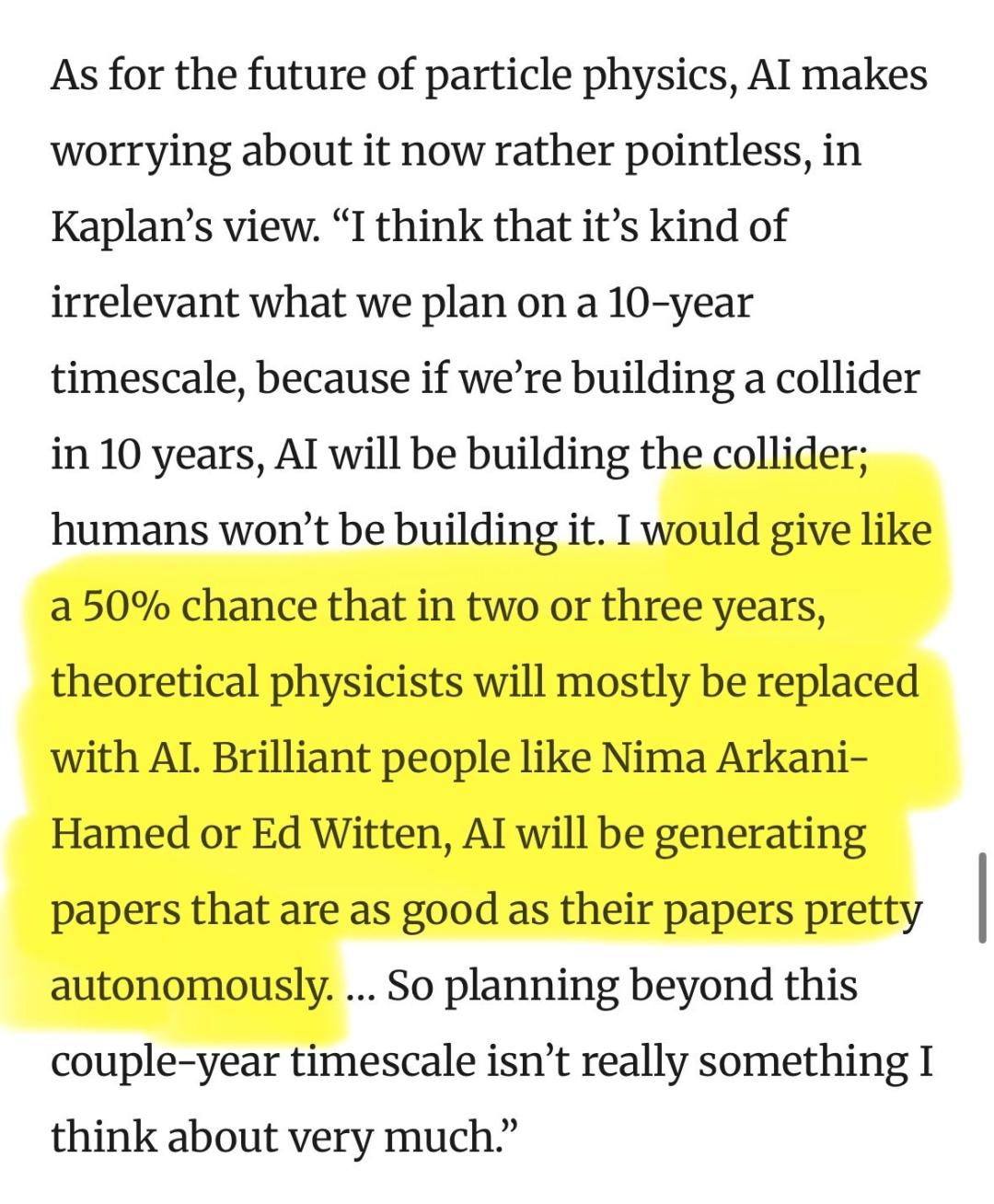
粒子物理十年无新发现,LHC成了「标准模型的坟场」。但Anthropic联创、哈佛物理博士Jared Kaplan却断言:再过2-3年,AI就能写出媲美顶尖物理学 家的论文,50%物理学家或将被彻底取代! 物理学界与科技圈地震! Anthropic联创、前物理学大牛Jared Kaplan放话:两到三年内,理论物理学家有50%概率被AI取代! 要知道,他博士毕业于哈佛大学物理学,同时是JHU的理论物理学教授,又是Anthropic的首席科学官。 对于AI和理论物理学,他都是行家,他的判断绝非无的放矢,白费口舌。 Kaplan引用内部研究与模型进展指出,未来2–3年内,AI在理论推导、数值模拟、公式发现和实验设计等核心科研环节中的能力,将逼近甚至超过大量人 类研究者。 他评估,至少有50%的物理学家工作内容,存在被AI替代或边缘化的明显风险。 替代50%理论物理学家,菲尔兹奖得主亦不例外 自2012年希格斯玻色子(即「上帝粒子」)被发现后,大型强子对撞机(LHC)的实验数据一直严格符合已有理论「标准模型」的预测,没有发现任何预 期之外的新粒子或新物理现象。 戏剧性并非源于希格斯粒子;当它在LHC现身时,其存在已 ...

春晚机器人解读专家会议
2026-02-24 14:16
春晚机器人解读专家会议 20260223 摘要 宇树机器人在春晚表演中展现出高度一致性和稳定性,得益于其优秀的 产品结构设计,减少了硬件迭代的需求,并在运动性和拟人化之间实现 了平衡。自研关节技术进一步提升了机器人的灵活性和一致性,减轻了 整体重量。 宇树机器人通过硬件平台化和通用性设计,支持软件持续优化,工程师 可在稳定硬件基础上进行长期开发,无需频繁适应硬件变化。通过模仿 学习与强化学习相结合,G1 型号机器人在短时间内完成了高难度动作 的训练。 预训练与遥控不会显著影响机器人的实际应用效果,感知、规划、决策 等技术已成熟。通过模仿学习和强化学习,机器人可积累大量数据,实 现模型涌现效应,快速掌握新技能。关键在于结合规划路径与运动能力, 避免跌倒。 机器人行业在运动控制和一致性方面面临挑战,尽管宇树机器人在稳定 性方面表现出色,但减速器和电机的一致性问题依然存在。银河通用通 过虚拟仿真环境生成数据训练模型,并敢于将免维护机器人投入实际运 营,获得市场优势。 Q&A 在机器人行业中,运动控制和一致性是两个主要的挑战。首先,尽管宇树的机 器人在稳定性方面表现出色,但由于其机身设计和手工制造的特点,减速器和 电 ...

星海图合伙人、CFO罗天奇:具身智能尚处于技术竞赛早期阶段
Mei Ri Jing Ji Xin Wen· 2026-02-12 10:47
Core Insights - The industry of embodied intelligence is at a crossroads of capital and industrial focus, with increasing financing and frequent technological demonstrations, yet facing challenges in stability, scalability, and cost control [1] Group 1: Financing and Valuation - Starry Sea has completed a Series B financing round of 1 billion yuan, bringing its total financing to nearly 3 billion yuan and achieving a valuation of 10 billion yuan, making it a unicorn in the embodied intelligence sector [1] - The CFO of Starry Sea emphasizes that the success in the AI industry is driven by Scaling Law, where the efficiency of capital utilization is more critical than the amount of financing [1][2] Group 2: Industry Dynamics - The current phase of the embodied intelligence industry is compared to the "Hundred Groups War," where companies are advised to focus on understanding the essence of business rather than just technology [2] - The industry is transitioning from early-stage technology exploration to resource-intensive competition, with a shift in capital logic from broad investment to focusing on leading companies [2] Group 3: Commercialization and Technology - The commercialization of embodied intelligence is divided into technology-driven and business-driven aspects, with specific operational boundaries that need to be met for successful deployment [4] - The CFO believes that the industry is still in the early stages of a technological race, and companies must retain sufficient funds to cope with the increasing costs of data and model training [2][4] Group 4: Financial Potential and Business Model - The ToB (business-to-business) segment of embodied intelligence has significant revenue potential, with large orders capable of generating substantial income, but the focus should be on revenue quality metrics [5] - The long-term business model in this industry is likened to selling "tokens of the physical world," with the real barriers being intelligence levels and the ability to design and manufacture hardware [5] Group 5: Competitive Advantages - China is recognized for its data supply chain advantages, which are significantly more cost-effective than those in the U.S., allowing for greater data collection at lower costs [6] - The CFO highlights that the unique aspect of embodied intelligence companies lies in developing their foundational models for physical world execution, emphasizing the need to focus resources on building these capabilities [7]
GLM-5架构细节浮出水面:DeepSeek仍是绕不开的门槛
3 6 Ke· 2026-02-10 23:57
Core Insights - The article discusses the imminent release of new AI models in the Chinese market, particularly focusing on the GLM-5 model from Zhipu AI, which is expected to leverage advanced technologies and compete effectively in the AI landscape [1][16]. Group 1: Model Development and Features - The GLM-5 model has been linked to multiple technical platforms, indicating a strong collaborative effort in its development [2][4]. - GLM-5 incorporates a 78-layer Transformer decoder with a total parameter count of approximately 745 billion, which includes a mixture of dense and sparse architectures [6][8]. - The model utilizes a hybrid expert (MoE) architecture, activating only a small fraction of its parameters during inference, which enhances efficiency while maintaining performance [9][10]. Group 2: Technological Innovations - The integration of DeepSeek's Sparse Attention (DSA) mechanism allows GLM-5 to handle long sequences more efficiently, reducing computational costs significantly [12][13]. - Multi-Token Prediction (MTP) technology is employed to accelerate token generation, allowing the model to predict multiple tokens simultaneously, which is particularly beneficial for structured text generation tasks [15][16]. - The model's architecture reflects a shift towards efficiency over sheer parameter count, indicating a trend in the AI industry towards optimizing performance rather than simply increasing size [9][17]. Group 3: Market Position and Challenges - GLM-5 is expected to excel in code generation and logical reasoning tasks, positioning it competitively in software development and algorithm design [16]. - However, the model currently lacks multi-modal capabilities, which may limit its applicability in creative AI-generated content (AIGC) scenarios, especially as competitors advance in this area [16]. - The article highlights a broader industry trend where companies are moving towards open-source technology integration, emphasizing efficiency and practicality in AI model development [16][17].


有的AI在算命,有的AI在救命
量子位· 2026-02-07 04:22
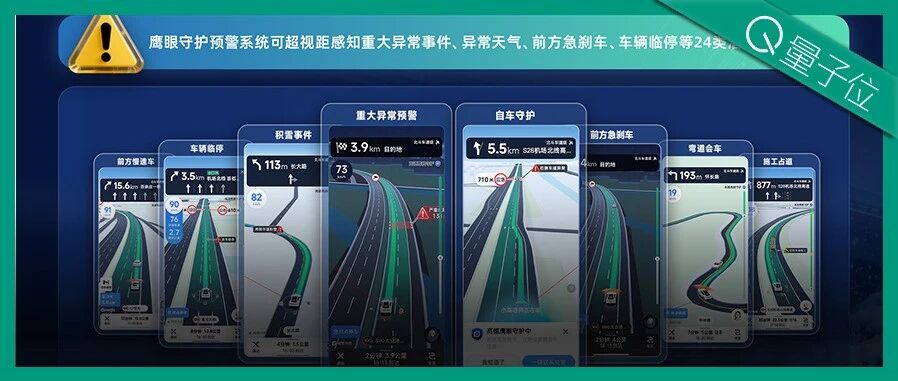
Core Viewpoint - The article discusses the increasing integration of AI in transportation safety, particularly through the "Eagle Eye" warning system developed by Gaode, which enhances driver awareness and reduces accident risks during the Spring Festival travel season [2][4][6]. Group 1: Spring Festival Travel - The Spring Festival travel volume is expected to reach a record high, with an estimated 9.5 billion trips over 40 days, and 80% of travelers opting for self-driving [1]. - The article highlights the unique aspects of this year's travel, emphasizing the role of AI in enhancing safety during journeys [1]. Group 2: AI's Role in Safety - The "Eagle Eye" system, developed in collaboration with the China Safety Production Science Research Institute, provides real-time risk awareness by detecting 24 types of potential hazards, including sudden braking and adverse weather conditions [4][6]. - The system has been upgraded to offer broader coverage and faster alerts, ensuring that it is accessible across various vehicles and road types [7]. Group 3: Technical Implementation - The core of the "Eagle Eye" system is the TrafficVLM model, which utilizes real-world traffic data to create a digital twin for training purposes [8][10]. - TrafficVLM enhances the system's ability to predict traffic conditions and provide timely warnings to drivers, thereby improving overall road safety [13][15]. Group 4: Performance Metrics - As of February 1, 2026, the "Eagle Eye" system has issued 11.2 billion warnings, averaging 88 million warnings per day, contributing to a 10% reduction in daily accident rates during peak travel times [16][18]. - The system's effectiveness is validated by real-world data, demonstrating its ability to help drivers avoid potential accidents [16][19].
凭借 27 万小时真机数据,Generalist 可能是最接近“GPT-1 时刻”的顶级机器人团队
海外独角兽· 2026-01-29 12:06
Core Insights - Generalist is a leading company in the robotics field with significant long-term competitive potential, focusing on data scale, team capability, and a clear scaling path [2][4]. Data Collection and Quality - High-quality real-world data is recognized as a core scarce resource in the robotics industry, with Generalist claiming to have accumulated 270,000 hours of training data, positioning it as the first robotics team to reach a data scale comparable to GPT-1 [4][6]. - The current mainstream methods for data collection include real machine data, human-operated data, pure video data, and synthetic data, with a consensus that real machine data is essential for training usable robotic models [5][6]. - Generalist's data collection strategy involves deploying thousands of data collection devices globally, utilizing egocentric data, and collaborating with data foundries to ensure diverse data sources [40][44]. Team and Technical Expertise - The core team of Generalist consists of members from prestigious institutions like OpenAI, Boston Dynamics, and Google DeepMind, contributing to significant projects such as PaLM-E and RT-2, showcasing strong technical capabilities [2][53]. - The team has demonstrated a clear research path and model dexterity through various demos, indicating a focus on achieving high levels of agility in robotic tasks [3][30]. Model Development and Performance - Generalist's GEN-0 model exhibits remarkable dexterity and the ability to perform complex tasks autonomously, showcasing its potential in physical interaction challenges [30][37]. - The model architecture employs Harmonic Reasoning, integrating perception and action tokens in a single Transformer flow, allowing for continuous and intelligent action generation [52]. Competitive Landscape - Generalist operates in a competitive environment with other companies like Physical Intelligence and Google, each with distinct strategies and strengths. Generalist's primary advantages lie in its extensive real machine data and strong team expertise, while facing challenges from competitors with more comprehensive team structures and funding [62][63]. - The company is positioned in the second quadrant of the robotics industry landscape, focusing on developing a general robotic brain, while competitors like Sunday are advancing faster in practical applications [61][62].

Altman承认“搞砸了”,曝 GPT-5.2 牺牲写作换顶级编程,明年成本降 100 倍,实锤Agent 已能永久干活
3 6 Ke· 2026-01-27 04:12
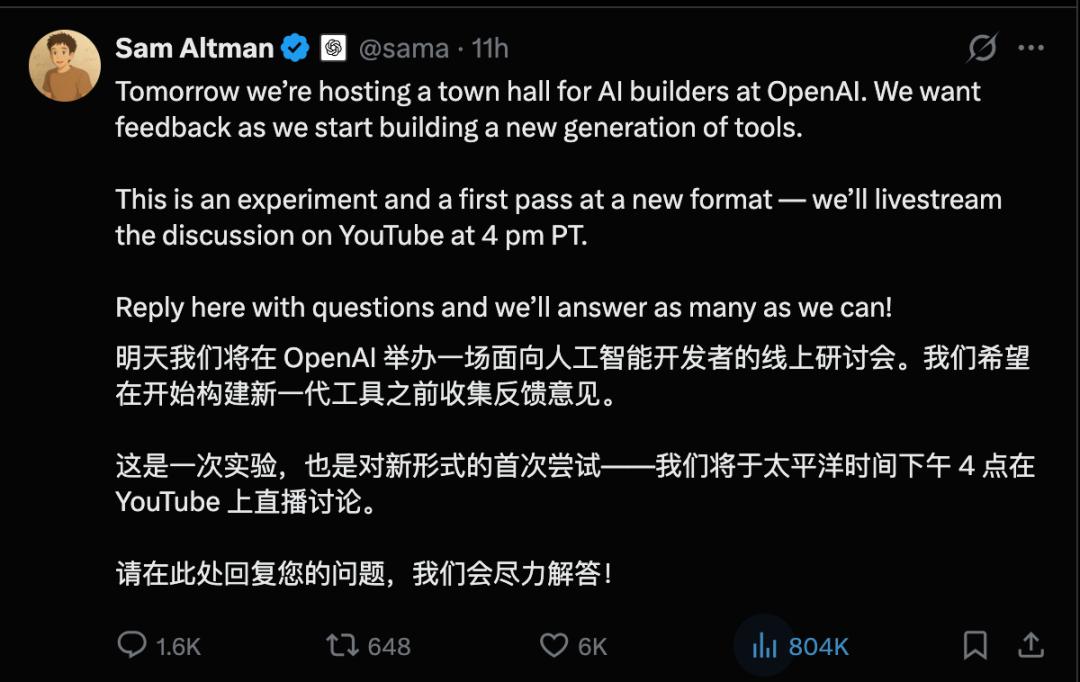
Core Insights - OpenAI CEO Sam Altman announced an online seminar to gather public feedback before developing the next generation of AI tools [1] - The seminar focused on the future of AI, model evolution, and the transition from static software to real-time generated applications [3][5] - Altman highlighted the asymmetry in GPT-5's performance, acknowledging a trade-off in writing ability for enhanced reasoning and programming skills [4][7] Group 1: AI Model Development - Altman revealed that by the end of 2027, the intelligence cost of GPT-5.2 is expected to decrease by at least 100 times [4][8] - The emphasis is shifting from cost to speed, with developers prioritizing rapid output for complex tasks [5][8] - OpenAI aims to provide two pathways: extremely low-cost intelligence and high-speed feedback systems [5] Group 2: Software Evolution - The future of software is envisioned as dynamic and personalized, moving away from static applications [5][9] - Users will expect computers to generate immediate solutions tailored to specific problems, leading to a restructured operating system [5][9] - This shift will create a unique, evolving productivity system for each user, fundamentally changing software interaction [5] Group 3: Economic and Social Impact - Altman believes AI will empower individuals, reduce barriers, and enable low-cost innovation and entrepreneurship [6] - However, there are concerns about potential wealth concentration and the need for policy focus to prevent this [6] - The integration of AI is expected to enhance human collaboration rather than diminish it, fostering new forms of teamwork [20] Group 4: Challenges and Future Directions - Altman acknowledged the challenges in achieving long-term autonomous operation for AI agents, emphasizing the need for task simplification [11] - The importance of resilience in AI safety, particularly in biological and cybersecurity contexts, was highlighted [16][17] - OpenAI is exploring how to effectively integrate AI into educational settings, particularly for younger children [24]
AI来了,大厂为什么留不住高管? | 巴伦精选
Tai Mei Ti A P P· 2026-01-26 10:44
Core Insights - The article discusses the transition of tech executives from large companies to startups, driven by the AI revolution and the limitations of traditional corporate structures [2][5][24] - It highlights the emergence of two waves of entrepreneurs: the "tech believers" focused on model development and the "business translators" who prioritize commercialization [17][20] Group 1: Reasons for Departure - Executives are leaving large firms due to structural conflicts between established corporate cultures and the innovative demands of AI development [5][9] - The rise of AI technologies, particularly the Transformer architecture, has prompted many to seek opportunities outside their companies, where they can pursue innovative projects without bureaucratic constraints [5][6] - The decision-making processes in large firms often hinder rapid innovation, leading talented individuals to pursue entrepreneurial ventures where they can explore new ideas more freely [11][12] Group 2: Characteristics of Departing Executives - The departing executives often possess deep technical knowledge and a strong understanding of AI, making them valuable assets in the startup ecosystem [17][25] - They have the ability to integrate resources and build teams, which is crucial for the collaborative nature of AI projects [25] - Their insights into industry needs and market demands position them well to identify and capitalize on new business opportunities [25][26] Group 3: Challenges Faced by Large Firms - Large companies struggle to retain talent due to lengthy decision-making processes and a culture that prioritizes risk minimization over opportunity maximization [10][11] - Despite offering attractive compensation packages, these firms fail to address the underlying issues related to organizational structure and innovation [10][12] - The inability to provide a conducive environment for experimentation and risk-taking further exacerbates talent retention challenges [12][13] Group 4: Investment Trends - Investors are increasingly favoring executives with backgrounds in major tech firms, viewing them as reliable indicators of potential success in the uncertain AI landscape [24][25] - The shift in investment focus reflects a broader trend where capital seeks to mitigate risks associated with new technologies by backing experienced leaders [24][26] - The emergence of a "hunting mechanism" among investors highlights the proactive approach to identifying and supporting promising talent from large companies [27][28]