体育消费

Search documents
赛事“烟火气”带来文旅新流量
Hai Nan Ri Bao· 2025-09-21 00:46
Core Viewpoint - The development of mass sports events in Hainan has transformed from a singular activity into a significant driver for urban development and a strong engine for the deep integration of culture, sports, and tourism [1][2]. Group 1: Innovation in Mass Sports Events - Hainan is actively exploring new models such as "Sports + Business District," "Sports + Scenic Area," and "Sports + Community," bringing events closer to citizens and integrating sports into daily life [2]. - The "Haikou Cup" basketball league serves as a vivid example of this innovation, breaking spatial limitations and enhancing the event's appeal and participation [2]. Group 2: Economic Impact and Consumption Growth - Mass sports events generate significant consumer demand in areas such as accommodation, dining, transportation, and shopping, contributing to economic growth [3]. - During the recent "May Day" holiday, 26 sports events attracted over 7,600 participants and nearly 100,000 spectators, resulting in approximately 65 million yuan in related consumption [3]. Group 3: Integration of Sports with Other Industries - Each mass sports event provides an excellent opportunity for the deep integration of culture, tourism, and sports industries, creating a virtuous cycle of development [2]. - The integration of sports with tourism, culture, and entertainment extends the industry chain and promotes a model of "promoting tourism through sports, enhancing culture through tourism, and invigorating sports through culture" [2]. Group 4: Government Support and Future Potential - The State Council has issued opinions to unleash the potential of sports consumption and promote high-quality development in the sports industry, indicating strong governmental support [3]. - With the expansion of sports consumption scenarios and the implementation of consumer-friendly measures, mass sports events are expected to play a larger role in enhancing urban quality and driving economic vitality in Hainan [3].
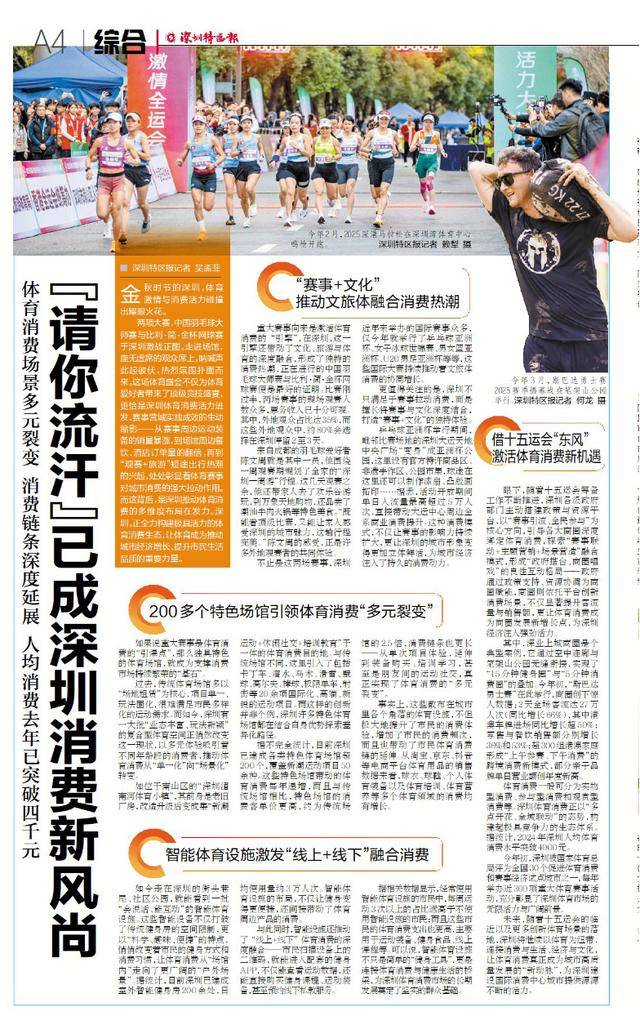
【深圳特区报】体育消费场景多元裂变 消费链条深度延展 人均消费去年已突破四千元
Sou Hu Cai Jing· 2025-09-20 14:28
Core Insights - The ongoing sports events in Shenzhen, such as the China Badminton Masters and the Billie Jean King Cup, are significantly boosting local consumption and showcasing the city's vibrant sports economy [2][4] - Shenzhen is actively integrating sports with culture and tourism, creating a unique consumption trend that enhances the overall experience for visitors [4][6] - The city has developed over 200 unique sports venues that cater to diverse consumer needs, leading to a substantial increase in sports-related spending [8][9] Group 1: Event Impact on Consumption - Major sports events serve as a catalyst for sports consumption, driving ticket sales and local tourism, with 35% of attendees being from outside Shenzhen [4][6] - The integration of cultural activities during events, such as the Asian Cup, has attracted over 50,000 visitors in a single day, enhancing commercial activity in surrounding areas [7] - The "event + culture" model is being effectively utilized to create a richer consumer experience, promoting both sports and local culture [6][7] Group 2: Venue Development and Consumer Behavior - Shenzhen has transformed traditional sports venues into multi-functional spaces that offer a variety of activities, appealing to a broader audience [8][9] - The average spending per visit at these unique venues is approximately 2.5 times higher than at traditional facilities, indicating a shift towards more diverse and engaging sports experiences [9] - The rise of smart sports facilities has further enhanced consumer engagement, with over 200 outdoor smart gyms attracting around 30,000 users daily [10] Group 3: Government Initiatives and Future Outlook - The upcoming 15th National Games is expected to further stimulate sports consumption, with government initiatives aimed at integrating sports with local commerce [11][12] - The establishment of a competitive sports consumption ecosystem is underway, with projections indicating that per capita sports spending in Shenzhen will exceed 4,000 yuan by 2024 [11][12] - Shenzhen's recognition as a pilot city for promoting sports consumption highlights its potential for sustained growth in the sports economy [12]

关于扩大服务消费的若干政策措施的学习体会
CAITONG SECURITIES· 2025-09-17 05:59
Policy Measures - On September 16, nine departments jointly issued policies to expand service consumption, focusing on five key areas: cultivating service consumption platforms, enriching high-quality service supply, stimulating new consumption, enhancing financial support, and improving statistical monitoring systems[2] - The report outlines 19 specific measures aimed at promoting the quality and expansion of service consumption, thereby unleashing domestic demand potential[2] Industry Insights - In the cultural and tourism sector, the added value of cultural and related industries reached CNY 5.95 trillion in 2023, while tourism and related industries added value was CNY 5.48 trillion[2] - Domestic travel is projected to reach 5.615 billion trips in 2024, with total consumption expected to hit CNY 5.75 trillion[2] - The sports industry is anticipated to grow significantly, with a focus on introducing high-quality international sports events and fostering grassroots sports events like "Village Super" and "Su Super" to create new consumption growth points[2] Investment Recommendations - Service retail sales are expected to grow by 6.2% year-on-year in 2024, outpacing goods retail sales by 3 percentage points[2] - Per capita service consumption expenditure is projected to increase by 7.4%, contributing 63% to overall per capita consumption growth[2] - Investment focus areas include "new" cultural tourism projects, quality sports event IPs, and long-term care insurance-related enterprises in the elder care sector[2] Risk Factors - Potential risks include slower-than-expected policy progress, lower-than-expected economic growth, and weaker-than-expected consumer sentiment recovery[2]
纺织服装2025中报总结暨三季报前瞻品牌趋势企稳,制造订单预期改善
Guoxin Securities· 2025-09-16 15:02
Investment Rating - The investment rating for the textile and apparel industry is "Outperform the Market" [2] Core Insights - The textile manufacturing sector shows growth while the apparel and home textile sectors face performance pressure. In the first half of 2025, textile manufacturing and apparel/home textile revenues grew by 7.8% and declined by 6.4% year-on-year, respectively. The gross margin for textile manufacturing remained stable at 19.4%, with a net margin increase of 2.2% to 8.5%. In contrast, the apparel/home textile sector saw a slight gross margin increase of 0.1% to 46.1%, but a net margin decline of 1.1% to 8.5% [3][12][15] Summary by Sections 1. Sector Summary: Textile Manufacturing Growth, Apparel/Home Textile Performance Pressure - In the first half of 2025, textile manufacturing revenue increased by 7.8% while apparel/home textile revenue decreased by 6.4%. The gross margin for textile manufacturing was 19.4%, and the net margin improved to 8.5%. The apparel/home textile sector's gross margin was 46.1%, with a net margin of 8.5% [3][12][15] 2. Sports Apparel: Industry Maintains Growth, Brand Differentiation - Sports brands continued to see revenue growth around 10%, while non-sports apparel brands mostly experienced revenue declines. The online channel outperformed offline, with some brands maintaining growth in direct sales [3][5] 3. Casual Home Textiles: Demand Under Pressure, Online Channels and New Business Models Leading Growth - The casual home textile sector continues to face demand pressure, but online channels and new business models are driving some growth [3][5] 4. Contract Manufacturing: Revenue Steady Amid Tariff Policy Impact, Profitability Stable - The textile manufacturing sector maintained steady revenue growth despite tariff policy disruptions. Major contract manufacturers like Huayi and Shenzhou reported full orders, with revenue growth exceeding 10% [3][5][20] 5. Textile Materials: Tariff Policy Affects Client Order Caution, Profitability Varies - The textile materials sector is experiencing varied profitability due to cautious ordering from clients influenced by tariff policies [3][5] 6. Q3 Report Outlook: Brand Trends Stabilizing, Manufacturing Order and Shipment Improvement - The apparel/home textile sector is expected to see improved revenue growth in Q3 compared to Q2, while the textile manufacturing sector anticipates better order and shipment performance following tariff policy stabilization [3][5] 7. Investment Recommendations - Focus on fundamentally sound, undervalued leaders in the market. For sports apparel, brands like Anta Sports, Xtep International, Li Ning, and 361 Degrees are recommended. In textile manufacturing, companies like Shenzhou International and Huayi Group are highlighted for their resilience and potential for profit improvement [5][6]





时评:释放体育消费潜力,推动体育产业高质量发展
Sou Hu Cai Jing· 2025-09-16 08:46
Core Insights - The State Council issued an opinion aimed at unleashing the potential of sports consumption and promoting high-quality development of the sports industry, targeting a total scale exceeding 70 trillion yuan by 2030 [1][7] Sports Industry Growth - Since the 2014 issuance of policies to accelerate sports industry development, the overall sports industry in China has shown rapid growth, with an average annual growth rate exceeding 10% over the past five years [3] - In the first half of 2025, retail sales of sports goods on major e-commerce platforms reached 218.17 billion yuan, marking a year-on-year increase of 17.5%, significantly outpacing the national online retail growth rate of 6.0% [3] Event-Driven Consumption - The opinion emphasizes the importance of enriching sports events and optimizing event management, highlighting the spillover effects of events like the "Su Super" league, which boosts related sectors such as transportation, accommodation, and dining [4] - The document supports integrating qualifying events into the Olympic points system to enhance international influence and promote sports consumption growth [4] Expanding Consumer Base - The interaction between stimulating sports consumption demand and expanding consumption scenarios is crucial, with youth sports playing a foundational role in driving family-level sports spending [5] - The opinion calls for strengthening the training of sports coaches in schools and promoting youth sports events, which will provide robust policy support for youth sports development [5][6] Emerging Sports and Consumption Trends - New sports consumption demands are emerging, particularly in sectors like e-sports and outdoor activities, with significant growth observed in the ice and snow sports sector, where ski resorts welcomed 256 million visitors, a 13.5% increase [6] - The opinion outlines measures to cultivate the ice and snow economy and develop outdoor sports industries, which will further expand the sports industry's development space [6] Policy Support and Economic Impact - The implementation of the opinion provides policy backing and direction for unleashing sports consumption potential and advancing the sports industry's high-quality development [7] - The multi-faceted approach aims to stimulate sports consumption, enhance the supply of sports products, and strengthen the operational entities within the sports industry, thereby injecting strong momentum into economic and social development [7]
从体育中挖掘经济增量
Ren Min Ri Bao· 2025-09-16 05:49
Group 1 - The core viewpoint of the articles highlights the rapid growth of China's sports industry, which has been expanding at an annual rate of over 10% since the 14th Five-Year Plan, becoming a significant contributor to public health and economic growth [1][2] - The State Council has emphasized the importance of developing the sports industry and consumption as a key part of the strategy to expand domestic demand, indicating that sports consumption is increasingly recognized for its role in promoting consumption and economic expansion [1][2] - The demand for sports has evolved from mere physical exercise to a multifaceted experience that includes social interaction, relaxation, and entertainment, reflecting the public's pursuit of health and quality of life [2][3] Group 2 - The sports goods manufacturing sector is experiencing innovation, with data showing that China's sports goods exports reached $14.901 billion in the first half of 2025, marking a year-on-year increase of 1.56%, driven by smart fitness equipment and treadmills [2] - The integration of sports with other industries, such as tourism and culture, is creating new consumption dynamics, as seen in urban developments like Chengdu's greenway and Shanghai's sports park, which combine various recreational and cultural activities [3] - The development of sports facilities is being integrated into broader urban renewal and rural revitalization efforts, enhancing the potential for sports consumption in areas rich in natural resources, thereby linking sports to transportation, accommodation, and dining sectors [3]
金观平:开动供需引擎扩大体育消费
Jing Ji Ri Bao· 2025-09-16 02:48
Core Viewpoint - The recent government opinion aims to enhance the sports industry, targeting a total scale exceeding 7 trillion yuan by 2030, emphasizing the importance of sports in improving public health and driving economic development [1] Group 1: Supply-Side Reform - Supply-side reform is essential for unlocking sports consumption potential, addressing shortcomings in high-quality and personalized offerings, and the lag in developing emerging sports projects [2] - The integration of "sports+" with industries such as culture, tourism, education, health, and technology is crucial for fostering new business models and enhancing consumer choices [2] - The application of new technologies like 5G, big data, and artificial intelligence is necessary to improve supply efficiency and quality, catering to diverse and high-quality consumer demands [2] Group 2: Demand-Side Cultivation - The demand side is pivotal in driving sports consumption, with a growing middle-income group in China increasingly shifting from traditional consumption to participatory and experiential consumption [3] - Optimizing the consumption environment by improving facilities, events, and public services is essential to lower barriers to consumption [3] - Encouraging businesses to focus on consumer needs, enhance product quality, and strengthen brand building will increase consumer loyalty and willingness to spend [3] Group 3: Collaborative Efforts - A coordinated effort between supply and demand sides is necessary to create a seamless cycle, requiring government support in areas like land, funding, and talent [3] - Companies must be responsive to market trends, invest in R&D, and maintain compliance with regulations to enhance innovation capabilities [3] - Industry associations should facilitate communication, establish standards, and promote self-regulation to strengthen the overall industry framework [3]
开动供需引擎扩大体育消费
Jing Ji Ri Bao· 2025-09-16 00:04
Core Insights - The Chinese government aims to exceed 7 trillion yuan in the sports industry by 2030, emphasizing the importance of sports in enhancing public health, fulfilling people's aspirations for a better life, and driving economic and social development [1] Group 1: Supply-Side Reforms - Supply-side reforms are essential for unlocking the potential of sports consumption, addressing shortcomings in high-quality and personalized offerings, and the lag in developing emerging sports projects [2] - The integration of sports with other industries such as culture, tourism, education, health, and technology is crucial for fostering new business models and enhancing consumer choices [2] - The adoption of advanced technologies like 5G, big data, and artificial intelligence is necessary to improve the efficiency and quality of sports supply, catering to diverse and high-quality consumer demands [2] Group 2: Demand-Side Cultivation - The demand for sports consumption is shifting from traditional viewing and physical goods to participation and experiential activities, driven by the largest middle-income group globally and increasing health awareness [3] - Improving the consumption environment by enhancing facilities, events, and public services is vital for lowering barriers to consumption [3] - Companies should focus on consumer needs, improve product value and service quality, and strengthen brand building to enhance consumer loyalty [3] Group 3: Collaborative Efforts - A coordinated effort between supply and demand sides is necessary to create a seamless cycle, requiring government support in terms of land, funding, and talent, while breaking down institutional barriers [3] - Companies must be attuned to market trends, invest in research and development, and maintain compliance with safety and legal standards [3] - Industry associations should facilitate communication, establish standards, and promote self-regulation to enhance the overall market environment [3] Group 4: Overall Impact - The promotion of sports consumption is linked to national strength and the well-being of the populace, necessitating stronger measures to enhance the quality and scale of sports consumption [4]
从体育中挖掘经济增量(人民时评)
Ren Min Ri Bao· 2025-09-15 22:22
Core Insights - The sports industry in China has been growing at an annual rate of over 10% since the 14th Five-Year Plan, becoming a significant contributor to public health and economic growth [1][2] - The State Council has emphasized the importance of developing the sports industry and consumption as part of the strategy to expand domestic demand, highlighting sports consumption as a key area for improving consumer spending [1][2] Group 1 - The demand for sports activities has evolved from mere physical exercise to include exploration of nature, social interaction, relaxation, and entertainment, reflecting the public's pursuit of health and quality of life [2][3] - The sports goods manufacturing sector has shown innovation, with exports reaching $14.901 billion in the first half of 2025, a year-on-year increase of 1.56%, driven by smart fitness equipment and treadmills [2] - The integration of sports with other industries, such as tourism and culture, has stimulated new consumption dynamics, as seen in urban developments like Chengdu's greenway and Shanghai's sports park [3] Group 2 - The development of sports facilities is being integrated into urban renewal and rural revitalization efforts, optimizing existing resources and creating new consumption hotspots [3] - The trend of "one person participating, the whole family traveling" is emerging, showcasing the strong influence of sports on related sectors like transportation, accommodation, and dining [3] - The sports industry is leveraging its strong grassroots support and innovative potential to continuously explore new avenues for growth, contributing significantly to public health and economic development [3]
未来五年,这个巨大市场将跑出一批“黑马”!
Sou Hu Cai Jing· 2025-09-14 04:05
Core Insights - China's service consumption growth has outpaced that of goods consumption, indicating a significant shift in economic structure towards a service-oriented economy [1][4] - The average annual growth rate of service consumption expenditure from 2020 to 2024 is projected to be 9.6%, with 46% of consumer spending now allocated to services [2][4] Economic Structure Impact - The increasing importance of the service sector in the national economy is highlighted by the average service industry value-added ratio of 54.6% over the past decade, which is expected to rise further due to rapid service consumption growth [4] - This shift reflects a change in consumer attitudes from material goods to higher-quality life experiences, driving demand in sectors like tourism, culture, and health services, thus stimulating related industries and promoting economic resilience [4] Global Trends in Service Consumption - Global service consumption is trending towards digitalization, sustainability, personalization, and experience-oriented services, with China leading in areas such as mobile payments and shared economy models [5][6] - The rise of digital services is supported by advancements in AI, 5G, and other technologies, which have accelerated demand for remote services like online education and digital healthcare [5][6] Emerging "Dark Horse" Sectors - Future growth in China's service consumption is expected in sectors such as the silver economy, sports consumption, and AI-integrated services, driven by demographic changes and technological innovation [8][9] - The silver economy will see increased demand for elder care, health management, and community services as the population ages [8] - Sports consumption is poised for growth through innovations in venues and events, while AI will create new service models in health, education, and legal sectors [8][9] Opportunities for Multinational Companies - The rising demand for high-end medical, financial, and digital entertainment services in China presents new opportunities for multinational companies to leverage their expertise and technology [11] - Companies in pharmaceuticals and medical devices can engage in precision medicine and anti-aging treatments, while financial institutions can focus on wealth management and green finance [11] Service Trade Cooperation - The recent service trade fair attracted nearly 2,000 exhibitors, providing a platform for countries to showcase their capabilities in digital, green, and professional services [12] - The fair aims to facilitate deep integration of industrial, innovation, and service chains, promoting a sustainable global service trade landscape [12]