关税冲击

Search documents
1.2%!日本二季度GDP超预期增长
Hua Er Jie Jian Wen· 2025-08-15 01:56
Group 1 - Japan's economy showed unexpected resilience in Q2, with GDP growth at an annualized rate of 1.0%, significantly above economists' expectations of 0.4% [1][2] - The first quarter's GDP was revised from a contraction to a growth of 0.6% [1] - Year-on-year GDP growth for Q2 was 1.2%, down from 1.8% in Q1 [1] Group 2 - Domestic demand was the main driver of the strong performance, with corporate investment rising by 1.3%, exceeding the expected 0.7% [4] - Private consumption, which accounts for nearly 60% of the economy, increased by 0.2%, supported by robust wage growth from this year's salary negotiations [4] Group 3 - Net exports contributed 0.3 percentage points to economic growth, with actual export values increasing by 2% despite higher tariff barriers [5] - Inbound tourism also bolstered net exports, with foreign tourist spending in Japan rising by 18% [5] Group 4 - The strong GDP data supports the Bank of Japan's path towards policy normalization, with expectations of potential interest rate hikes in the near future [6] - Approximately 42% of economists anticipate action from the Bank of Japan in October, despite expectations to maintain rates in the upcoming September meeting [6]


美股三大指数低开,英伟达、AMD跌超1%
Ge Long Hui· 2025-08-14 13:44
特朗普关税冲击经济,美国7月份批发价格同比上涨3.3%超预期,环比上涨0.9%创2022年6月以来最大 增幅。美股三大指数集体低开,纳指跌0.3%,标普500指数跌0.28%,道指跌0.41%。 英伟达、AMD跌超1%,美国财长贝森特在被问及英伟达和AMD交易时表示这些公司很特殊。 亚马逊涨超2%,公司计划在年底前将"当日达"配送覆盖范围扩大一倍以上,达到2300个美国城市。 思科跌超4%,第四财季业绩胜预期,但新财年业绩指引保守、未有惊喜,令市场失望。 网易跌超6%,Q2净收入同比增加9.4%至279亿元,接近市场预期下限。 (格隆汇) ...

Coach热销难抵关税寒流 Tapestry(TPR.US)盈利展望受挫股价暴跌
智通财经网· 2025-08-14 12:18
Core Viewpoint - Tapestry's latest quarterly earnings report exceeded expectations, but the company's annual outlook fell short due to tariff costs impacting key profitability metrics, leading to a significant drop in stock price [1] Group 1: Financial Performance - For the fourth quarter of fiscal year 2025, Tapestry reported an adjusted earnings per share of $1.04, surpassing analyst expectations by $0.02 [1] - The quarterly sales reached $1.72 billion, exceeding the forecast of $1.68 billion [1] - The company anticipates diluted earnings per share for fiscal year 2026 to be between $5.30 and $5.45, reflecting a growth of 4% to 7% year-over-year, but below the analyst expectation of $5.49 [1] Group 2: Tariff Impact - Tapestry's management indicated that tariffs are expected to result in a negative impact of $0.60 per share [1] - CFO Scott Roe mentioned that the additional tariff costs for the fiscal year would amount to approximately $160 million, which is expected to have a significant impact [2] - The company expressed confidence in its ability to gradually mitigate the impact of tariffs [2] Group 3: Brand Performance - Coach's revenue grew by 13% in the last quarter when excluding currency effects, while Kate Spade's revenue declined by 13% [2] - Tapestry's revenue for the fiscal year ending in June is projected to reach $7.2 billion, slightly above market expectations of $7.12 billion, with a mid-single-digit growth year-over-year [2] - Coach ranked as the fifth most popular fashion brand globally in June, with its Tabby and Brooklyn bags becoming standout products [3] Group 4: Market Position - Despite the dominance of European luxury brands, Coach has successfully positioned itself as a competitive American brand, maintaining a more approachable pricing strategy [3] - Analysts noted that the strong performance of Tapestry's brands suggests potential for continued market share expansion and maintenance of operating margins amid rising price sensitivity and tariff risks [3]

【环球财经】巴西雷亚尔兑美元汇率升至一年来新高
Xin Hua Cai Jing· 2025-08-13 01:37
Group 1 - The Brazilian real appreciated significantly against the US dollar, rising by 1.06% to close at 5.3864 reais per dollar, the highest level since June 14, 2024 [1] - The Brazilian stock index Ibovespa increased by 1.69%, closing at 137,913.68 points [1] - Analysts attribute the currency's rise to lower-than-expected US inflation data, which decreased the dollar's attractiveness to investors, leading to capital flowing into riskier currencies like the real [1] Group 2 - Investors are closely monitoring the Brazilian government's response to the US tariff impact, particularly after President Trump announced a 50% tariff on certain Brazilian exports [1] - Brazilian Finance Minister Haddad indicated that the government's response plan may include credit support, tax deferral, government procurement of export products, and structural reforms to promote exports [1] - A scheduled video meeting between Haddad and US Treasury Secretary Scott Basset was canceled by the US side, with limited market reaction, as the negotiations are seen as primarily political and unlikely to yield breakthroughs in the short term [1]
业绩预期不佳 “洞洞鞋鼻祖”卡洛驰卖不动了?
Sou Hu Cai Jing· 2025-08-12 08:25
Core Viewpoint - The latest financial report from Crocs' parent company, Karlochi, indicates a troubling trend with significant net losses despite revenue growth, and a forecasted revenue decline for the third quarter, marking the most substantial expected drop in two years [1][6]. Revenue Performance - In Q2 2025, Karlochi reported consolidated revenue of $1.149 billion, a year-on-year increase of 3.4%, with a 2.7% increase when adjusted for fixed exchange rates [1]. - Direct-to-consumer (DTC) revenue grew by 4.0% to $495 million, while wholesale revenue increased by 2.8% to $465 million [1]. - The Crocs brand generated $960 million in revenue, reflecting a 5.0% year-on-year increase, with DTC and wholesale channels both showing positive growth [1][2]. Regional Performance - International revenue for the Crocs brand rose by 18.1% to $502 million, while North American revenue declined by 6.5% to $457 million [2]. - The HEYDUDE brand experienced a revenue drop of 3.9% to $190 million, with DTC revenue increasing by 7.6% but wholesale revenue declining by 12.4% [2]. Profitability Concerns - Karlochi reported a net loss of $492 million in Q2, compared to a net profit of $229 million in the same period last year, primarily due to non-cash impairment losses related to the HEYDUDE brand [2][3]. Future Outlook - The company anticipates a revenue decline of 9% to 11% for Q3 2025, marking the largest contraction in its financial outlook in nearly two years [6]. - CEO Andrew Rees expressed satisfaction with Q2 performance but acknowledged the uncertain operating environment, leading to a focus on cost control measures [4][6]. Market Challenges - The company faces challenges from increased tariffs, which are expected to impact profits by approximately $40 million in the second half of the year [7]. - The North American market's performance is under pressure, with consumers becoming more cautious about spending on non-essential items [7]. Competitive Landscape - In China, Karlochi continues to see growth, but faces competition from local brands offering similar products at lower prices [8]. - The brand's unique selling proposition is being challenged as new footwear styles gain popularity, potentially affecting customer loyalty and repeat purchases [8].

就业疲软阴影笼罩 今晚美国CPI只要不爆表 9月降息大势难以逆转
Hua Er Jie Jian Wen· 2025-08-12 07:57
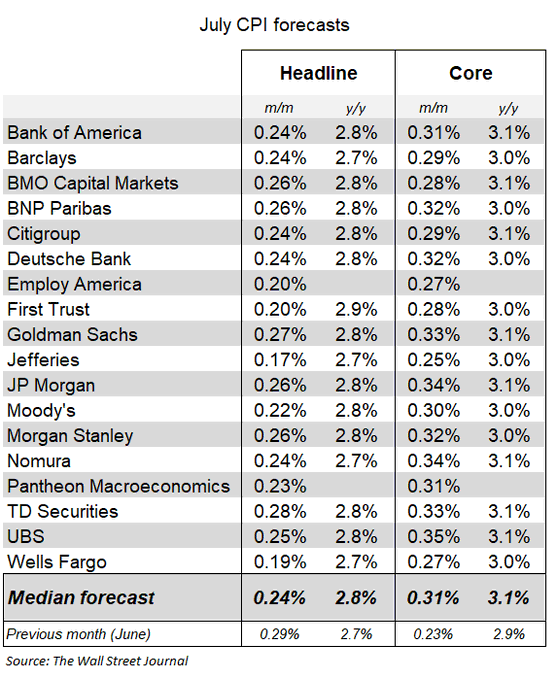
Core Insights - The upcoming July Consumer Price Index (CPI) report is expected to show a slight increase in inflation, but not enough to alter the Federal Reserve's path towards a rate cut in September [1][4][8] - The consensus forecast for July CPI is a month-over-month increase of 0.2% and a year-over-year increase to 2.8%, while core CPI is expected to rise by 0.3% month-over-month and 3.0% year-over-year, marking the highest level since February [1][2][5] Inflation Expectations - Various financial institutions have provided their forecasts for July CPI, with a median expectation of 0.24% month-over-month and 2.8% year-over-year for overall CPI, and 0.31% month-over-month and 3.1% year-over-year for core CPI [2] - Deutsche Bank anticipates a divergence in short-term core inflation trends, with a three-month annualized rate rising to 2.7% while the six-month rate may drop to 2.4% [5] Impact of Tariffs - The data will serve as a critical signal to assess the impact of new tariffs on consumer prices, with Wells Fargo noting that the price transmission from tariffs is still in its early stages [4][6] - Goldman Sachs estimates that the direct contribution of tariffs to core inflation will be approximately 0.12 percentage points in the month [5] Market Reactions - The market is currently pricing in a high probability (89%) of a 25 basis point rate cut in September, driven by weak employment data [8][9] - JPMorgan's market intelligence team has outlined potential market reactions based on core CPI results, indicating that a month-over-month increase above 0.40% could lead to a significant drop in the S&P 500 [13] Data Quality Concerns - There are concerns regarding the quality of the CPI data due to budget cuts and reduced personnel at the Bureau of Labor Statistics, which may lead to increased volatility in the reported figures [10][11]


美加征关税持续冲击瑞士药企
Jing Ji Ri Bao· 2025-08-11 22:05
最近,瑞士药企正遭遇美国加征关税举措的连续冲击。 7月31日,美国政府宣布对从瑞士进口的商品征收39%关税。近日,美国又向全球主要制药企业发出"最 后通牒",要求其降低在美药品价格,并将更多生产环节转移至美国。其中就包括瑞士知名药企罗氏和 诺华。 长期以来,全球医药行业普遍采用"全球分工、区域协作"的供应链模式:从发展中国家采购原料药,在 欧洲进行生产加工,最终出口至美国市场。美国大幅提高进口关税,势必推高企业生产成本,打乱原有 分工格局,迫使企业重新布局产能与供应链。这种人为推动的"回流"政策,违背了市场经济基本规律, 将会扭曲产业链结构,提升成本、压低效率,不利于全球医药行业的可持续发展。 更现实的问题在于,医药产业链建设极为复杂,涉及选址、设备、质量控制、人员招聘、环保审批等多 个环节,绝非短期内可以完成的。在多变的政策环境下,企业虽有投资承诺,但最终能否落地,仍存在 较大不确定性。 美国是全球最大的医药市场,也是绝大部分国际医药企业最大的营收来源地。当这一巨大市场迎来充满 不确定性的关税冲击,企业的经营风险就被空前放大。因此,对于包括瑞士药企在内的全球医药企业来 说,进行更多元化的市场布局,让营收结构 ...
关税冲击正转嫁至美国消费者 高盛警示通胀与美债风险
智通财经网· 2025-08-11 09:17
智通财经APP获悉,高盛集团的研究显示,美国总统特朗普的关税政策对消费者价格的影响才刚刚开 始,这给本已因利率下调预期而动荡不安的美国国债市场增添了更多不确定性。 高盛经济学家Jan Hatzius等人在报告中写道,美国企业迄今承担了特朗普关税的大部分冲击,但随着企 业提高价格,负担将越来越多地转嫁给消费者。 他们写道,截至6月,美国消费者估计吸收了22%的关税成本,但如果最新关税遵循前几年的征税模 式,消费者的负担比例将升至67%。 最终结果是:通胀加速。高盛分析师表示,美联储最青睐的通胀指标之一——核心个人消费支出价格指 数12月同比涨幅将达到3.2%。他们表示,扣除关税后的潜在通胀率将为2.4%。6月份该指数为2.8%。 这份报告进一步印证了经济学家普遍持有的观点:特朗普的全面关税将加剧通胀,而美联储政策不仅对 债券交易员,甚至对总统本人来说都已成为热门话题。特朗普打破常规,公开呼吁美联储降息,建议美 联储主席鲍威尔辞职,并在货币政策委员会中至少暂时增加一名盟友。 美国指南针组织创始人兼首席经济学家奥伦·卡斯在播客中表示:"通胀,当然与央行制定货币政策有 关,它涉及整体价格水平的持续上涨。如果你选择一项 ...
美国关税重压下,台湾传统制造业沦为最大输家
Sou Hu Cai Jing· 2025-08-10 11:10
Group 1 - The announcement of tariffs by Trump in April has placed Taiwan in a challenging position despite its perceived advantages in negotiations [1] - TSMC's investments in the US may shield it from 100% tariffs, but this does not guarantee a trade agreement for Taiwan or protect its economy from other tariffs imposed by Trump [1] - Taiwan's economy is heavily export-oriented, with the US being its largest buyer, and it exports significant amounts of semiconductor components and related electronic parts [1] Group 2 - Traditional manufacturing in Taiwan is facing significant challenges, with the New Taiwan Dollar's appreciation adding pressure on factory owners [3] - The uncertainty in the current situation has led some companies to doubt their ability to sustain operations in the coming months, with reports of clients either halting orders or requesting delivery delays [3] - Manufacturers are experiencing the impact of a 20% tariff on their products, alongside a 50% tariff on steel and aluminum imposed by the Trump administration [1][3]


关税冲击来了:欧洲对美出口骤降,汽车出口暴跌35%
Hu Xiu· 2025-08-10 10:03
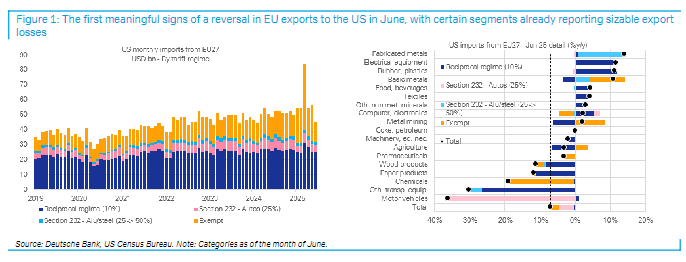
Group 1 - The core impact of the tariffs is evident, with a significant decline in U.S. imports from Europe, dropping from $56.6 billion in May to $45.2 billion in June, marking the lowest level since February 2024 [2] - The automotive sector is the hardest hit, with a year-on-year decline of 36% in European exports to the U.S. in June due to a 25% additional tariff [3][6] - Other sectors also experienced declines, with transportation equipment and chemicals seeing year-on-year drops of 30% and 19% respectively, while some sectors like base metals and agricultural products remained resilient due to tariff exemptions [7] Group 2 - The report warns that the observed decline is still mild compared to the potential overall losses predicted by models, indicating that more severe impacts are yet to come [4][9] - Starting August 1, the average tariff rate on European exports to the U.S. increased from 12% in June to 16%, with the current 15% rate being more damaging than the previous 10% during the tariff suspension period [11] - The negative impacts of tariffs may have a lagging effect, particularly in the pharmaceutical sector, where a significant drop in exports is anticipated as inventory is consumed and tariffs potentially rise further [11]