
关税谈判

Search documents
国投期货综合晨报-20250801
Guo Tou Qi Huo· 2025-08-01 05:09
1. Report Industry Investment Ratings No relevant content provided. 2. Core Views of the Report - The short - term trend of crude oil is expected to be oscillating and strengthening, and investors can focus on the hedging value of out - of - the - money call options [2]. - Precious metals may continue to experience oscillating adjustments, and attention should be paid to the US non - farm payrolls guidance [3]. - Copper short positions should be held as the import tariff on refined copper is excluded, reversing the physical import arbitrage expectation [4]. - Aluminum may continue to be under pressure and oscillate in the short term due to inventory accumulation and weak consumption [5]. - For various commodities, different trading strategies are recommended according to their specific supply - demand and market conditions, such as short - selling aluminum oxide, waiting for inventory verification for aluminum, etc. 3. Summary by Commodity Categories Energy Commodities - **Crude Oil**: Overnight international oil prices declined. Although trade wars suppress market sentiment, there are still supporting factors from sanctions on oil. The short - term trend is expected to be oscillating and strengthening [2]. - **Fuel Oil & Low - Sulfur Fuel Oil**: The cracking spreads of FU and LU are further declining due to weak fundamentals and the support of the crude oil market [22]. - **Asphalt**: In August, domestic production is expected to decline compared to July. Demand recovery is delayed, and inventory reduction is weak. The price trend follows crude oil [23]. - **Liquefied Petroleum Gas**: The overseas market is under pressure due to supply loosening. The domestic market is also under pressure, and the price is generally low [23]. - **Urea**: The futures price has fallen sharply. The agricultural demand is in the off - season, and the short - term market is expected to be weakly oscillating [24]. - **Methanol**: A coastal olefin plant is under maintenance, and the port is accumulating inventory seasonally. The domestic supply is sufficient, and attention should be paid to macro - policies [25]. Metal Commodities - **Copper**: The price has fallen below the MA60 moving average. Trump's tariff policy affects the import arbitrage expectation, and short positions should be held [4]. - **Aluminum**: The price is declining. The social inventory of aluminum ingots is accumulating, and the short - term trend is under pressure [5]. - **Cast Aluminum Alloy**: It has followed the decline of Shanghai aluminum. The short - term price is under pressure, but it has certain resilience in the medium term [6]. - **Alumina**: The industry profit has recovered, but the market is in an oversupply state. Short - selling is recommended near the recent high of 3500 yuan [7]. - **Zinc**: The macro - optimistic sentiment has faded. The supply - demand pattern is supply - increasing and demand - weakening. Short - selling on rebounds is the main strategy [8]. - **Nickel and Stainless Steel**: The price of nickel is oscillating. The upstream price support has weakened, and short - selling is recommended [10]. - **Tin**: The price has fallen below the MA60 moving average. High - position short positions should be held [11]. Chemical Commodities - **Polypropylene, Plastic & Propylene**: The demand for propylene has increased slightly, but the market is lackluster. Polyolefin futures are in an interval - consolidation pattern [28]. - **PVC & Caustic Soda**: PVC is weakening, and the short - term price is expected to be oscillating and weakening. Caustic soda is running weakly, and the long - term price is under pressure [29]. - **PX & PTA**: The prices of PX and PTA have fallen. The mid - term processing margin has a repair drive, but it needs the recovery of downstream demand [30]. - **Ethylene Glycol**: The price is declining. The domestic supply is increasing, and the overseas supply is stabilizing [31]. - **Short - Fiber & Bottle Chip**: The prices have followed the decline of raw materials. Short - fiber can be considered for long - position allocation in the medium term, while bottle chips have long - term over - capacity pressure [32]. Agricultural Commodities - **Soybean & Soybean Meal**: The US soybean is under pressure due to good weather and high excellent - rate. The domestic soybean meal inventory is accumulating. The market is waiting for the result of trade negotiations [36]. - **Soybean Oil & Palm Oil**: The prices of both are adjusting. A long - position allocation strategy at low prices is recommended, and attention should be paid to weather and policies [37]. - **Rapeseed Meal & Rapeseed Oil**: The Canadian rapeseed price is expected to be in a consolidation state. The short - term strategy is to wait and see [38]. - **Corn**: The futures price is oscillating and weakening. The US corn is growing well, and the domestic market focuses on the supply in the circulation link [40]. - **Cotton**: The price is declining. The downstream demand is weak, and the new - season production in Xinjiang is expected to increase. The operation strategy is to wait and see or conduct intraday trading [43]. - **Sugar**: The US sugar trend is downward, and the Zhengzhou sugar lacks positive factors. The short - term price is expected to be oscillating [44]. - **Apple**: The price is oscillating. The market focuses on the new - season production estimate, and the operation strategy is to wait and see [45]. - **Wood**: The supply - demand situation has improved, and the futures price is expected to rise. A long - position strategy is recommended [46]. - **Paper Pulp**: The price is falling. The supply is relatively loose, and the demand is weak. The price may return to low - level oscillation [47]. Others - **Stock Index**: The stock market declined, and the mid - term market is expected to be relatively positive. Allocation to technology - growth sectors and low - level consumer sectors can be considered [48]. - **Treasury Bond**: The futures price of treasury bonds has strengthened. The yield curve is expected to steepen in the short term [49].
今日早评-20250801
Ning Zheng Qi Huo· 2025-08-01 02:25
Key Points of the Research Report 1. Report Industry Investment Ratings No industry investment ratings are provided in the report. 2. Core Views - The short - term fundamentals of coking coal and coke are strong, and it is expected to maintain a volatile trend after a correction [2]. - Silver is expected to be in a high - level volatile and slightly bearish situation due to the weakening of short - term interest rate cut expectations [2]. - The 09 contract of soda ash is expected to fluctuate in the short term, and it is recommended to wait and see or short on rebounds [4]. - Crude oil should be treated with a volatile and bullish view [5]. - Methanol's 09 contract is expected to fluctuate in the short term, and it is recommended to wait and see or short on rebounds [6]. - The rebar futures price is expected to fluctuate and consolidate in the short term [7]. - Iron ore is expected to be volatile and bullish in the short term [7]. - Gold remains volatile and bearish [8]. - The bond market is affected by the stock - bond seesaw effect, and the logic of the bond market itself is unclear [8][9]. - Rapeseed meal is expected to be volatile and bearish in the short term [9]. - Palm oil is expected to be volatile and bearish in the short term [10]. - Short - term pig prices have adjusted, and short - term long positions can be considered; farmers can choose to sell for hedging according to the slaughter rhythm [12]. - It is advisable to wait and see for PTA [12]. - Rubber is relatively weak in the short term, and it is recommended to realize profits on short positions on dips [13]. - The L09 contract of LLDPE is expected to fluctuate in the short term, and it is recommended to wait and see [14]. 3. Summary by Variety Coking Coal - The price of low - sulfur main coking coal in Linfen Anze increased by 50 yuan/ton to 1500 yuan/ton. The inventory of 523 sample mines decreased by 30.2 tons week - on - week to 248.3 tons. After the fourth round of price increases for coke was implemented, the fifth round started. The market speculation sentiment cooled, and coking coal hit the daily limit down. The short - term fundamentals are strong, and it is expected to maintain a volatile trend after a correction, with a support level of 980 yuan/ton [2]. Silver - The core PCE price index in the US in June increased by 2.8% year - on - year, higher than the expected 2.7%. The actual consumer spending increased by only 0.1% month - on - month. The number of initial jobless claims in the US last week increased by 1000 to 218,000, lower than the market expectation. The short - term interest rate cut expectations weakened, which is bearish for silver. It is expected to be in a high - level volatile and slightly bearish situation [2]. Soda Ash - The national mainstream price of heavy - quality soda ash is 1366 yuan/ton, and the price is temporarily stable. The weekly output decreased by 3.32% week - on - week to 69.98 tons, and the total inventory of manufacturers decreased by 3.69% week - on - week to 179.58 tons. The float glass start - up rate is 75%, down 0.1% week - on - week. The market is expected to fluctuate in the short term, with a resistance level of 1285 for the 09 contract. It is recommended to wait and see or short on rebounds [4]. Crude Oil - The US Treasury imposed sanctions on a large number of individuals, entities, and vessels related to a shipping network. Russia and Saudi Arabia discussed the oil market situation. The US crude oil production in May increased by 24,000 barrels per day, breaking the previous record. The market is concerned about the possible significant production increase by OPEC+ in September, and the international oil price corrected. The overall situation is volatile and bullish [5]. Methanol - The market price in Jiangsu Taicang decreased by 15 yuan/ton to 2395 yuan/ton. The port inventory increased by 8.26 tons week - on - week to 80.84 tons, and the production enterprise inventory decreased by 1.53 tons week - on - week to 32.45 tons. The 09 contract is expected to fluctuate in the short term, with a resistance level of 2425. It is recommended to wait and see or short on rebounds [6]. Rebar - As of July 31, the weekly output decreased by 0.42% to 211.06 tons, the factory inventory decreased by 2.12% to 162.15 tons, the social inventory increased by 2.99% to 384.14 tons, and the apparent demand decreased by 6.08% to 203.41 tons. Affected by bad weather, the terminal demand is low, and it is expected to fluctuate and consolidate in the short term [7]. Iron Ore - From July 21 to July 27, the global iron ore shipment volume increased by 91.8 tons week - on - week to 3200.9 tons. The shipment volume from Australia and Brazil increased by 203.9 tons week - on - week to 2755.9 tons. Affected by the policy expectations and market sentiment, the current fundamentals are neutral to strong, and it is expected to be volatile and bullish in the short term, with a support level of 750 yuan/ton [7]. Gold - The US will resume collecting "reciprocal tariffs" on August 1. The tariff negotiations are ongoing, but the market risk - aversion sentiment is weak. Gold remains volatile and bearish, and attention should be paid to the US dollar trend [8]. Long - and Medium - Term Treasury Bonds - China's official manufacturing PMI in July was 49.3, down 0.4 percentage points month - on - month. The economic sentiment declined, and counter - cyclical adjustment needs to be increased. The stock market's short - term upward momentum weakened, and the stock - bond seesaw effect is favorable for the bond market. The bond market's own logic is unclear [8]. Short - Term Treasury Bonds - On July 31, most money market interest rates rose. The increase in money market interest rates is bearish for short - term bonds. The short - term upward momentum of the stock market weakened, which may be favorable for the bond market. The stock - bond seesaw effect is the main logic of the bond market [9]. Rapeseed Meal - As of July 27, the Canadian rapeseed export volume decreased by 72.78% week - on - week to 5.51 tons. The domestic rapeseed and rapeseed meal inventories are relatively low, but the demand is weak, and the granular rapeseed meal inventory is high. It is expected to be volatile and bearish in the short term [9]. Palm Oil - In July 2025, the Malaysian palm oil export volume decreased. The domestic palm oil inventory is sufficient, the downstream demand is weak, and the price is expected to be volatile and bearish in the short term [10]. Pig - On July 31, the national average pork price decreased by 1.1% to 20.45 yuan/kg. At the end of the month, the slaughter of farmers decreased, and the price - support intention increased. The short - term price adjustment is in place, and short - term long positions can be considered. Farmers can choose to sell for hedging according to the slaughter rhythm [12]. PTA - The polyester market inventory is concentrated in 16 - 26 days. The PTA supply is expected to be loose, and the downstream polyester load may continue to decline with limited space. The PX spot tension has eased, and the PX futures price is expected to be volatile and bearish. It is advisable to wait and see for PTA [12]. Rubber - The Thai raw material prices continued to fall. The Hainan raw material output increased seasonally. The annual natural rubber supply and demand are expected to be tight, but the short - term supply may increase, and the demand is not strong. The short - term situation is relatively weak [13]. LLDPE - The mainstream price in North China decreased by 7 yuan/ton to 7363 yuan/ton. The weekly output decreased by 1.08% week - on - week to 27.25 tons, and the production enterprise inventory decreased by 17.44% week - on - week to 14.25 tons. The L09 contract is expected to fluctuate in the short term, with a resistance level of 7385. It is recommended to wait and see [14].
特朗普的关税倒计时:谁在买单?谁在硬扛?|907编辑部
Xin Lang Cai Jing· 2025-07-31 14:08
Group 1 - The U.S. President Trump is set to sign an executive order on July 31, imposing higher tariff rates on several countries that fail to reach a trade agreement by the August 1 deadline, potentially affecting major trade partners like Canada and Mexico [1] - Since April 2, when Trump announced a 10% base tariff on all imports and exports, along with additional "country-specific reciprocal tariffs" of up to 50% based on trade deficits, the ongoing negotiations and their impacts on ordinary Americans, Chinese foreign trade enterprises, and the global economy have been closely monitored [2] - The 90-day tariff suspension period is nearing its end, raising questions about the outcomes of global tariff negotiations and the potential effects on countries that have not reached agreements [2] Group 2 - In a related development, Meta has reported a satisfactory earnings report while also announcing the establishment of a "Super Intelligence Lab," which has sparked controversy due to its ambitious vision and radical approach [3]

说好的“双赢伙伴”呢?关税僵局后,特朗普痛斥印度是“死亡经济体”
Hua Er Jie Jian Wen· 2025-07-31 13:46
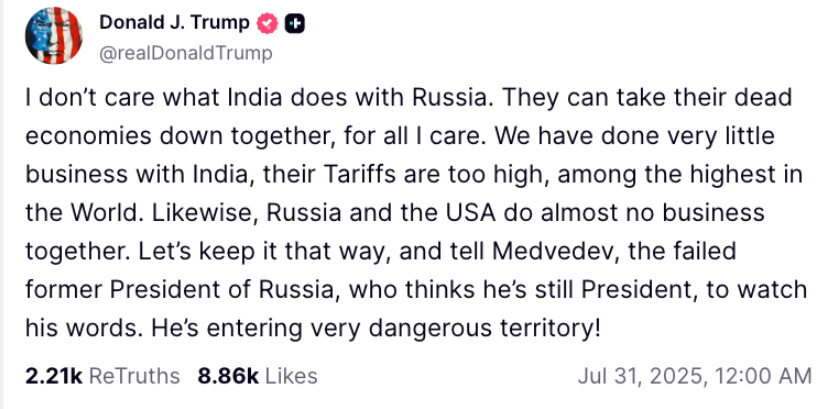
Group 1 - Trump criticized India as a "stagnant economy" and announced a 25% tariff on Indian goods starting August 1, which he claims is due to India's high tariffs and lack of business with the U.S. [1] - The Indian government responded by stating that any trade agreement with the U.S. must be "mutually beneficial" and protect local farmers and small businesses [1][2] - The implementation of the 25% tariff could directly impact India's $10 billion export trade to the U.S., affecting key sectors such as textiles, pharmaceuticals, and IT services [2] Group 2 - The recent strong statements from Trump contrast sharply with the previously cooperative atmosphere, as seen in April when U.S. Vice President JD Vance referred to U.S.-India relations as a "win-win partnership" [2] - Analysts warn that the current situation may lead to a more cautious approach from India in its dealings with the U.S., although they do not foresee a complete breakdown in relations [2] - The tariffs are expected to weaken India's relative tariff advantage in labor-intensive exports, but the overall disadvantage may not be overly severe [2]
25%关税!特朗普对印度下手了 | 京酿馆
Sou Hu Cai Jing· 2025-07-31 11:03
Core Viewpoint - The article discusses President Trump's decision to impose a 25% tariff on goods from India, along with an undisclosed penalty, signaling a shift in U.S.-India trade relations and highlighting the complexities of their negotiations [4][9]. Trade Relations - Trump announced that starting August 1, the U.S. will impose a 25% tariff on Indian goods, which surpasses tariffs on other countries like Vietnam (20%) and Indonesia (19%) [4][6]. - The U.S. has a significant trade deficit with India, with a reported $457 billion, which Trump emphasized in his statements [4][6]. Negotiation Challenges - Key obstacles in U.S.-India trade negotiations include agricultural market access and India's digital tax on U.S. tech companies, which has led to tensions [7][10]. - India's previous proposals to increase bilateral trade to $500 billion by 2030 have not materialized, indicating a failure in negotiations [6][10]. Geopolitical Implications - The imposition of tariffs is seen as a tool for the U.S. to challenge India's trade and diplomatic autonomy, particularly due to India's reliance on Russian military equipment and energy [9][11]. - Trump's actions suggest a shift in U.S. foreign policy, prioritizing "America First" over traditional alliances, which may diminish India's strategic position [16]. Political Context - India's Prime Minister Modi faces political pressure domestically, making it difficult for him to concede to U.S. demands without risking his support base [15][16]. - The upcoming 2024 elections in India add to the complexity, as Modi's party has lost its parliamentary majority, limiting his negotiating power [15][16].

25%关税!特朗普对印度下手了
Xin Jing Bao· 2025-07-31 09:50
Core Viewpoint - The article discusses President Trump's decision to impose a 25% tariff on goods from India, highlighting the deterioration of trade relations between the two countries and the underlying political motivations behind this move [1][4]. Trade Relations - Trump announced that starting August 1, the U.S. will impose a 25% tariff on Indian goods, citing India's high tariffs and trade barriers as reasons for the trade imbalance [1]. - The tariff on India exceeds those imposed on other countries, such as Vietnam (20%), Indonesia and the Philippines (19%), and Japan and South Korea (15%) [1]. - India had previously proposed a bilateral trade target of $500 billion by 2030, but this now seems unattainable [2]. Political Motivations - The imposition of tariffs is not solely based on trade deficits; it also reflects deeper political interests, particularly regarding agricultural and digital tax issues [4]. - The U.S. is pressuring India to open its agricultural market, which is politically sensitive for the Modi government due to declining support among farmers [4]. - The digital tax imposed by India on foreign tech companies is another sticking point, as it disproportionately affects U.S. firms [4]. Geopolitical Implications - The U.S. is using tariffs as a geopolitical tool, signaling its discontent with India's defense ties with Russia and energy purchases from the country [5]. - The additional "penalty" on India is unprecedented and indicates a shift in how the U.S. approaches trade negotiations with key partners [5]. - India's reliance on Russian military equipment and energy imports complicates its position, as the U.S. seeks to influence its defense procurement decisions [6]. Negotiation Dynamics - India's potential for compromise is limited, especially with upcoming elections and a weakened parliamentary majority for Modi's party [7]. - While India may delay negotiations, the scope for concessions is narrow, particularly regarding market access and foreign policy alignment with U.S. interests [7]. - The article suggests that even if tariffs are reduced in the future, the extent of such reductions will likely be minimal [7]. Conclusion - The current situation poses a significant challenge to Modi's political authority and highlights the need for vigilance regarding the U.S.'s use of tariffs as a geopolitical strategy [8].
原油日报:特朗普威胁印度对其进行俄油采购惩罚-20250731
Hua Tai Qi Huo· 2025-07-31 05:38
Report Summary 1. Investment Rating - Short - term: Oil prices will fluctuate within a range; Medium - term: Bearish allocation [3] 2. Core View - Trump's threat of imposing separate tariff penalties on India's Russian oil purchases is a fabricated tariff bargaining chip. Given that the EU and Japan are still importing Russian natural gas, India is unlikely to significantly reduce its Russian crude oil purchases [2] 3. Summary by Directory Market News and Important Data - Crude oil futures prices rose: NYMEX September - delivery light crude oil futures rose 79 cents to $70.00 per barrel, a 1.14% increase; ICE September - delivery Brent crude oil futures rose 73 cents to $73.24 per barrel, a 1.01% increase; SC crude oil main contract rose 1.66% to 533 yuan per barrel [1] - UAE's Fujeirah Port: As of the week ending July 28, the total refined oil inventory decreased by 3.477 million barrels to 17.048 million barrels, with light distillates, medium distillates, and heavy residual fuel oil inventories all decreasing [1] - Trump's statements: He will give Russia 10 days to reach an agreement with Ukraine, or else impose additional tariffs on Russia; he plans to impose a 25% tariff on Indian goods exported to the US starting August 1 and warns of additional penalties for India's continued purchase of Russian energy [1] - India: Indian refiners are seeking government clarification on whether their Russian oil purchases will be affected by Trump's threat [1] - Japan: As of the week ending July 26, Japan's commercial crude oil inventory increased by 482,030 kiloliters, gasoline inventory decreased by 131,669 kiloliters, kerosene inventory increased by 58,973 kiloliters, and the average refinery operating rate dropped to 82.7% [1] Investment Logic - India has become a focal point in tariff negotiations and secondary tariffs on Russian oil purchases. It imports nearly 1.5 million barrels of Russian crude oil per day. Trump's threat of tariff penalties on India's Russian oil purchases is a fabricated bargaining chip, and India is unlikely to significantly reduce its purchases [2] Strategy - Short - term: Oil prices will fluctuate within a range; Medium - term: Bearish allocation [3] Risks - Downside risks: US relaxes sanctions on Iranian oil; macro black - swan events [3] - Upside risks: US intensifies sanctions on Russian oil; Middle - East conflicts lead to large - scale supply disruptions [3]
马来西亚贸易部长:已结束与美国的关税谈判。
news flash· 2025-07-31 05:28
Group 1 - The Malaysian Trade Minister announced the conclusion of tariff negotiations with the United States [1]
国投期货综合晨报-20250731
Guo Tou Qi Huo· 2025-07-31 04:02
Oil Market - International oil prices continued to rise, with Brent crude for September increasing by 0.98% [1] - The U.S. EIA reported an unexpected increase in crude oil inventories by 7.698 million barrels, but the market remains focused on the renewed risks of sanctions on oil [1] - The geopolitical risks related to Iran and Russia are expected to support oil prices in the short term, and investors are advised to consider the hedging value of out-of-the-money call options on crude oil [1] Precious Metals - The U.S. reported a rebound in Q2 GDP at an annualized rate of 3%, exceeding expectations, while ADP employment increased by 104,000, also above expectations [2] - Following the data release, the dollar strengthened, putting pressure on precious metals, which are expected to continue adjusting in a volatile manner due to reduced risk aversion and clearer tariff negotiations [2] Copper - Copper prices fell sharply, with a near 20% drop in short-term prices, as the U.S. imposed tariffs on copper products, impacting market sentiment [3] - The COMEX copper inventory has reached 250,000 tons, and the market is closely watching the implementation of the U.S. tariff agreements [3] - Despite the Federal Reserve maintaining interest rates, a stronger dollar is suppressing copper prices, with adjustments expected towards the 60-day moving average [3] Aluminum - Shanghai aluminum prices continued to fluctuate, with seasonal demand showing signs of decline and inventory levels increasing [4] - The market is experiencing a drop in aluminum alloy profits, with short-term price pressures expected despite some resilience in the medium term [5] Lithium Carbonate - Lithium carbonate prices opened high but experienced significant fluctuations, with total market inventory continuing to rise [10] - Traders are optimistic, with spot market activity increasing, and Australian mine prices reported at $845, indicating a rebound from low levels [10] Steel Market - Steel prices are experiencing a downward trend, with rebar demand showing slight recovery but overall investment in infrastructure and manufacturing slowing down [13] - Iron ore prices are fluctuating, with global shipments exceeding last year's levels, but domestic port arrivals are weak, leading to a potential slight reduction in inventory [14] Agricultural Products - U.S. soybean quality ratings are at 70%, higher than expected, indicating a potential for early harvest expectations [35] - Corn futures are fluctuating, with U.S. corn quality ratings at 73%, suggesting a stable growth trend [39] - The domestic demand for urea is weak, with production increasing but overall demand remaining low [23] Financial Markets - The A-share market showed increased volatility, with major indices experiencing mixed movements, and the market sentiment remains relatively positive [47] - The bond market is expected to enter a repair phase, with the yield curve likely to steepen due to increased fiscal measures [48]