利差损风险

Search documents
东吴证券:险企负债端持续改善 利差损风险逐步缓解
智通财经网· 2025-05-06 04:00
Group 1: Core Insights - The insurance industry is expected to see a gradual alleviation of interest spread loss risks due to continuous improvement in the liability side and strong market savings demand [1] - The ten-year government bond yield has recently dropped to approximately 1.63%, and with the anticipated domestic economic recovery, the pressure on new fixed-income investment returns for insurance companies is expected to ease [1] - The valuation of the insurance sector remains low, with projected 2025E PEV of 0.49-0.79 times and PB of 0.88-1.95 times, indicating a historical low and maintaining an "overweight" rating for the industry [1] Group 2: Q1 2025 Operational Review - Net profit and net asset growth for listed insurance companies experienced short-term fluctuations due to rising interest rates and falling bond markets, with significant differentiation among companies based on their reserve discount rates and VFA model measurement bases [2] - New business structure has improved significantly, with a rapid growth in NBV driven by factors such as reduced preset interest rates and optimized business structures, despite a slight short-term pressure on new single premiums [2] - The agent workforce remains stable, and the contribution of bank insurance channels to NBV is expected to continue increasing as companies' reform efforts yield results [2] Group 3: Property Insurance Insights - The combined ratio for property insurance has significantly improved year-on-year, primarily due to reduced disaster claims, cost-cutting measures, and the clearing of high-risk businesses [3] - Investment returns have faced slight pressure due to rising interest rates and falling bond markets, but improvements in bond-related investment losses are expected from Q2 onwards [3] Group 4: Product Evolution and Future Outlook - The insurance industry has evolved from single protection products to diversified offerings, with significant opportunities in health and long-term care insurance [4] - Learning from overseas markets, there are opportunities for both savings and protection products tailored to local conditions, with a focus on long-term value and investment [4] - The industry is optimistic about the innovative development of health insurance, with dividend insurance being a preferred choice for balancing premium growth and alleviating interest spread loss pressures [4]

新规本月起实施!五年期以下万能险告别市场
Nan Fang Du Shi Bao· 2025-05-02 23:09
Core Viewpoint - The new regulations on universal life insurance (ULI) aim to enhance supervision and address deep-rooted issues in the market, allowing for dynamic adjustment of minimum guaranteed interest rates and prohibiting products with terms shorter than five years [2][3][4]. Group 1: Regulatory Changes - The National Financial Supervision Administration has issued a notification that allows for dynamic adjustments to the minimum guaranteed interest rates of ULI products, effective from May 1, 2025 [2][4]. - The notification prohibits the development of ULI products with terms shorter than five years and encourages insurance companies to extend the actual duration of policies through reasonable adjustments to surrender fees and policy bonuses [3][4]. - Insurance companies are required to strengthen liquidity management of ULI accounts and strictly control the risks associated with mismatched funding and terms [2][3]. Group 2: Sales and Marketing Regulations - The notification mandates insurance companies to enhance the classification and suitability management of sales personnel to prevent misleading sales practices [3][4]. - A negative list of sales behaviors is to be established, prohibiting the use of terms like "interest" and "expected returns" in marketing, and ensuring that the insurance protection attributes are not downplayed [3][4]. Group 3: Historical Context and Market Trends - ULI products were once highly favored due to their high guaranteed returns, with some products offering rates as high as 6%-8% between 2014 and 2017, significantly outperforming traditional bank products [5][6]. - The rapid growth of ULI premiums peaked in 2016, accounting for 34% of total premiums in the life insurance sector, but this growth has since declined due to regulatory tightening and market adjustments [6][7]. - In 2024, the new premiums for ULI products decreased by 2.8% year-on-year, indicating a cooling market [7]. Group 4: Future Outlook - The new regulations are expected to lead to a significant transformation in the ULI market, with a potential shift from short-term investment tools to long-term protection products, focusing on needs such as retirement and education funding [8][9]. - Industry insiders predict that insurance companies may lower settlement rates further or develop hybrid products that combine protection with light investment features [9].


寿险变天,“3%保底”神话已终结
阿尔法工场研究院· 2025-04-30 02:15
以下文章来源于阿尔法工场金融家 ,作者金妹妹 阿尔法工场金融家 . 追踪保险银行业圈内动态,剖析最新风向,分享有料、有价值的"内行人"洞察见解。 作者 | 金妹妹 来源 | 阿尔法工场金融家 导语 :万能险终结高保底时代,个险刮起"报行合一"旋风。 在寿险"最冷开门红"寒意未散之时,监管短时间内连发两道文件,剑指寿险两大柱石——万能险和 个险代理人队伍。 4月25日,监管发布《关于加强万能型人身保险监管有关事项的通知》(简称"14号文")而在一周 之前,4月18日,国家金融监管总局官网发布《关于推动深化人身保险行业个人营销体制改革的通 知》(简称"13号文")。 监管核心管理思路是降低风险。其实现途径是从"三差"入手——死差上,主要是此前调整生命表; 利差上,主要是预定利率动态调整机制;费差上,管控行业整体销售费用过高的问题。 在利率不断下行之时,监管为压降行业负债端成本,可谓用心良苦。 但,也或是刮骨疗毒。 金妹妹从第一个发布财报的中国平安(601318.SH)的代理人数据中发现,2025年3月底寿险代理人 数为33.8万,相比去年末的36.3万人,环比下降了6.9%。"清虚"代理人的风,还在继续吹。 同时 ...
寿险变天,“3%保底”神话已终结
3 6 Ke· 2025-04-29 01:06
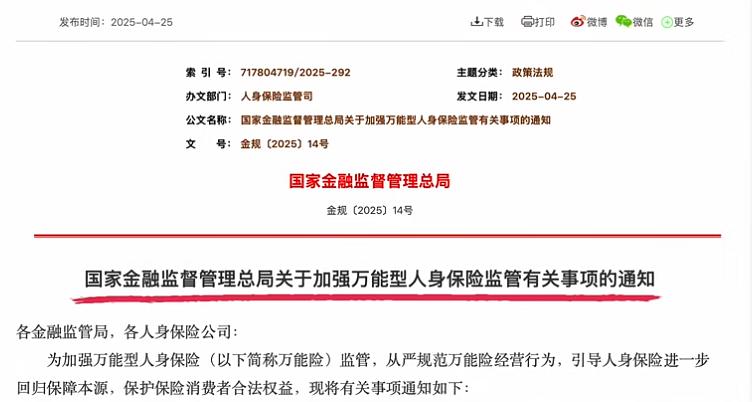
在寿险"最冷开门红"寒意未散之时,监管短时间内连发两道文件,剑指寿险两大柱石——万能险和个险代理人队伍。 4月25日,监管发布《关于加强万能型人身保险监管有关事项的通知》(简称"14号文")而在一周之前,4月18日,国家金融监管总局官网发布《关于推动 深化人身保险行业个人营销体制改革的通知》(简称"13号文")。 监管核心管理思路是降低风险。其实现途径是从"三差"入手——死差上,主要是此前调整生命表;利差上,主要是预定利率动态调整机制;费差上,管控 行业整体销售费用过高的问题。 在利率不断下行之时,监管为压降行业负债端成本,可谓用心良苦。 但,也或是刮骨疗毒。 金妹妹从第一个发布财报的中国平安(601318.SH)的代理人数据中发现,2025年3月底寿险代理人数为33.8万,相比去年末的36.3万人,环比下降了 6.9%。"清虚"代理人的风,还在继续吹。 同时,金融监管总局发布的数据显示,今年前3个月保险业实现人身险原保险保费收入1.79万亿元,增速仅有0.24%。 而今寿险再迎来剧变,究竟几家欢喜几家愁? 01 "3.0%保底"终结 14号文最被广泛讨论的点是,保险公司应明确万能险最低保证利率,允许保险公司 ...

保险业2025Q1经营数据点评:财险增长强劲,寿险降幅收窄
HUAXI Securities· 2025-04-28 11:34
Investment Rating - The industry rating is "Recommended" [2] Core Insights - In Q1 2025, the life insurance sector saw a slight decline in premium income, with a year-on-year decrease of 0.3%, totaling 1,659 billion yuan. The breakdown includes life insurance at 1,383.2 billion yuan (-1.0%), accident insurance at 11.7 billion yuan (-4.5%), and health insurance at 264.1 billion yuan (+3.7%) [1] - The property insurance sector experienced robust growth, with total premium income reaching 515.5 billion yuan in Q1 2025, reflecting a year-on-year increase of 5.1%. This includes auto insurance at 223.4 billion yuan (+4.3%) and non-auto insurance at 292.1 billion yuan (+5.7%) [2] - The total assets of the insurance industry reached 37,842.5 billion yuan by the end of March 2025, marking a 5.4% increase from the end of 2024. Life insurance companies accounted for 33,063 billion yuan (+4.8%), while property insurance companies had assets of 3,081.3 billion yuan (+6.2%) [3] Summary by Sections Life Insurance - In Q1 2025, life insurance premium income showed a declining trend, with a total of 1,659 billion yuan, down 0.3% year-on-year. The monthly premium income in March was 463.9 billion yuan, up 6.3% year-on-year, indicating a recovery trend [1] - The decline in premium income is attributed to factors such as reduced consumer demand due to last year's adjustments in product interest rates and the shift towards dividend insurance products, which have a higher sales difficulty [1] Property Insurance - The property insurance sector demonstrated strong performance with a total premium income of 515.5 billion yuan in Q1 2025, a 5.1% increase year-on-year. The growth was driven by a 6.0% increase in new car sales, which supported auto insurance premiums [2] - Non-auto insurance growth was primarily fueled by accident and health insurance, with year-on-year increases of 8.6% and 7.7%, respectively [2] Asset Management - As of March 2025, the total assets of the insurance industry reached 37,842.5 billion yuan, a 5.4% increase from the previous year. The net assets totaled 3,523.7 billion yuan, reflecting a 6.0% increase [3] Investment Recommendations - The report suggests maintaining a "Recommended" rating for the industry, highlighting companies like China Life Insurance and New China Life Insurance for their strong asset management and business optimization strategies [4]
监管严禁开发5年期以下产品,万能险整改倒计时
Hua Xia Shi Bao· 2025-04-28 08:19
Core Viewpoint - The regulatory authority has implemented strict regulations on universal life insurance (ULI) to prevent risks associated with low interest rates and to protect consumer interests, effective from May 1, 2025 [1][2][3] Regulatory Changes - The new regulations prohibit the design of ULI products, except for whole life insurance, endowment insurance, and annuity insurance, to strengthen the insurance product's protection attributes and avoid misuse for short-term financial management [3][4] - The insurance term for ULI must not be less than five years, addressing the issue of short-term products that have been prevalent in the market [5][6] Market Impact - The current interest rate environment, with five-year fixed deposit rates at 1.55% and ten-year government bond rates at 1.67%, has pressured life insurance companies as their asset yields decline while liability costs remain rigid [2][4] - The regulations are expected to lead to a restructuring of ULI products, with existing products needing to comply by April 30, 2026, and new products developed under the new rules starting May 1, 2025 [4][6] Consumer Protection - The regulations aim to reduce misleading sales practices and enhance the insurance protection function of ULI, ensuring that consumers are adequately informed about risks and product features [1][4] - Insurance companies are required to provide clear terms regarding additional premium payments and must inform customers of any adjustments to the minimum guaranteed interest rates [4][6] Investment Management - The regulations emphasize the need for insurance companies to establish sound investment strategies for ULI accounts, including strict controls on investment concentration and risk exposure [6][7] - Specific limits are set on investments in single unlisted companies and equity investment funds to mitigate risks associated with asset-liability mismatches and liquidity [7]

万能险新规下月起实施,最低保证利率不“保证”了,还划算吗
Nan Fang Du Shi Bao· 2025-04-28 01:18
Core Viewpoint - The new regulations on universal life insurance (ULI) aim to enhance supervision and address deep-rooted issues in the market, including the prohibition of products with terms shorter than five years and the dynamic adjustment of minimum guaranteed interest rates [2][3][4]. Summary by Relevant Sections Regulation Overview - The National Financial Supervision Administration issued a notification that will take effect on May 1, 2025, allowing for dynamic adjustments to the minimum guaranteed interest rates of ULI and prohibiting products with terms shorter than five years [2][3]. - Insurance companies must complete rectifications for existing ULI products that do not comply with the new regulations by April 30, 2026 [2]. Product Development and Management - The notification emphasizes the need to regulate ULI product development, enhance protection levels, and strengthen account management and fund utilization supervision [3]. - It prohibits the design of ULI products, except for whole life insurance, endowment insurance, and annuity insurance, and encourages companies to adjust surrender fees and policy bonuses to extend the actual duration of policies [3]. Sales Management - Insurance companies are required to improve the classification and suitability management of sales personnel to prevent misleading sales practices [3]. - A negative list for sales behavior is mandated, prohibiting the use of terms like "interest" and "expected returns" in marketing, and ensuring that the insurance protection attributes are not downplayed [3]. Fund Utilization and Risk Management - The notification allows for the adjustment of minimum guaranteed interest rates under certain conditions, reflecting a more flexible regulatory approach to market interest rate fluctuations [4][9]. - Strict regulations on fund utilization are introduced, including limits on concentration and non-standard investments, and prohibitions on complex transactions that could harm policyholders' interests [4][5]. Market Trends and Historical Context - ULI products were once highly favored due to their high guaranteed returns, with some products offering rates as high as 8% between 2014 and 2017, significantly outperforming traditional bank products [6][7]. - However, issues such as inadequate protection functions and aggressive fund management practices have led to increased regulatory scrutiny and a decline in ULI's popularity since 2017 [7][8]. Future Outlook - The implementation of the new regulations is expected to lead to a significant transformation in the ULI market, with a potential shift towards long-term protection products that cater to needs such as retirement and education funding [9][10]. - Industry insiders predict that companies may lower settlement rates further or develop hybrid products that combine protection with light investment features [10].

万能险监管大变天!保险期限不得低于五年,可调整最低保证利率
Bei Jing Shang Bao· 2025-04-25 13:20
为从严监管,推动万能险进一步回归保障本源,4月25日,金融监管总局发布了《关于加强万能型人身保险监管有关事项的通知》(以下简称《通 知》)。 综合来看,《通知》坚持问题导向,聚焦保障功能有待强化、账户运作不规范、少数万能险资金运用较为激进等突出问题,深挖问题根源,并提 出了针对性要求。 最低保证利率、产品年限有新政策 根据《通知》,保险公司为强化资产负债管理、保障客户长期利益,可以对万能险最低保证利率设置保证期间,保证期满以后可以合理调整最低 保证利率。保险公司在销售此类产品时应当向客户充分提示风险,在调整最低保证利率时应当及时告知调整原因并做好客户服务。如合同约定可 以追加保费,应当在产品条款中明确追加保费的条件。这代表着,监管给予了保险公司调整万能险最低保证利率的空间。 北京商报记者了解到,早年间很多保险公司销售的部分万能险产品,最低保证利率能达到3.5%甚至更高,在当前的利率环境下,无疑面临较大的 利差损风险。金融监管总局有关司局负责人表示,允许最低保证利率可调,有助于更好防控利差损风险。 首都经贸大学农村保险研究所副所长李文中进一步分析,允许保险公司在满足约束条件下调整最低保证利率,尤其是利率下行期可 ...

“勇闯”低利率周期,五大A股险企业绩高光背后丨上市险企年报观察①
2 1 Shi Ji Jing Ji Bao Dao· 2025-03-31 12:02
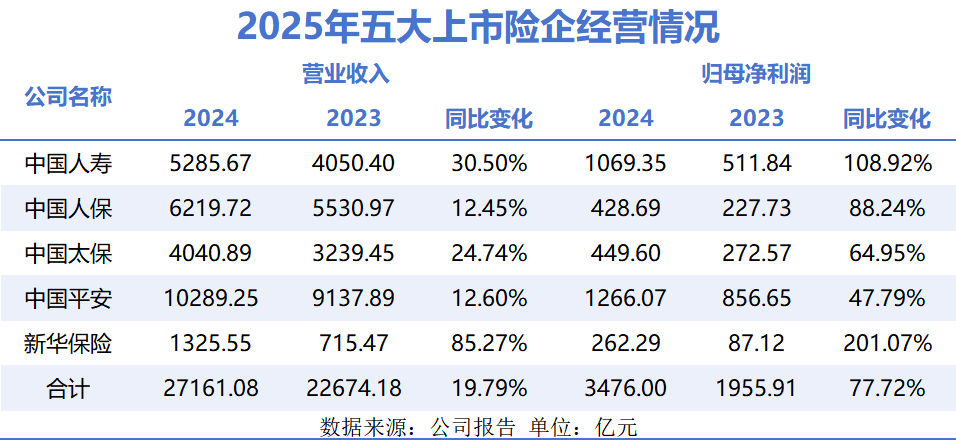
南方财经全媒体记者 林汉垚 北京报道 截至2025年3月31日,A股五家上市险企——中国人寿、中国平安、中国人保、中国太保、新华保险已全部完成2024年业绩披露。 整体来看,上述五家险企2024年合计营业收入达27161.08亿元,较去年增长19.79%;合计获得归母净利润3476亿元,较去年增长 77.72%。其中,中国人寿、中国太保、新华保险净利润均突破历史峰值,中国人寿以1069.35亿元净利润首次跨越千亿门槛,新华保险 则以201.07%的增速领跑行业。 面对后市,多家险企表示,将继续加码权益市场投资,同时为应对低利率环境下的利差损风险,正大力推动浮动收益型产品发展。 投资推动经营业绩高速增长 | 公司名称 | | 营业收入 | | | 归母净利润 | | | --- | --- | --- | --- | --- | --- | --- | | | 2024 | 2023 | 同比变化 | 2024 | 2023 | 同比变化 | | 中国人寿 | 5285.67 | 4050.40 | 30.50% | 1069.35 | 511.84 | 108.92% | | 中国人保 | 6219.72 | ...


新华保险去年净利同比大增2倍,管理层这样回应|直击业绩会
Guo Ji Jin Rong Bao· 2025-03-29 11:20
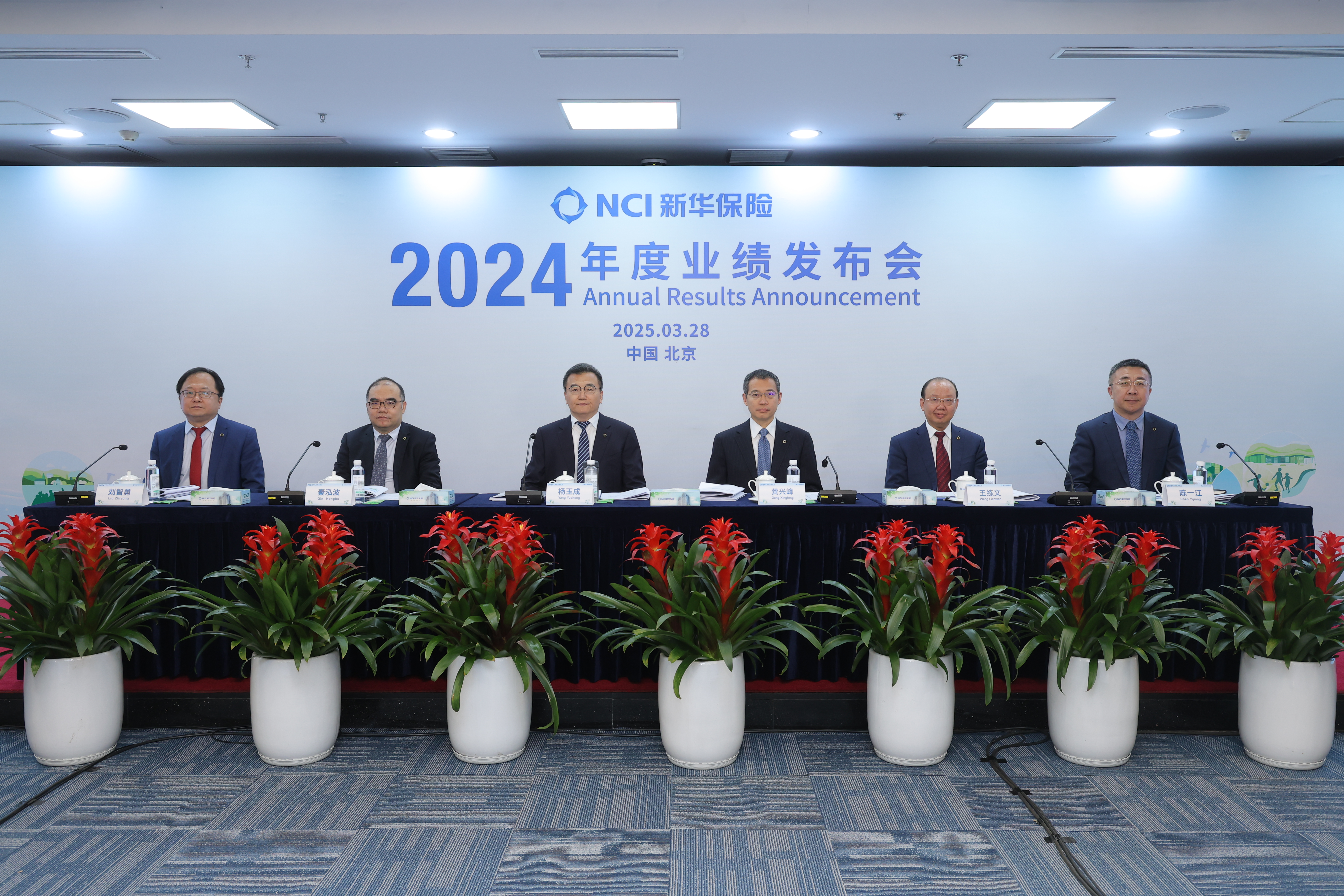
Core Viewpoint - The company has successfully transformed and achieved impressive results in the past year, marking a significant milestone under the leadership of Yang Yucheng, who joined as CEO [1][3]. Investment Performance - By the end of 2024, the company's investment scale exceeded 1.6 trillion yuan, representing a year-on-year growth of 21%. The total investment return rate was 5.8%, and the comprehensive investment return rate was 8.5%, showing substantial year-on-year growth [3]. - The net profit attributable to shareholders reached 26.2 billion yuan, a remarkable increase of 201.1%, setting a historical record [3]. Stock Market Reaction - Following the release of the impressive financial results, the company's stock prices saw positive movement, with A-shares closing at 51.98 yuan (up 1.15%) and Hong Kong shares at 30 HKD (up 5.45%) [3]. Confidence in the Insurance Market - The company’s leadership expressed strong confidence in the ongoing positive trends in the Chinese economy and the life insurance sector, highlighting that life insurance products are crucial for boosting domestic consumption [5]. - The insurance industry is experiencing positive changes, with a consensus on transformation among companies regarding product innovation, sales channel reform, and risk management [6]. Risk Management Strategies - The company is addressing the embedded risk of interest rate spread loss by balancing traditional and floating income products, as well as new and existing business lines [6]. - A dynamic adjustment mechanism for preset interest rates has been established to meet the needs for wealth preservation amid declining interest rates [6]. Long-term Investment Strategy - The company is committed to a long-term investment strategy, focusing on diversifying investment types and enhancing research capabilities to identify quality investment opportunities [8]. - A private equity fund with a total scale of 50 billion yuan was established in collaboration with China Life, which has shown promising financial performance [9]. Sector Investments - In 2024, the company actively invested in sectors such as integrated circuits, hard technology, and healthcare, acquiring stakes in quality listed companies like Shanghai Pharmaceuticals and China National Pharmaceutical Group [10]. Shareholder Returns - The company plans to distribute a cash dividend of 1.99 yuan per share at the end of 2024, totaling 6.208 billion yuan, which represents over 30% of the net profit attributable to shareholders and a nearly 200% increase year-on-year [12]. Technological Advancements - The company is leveraging advancements in artificial intelligence, having integrated AI models to enhance customer service and operational efficiency [13].