
期货套期保值

Search documents
关注马士基1月第二周开价情况
Hua Tai Qi Huo· 2025-12-23 03:12
航运日报 | 2025-12-23 关注马士基1月第二周开价情况 市场分析 线上报价方面。 Gemini Cooperation:马士基上海-鹿特丹1月第一周报价1580/2540;HPL12月下半月价格1535/2535,1月上半月报 价2135/3535. 地缘端:马士基集装箱船\"Maersk Sebarok\"号于2025年12月19日完成自2024年1月撤离后首次红海航行,标志其试 探性恢复红海航线。此次复航被视为行业风向标,但马士基强调安全仍是首要前提,全面恢复需循序渐进。美国 国务卿鲁比奥表示,加沙和平进程的下一步应是宣布任命一个和平委员会,并确定将协助管理该飞地的一批技术 官僚团队。 上海国际能源交易中心拟修订《上海国际能源交易中心集运指数(欧线)其期货标准合约》。向社会公开征求意见, 具体内容如下:一是将合约月份由"2、4、6、8、10、12月"调整为"最近1-6个月为连续月份(2月除外),以及随后两 个季月"。拟挂牌最近1-6个月连续月份合约,便于产业客户精确匹配期货和现货的到期时间、提高套期保值效率; 考虑到2月春节假期期间,集运现货市场较为清淡,拟剔除2月合约;同时,为保持挂牌合约覆盖 ...
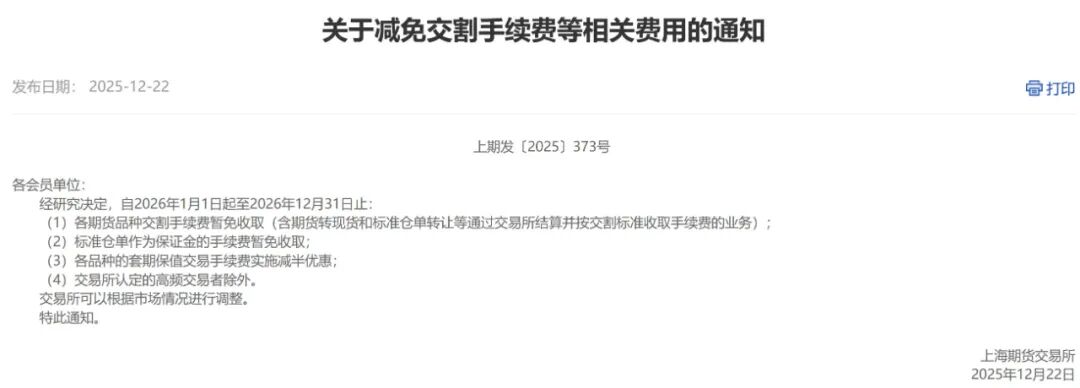
2026年,继续减、免各项手续费!国内期货交易所发布通知→
Qi Huo Ri Bao· 2025-12-22 14:36
Core Viewpoint - The announcement of fee reductions for futures delivery and related costs by multiple exchanges aims to support the real economy and enhance risk management for enterprises in response to increasing market volatility and demand for hedging tools [15][16]. Group 1: Fee Reductions - The Shanghai Futures Exchange, its subsidiary Shanghai Energy, Zhengzhou Commodity Exchange, Dalian Commodity Exchange, and other exchanges will waive delivery fees, standard warehouse receipt transfer fees, margin fees for standard warehouse receipts, and conversion fees for the year 2026 [1][7][8][9][10]. - The Dalian Commodity Exchange will also implement a 50% reduction in fees for hedging transactions, excluding high-frequency traders [11][12]. - The China Financial Futures Exchange will reduce delivery fees for stock index futures and government bond futures by 50%, as well as fees for exercising stock index options, also excluding high-frequency traders [2][13]. Group 2: Market Impact - The fee reductions are seen as a key measure to enhance the participation of enterprises in the futures market, aligning with the increasing demand for risk management tools due to significant price volatility in commodity markets influenced by geopolitical factors and macroeconomic policies [15][16]. - The measures are expected to lower the hedging costs for enterprises, making it easier for small and medium-sized enterprises to engage in hedging activities, thus broadening the use of hedging tools across the entire industry chain [15][16]. - The focus on optimizing delivery costs is anticipated to encourage more eligible physical resources to enter the futures delivery system, improving the efficiency of warehouse receipts and facilitating better resource allocation for enterprises [16].

光伏行业破局“内卷”,期货成企业避险关键
Zhong Guo Neng Yuan Wang· 2025-12-22 07:36
Core Viewpoint - The photovoltaic industry is undergoing significant changes due to government policies aimed at curbing low-price competition and promoting high-quality development, creating a critical period for industry consolidation and risk management [1][2]. Group 1: Industry Dynamics - The Central Financial Committee emphasized the need to combat "involution" and low-price competition in the photovoltaic sector, aiming to enhance quality and phase out outdated production capacity [1]. - The 2026 National Energy Work Conference set a target of adding over 200 million kilowatts of new wind and solar power installations, providing a solid policy anchor for long-term demand in the photovoltaic industry [1]. - In Q2 2023, the average capacity utilization rates for the silicon wafer, battery, and module segments were 38.7%, 45.7%, and 48.3%, respectively, indicating a challenging market environment [2]. Group 2: Price Trends and Market Conditions - Following a period of price decline due to anticipated reductions in photovoltaic installations, the market saw a significant recovery in prices starting in July 2023, with many companies recovering from losses [2]. - As of December 17, 2023, the average transaction price for N-type polysilicon was 53,200 yuan/ton, with most companies raising new order prices to above 65,000 yuan/ton, despite a slowdown in new orders [2]. Group 3: Risk Management Strategies - Companies in the photovoltaic sector are increasingly adopting futures contracts for hedging against price volatility, with several major firms announcing their participation in hedging activities [3][4]. - For instance, Trina Solar increased its futures hedging margin from 1 billion yuan to 3 billion yuan, reflecting a growing emphasis on risk management tools to stabilize operations [3]. - Other companies, such as JA Solar and JinkoSolar, have also raised their hedging margins significantly, indicating a collective shift towards more robust risk management practices [4]. Group 4: Future Outlook - The photovoltaic market is expected to seek a new balance amid capacity consolidation and industry self-discipline, with effective domestic polysilicon capacity projected to decrease to approximately 2.4 million tons per year, a 16.4% reduction from the end of 2024 [6]. - Forecasts suggest that domestic new photovoltaic installations will decline by 26% in 2026, while global installations will see a slight decrease of 2% [6]. - The anticipated reduction in production capacity and the potential for improved supply-demand dynamics may stabilize prices and profitability in the coming years [6].

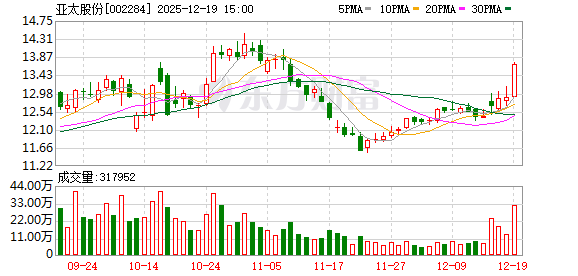
亚太股份:公司目前铝合金卡钳和铝合金转向节业务增长明显
Zheng Quan Ri Bao· 2025-12-19 15:47
Core Viewpoint - The company is experiencing significant growth in its aluminum alloy calipers and aluminum alloy steering knuckles business, and it plans to implement futures hedging to mitigate raw material price volatility risks and ensure stable operational performance [2] Group 1 - The company reported notable growth in its aluminum alloy calipers and aluminum alloy steering knuckles segments [2] - To effectively manage and reduce the risks associated with raw material price fluctuations, the company intends to engage in futures hedging activities [2] - The goal of these hedging activities is to maintain relative stability in product costs and minimize the impact of price volatility on production and operations [2]

奕东电子(301123)拟斥资1.5亿元开展金铜期货套期保值 应对原材料价格波动风险
Xin Lang Cai Jing· 2025-12-19 13:56
Core Viewpoint - Yidong Electronics plans to conduct commodity futures hedging to mitigate the impact of price fluctuations in core raw materials like gold and copper on production costs [1][2]. Group 1: Hedging Strategy - The company aims to invest up to 150 million yuan in margin to hedge against raw material price risks using futures and options [1][2]. - The hedging strategy focuses on gold and copper futures and derivatives, with the primary goal of risk mitigation rather than speculative trading [2][3]. - The maximum margin and premium usage is capped at 150 million yuan, with a maximum contract value of 500 million yuan on any trading day [2]. Group 2: Risk Management Measures - Yidong Electronics has established a Futures Hedging Management System to ensure compliance and risk control [3]. - The company will match futures positions with actual production needs to avoid excessive hedging and will manage funds carefully to prevent liquidity risks [3]. - Regular training for staff and periodic reviews of business compliance and internal controls will be implemented to enhance operational effectiveness [3]. Group 3: Board Approval and Market Analysis - The board of directors has approved the hedging plan, which will be submitted for shareholder approval [4]. - The audit committee and sponsor institution, China Merchants Securities, support the initiative, emphasizing the need for personnel training to prevent speculative behavior [4]. - Analysts note that stabilizing procurement costs through hedging will positively impact the company's long-term operational stability amid increasing price volatility in key raw materials due to macroeconomic and geopolitical factors [4].
英联股份拟斥资5000万元开展铝材期货套期保值 对冲原材料价格波动风险
Xin Lang Cai Jing· 2025-12-18 13:06
Core Viewpoint - The company, Guangdong Yinglian Packaging Co., Ltd., is initiating aluminum hedging operations to mitigate risks associated with price fluctuations of aluminum materials, which are critical to its production processes [1][2]. Group 1: Business Background - Aluminum materials, including lid and pull-tab materials, are core raw materials for the company, and recent economic conditions have led to significant price volatility, challenging cost control [2]. - The hedging initiative aims to lock in raw material costs, stabilize profit margins, and enhance sustainable profitability [2]. Group 2: Key Transaction Elements - The hedging operations will involve trading aluminum futures contracts with a maximum margin investment of 50 million yuan, which can be rolled over during the specified period [3]. - The funding for this initiative will come entirely from the company's own funds, prohibiting the use of raised funds for trading [3]. - The implementation period will last from the approval date by the shareholders' meeting until the annual shareholders' meeting in 2025 [3]. - The chairman or authorized personnel will be responsible for signing specific agreements related to the hedging operations [3]. Group 3: Risk Management and Control Measures - The company has identified six potential risks associated with the hedging operations and has established corresponding risk control mechanisms [3]. - Price fluctuation risk will be managed through hedging operations that align with production needs [3]. - Financial risks will be controlled by adhering to the "Futures Hedging Management System" and ensuring that margin sizes do not exceed approved limits [3]. - Liquidity risks will be mitigated by selecting appropriate contract months to avoid illiquid markets [3]. - Internal control risks will be managed through established operational procedures [3]. - Accounting risks will be handled according to the relevant accounting standards for hedging [3]. - Technical risks will be addressed by equipping a multi-channel trading system to ensure stable trading operations [3]. Group 4: Review Process and Market Impact - The hedging initiative has been approved by the company's board of directors and received favorable opinions from independent directors and the audit committee [3]. - Independent directors believe that the hedging operations are based on normal business operations and adhere to hedging principles, enhancing financial stability without harming shareholder interests [3]. - Market analysts view this move as a proactive management strategy to address cost risks, which is crucial in the context of increasing commodity price volatility [4].
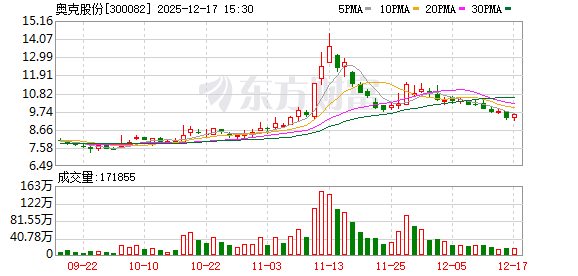
奥克股份:公司开展期货套期保值业务主要是为了规避价格波动给公司经营带来的不利影响
Zheng Quan Ri Bao· 2025-12-17 12:44
Group 1 - The core viewpoint of the article is that Aok Holdings is engaging in futures hedging to mitigate the adverse effects of price fluctuations on its operations [2] - The company limits its trading to products and raw materials related to its production and trading activities [2] - The trading activities are restricted to on-exchange transactions and do not involve quantitative trading tools [2]

天华新能:公司利用期货衍生品等工具的避险保值功能,根据生产经营计划择机开展期货套期保值业务
Zheng Quan Ri Bao Wang· 2025-12-17 08:44
Core Viewpoint - Tianhua New Energy (300390) is actively utilizing futures derivatives for hedging purposes to mitigate operational risks associated with market price fluctuations [1] Group 1: Company Operations - The company engages in futures hedging activities that are directly related to its production and operational plans [1] - The specific futures products used for hedging include lithium salts and raw materials necessary for lithium salt production [1] - The hedging mechanism aims to reduce the operational risks posed by market price volatility [1]

杭州中恒电气股份有限公司第九届董事会第五次会议决议公告
Shang Hai Zheng Quan Bao· 2025-12-15 19:19
Core Viewpoint - The company has approved two significant resolutions during its board meeting, including the initiation of futures hedging business and the disposal of equity in an associate company, aimed at optimizing its asset structure and managing risks associated with raw material price fluctuations [1][3][18]. Group 1: Futures Hedging Business - The company plans to conduct futures hedging to mitigate the adverse effects of price fluctuations in bulk raw materials, thereby effectively managing costs [7][8]. - The maximum margin balance for the futures hedging business will not exceed RMB 20 million, with a maximum contract value of RMB 200 million on any trading day [7][8]. - The hedging will involve commodities such as copper, aluminum, lead, tin, and steel, traded on approved domestic and international exchanges [7][8]. Group 2: Disposal of Equity in Associate Company - The company intends to dispose of its entire 7.3346% equity stake in Fujian Ningde Zhixiang Unlimited Technology Co., Ltd., through market search, original shareholders, or buyback [3][18]. - The board has authorized management to handle the transaction, ensuring the transaction amount is not less than RMB 200 million [3][18]. - This transaction is not classified as a related party transaction and does not constitute a major asset restructuring under relevant regulations [19][20].

中恒电气(002364)拟开展期货套期保值业务 最高合约价值不超2亿元
Xin Lang Cai Jing· 2025-12-15 12:31
Core Viewpoint - The company plans to engage in futures hedging to manage the risks associated with fluctuations in raw material prices, aiming to stabilize production costs and enhance operational certainty [1][2]. Business Background and Core Purpose - The primary objective of the futures hedging business is to mitigate the adverse effects of price volatility in key raw materials such as copper, aluminum, lead, tin, and steel on production operations, thereby stabilizing costs [2]. - The company has faced challenges in cost control due to increased volatility in commodity prices influenced by macroeconomic factors and supply chain issues [2]. Specific Business Arrangements - The hedging business will focus on commodities closely related to production, with a maximum contract value of 200 million yuan and a trading margin limit of 20 million yuan [3]. - The funding for this business will come from the company's own resources, and it will not involve raised funds [3]. - The authorization period for this hedging activity is set for twelve months following the board's approval [3]. Approval Process and Compliance - The board of directors approved this initiative on December 15, 2025, and it falls within the board's authority, thus not requiring shareholder approval [3]. - The management is authorized to implement the hedging activities within the specified limits [3]. Risk Analysis and Control Measures - The company acknowledges potential risks associated with the hedging business, including market risk, policy risk, liquidity risk, internal control risk, and technical risk [4]. - To mitigate these risks, the company has established a management system for the hedging business, including clear approval processes, operational procedures, and stop-loss mechanisms [4]. - A dedicated futures management team will be set up to ensure compliance with the board's authorization and to match the scale of operations with production needs [4]. Accounting Treatment and Follow-up Arrangements - The company will account for the hedging activities in accordance with relevant accounting standards, ensuring proper financial reporting [5]. - Analysts suggest that this proactive approach to managing cost risks could smooth out the impact of raw material price fluctuations on the company's performance, thereby enhancing operational stability [5].