
汇率波动

Search documents
央行博弈下镑美短线反弹
Jin Tou Wang· 2025-12-24 02:38
Group 1 - The British pound stabilized around 1.3405 against the US dollar after a three-day decline, indicating a balance between bullish and bearish factors [1] - The Bank of England announced a 25 basis point rate cut to 3.75%, marking the lowest level in nearly three years, with a 5:4 voting result [1] - The Bank of England's decision reflects a cautious approach, emphasizing data dependency for future rate changes, suggesting the current easing cycle may be nearing its end [1] Group 2 - Market sentiment remains cautious ahead of the UK Q3 GDP data release, with investors reducing directional bets to avoid volatility [2] - Technical analysis shows the GBP/USD pair has established support around 1.3300, with resistance levels between 1.3420 and 1.3450 [2] - The divergence in monetary policy between the Bank of England and the Federal Reserve is expected to be a key driver for the exchange rate in the short term [2]
加元持续拉锯震荡政策分化油价成核心博弈点
Jin Tou Wang· 2025-12-24 02:37
Core Viewpoint - The USD/CAD exchange rate is currently at 1.3676, reflecting a narrow fluctuation pattern driven by the divergence in monetary policies between the US and Canada, alongside factors such as international oil price volatility, economic fundamentals, and geopolitical risks [1][2]. Group 1: Monetary Policy Divergence - The Bank of Canada has completed four rate cuts totaling 100 basis points this year and maintained the overnight rate at 2.25% on December 10, indicating a neutral to hawkish stance that has led to market expectations of a rate hike in 2026 [1]. - In contrast, the Federal Reserve has implemented its third rate cut of the year in December, lowering the key interest rate to a range of 3.5%-3.75%, with internal dissent highlighting significant policy divergence within the Fed [2]. - The contrasting monetary policies of the two central banks are a primary driver of the ongoing pressure on the USD/CAD exchange rate [2]. Group 2: Economic Fundamentals - Canada's economy showed resilience with a 2.6% annualized GDP growth in Q3, reversing previous contractions, and a drop in the unemployment rate to 6.5%, the lowest in nearly 16 months [1]. - The Canadian dollar, as a commodity currency, is influenced by oil prices, which have declined by 15.2% since 2025, impacting Canada's oil export revenues and providing some support for the USD/CAD exchange rate [2]. Group 3: Technical Analysis and Market Sentiment - The USD/CAD exchange rate is currently characterized by bearish dominance but with slowing momentum, as indicated by technical indicators [3]. - Short-term price fluctuations are expected to remain within the range of 1.3740-1.3830, with key support at 1.3720-1.3680 and resistance at 1.3830 and 1.3890 [3]. - Some institutions are beginning to adopt a bullish outlook on the Canadian dollar, anticipating it could rise to 77 cents against the USD by 2026 due to factors such as narrowing interest rate differentials and enhanced economic resilience [3]. Group 4: Future Outlook - The future trajectory of the USD/CAD exchange rate will depend on multiple factors, including guidance from the Bank of Canada on interest rate hikes, core inflation data, and statements from Federal Reserve officials [3]. - Additionally, OPEC+ production policies, international oil price trends, and developments in US-Canada trade negotiations will be critical variables influencing the exchange rate [3]. - The ongoing divergence in monetary policies, oil price recovery, and the pace of Canada's economic recovery will determine the long-term direction of the exchange rate [3].
法国兴业银行认为日元干预面临“颇具吸引力”的有利情境
Xin Lang Cai Jing· 2025-12-23 15:26
Group 1 - The current environment presents a "strong intervention backdrop," increasing the likelihood of the Japanese government successfully preventing yen depreciation compared to usual circumstances [1][3] - The rationale for intervention is clear: year-end market liquidity shortages provide an opportunity, and market participants are struggling to justify current price levels, indicating a higher chance of successful intervention [1][3] - Long-term interest rate differentials and volatility indicators suggest that the euro/yen and dollar/yen exchange rates should have peaked by the end of 2023; however, both pairs have continued to rise, with euro/yen reaching a record high near 184 and dollar/yen hovering around 162 [1][3] Group 2 - There has been a dramatic decoupling of dollar/yen and euro/yen exchange rates from interest rate differentials since spring, described as a disorderly state [2][4] - Intervention is expected to curb the upward momentum of dollar/yen and euro/yen, but the likelihood of a significant reversal in the yen's weakening trend is low due to generally weak Asian currencies and ongoing concerns about economic growth and an aging population [2][4] - A correction similar to the one seen in 2014 after the sharp rise in dollar/yen and euro/yen is still possible; in the long term, this could pull dollar/yen back to the 140 level and euro/yen down to the 160 level [2][4]


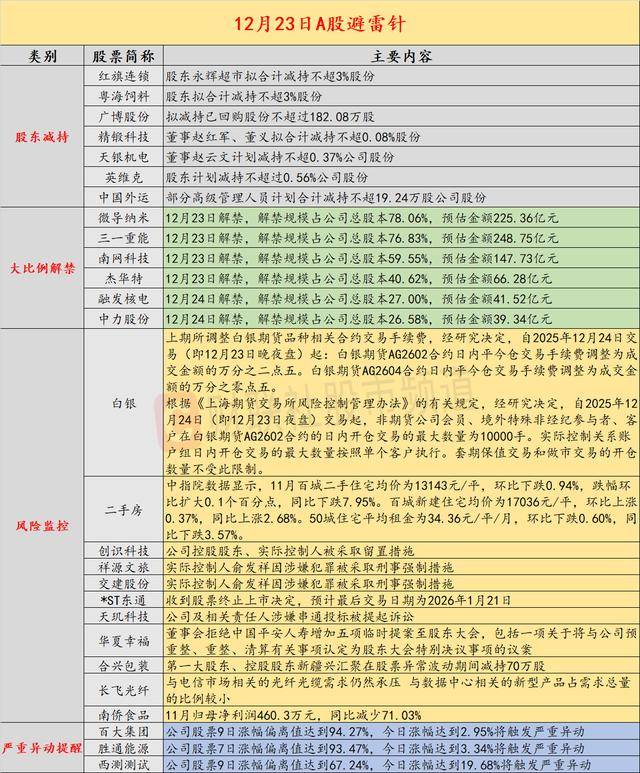
12月23日投资避雷针:两家上市公司同步发布公告 实控人被采取刑事强制措施
Sou Hu Cai Jing· 2025-12-23 00:13
Economic Information - The Shanghai Futures Exchange has adjusted the trading fees for silver futures contracts, effective from December 24, 2025. The trading fee for the AG2602 contract will be 0.025% of the transaction amount, while the AG2604 contract will be 0.005% [2] - The average price of second-hand residential properties in 100 cities in November was 13,143 yuan per square meter, a month-on-month decrease of 0.94% and a year-on-year decrease of 7.95%. The average price of new residential properties was 17,036 yuan per square meter, with a month-on-month increase of 0.37% and a year-on-year increase of 2.68% [2] Company Alerts - Chuangshi Technology's controlling shareholder and actual controller has been placed under detention [5] - Xiangyuan Cultural Tourism's actual controller, Yu Faxiang, has been subjected to criminal coercive measures due to suspected criminal activity [5] - Jiao Jian Co., Ltd.'s actual controller, Yu Faxiang, has also been subjected to criminal coercive measures [5] - Hongqi Chain's shareholder Yonghui Supermarket plans to reduce its holdings by no more than 3% [5] - Yuehai Feed's shareholders plan to reduce their holdings by no more than 3% [5] - *ST Dongtong has received a decision for stock delisting, with the last trading date expected to be January 21, 2026 [5] - Tianji Technology and related responsible persons are facing litigation for suspected collusion in bidding [5] Overseas Alerts - The Japanese government is increasingly likely to intervene in the foreign exchange market as the yen continues to depreciate following the recent interest rate hike by the Bank of Japan [7] - A report from a German economic research institute indicates that Germany's exports to the U.S. have significantly declined by 7.8% in the first three quarters of this year due to increased tariffs [7]





日本财务大臣片山皋月称必要时“可以放手”就日元采取大胆行动
Xin Lang Cai Jing· 2025-12-22 15:04
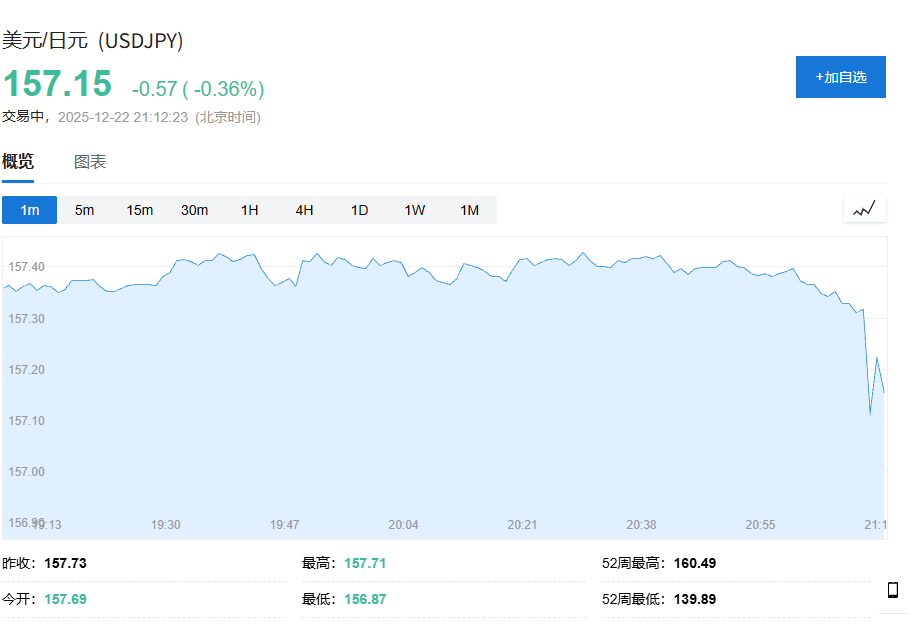
Core Viewpoint - Japan's Finance Minister, Shunichi Suzuki, indicated a willingness to take bold actions against speculative currency fluctuations that do not align with economic fundamentals, particularly in light of the yen's continued weakness following the central bank's interest rate hike [1][4]. Group 1: Currency Intervention - Suzuki issued a stern warning to speculators regarding the recent significant depreciation of the yen, emphasizing that the current trend is driven by speculation rather than fundamentals [1][4]. - The yen strengthened after Suzuki's remarks, with the USD/JPY briefly falling below the 157 level [1]. - The Finance Minister hinted at potential direct intervention in the currency market, suggesting that she has received tacit approval from Washington to act without further consultation if necessary [4][7]. Group 2: Economic Growth and Fiscal Policy - Suzuki acknowledged that the government's push for stronger economic growth under Prime Minister Fumio Kishida may temporarily worsen Japan's fiscal situation, which is a point of concern for investors [4][7]. - She mentioned that any deterioration in fiscal conditions is expected to be temporary, with anticipated increases in investment and tax revenue over the next one to two years as the government implements spending to stimulate the economy [8]. - Suzuki stated that the initial fiscal data following a shift to more aggressive fiscal policies may show deterioration, but this is not a concern, as past measures have failed to accelerate economic growth [5][8].

日元在日本财务大臣发表讲话后上涨 创下盘中高点
Xin Lang Cai Jing· 2025-12-22 13:50
Core Viewpoint - The Japanese yen has strengthened against the US dollar, reaching a new intraday high, following comments from Japan's Finance Minister Shunichi Suzuki indicating a willingness to take bold actions against exchange rate fluctuations that do not align with fundamentals [1][2]. Group 1 - The USD/JPY exchange rate fell by 0.6% to 156.88 before the decline was partially reversed [3]. - The Bloomberg Dollar Spot Index decreased by 0.3%, heading towards its largest single-day drop in over a week [4].
迄今最严厉警告!日本财务大臣:针对汇市投机拥有“自由裁量权”,将采取大胆行动
Sou Hu Cai Jing· 2025-12-22 13:47
Group 1: Government Intervention and Currency Policy - The Japanese government has issued its strongest warning to currency speculators, indicating a readiness to take bold actions against exchange rate fluctuations that deviate from economic fundamentals [1] - Finance Minister Katsunobu Kato's previous agreement with U.S. Treasury Secretary Bessent allows Japan to intervene in the currency market under certain conditions, including excessive volatility [7] - The recent depreciation of the yen is counterintuitive given the Bank of Japan's interest rate hike to 0.75%, the highest in 30 years, but lack of clear guidance on future rate increases has disappointed market participants [8] Group 2: Bond Market and Fiscal Policy - The Japanese bond market is experiencing significant volatility, with the 10-year government bond yield reaching 2.1%, the highest in 27 years, due to concerns over the government's aggressive fiscal stimulus plans [4] - The new fiscal year budget for April 2024 may expand to a record 120 trillion yen (approximately 760 billion USD), alongside a supplementary budget of 18.3 trillion yen, which is the largest since the easing of pandemic restrictions [9] - The rise in bond yields is partly driven by investor fears that a weak yen will exacerbate domestic inflation, potentially forcing the Bank of Japan to accelerate interest rate hikes [9]
人民币创14个月来新高,出口商“肉痛”一到账就结汇
Di Yi Cai Jing· 2025-12-22 13:20
Group 1 - The core viewpoint is that the Chinese yuan is expected to appreciate further, potentially entering the "6 era" in the long term, despite short-term fluctuations [5][7] - Recent trends show that exporters are increasingly opting for immediate currency settlement upon receipt of payments to mitigate losses from currency fluctuations, particularly in light of the yuan's recent appreciation [1][3] - The yuan has reached a 14-month high, which poses challenges for small and medium-sized export enterprises, as they may face immediate currency exchange losses and potential price competitiveness issues [1][5] Group 2 - The People's Bank of China reported a slight depreciation of the yuan against the US dollar, with the central parity rate set at 7.0572 yuan per dollar, reflecting a decrease of 22 basis points from the previous trading day [4] - Analysts suggest that the seasonal increase in currency settlement demand towards the end of the year may contribute to a stronger yuan, as exporters typically need to settle accounts to pay year-end bonuses [7][9] - The overall trade environment is expected to remain stable, with the central bank's recent adjustments indicating a focus on aligning the yuan's exchange rate with economic fundamentals rather than promoting rapid appreciation [9][10] Group 3 - China's foreign trade maintained positive growth, with total trade value reaching 41.21 trillion yuan in the first eleven months of the year, a year-on-year increase of 3.6%, driven by a 6.2% rise in exports [8] - The shift from price competition to brand and technology diversification is anticipated as companies adapt to exchange rate pressures, aligning with government initiatives to support service exports and digital trade [8][9] - The recent increase in the yuan's value is seen as beneficial for importers, enhancing purchasing power and potentially lowering costs for raw materials and consumer goods, which aligns with China's strategy to boost domestic consumption [7][8]

美元定存新一轮降息来了,有银行逆势抢客,1个月定存利率达4.5%
3 6 Ke· 2025-12-22 08:12
Core Viewpoint - The article discusses the recent trend of banks lowering their USD deposit interest rates following the Federal Reserve's interest rate cut, while highlighting the ongoing appeal of USD deposits despite the risks associated with currency fluctuations. Group 1: Interest Rate Changes - Several banks have begun to lower their USD deposit rates, with Guangdong Huaxing Bank announcing a reduction of 25 basis points effective December 23, bringing the 1-year rate down to 3.65% from 3.90% [2] - Nanjing Bank has also adjusted its USD deposit rates, with a decrease from 3.55% to 3.42% for a 1-year product with a minimum deposit of $200,000 [2] - HSBC reported a decrease in rates for its USD deposits, with the 3-month rate dropping by 10 basis points to 3.50% [3] Group 2: High-Interest USD Deposit Products - Some smaller banks still offer competitive USD deposit rates above 3%, such as Xi'an Bank's 1-year rate at 3.98% [1][3] - Ant Bank (Hong Kong) has introduced a year-end promotion for USD deposits, offering a maximum annual interest rate of 4.5% for a 1-month deposit [4] Group 3: Currency Exchange Rate Considerations - The Chinese Yuan has strengthened against the USD, with the onshore and offshore rates surpassing 7.03, marking a 14-month high [1] - Analysts suggest that while USD deposit rates are attractive, investors must consider the risks associated with currency fluctuations, especially as the Yuan continues to appreciate [5][6] Group 4: Future Outlook - Analysts predict that USD deposit rates may continue to decline as banks seek to optimize their asset-liability structures following the Fed's rate cuts [5] - There is a recommendation for investors to avoid long-term, large-amount USD deposits and consider more flexible investment options [6]
韩国金融委员会委员长:准备好以先发制人的措施稳定市场
Xin Lang Cai Jing· 2025-12-21 23:12
Core Viewpoint - The South Korean Financial Services Commission (FSC) is prepared to take preemptive measures to stabilize the financial market if necessary, indicating vigilance towards rising bond yields and currency fluctuations [1]. Group 1: Financial Stability - The FSC Chairman Lee Eog-weon stated that the robustness of the South Korean financial system and its ability to respond to crises is not in significant doubt [1]. Group 2: Currency and Inflation Concerns - The ongoing weakness of the Korean won has raised concerns about inflation, prompting the Bank of Korea to announce temporary measures aimed at increasing the supply of US dollars in the onshore foreign exchange market [1].