
险资入市

Search documents
以中长期制度建设打造资本市场安全垫
第一财经· 2025-08-26 00:34
Core Viewpoint - The article discusses the current bullish trend in the A-share market, highlighting the patience of investors and the influence of monetary policy on market dynamics [2][4]. Market Performance - As of July 25, the A-share market has been on an upward trajectory, approaching a new high of 3900 points, with trading volumes exceeding 3 trillion yuan [2]. - Since June 23, the Chinese stock market has shown strength for over two months, with valuations reaching new highs and sectors rotating upward [2]. Monetary Policy Impact - The People's Bank of China has implemented significant monetary easing measures, including a trillion-yuan reverse repurchase operation and a 10 basis point cut in key interest rates, which has lowered market interest rates across various time frames [2][4]. - These policies have directed institutional investors, particularly insurance funds, towards equity markets due to limited options in the financial market [2][4]. Investor Behavior - The influx of insurance capital into the equity market reflects a broader trend of risk-averse investors seeking stable returns, particularly in dividend yields [4][5]. - There is a notable "slow bull" consensus in the market, driven by the need for reallocation of funds, as the phenomenon of household savings moving into the stock market has not fully materialized [2][3]. Economic Fundamentals - The article emphasizes the need to strengthen the economic fundamentals supporting the stock market, suggesting that reforms should enhance market participants' operational freedom and improve government services [5]. - It calls for long-term institutional reforms to enhance market attractiveness and ensure fair competition, including improvements in information disclosure and risk pricing mechanisms [5][6]. Regulatory Focus - The article stresses the importance of creating a protective framework for investors, particularly for risk-averse funds, to ensure stability in the capital market and prevent systemic risks [4][6]. - It advocates for a shift away from the "short bull, long bear" cycle by establishing a comprehensive protection mechanism for investors' legal rights [6].


一财社论:以中长期制度建设打造资本市场安全垫
Di Yi Cai Jing· 2025-08-25 13:02
Core Viewpoint - The article emphasizes the need for long-term institutional reforms to support the equity market and ensure that both resident deposits and insurance capital can safely invest in this market, breaking the cycle of "short bull and long bear" [1][5]. Group 1: Market Performance and Trends - The A-share market has shown significant strength, reaching new highs and exceeding a trading volume of 3 trillion yuan, indicating a strong upward trend since June 23 [1]. - The current market rally is characterized by patience, supported by the central bank's monetary policies, including a series of interest rate cuts that have lowered market rates [1][2]. - There is a notable shift of resident savings towards the stock market, although this transition is still in its early stages, as evidenced by a decrease in resident deposits and an increase in non-bank financial institution deposits [2]. Group 2: Investment Behavior and Risks - The influx of insurance capital into the equity market reflects a broader trend of risk-averse investors seeking stable returns, highlighting the need for a secure investment environment [2][4]. - The current market sentiment is influenced by a desire to avoid losses, with both insurance capital and resident deposits being inherently risk-averse [2][3]. - The article warns that mismatching risk-averse capital with high-risk assets could lead to systemic instability in the financial market [2]. Group 3: Recommendations for Market Improvement - Strengthening the economic fundamentals of the stock market is crucial, which involves implementing reforms that enhance market participants' operational freedom and ensure effective government services [3]. - Long-term institutional reforms should focus on improving risk pricing mechanisms and ensuring fair competition in the market, including better information disclosure and investor protection measures [3][4]. - Regulatory bodies must recognize the capital market as a risk trading and allocation venue, allowing risk-averse investors to operate securely within it, which is essential for establishing long-term investment value [4][5].
保险资金入市加速,这些险资中报重仓股已浮出水面
Xin Lang Cai Jing· 2025-08-20 06:31
Core Viewpoint - The establishment of private securities investment fund management companies by insurance firms marks a significant step in the long-term investment reform pilot, with a total of 7 insurance-related private equity firms now approved to operate in the market [1][4]. Group 1: Investment Scale and Participants - The total scale of the three batches of pilot projects has reached 222 billion yuan, with the first batch approved for 50 billion yuan, the second batch for 112 billion yuan, and the third batch for 60 billion yuan [1]. - Key participants in these pilot projects include major insurance companies such as China Life, New China Life, Taikang Life, and others [1][2]. Group 2: Investment Strategy and Market Impact - The influx of 222 billion yuan from these pilot projects is expected to improve the characteristics of the A-share market, shifting it away from short-term speculative trading towards a focus on low volatility and high dividend stocks [1]. - Insurance capital, characterized as "patient capital," is anticipated to smooth out short-term market fluctuations and direct investments towards technology innovation, green economy, and consumption recovery [1][4]. Group 3: Fund Management and Performance - The newly established private funds, such as Guofeng Xinghua and Taikang Stable, have begun operations with significant initial capital, indicating a robust start in the private equity sector [2][3]. - Guofeng Xinghua has already completed investments for its first fund with a good return rate, while Taikang Stable has successfully executed its first investment transaction [2][3]. Group 4: Industry Dynamics and Future Outlook - The emergence of insurance-related private equity firms is expected to reshape the competitive landscape of the private equity industry, introducing new investment logic and governance models [9]. - The management teams of these private equity firms are primarily composed of former executives from insurance asset management companies, ensuring continuity in investment philosophy and operational standards [4].



险资大力加仓股票:上半年净买入6400亿元,环比增长78%
Zhong Guo Jing Ji Wang· 2025-08-20 02:14
Core Viewpoint - Current valuations of A-shares and Hong Kong stocks are relatively low, while dividend yields are high, suggesting that long-term capital allocation to equities may yield substantial returns and promote stable capital market operations [1] Group 1: Insurance Capital Allocation Trends - Insurance capital utilization has surpassed 36 trillion yuan, with a strong push towards equity investments due to low interest rates and asset scarcity [1][3] - As of the end of Q2, funds allocated to stocks reached 3.07 trillion yuan, an 8.9% increase from Q1, indicating a net purchase of approximately 640 billion yuan in the first half of the year [3][4] - The proportion of insurance funds allocated to equities has risen from 7.3% at the end of 2024 to 8.47% [3] Group 2: Investment Strategy Shifts - Insurance funds are transitioning from a focus on "position control" to "selecting sectors," adapting to market volatility and structural changes [2][5] - The preference for large-cap, high-dividend, and low-volatility assets is evident, with banks being the most favored sector, followed by public utilities and transportation [6] Group 3: Long-term Investment Reforms - Recent approvals for private fund management companies signal progress in long-term investment reforms for insurance capital, with the number of pilot funds increasing to seven [8] - Notable private equity funds have been established, including a 50 billion yuan fund initiated by China Life and New China Life, which has already invested in several A-share companies [8]
险资今年举牌30次助力牛市
2 1 Shi Ji Jing Ji Bao Dao· 2025-08-18 23:09
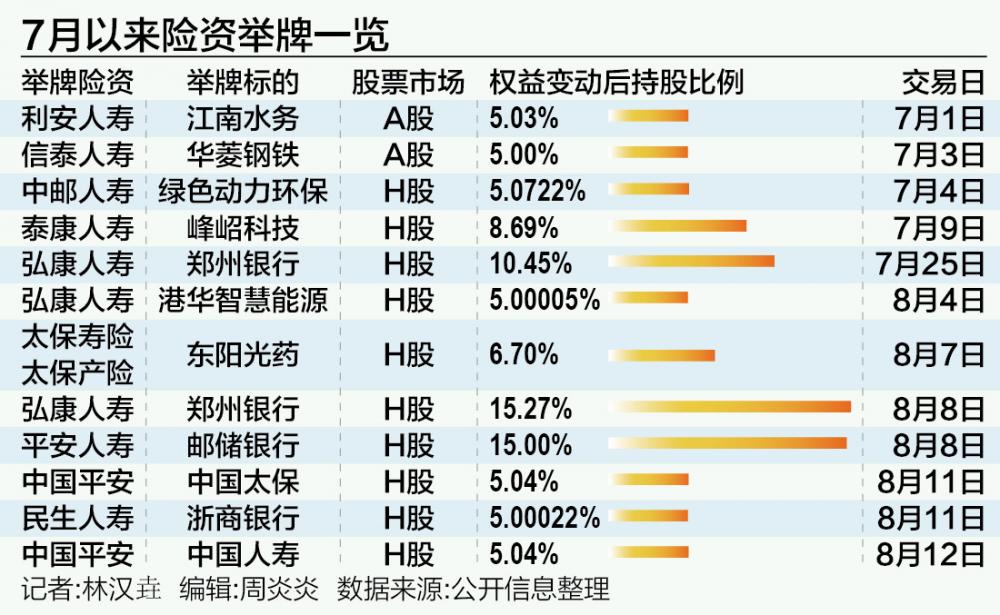
Core Viewpoint - The activity of insurance funds in the capital market has significantly increased in 2025, with a record 30 stake acquisitions this year, second only to 2015's 62 acquisitions, indicating a robust trend towards long-term investment in the A-share market [1][2][3]. Group 1: Insurance Fund Activity - Insurance funds have made 30 stake acquisitions this year, surpassing 20 in 2024 and 26 in 2020, with a notable focus on both A-shares and H-shares [2][3]. - The sectors targeted by insurance funds include banking, public utilities, non-bank financials, media, and pharmaceuticals, with banks being the most favored, receiving 14 out of 30 acquisitions [3][4]. - The total amount involved in the long-term investment reform pilot has reached 222 billion yuan, with seven insurance fund private equity companies established [1][6]. Group 2: Market Impact - On August 18, the total market capitalization of A-shares surpassed 100 trillion yuan for the first time, with the Shanghai Composite Index reaching a nearly 10-year high [1][8]. - The current market is characterized by a "slow bull" trend, supported by improving economic conditions and increased capital inflow [9][10]. - Insurance funds are seen as a key driver of this market trend, enhancing the participation of institutional investors and stabilizing market fluctuations [11][12]. Group 3: Regulatory Environment - Recent regulatory measures have encouraged insurance funds to increase their equity investments, with a target for large state-owned insurance companies to allocate 30% of new premiums to A-shares starting in 2025 [10][11]. - The adjustment of regulatory ratios for equity assets has further expanded the investment scope for insurance funds, promoting a more favorable environment for long-term investments [10][11]. - The establishment of private equity funds by insurance companies is aimed at optimizing asset-liability management and reducing the volatility of equity investments [7][8].
多重驱动显效 险资入市提速
Zheng Quan Shi Bao· 2025-08-18 18:33
Group 1 - Insurance funds are accelerating their entry into the market, with significant investments in H-shares of companies like China Pacific Insurance and China Life Insurance, marking a shift from previous preferences for bank stocks [1] - The insurance sector is witnessing a resurgence in "insurance buying insurance," indicating a strategic move towards high-dividend assets and an optimistic outlook on industry fundamentals [1] - The stock investment balance of life and property insurance companies has increased significantly, with life insurance companies holding 2.87 trillion yuan in stocks, representing 8.81% of their total investments, and property insurance companies holding 195.5 billion yuan, representing 8.33% [1][2] Group 2 - Regulatory policies are driving insurance companies to invest more in the stock market, with a directive for large state-owned insurers to allocate 30% of new premiums to A-shares starting in 2025 [2] - The new accounting standards have increased the impact of equity asset fluctuations on insurance profits, incentivizing insurers to invest in high-dividend equities for better returns [2] - The forecast indicates that large state-owned insurance companies could generate incremental funds of 378.8 billion yuan, 393.3 billion yuan, and 408.5 billion yuan over the next three years, leading to an overall increase in market entry funds approaching one trillion yuan [3]
险资二季度加大入市步伐
Shen Zhen Shang Bao· 2025-08-18 16:44
Group 1 - The core viewpoint of the articles indicates that insurance capital has increased its market entry pace in the second quarter, with total investment balance reaching 36.23 trillion yuan, a year-on-year increase of 17.4% [1] - By the end of the second quarter, the combined investment in stocks by life insurance and property insurance companies exceeded 3 trillion yuan, marking an increase of nearly 1 trillion yuan compared to the same period last year [1] - Life insurance companies' stock investment balance reached 2.87 trillion yuan, with a net increase of over 200 billion yuan from the previous quarter and over 600 billion yuan since the beginning of the year, resulting in a stock investment ratio of 8.81% [1] Group 2 - The rise in the stock investment ratio of insurance capital is attributed to two main reasons: the low interest rate environment prompting insurance companies to invest in high-dividend stocks, and favorable policies from regulators encouraging long-term capital market entry [2] - Recent policy changes have included an increase in the equity asset ratio by 5% for certain solvency levels and a reduction of risk factors for stock investments by 10%, aimed at promoting greater market participation by insurance companies [3] - As of mid-year, the total approved amount for long-term investment pilot projects by insurance funds reached 222 billion yuan, with new private equity funds being established to facilitate these investments [3]
金改前沿|高歌猛进!36万亿元险资变身“超级买方”
Xin Hua Cai Jing· 2025-08-18 10:18
Core Viewpoint - The recent actions of China Ping An in increasing its stakes in China Life and China Pacific Insurance are seen as a positive signal for the insurance sector, indicating a recovery in the industry's fundamentals after a six-year hiatus in such activities [1][2]. Group 1: Investment Activities - China Ping An increased its holdings in China Life H-shares by 9.5 million shares, raising its stake from 4.91% to 5.04% [2]. - The company also acquired 1.7414 million shares of China Pacific Insurance H-shares at an average price of HKD 32.07 per share, increasing its stake from 4.98% to 5.04% [2]. - This marks the first instance of insurance capital making significant investments in listed insurance companies since 2019, reflecting a renewed confidence in the sector [2]. Group 2: Market Trends - Insurance capital has been increasingly entering the market, with a notable rise in the scale of funds managed by insurance companies, surpassing CNY 36 trillion by mid-2025, a year-on-year increase of 17.4% [4]. - The proportion of stock investments has been on the rise, with investments in stocks and securities investment funds reaching CNY 4.73 trillion, a 25% increase compared to the previous year [4]. - The number of times insurance capital has made significant investments this year has reached 29, surpassing the total of 20 from the previous year [4]. Group 3: Regulatory Environment - The regulatory environment has been supportive of long-term investments by insurance funds, with recent policies encouraging stable and active capital market participation [5]. - The Ministry of Finance has adjusted the assessment methods for net asset returns to promote long-term investment strategies among insurance companies [4][5]. - The total approved amount for long-term investment pilot programs by the financial regulatory authority has reached CNY 222 billion as of mid-2023 [4].


险资大力加仓股票:上半年净买入6400亿元,环比增长78%
Feng Huang Wang· 2025-08-17 12:06
Group 1 - The current valuation of A-shares and Hong Kong stocks is relatively low, while dividend yields are high, suggesting that long-term capital allocation to equities may yield substantial returns [1] - Insurance funds have significantly increased their stock allocations, with the proportion reaching a recent high, driven by low interest rates and asset scarcity [1][3] - As of the end of Q2, the balance of insurance funds allocated to stocks was 3.07 trillion yuan, an increase of 8.9% from the previous quarter, representing a net purchase of approximately 640 billion yuan in the first half of the year [3][4] Group 2 - The shift in insurance funds' investment strategy is moving from "controlling positions" to "selecting sectors," reflecting the need to adapt to market volatility and structural changes [2][5] - Insurance companies have made 28 equity stakes in 23 listed companies this year, marking the highest number of actions in nearly four years [5] - The overall investment style of insurance funds favors large-cap, high-dividend, and low-volatility assets, with a preference for stable companies in sectors like banking, public utilities, and transportation [6] Group 3 - The total balance of insurance funds reached 36.23 trillion yuan by the end of Q2, with a 3.73% increase from the previous quarter [3] - The proportion of insurance funds allocated to long-term equity investments rose to 7.6%, while the allocation to securities investment funds was 4.6% [4] - The recent approval of several private fund management companies indicates progress in the long-term investment reform pilot for insurance funds [8]
险资大力加仓股票:上半年净买入6400亿元,环比增长78%丨36万亿险资重构资产底仓②
Xin Lang Cai Jing· 2025-08-17 08:17
Group 1 - The current valuation of A-shares and Hong Kong stocks is relatively low, while dividend yields are high, suggesting that long-term capital allocation to equities may yield substantial returns [1][2] - Insurance funds have significantly increased their stock allocations, with the proportion reaching a recent high, driven by low interest rates and asset scarcity [1][2] - As of the end of Q2, the balance of insurance funds allocated to stocks was 3.07 trillion yuan, an 8.9% increase from the previous quarter, equating to a net purchase of approximately 640 billion yuan in the first half of the year [2][3] Group 2 - The shift in insurance funds' investment strategy from "controlling positions" to "selecting sectors" is necessary due to increased market volatility during the economic transition [2][4] - Insurance funds have shown a preference for large-cap, high-dividend, and low-volatility assets, with banks being the most favored sector, followed by public utilities, transportation, and energy [4][5] - The investment in long-term equity has increased to 2.75 trillion yuan, representing 7.6% of the overall asset allocation, while the allocation to securities investment funds stands at 4.6% [3][4] Group 3 - Recent regulatory changes have facilitated insurance funds' entry into the capital market, allowing for increased investments through private equity funds and shareholding [4][7] - The number of equity stakes taken by insurance companies has reached a four-year high, with 28 stakes in 23 listed companies this year [4][7] - The establishment of new private fund management companies by major insurance firms indicates a growing trend towards long-term investment strategies [7]