零碳工厂

Search documents
工信部等重磅利好!在汽车等领域培育零碳工厂,A股沸腾了!
Xin Lang Cai Jing· 2026-01-19 12:00
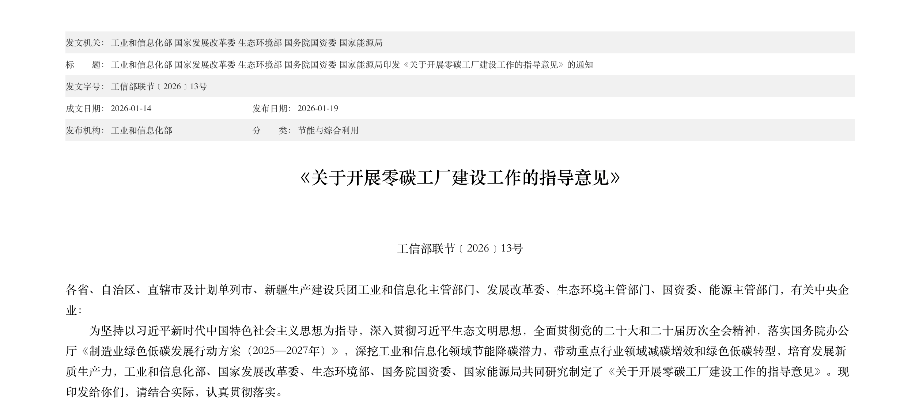
转自:中国商报 (来源:中国商报) 【工信部等重磅利好!在汽车等领域培育零碳工厂,A股沸腾了!】1月19日,超3500只个股上涨。板 块方面,电网设备延续强势,商业航天展开修复反弹,机器人、旅游、贵金属等方向同样在盘中活跃。 储能概念午后持续反弹,海博思创盘中涨超10%,华自科技、艾罗能源、阿特斯、锦浪科技、阳光电源 跟涨。在消息面上,工业和信息化部等五部门联合印发《关于开展零碳工厂建设工作的指导意见》。文 件指出,到2030年,将零碳工厂建设逐步拓展至钢铁、有色金属、石化化工、建材、纺织等行业领域, 探索传统高载能产业脱碳新路径,推广零碳工厂设计、融资、改造、管理等综合服务模式和系统解决方 案,大幅提升产品全生命周期和全产业链管理能力,实现工厂碳排放的稳步下降。最近,你看好哪个板 块?(注:本文不构成任何投资建议)#A股迎重要调整# ...
直通部委|去年刑事案件为本世纪以来最低 上月各线城市商品房售价总体下降
Xin Lang Cai Jing· 2026-01-19 10:12
Group 1: Crime and Law Enforcement - The number of criminal cases nationwide decreased by 12.8% year-on-year, marking the lowest level since the beginning of the century [1] - The number of drug users has decreased by 63% compared to the end of 2020, indicating significant achievements in combating drug-related crimes [1] - The number of juvenile crime cases and cases of harm against minors decreased by 9.8% and 2.2% respectively, achieving a "double decrease" for the first time [1] Group 2: Economic Indicators - The GDP for 2025 was reported at 14,018.79 billion yuan, with a year-on-year growth of 5.0% [8] - The per capita disposable income for residents reached 43,377 yuan, also reflecting a nominal growth of 5.0% [9] - The first, second, and third industries saw growth rates of 3.9%, 4.5%, and 5.4% respectively [8] Group 3: Real Estate Market - In December, new residential property prices in first-tier cities fell by 0.3% month-on-month, while second and third-tier cities saw declines of 0.4% [9] - Year-on-year, new residential property prices in first-tier cities decreased by 1.7%, with second and third-tier cities experiencing declines of 2.5% and 3.7% respectively [9] - The second-hand residential property prices in first-tier cities dropped by 7.0% year-on-year, with significant declines noted in major cities like Beijing and Shanghai [9] Group 4: Standards and Regulations - The National Market Supervision Administration announced the release of 213 national measurement technical standards in 2025, a 63.8% increase from 2024 [6] - The newly established standards aim to support high-end manufacturing and promote fair trade practices [6] - The standards include regulations for zero-carbon buildings and energy resource measurement, contributing to the "dual carbon" goals [6] Group 5: Cultural Development - The Ministry of Education and six other departments issued an opinion to promote the inheritance and development of excellent Chinese language culture [7] - The opinion outlines seven main tasks, including scientific research, education promotion, and digital empowerment [7] - The initiative aims to enhance the attractiveness and influence of Chinese language culture through various means [7]
培育零碳工厂深挖节能降碳潜力 推动重点行业减碳增效与绿色低碳转型
Yang Shi Wang· 2026-01-19 09:21
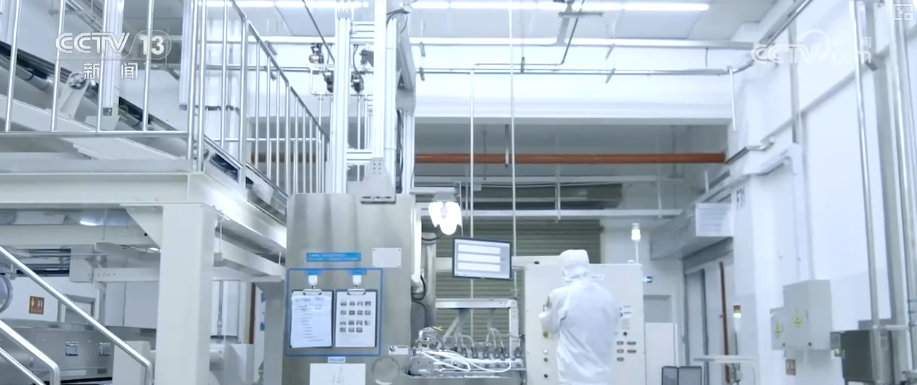
Core Viewpoint - The article discusses the joint issuance of the "Guiding Opinions on the Construction of Zero Carbon Factories" by several Chinese government agencies, aiming to enhance energy conservation and carbon reduction in key industries, thereby promoting green and low-carbon transformation and fostering new productive forces [1]. Group 1: Definition and Concept - Zero carbon factory construction involves reducing carbon dioxide emissions through technological innovation, structural adjustments, and management optimization, aiming for near-zero emissions rather than absolute zero [4]. Group 2: Implementation and Timeline - The guiding opinions outline a phased approach for cultivating zero carbon factories, with benchmark factories to be selected starting in 2026, followed by the development of zero carbon factories in sectors such as automotive, lithium batteries, photovoltaics, and electronics by 2027, and expanding to traditional high-energy industries like steel and petrochemicals by 2030 [6]. Group 3: Construction Pathways - Six major directions for construction are proposed, including establishing a carbon accounting system, optimizing energy structure, enhancing energy efficiency, conducting carbon footprint analysis, enabling smart carbon control through digitalization, and implementing carbon offsetting and information disclosure for continuous improvement [9]. - The guiding opinions also emphasize organizational implementation, standard system improvement, and the promotion of comprehensive energy-saving and carbon reduction services [9]. Group 4: Current Initiatives - Some regions in China have already initiated pilot projects for near-zero carbon factories, with over 30 related group standards developed and implemented, laying the foundation for nationwide promotion [9].

A股重要信息回顾:2025年GDP突破140万亿元同比增长5%,2026年春运首日火车票1月19日开售且铁路部门推出误购票限时免费退等新服务
Jin Rong Jie· 2026-01-19 08:52
Company News - Vanke A and Changsha Vanke Enterprise Co., Ltd. have added a new execution information of over 1.08 billion yuan [1] - Longi Green Energy has released a 2025 performance forecast, expecting a net loss of 6-6.5 billion yuan, while successfully scaling up the production of BC Generation II products and officially entering the energy storage sector [1] - Wanhua Chemical established Wanhua Chemical Group (Laizhou) New Energy Materials Technology Co., Ltd. with a registered capital of 740 million yuan on January 16 [1] - Zhiyuan Robotics has signed a memorandum of cooperation with Lens Technology, Thailand's SKY, and Com7 to establish a joint venture in Thailand to explore the implementation path of embodied intelligence industry [1] - Tianrongxin has stated that the company has technical reserves and layout in the commercial aerospace security field and will continue to expand research and application of new technologies and scenarios [1] - Sunlord Electronics claims its products are widely used in AI glasses, covering inductors, LTCC, antennas, and have been supplying major clients in related fields [1] - Tianyi Medical has recently received a medical device registration certificate for disposable continuous renal replacement therapy tubing from the National Medical Products Administration [1] Industry News - The National Bureau of Statistics has released the 2025 national economic data, with GDP exceeding 140 trillion yuan, a year-on-year growth of 5%, and the manufacturing sector expected to maintain its position as the world's largest for 16 consecutive years, driven by "Artificial Intelligence+" with storage chips and server production increasing by 22.8% and 12.6% respectively [1] - The Ministry of Industry and Information Technology, the National Development and Reform Commission, and four other departments have jointly issued opinions to cultivate and build a number of zero-carbon factories in the automotive, lithium battery, and photovoltaic industries by 2027 [1] - Hainan Free Trade Port has shown initial results in its first month of closure, with 5,132 new foreign trade registered enterprises, and border inspection agencies reporting a year-on-year increase of 31% and 27% in inspected personnel and transportation vehicles respectively [1] - The first day of the 2026 Spring Festival travel season (February 2) train tickets will go on sale on January 19, with the railway department introducing new services such as limited-time free refunds for mistakenly purchased tickets, expecting a significant increase in short- and medium-distance passenger flow [1]
我国2026年起将遴选一批标杆零碳工厂
Xin Hua She· 2026-01-19 08:28
新华社北京1月19日电(记者周圆)记者19日获悉,工业和信息化部等五部门日前联合印发《关于开展 零碳工厂建设工作的指导意见》,深挖工业和信息化领域节能降碳潜力,带动重点行业领域减碳增效和 绿色低碳转型。其中,提出2026年起,遴选一批零碳工厂,做好标杆引领。 ...
利好来了,五部门联合发文
21世纪经济报道· 2026-01-19 08:02
Core Viewpoint - The article discusses the implementation of zero-carbon factory construction in China, emphasizing the government's commitment to promoting green and low-carbon development through a series of guidelines and policies aimed at reducing carbon emissions across various industries [1][2]. Group 1: Policy and Guidelines - On January 19, 2026, five government departments issued the "Guiding Opinions on Zero-Carbon Factory Construction," which outlines the selection of benchmark zero-carbon factories starting in 2026 [1]. - By 2027, the initiative aims to cultivate zero-carbon factories in sectors such as automotive, lithium batteries, photovoltaics, electronics, light industry, machinery, and computing facilities [1][5]. - The goal is to expand zero-carbon factory construction to industries like steel, non-ferrous metals, petrochemicals, building materials, and textiles by 2030, exploring new decarbonization pathways for traditional high-energy industries [1][5]. Group 2: Construction and Implementation - Zero-carbon factory construction involves continuous reduction of carbon dioxide emissions through technological innovation, structural adjustments, and management optimization [2][4]. - The construction path includes establishing a carbon emission accounting management system, transforming energy structures to be greener, enhancing energy efficiency, analyzing carbon footprints of key products, and improving digital intelligence levels for carbon control [5][6]. - The article highlights that various regions, including Tianjin, Shanghai, Jiangsu, and Guangdong, have begun pilot projects for near-zero carbon factories, with over a hundred near-zero carbon factory lists published [6]. Group 3: Challenges and Future Directions - The construction of zero-carbon factories is a complex and systematic project that involves multiple aspects such as energy structure, process technology, funding, and management services, with significant variations in implementation across different regions and industries [6]. - Challenges include inconsistent evaluation requirements, unverified key technologies, and weak foundations for carbon emission statistics, necessitating enhanced guidance and technical support [6]. - The Ministry of Industry and Information Technology plans to coordinate with other departments to promote the implementation of the guidelines and support high-quality progress in zero-carbon factory construction [6].

利好来了!五部门联合印发《关于开展零碳工厂建设工作的指导意见》
Zhong Guo Ji Jin Bao· 2026-01-19 07:54
Core Viewpoint - The release of the "Guiding Opinions on the Construction of Zero Carbon Factories" aims to enhance energy conservation and carbon reduction in the industrial sector, promoting green and low-carbon transformation while fostering new productive forces [1][2]. Group 1: Overall Requirements - The initiative is guided by Xi Jinping's thoughts on ecological civilization and aims to integrate green energy with modern manufacturing, accelerating technological and industrial innovation to significantly reduce carbon emissions and strengthen green manufacturing [5][6]. Group 2: Principles of Zero Carbon Factory Construction - The construction of zero carbon factories will follow principles such as tailored strategies based on industry needs, innovation-driven approaches, continuous improvement in carbon reduction, and ensuring transparency and standardization in carbon emissions reporting [6][7]. Group 3: Main Goals - The plan includes phased cultivation of zero carbon factories, starting with industries that have urgent decarbonization needs and gradually expanding to more challenging sectors by 2030, with specific targets set for 2026 and 2027 [8]. Group 4: Construction Pathways - Key pathways for construction include establishing a carbon emission accounting system, transitioning to green energy sources, enhancing energy efficiency, analyzing carbon footprints of key products, leveraging digital technologies for carbon management, and implementing carbon offsetting and information disclosure [9][10][11][12]. Group 5: Work Requirements - Local industrial and information departments are encouraged to develop specific implementation plans for zero carbon factory construction, emphasizing collaboration among government, enterprises, and markets, while also enhancing the standard system to support effective management and evaluation of zero carbon factories [13][14].
全指现金流ETF鹏华(512130)涨超1.1%,午后电力设备、能源股上涨
Xin Lang Cai Jing· 2026-01-19 06:36
Group 1 - The core viewpoint of the news highlights the significant investment plans of State Grid Corporation, which is expected to reach 4 trillion yuan during the "14th Five-Year Plan" period, representing a 40% increase compared to the previous plan [1] - The Ministry of Industry and Information Technology, along with four other departments, has issued guidelines for the construction of zero-carbon factories, emphasizing the need for a green and low-carbon energy structure and encouraging the development of distributed renewable energy sources [1] - The market is currently experiencing a "slow bull" phase, with institutions suggesting that the A-share market has a solid foundation for medium-term strength, and funds are likely to rotate towards higher cost-performance assets as momentum effects decline [1] Group 2 - As of January 19, 2026, the CSI All Index Free Cash Flow Index has risen by 1.17%, with significant gains in stocks such as Xinhua Department Store, Pinggao Electric, and Zhongmin Energy [2] - The CSI All Index Free Cash Flow Index consists of 100 listed companies with high free cash flow rates, reflecting the overall performance of companies with strong cash flow generation capabilities [2] - The top ten weighted stocks in the CSI All Index Free Cash Flow Index account for 53.78% of the index, including major companies like China National Offshore Oil Corporation and SAIC Motor [2]
利好来了,五部门联合发布
Zhong Guo Ji Jin Bao· 2026-01-19 06:34
Core Viewpoint - The release of the "Guiding Opinions on the Construction of Zero Carbon Factories" aims to enhance energy conservation and carbon reduction in the industrial sector, promoting green and low-carbon transformation while fostering new productive forces [1][6]. Group 1: Principles of Zero Carbon Factory Construction - The construction of zero carbon factories follows four principles: tailored strategies based on industry needs, systematic advancement, innovation-driven and technology-enabled approaches, and a commitment to transparency and standardization [4][10]. Group 2: Goals and Phased Implementation - The initiative will prioritize industries with urgent decarbonization needs and lower decarbonization difficulties, with a phased approach starting in 2026 to select benchmark zero carbon factories [4][11]. - By 2027, a batch of zero carbon factories will be established in sectors such as automotive, lithium batteries, photovoltaics, electronics, light industry, machinery, and computing facilities [4][11]. - By 2030, the initiative aims to expand to high carbon intensity industries like steel, non-ferrous metals, petrochemicals, building materials, and textiles, exploring new decarbonization pathways [4][11]. Group 3: Construction Pathways - Key pathways for construction include establishing a carbon emission accounting management system, accelerating the transition to a green and low-carbon energy structure, and enhancing energy efficiency through technological upgrades [5][12][13]. - The initiative emphasizes the importance of carbon footprint analysis for key products to drive collaborative carbon reduction across the entire supply chain [5][14]. - Digitalization and intelligent management will be leveraged to achieve precise measurement and control of energy consumption and carbon emissions [5][15]. Group 4: Implementation Requirements - Local industrial and information authorities are encouraged to develop specific implementation plans for zero carbon factory construction, promoting collaboration among government, enterprises, and markets [16][17]. - A comprehensive standard system will be established to support the management and evaluation of zero carbon factories, ensuring alignment with international standards [16][17].
五部门发文:2027年前在汽车等重点领域培育零碳工厂
2 1 Shi Ji Jing Ji Bao Dao· 2026-01-19 06:32
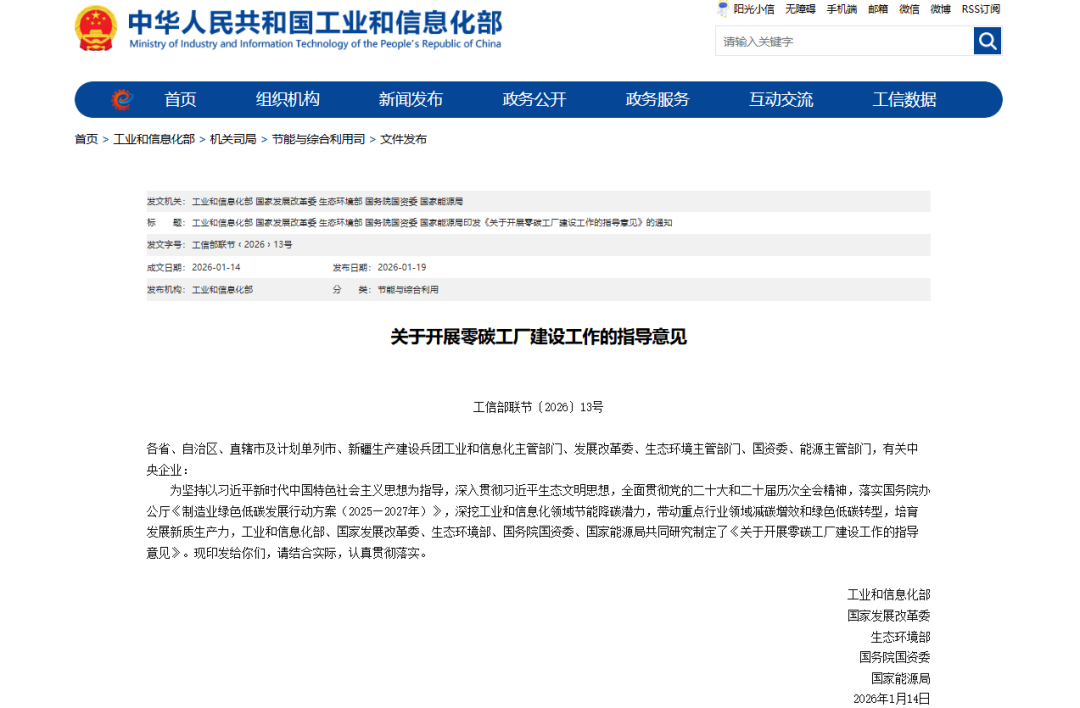
Core Viewpoint - The ongoing trend towards zero-carbon initiatives is being reinforced by the implementation of policies for zero-carbon factories, which are expected to significantly contribute to the green transformation of industries in China [1][4]. Group 1: Policy and Guidelines - The Ministry of Industry and Information Technology, along with four other departments, issued the "Guiding Opinions on the Construction of Zero-Carbon Factories," which outlines the selection of zero-carbon factories starting in 2026 and aims to establish benchmarks for various industries [1][4]. - By 2027, the plan includes the cultivation of zero-carbon factories in sectors such as automotive, lithium batteries, photovoltaics, electronics, light industry, machinery, and computing facilities [1][4]. - The expansion of zero-carbon factory initiatives to traditional high-energy industries like steel, non-ferrous metals, petrochemicals, building materials, and textiles is targeted by 2030 [1][4]. Group 2: Objectives and Implementation - The guiding opinions emphasize a phased approach to nurturing zero-carbon factories, focusing on quality improvement and green transformation across the entire industrial chain [4][5]. - Key objectives include the establishment of a carbon emission accounting management system, enhancing energy efficiency, and promoting digitalization to achieve intelligent carbon control [4][5]. Group 3: Challenges and Support - The construction of zero-carbon factories faces challenges such as inconsistent evaluation standards, unverified key technologies, and weak foundations for carbon emission statistics [6]. - The Ministry of Industry and Information Technology plans to enhance coordination and policy support to facilitate the high-quality advancement of zero-carbon factory construction [6].