L3级自动驾驶

Search documents
61亿融资难掩困局,深蓝汽车的“输血”与“失血”赛跑
Sou Hu Cai Jing· 2025-12-26 04:24
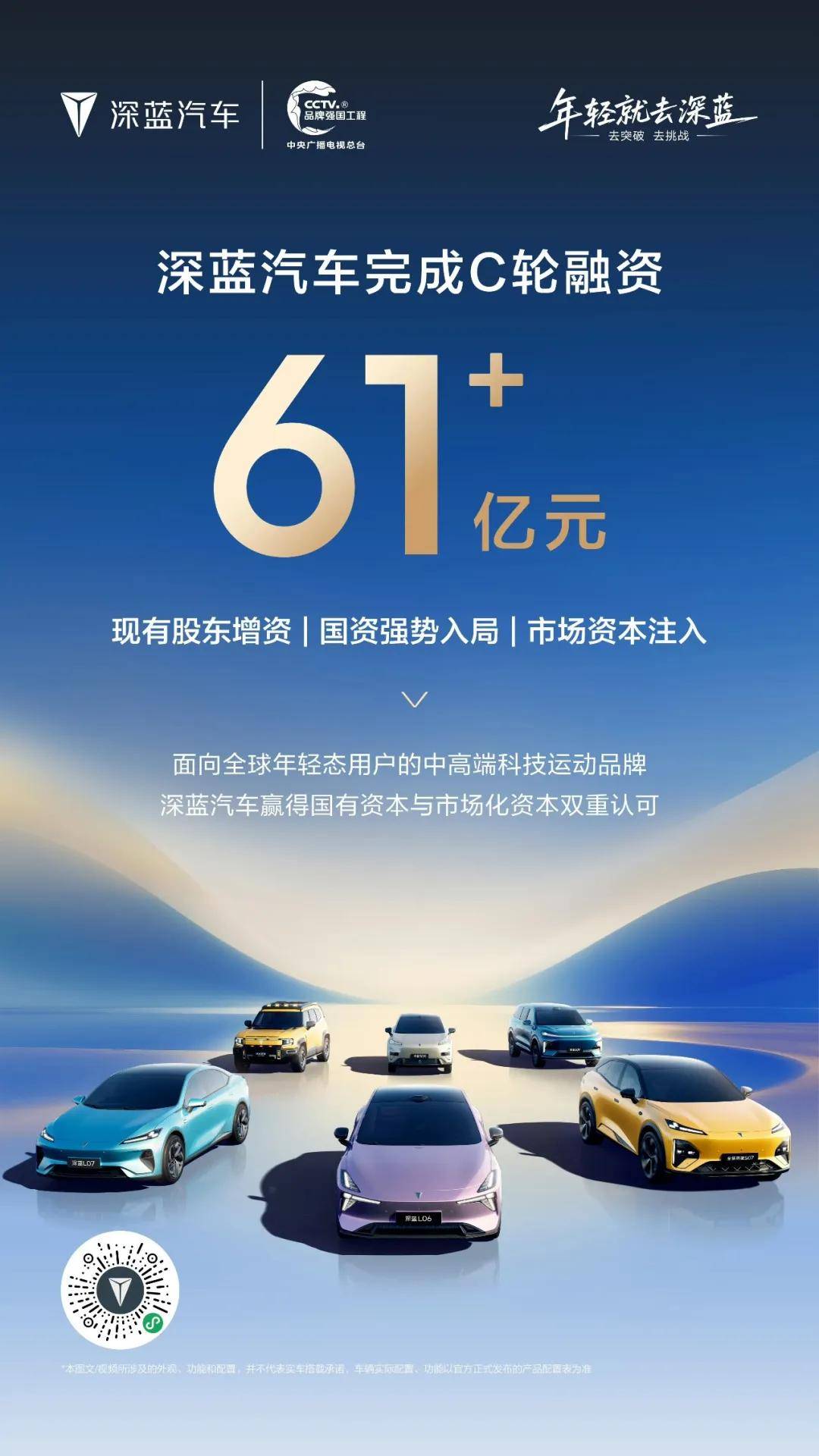
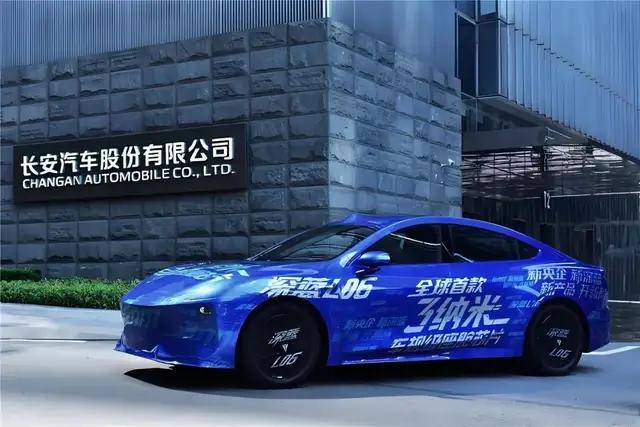
Group 1 - The core point of the article highlights that despite the significant financing of 6.122 billion yuan, Deep Blue Automotive is still facing severe financial challenges, including continuous losses and an inability to meet sales targets [2][5][12] - Deep Blue Automotive completed a Series C financing round with contributions from Changan Automobile, Chongqing Yufu Holdings, and China Merchants Bank Financial Asset Investment Co., totaling 6.122 billion yuan, which increased its registered capital from approximately 328 million yuan to 466 million yuan [3][12] - The financing structure includes 3.122 billion yuan from Changan Automobile, which consists of 2.079 billion yuan in cash and 1.043 billion yuan in intangible assets, while Chongqing Yufu and China Merchants contributed 2.5 billion yuan and 500 million yuan in cash, respectively [3][12] Group 2 - Financial data reveals that as of October 31, 2025, Deep Blue Automotive has total assets of 31.474 billion yuan and total liabilities of 35.986 billion yuan, indicating a negative net asset position for three consecutive years [5][12] - Since its independent operation in 2022, Deep Blue has accumulated losses of 8.899 billion yuan, with annual losses of 3.196 billion yuan in 2022, 3.107 billion yuan in 2023, and 1.571 billion yuan in 2024, alongside a loss of 1.025 billion yuan in the first ten months of 2025 [5][12] - Despite achieving a monthly sales volume of around 30,000 units, which is considered the breakeven point, Deep Blue has not managed to stop its financial bleeding, indicating deeper issues in cost structure, product pricing, and operational efficiency [5][12] Group 3 - Deep Blue Automotive has failed to meet its annual sales targets for three consecutive years, with a reported global sales volume of 33,060 units in November 2025, representing an 8.2% year-on-year decline [6][12] - The best-selling model, the Deep Blue S05, accounted for nearly half of the total sales in November, highlighting a reliance on lower-end models rather than the higher-end offerings [6][12] - The performance of higher-end models like the Deep Blue S09 and G318 has been disappointing, with monthly sales below 2,000 units and only a few hundred units, respectively [7][12] Group 4 - Deep Blue Automotive's brand trust has been severely impacted due to consumer dissatisfaction, particularly following an incident involving mandatory full-screen advertisements during vehicle startup [9][12] - The slowdown in sales growth and ongoing losses create a vicious cycle, making it difficult to dilute high R&D and manufacturing costs, while insufficient profits hinder ongoing technological innovation and market expansion [9][12] - The competitive landscape in the domestic new energy vehicle market has shifted from "incremental competition" to "stock competition," with leading brands like BYD and Geely exerting pressure on second-tier players like Deep Blue [9][12] Group 5 - The recent financing is seen as a "timely rain" for Deep Blue, especially following its achievement of obtaining L3-level autonomous driving licenses, marking a significant technological milestone [11][12] - However, the capital market's patience with new energy vehicle companies is waning, and while the financing is substantial, it remains uncertain how long it will sustain Deep Blue's operational needs [12] - The financing will primarily support high-level intelligent driving, electric platform development, and global expansion, but it does not directly address the company's negative financial status [12]

四大证券报精华摘要:12月26日
Zhong Guo Jin Rong Xin Xi Wang· 2025-12-26 00:24
Group 1 - The Ministry of Industry and Information Technology has officially announced the first batch of L3-level vehicle access permits, marking a significant step towards the commercialization of L3-level autonomous driving in pilot cities like Chongqing and Beijing [1] - L3-level "conditional autonomous driving" introduces a shift in driving responsibility from human to machine, raising concerns about system reliability, algorithm decision-making, and sensor performance [1] - The emergence of "intelligent driving insurance" products in the market is primarily a safety net for car manufacturers or intelligent driving solution providers, rather than genuine insurance products [1] Group 2 - Heng Rui Medicine announced that its SHR-A1904 injection has been included in the list of breakthrough therapeutic varieties by the National Medical Products Administration, highlighting its potential in the ADC drug development field [2] - The ADC drug market is expected to grow significantly, with Chinese companies emerging as global innovation engines in this sector [2] - The A-share market has shown a continuous upward trend, with the MSCI Emerging Markets Index increasing nearly 30% year-to-date, indicating a favorable investment environment for emerging markets [2] Group 3 - The People's Bank of China continues to release liquidity into the market through medium-term lending facilities (MLF), maintaining a "stable and loose" liquidity management approach [3] - In December, the central bank conducted a 400 billion yuan MLF operation, resulting in a net liquidity injection of 1,888 billion yuan, ensuring stable financial market operations at year-end [3] - The total net MLF injection for the year 2025 is projected to exceed 1 trillion yuan, supporting market liquidity [3] Group 4 - The Asian currency market is experiencing significant divergence, with the Japanese yen and South Korean won facing depreciation pressures, while the Chinese yuan shows a strong rebound [4] - Japan and South Korea are actively implementing measures to stabilize their currencies amid unprecedented depreciation pressures [4] - A new climate-related disclosure guideline has been introduced, focusing on governance, strategy, risk management, and metrics for corporate sustainability [4] Group 5 - The low-altitude economy is recognized as a promising future industry, with significant growth potential and increasing investment from capital markets [5] - The development of the low-altitude economy faces challenges such as business model exploration and infrastructure improvement, which need to be addressed for sustainable growth [6] - The IPO underwriting amount for securities firms in 2025 is expected to nearly double year-on-year, indicating a strong market for capital raising [6] Group 6 - A new platform for integrating and acquiring polysilicon production capacity in the photovoltaic industry has been established, aimed at addressing excessive competition [7] - The photovoltaic industry is facing challenges, including a projected decline in domestic demand and uncertainty regarding the impact of rising silicon material prices on downstream prices [7] - The cost increase of auxiliary materials is likely to delay the profitability of downstream battery and component sectors [7] Group 7 - The capital market has seen active financing, with a significant increase in funds raised through private placements, which has benefited securities firms [8] - The total amount raised through private placements by A-share listed companies has increased by over 375% year-on-year, providing more business opportunities for brokers [8] Group 8 - The People's Bank of China is focusing on maintaining capital market stability through various monetary policy tools, emphasizing the importance of supporting the market [9] - In 2025, 111 companies successfully listed on the A-share market, raising a total of 125.32 billion yuan, with a significant portion from strategic emerging industries [9] - Over 200 major asset restructuring announcements have been made in the A-share market, primarily in key sectors such as semiconductors and information technology [9]
长安汽车总裁赵非:技术务实锚定产业稳态 生态聚力激活资本估值
Zhong Guo Zheng Quan Bao· 2025-12-26 00:21
Core Insights - Zhao Fei's career reflects Changan Automobile's transformation from a traditional manufacturer to a technology company, leading the firm through the challenges of profitability in the new energy vehicle (NEV) sector [1] - Changan's NEV sales have exceeded 100,000 units for three consecutive months, with an annual target of one million units, showcasing the company's commitment to technological advancement and market adaptation [1][2] Group 1: Strategic Management and Organizational Restructuring - Zhao Fei's appointment is part of a systematic organizational restructuring during a critical strategic transition for Changan, with a complete personnel reshuffle across the group and its main brands [2] - The company aims for a stable progression in the NEV market, predicting a 7:3 ratio of NEVs to fuel vehicles in China within two to three years, while globally, fuel vehicles will still account for 70% by 2030 [2] - Changan emphasizes a rational approach to technology, focusing on steady growth rather than aggressive competition, with a commitment to internal capabilities [2] Group 2: Industry Challenges and Responses - Changan welcomes government efforts to address industry over-competition, having reduced supplier payment cycles to 53 days to build trust within the supply chain [3] - The company is committed to avoiding a "no profit" cycle in the industry, advocating for responsible pricing practices [3] - Changan invests 6% of its sales revenue in R&D annually, underscoring the importance of innovation in its transition to a technology-driven enterprise [3] Group 3: Technological Advancements and Safety - The company has achieved significant milestones in L3-level autonomous driving technology, becoming one of the first in China to utilize specialized licenses for such vehicles [3][4] - Zhao Fei identifies data as the critical factor for advancing from L3 to L4 autonomous driving capabilities, emphasizing the need for extensive data to enhance system performance [4] Group 4: Brand Strategy and Market Positioning - Changan's three NEV brands—Avita, Deep Blue, and Changan Origin—are strategically positioned to target different market segments, supported by a centralized management structure [5] - Avita has established a foothold in the high-end market, while Deep Blue has attracted younger consumers with innovative technology [5] Group 5: Capital Operations and Global Strategy - Capital operations are crucial for enhancing the competitiveness of Changan's sub-brands, with a focus on building capabilities rather than immediate profitability [6] - Changan aims for overseas sales to exceed 600,000 units by 2025, with a comprehensive strategy for global market penetration [6] - The company maintains a proactive stance on supply chain risks, particularly regarding battery and chip prices, and is recognized for its advancements in domestic chip applications [6] Group 6: Market Valuation and Operational Quality - Zhao Fei emphasizes that market valuation is a gradual process based on operational quality rather than speculative practices [7] - Changan's focus on practical R&D over marketing has helped it avoid pitfalls in the NEV transition, building a robust foundation of technological and brand strength [7] - The company's transformation is characterized by a systematic approach to value reconstruction, with a clear path for enhancing efficiency and expanding globally [7]

L3级自动驾驶迈向商业化阶段 浙江世宝股价走出强势行情
Zhong Guo Zheng Quan Bao· 2025-12-25 22:12
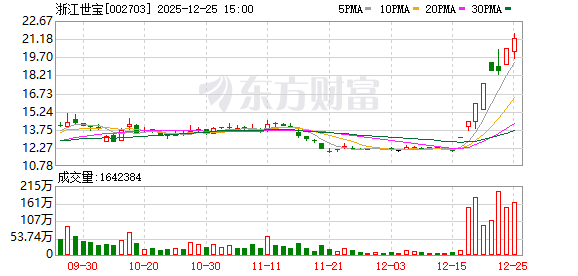
Core Viewpoint - The development of intelligent chassis technologies, such as fully active suspension and steer-by-wire systems, is becoming a key indicator of vehicle intelligence levels. Zhejiang Shibao is advancing its steer-by-wire technology, aiming for mass production by the second half of 2026, which aligns with the introduction of L3 autonomous driving standards [1][2]. Group 1: Company Performance - Zhejiang Shibao's stock price reacted positively to the news, achieving four consecutive trading limits from December 16, with a closing price of 21.22 yuan per share by December 25, marking five limit-up closures in eight trading days [1]. - In the 2024 annual report, Zhejiang Shibao reported a revenue of 2.693 billion yuan, representing a year-on-year growth of 48.04%, and a net profit attributable to shareholders of 149 million yuan, up 93.15% year-on-year. Revenue from steering systems and components accounted for 94.18% of total revenue [1][2]. Group 2: Industry Context - The automotive steering system industry has high entry barriers, requiring manufacturers to pass multiple standards and trials before becoming qualified suppliers for automakers. Zhejiang Shibao has established close relationships with major automakers, with its top five customers, including Chery, Geely, NIO, and Li Auto, contributing 1.778 billion yuan, or 66.01% of total sales [2]. - The recent favorable developments in L3 autonomous driving and the push for commercialization have attracted institutional funds to related concept stocks, leading to a strong market performance for Zhejiang Shibao, characterized by an "8 days 5 boards" trend [3]. Group 3: Challenges - Despite its focus on vertical integration within its main business, Zhejiang Shibao faces challenges such as high accounts receivable, which stood at 1.181 billion yuan as of September 30 [4].

技术务实锚定产业稳态 生态聚力激活资本估值
Zhong Guo Zheng Quan Bao· 2025-12-25 21:11
Core Insights - Zhao Fei's appointment as president of Changan Automobile symbolizes the company's transformation from a traditional manufacturer to a technology-driven enterprise, particularly in the context of navigating the profitability challenges in the new energy vehicle (NEV) sector [1][2] - Changan's NEV sales have exceeded 100,000 units for three consecutive months, with a target of reaching one million units annually, reflecting a commitment to steady growth rather than aggressive competition [2][3] Group 1: Strategic Direction - The company aims to leverage its ecological advantages and utilize capital effectively, moving beyond traditional hard work to smarter operations [1][3] - Zhao Fei emphasizes a balanced approach to market trends, predicting a 7:3 ratio of NEVs to fuel vehicles in China within two to three years, while globally, fuel vehicles will still account for 70% by 2030 [2][3] - Changan has undergone a comprehensive organizational restructuring to support its strategic transformation, with a focus on R&D, responsibility, and data integrity [1][3] Group 2: R&D and Innovation - Changan invests 6% of its sales revenue in R&D, underscoring the importance of technological advancement in its transition to a tech company [3][4] - The company has achieved a significant milestone by becoming one of the first in China to utilize L3-level autonomous driving technology, highlighting its commitment to safety and innovation [3][4] - Zhao Fei believes that the transition from L3 to L4 technology will hinge on data accumulation, which Changan is well-positioned to achieve through its global R&D network [4] Group 3: Market Positioning and Capital Strategy - Changan's three NEV brands—Avita, Deep Blue, and Changan Origin—are strategically positioned to capture different market segments, supported by a centralized management structure to minimize internal competition [4][5] - The company views capital operations as essential for enhancing the competitiveness of its sub-brands, with Deep Blue expected to achieve profitability next year [5][6] - Changan is proactive in managing supply chain risks, particularly regarding battery and chip prices, and is recognized as a leader in the application of domestic chips [5][6] Group 4: Global Expansion and Valuation - Changan aims to achieve overseas sales of 600,000 units by 2025, with plans to enhance efficiency and effectiveness in its global operations [5][6] - The company is focused on building a strong valuation through quality operations rather than speculative market activities, aligning with its engineering and entrepreneurial culture [6] - The transformation of Changan is characterized by a systematic approach to value reconstruction, moving from scale competition to value competition in the automotive industry [6]
浙江世宝股价走出强势行情
Zhong Guo Zheng Quan Bao· 2025-12-25 21:11
Group 1 - The core viewpoint of the articles highlights the increasing interest from institutional investors in Zhejiang Shibao due to the favorable developments in L3-level autonomous driving and the company's strong stock performance, achieving "5 limit-up in 8 days" [1] - Zhejiang Shibao's stock price has shown a rapid response, with a continuous rise leading to a closing price of 21.22 yuan per share by December 25, following five limit-up closures in eight trading days [2] - The company reported a revenue of 2.693 billion yuan for 2024, marking a year-on-year growth of 48.04%, and a net profit of 149 million yuan, which is a 93.15% increase year-on-year [2] Group 2 - Zhejiang Shibao specializes in the research, manufacturing, and sales of automotive steering systems and components, with a significant portion of its revenue (94.18%) coming from this sector in 2024 [2] - The automotive steering system industry has high entry barriers, requiring manufacturers to pass multiple standards and trials before becoming qualified suppliers for automakers [2] - The company maintains close relationships with major automotive manufacturers, with its top five clients, including Chery, Geely, NIO, and Li Auto, accounting for 66.01% of total sales [2] - As of September 30, Zhejiang Shibao faced challenges with high accounts receivable, totaling 1.181 billion yuan [3]
L3级自动驾驶迈向商业化阶段 浙江世宝股价 走出强势行情
Zhong Guo Zheng Quan Bao· 2025-12-25 21:09
Core Viewpoint - The rapid development and commercialization of L3-level autonomous driving technology have attracted institutional investment towards related concept stocks, particularly Zhejiang Shibao, which has experienced a strong market performance with "5 limit-up in 8 days" [1]. Group 1: Company Performance - Zhejiang Shibao's stock price has shown a significant increase, with four consecutive limit-up days starting from December 16, reaching a closing price of 21.22 yuan per share by December 25 [2]. - In the 2024 annual report, Zhejiang Shibao reported a revenue of 2.693 billion yuan, representing a year-on-year growth of 48.04%, and a net profit attributable to shareholders of 149 million yuan, up 93.15% year-on-year [2]. - The revenue from steering systems and components accounted for 94.18% of the total revenue in 2024, indicating a strong focus on this segment [2]. Group 2: Industry Context - The automotive steering system industry has a relatively high entry barrier, requiring manufacturers to pass multiple standards and trials before becoming qualified suppliers for automakers [2]. - Zhejiang Shibao maintains close relationships with major automakers, with its top five customers, including Chery, Geely, NIO, and Li Auto, contributing a total sales amount of 1.778 billion yuan, which accounts for 66.01% of total sales [2]. - The company is actively advancing its development of steer-by-wire technology, with plans to achieve mass production conditions by the second half of 2026, aligning with the push for higher-level autonomous driving [1]. Group 3: Financial Challenges - Despite its strong performance, Zhejiang Shibao faces challenges such as high accounts receivable, which amounted to 1.181 billion yuan as of September 30 [3].
今日新闻丨智己实现盈利!丰田11月全球销量、中国销量双双下滑!
电动车公社· 2025-12-25 16:05
Core Viewpoint - The article highlights the significant achievements of Zhiji Auto in its fifth anniversary, including its first month of profitability and plans for future technological advancements and market expansion [3][5][9]. Group 1: Zhiji Auto Achievements - Zhiji Auto announced its first full-cost profitability in December, marking a milestone in its financial performance [3][4]. - The company plans to accelerate the mass production of its steer-by-wire chassis and promote the large-scale application of L3 autonomous driving in the coming year [3][8]. - The launch of the new generation Zhiji LS6 has positioned it as a top seller in the mid-to-large new energy SUV segment, reflecting strong market acceptance [5][6]. Group 2: Future Plans and Market Strategy - For 2026, Zhiji Auto aims to continue its focus on "brand elevation + technological breakthroughs," with plans to enhance its product matrix and expand its overseas market presence [8][9]. - The company has successfully entered Southeast Asia, Europe, and Australia, with overseas orders exceeding expectations, indicating a robust global market strategy [6][8]. Group 3: Toyota's Sales Decline - Toyota's global sales in November fell to 900,011 units, a 2% year-on-year decrease, marking the first decline in 11 months [10][11]. - In China, Toyota's sales dropped by 12% to 154,645 units in November, highlighting challenges in maintaining growth in a competitive market [11]. - The decline in sales, particularly in electrified models, underscores the importance of technological advancement and smart connectivity in the evolving automotive industry [11].


顶着首个L3牌照光环,深蓝汽车增资,渝富招银投资新进,长安汽车把S05、G318车型专利技术评估10.43亿元来入股
Xin Lang Cai Jing· 2025-12-25 12:40
Core Viewpoint - Deep Blue Automotive has completed a capital increase, attracting two external investors, despite holding the first L3 autonomous driving license in China, indicating cautious market sentiment towards investment in the electric vehicle sector [2][11][12]. Group 1: Capital Increase Details - The capital increase involves three parties: Changan Automobile, Chongqing Yufu Holding Group, and China Merchants Bank Financial Asset Investment Co., with contributions of 3.122 billion, 2.5 billion, and 500 million respectively [2][25]. - After the capital increase, Changan Automobile retains a controlling stake of 50.9959%, while the stakes of other original shareholders are diluted to the range of 5%-8% [2][25]. - The total registered capital of Deep Blue Automotive increased from approximately 32.81 billion to 46.62 billion [26]. Group 2: Investment Context - Chongqing Yufu Holding Group, as a local state-owned platform, is likely focused on industrial synergy, while China Merchants Bank's investment may provide financial support, indicating a non-purely financial investment role [10][33]. - The cautious entry of only two investors reflects the intensified competition in the electric vehicle market, alongside subsidy reductions and price wars [11][35]. Group 3: Valuation and Financial Implications - Deep Blue Automotive's valuation is set at 14.55 billion, with the capital increase providing over 5 billion in cash reserves to support ongoing technology investments [14][40]. - The funding is expected to be directed towards the research and development of intelligent driving technology and capacity expansion, crucial for commercializing L3-level vehicles [18][41]. - Changan Automobile's investment strategy includes both cash and technology patents valued at 1.043 billion, ensuring continued R&D progress without burdening the parent company's financials [4][42]. Group 4: Market Position and Future Outlook - The successful acquisition of the L3 license and partnerships with Huawei and CATL provide Deep Blue Automotive with a competitive edge, but long-term success will depend on the speed of technology implementation and market acceptance [10][43]. - The electric vehicle sector's competitive landscape is becoming increasingly challenging, necessitating rapid production scaling for Deep Blue Automotive to keep pace with rivals like Tesla and BYD [18][41][44].
25年车圈最后一笔融资到位,深蓝汽新年开启新征程
Sou Hu Cai Jing· 2025-12-25 12:34
Core Viewpoint - Deep Blue Automotive has successfully completed a significant financing round of 6.122 billion yuan, marking it as the last major financing in the automotive sector for 2025, which is expected to catalyze a leap in brand, product, technology, and marketing dimensions in 2026 [1] Financing Details - The financing round included contributions from Chongqing Yufu Holding Group Co., Ltd. (2.5 billion yuan), Chongqing Changan Automobile Co., Ltd. (3.122 billion yuan), and Zhuhai Financial Asset Investment Co., Ltd. (500 million yuan), totaling 6.122 billion yuan [5] Shareholding Structure - Post-financing, Chongqing Changan Automobile Co., Ltd. remains the largest shareholder with a 50.9959% stake, while Chongqing Yufu Holding Group Co., Ltd. holds 12.0937% and Zhuhai Financial Asset Investment Co., Ltd. holds 2.4187%, indicating strong confidence from new investors [7] Strategic Advantages - Deep Blue Automotive benefits from its unique state-owned enterprise brand value, which enhances investor confidence and provides a solid foundation for financing [7] - As a mid-to-high-end brand under Changan Automobile, Deep Blue aligns with national strategies for technological self-reliance and automotive strength, with financing aimed at core technology advancements in smart and electric vehicles [7] Market Performance - By December 18, 2025, Deep Blue Automotive achieved cumulative deliveries of 700,000 vehicles and has established a presence in nearly 100 countries, with significant sales of its models, including over 300,000 units of the Deep Blue S07 and consistent monthly sales of over 10,000 units for the Deep Blue S05 [7][8] Technological Innovation - The financing will primarily support innovations in smart and electric vehicle technologies, including advancements in L3-level autonomous driving, laser radar algorithms, and the development of a complete technology ecosystem from chips to systems [12][15] - Deep Blue has been a leader in product development, exemplified by its collaboration with Jingxi Group on a magnetorheological suspension system, making the L06 the first Chinese brand model to adopt this technology [14] Future Growth Potential - The company's international success, particularly in Europe and Southeast Asia, is viewed as a key growth driver, enhancing its global brand strength and providing a clear path for future financing [8] - The upcoming changes in the automotive industry, particularly in smart driving and battery technology, are expected to widen the gap between manufacturers, with Deep Blue poised to leverage its technological advancements to gain a competitive edge [15][16] Conclusion - The successful financing not only strengthens Deep Blue's capabilities but also serves as a strategic boost against competitors, positioning the company for a new phase of high-quality development in 2026, with a target of achieving one million vehicle sales [16]