
新能源

Search documents
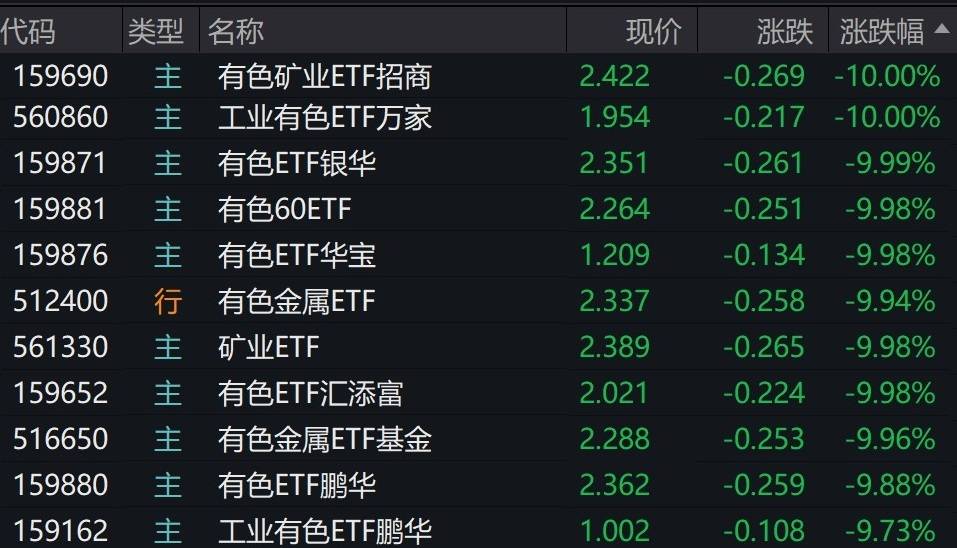
有色金属概念股走低,多只有色相关ETF跌停
Sou Hu Cai Jing· 2026-01-30 02:36
Group 1 - The core viewpoint of the news is that non-ferrous metal stocks have declined significantly, with companies like Luoyang Molybdenum, Huayou Cobalt, China Aluminum, Shandong Gold, Yun Aluminum, and Zhongjin Gold hitting their daily limit down [1] - Affected by the market trend, many non-ferrous related ETFs also experienced limit down [1] Group 2 - Recent reports indicate that not only precious metals like gold and silver have seen significant increases, but industrial metals such as copper and aluminum, as well as energy metals like cobalt and lithium, have also performed well, with multiple metals reaching historical or phase highs [2] - The reasons for the super cycle in non-ferrous metals are primarily threefold: first, the Federal Reserve's interest rate cut cycle has led to a weakening dollar, which supports the rise in non-ferrous metal prices denominated in dollars; second, there is a supply-demand gap, with industrial metals like copper facing supply pressures due to declining ore grades, rising marginal costs, and previous reductions in mining capital expenditures, while demand is driven by AI, new energy, and infrastructure construction; third, domestic "anti-involution" policies are optimizing excess capacity, which helps promote supply-demand balance [2]

ETF盘中资讯|有色ETF跌超9%,获资金实时净申购1.42亿份!资金为何逆行加仓,越跌越买?
Sou Hu Cai Jing· 2026-01-30 02:31
Core Viewpoint - The article discusses the recent volatility in the global risk asset market, particularly focusing on the surge in demand for precious metals and the performance of the Huabao ETF amid geopolitical tensions and macroeconomic factors [1][3]. Group 1: Market Dynamics - Geopolitical risks have led to a significant drop in global risk assets, prompting some investors to take profits, which has resulted in a sharp decline in gold and silver prices [1]. - Despite the market downturn, the Huabao ETF saw a net subscription of 142 million units, indicating a counter-trend investment in the non-ferrous metals sector [1]. - The demand for non-ferrous metals is supported by macroeconomic factors such as the Federal Reserve's ongoing easing policies, rising geopolitical uncertainties, and concerns over the sustainability of U.S. debt and deficits [3]. Group 2: Industry Outlook - The non-ferrous metals sector is expected to maintain a high profitability state for an extended period, driven by new demand from emerging industries such as renewable energy, AI, and aerospace [4]. - Domestic non-ferrous metal companies are valued lower compared to their international counterparts, despite having similar growth potential and core competitiveness [4]. - The industry is experiencing a significant output gap due to a long-term contraction in capital expenditures since 2011, which continues to support prices and highlight the strategic value of these metals [3]. Group 3: Performance Indicators - As of January 28, 2025, 24 out of 60 listed companies covered by the non-ferrous ETF have released earnings forecasts, with 21 companies expected to be profitable, indicating a positive outlook for the sector [3]. - The Huabao ETF covers a wide range of metals, including copper, aluminum, gold, rare earths, and lithium, allowing investors to capture the overall sector's performance effectively [5].
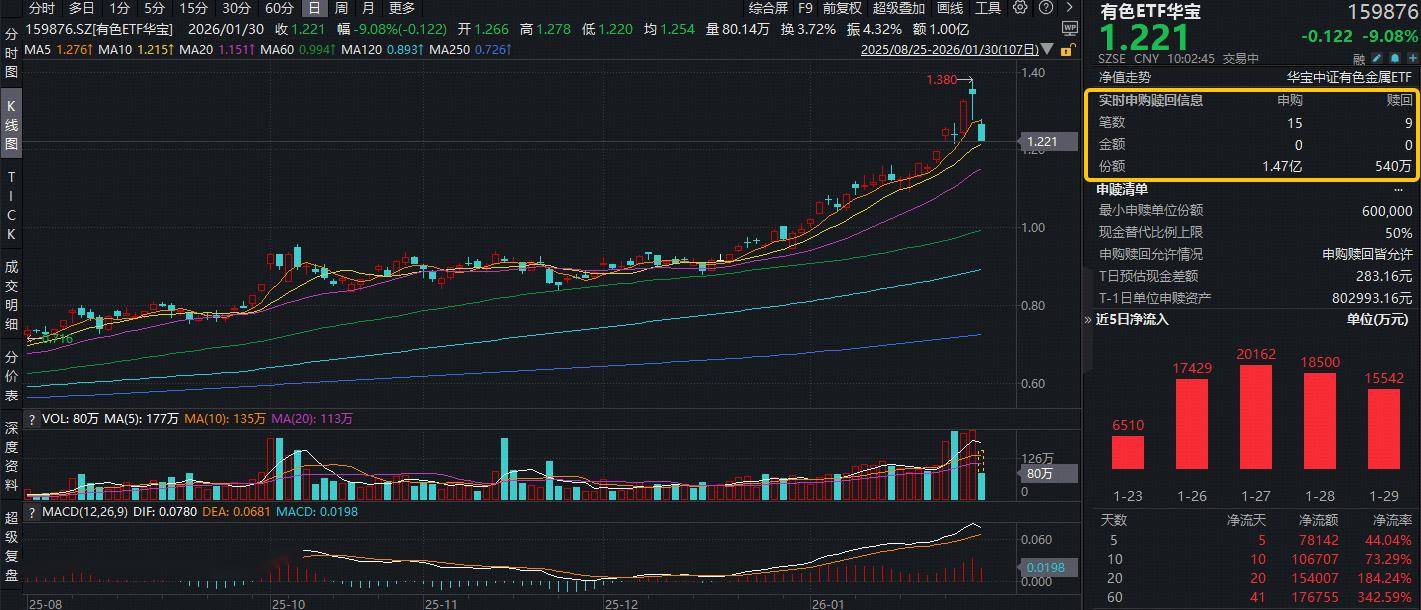
有色ETF跌超9%,获资金实时净申购1.42亿份!资金为何逆行加仓,越跌越买?
Xin Lang Cai Jing· 2026-01-30 02:15
Core Viewpoint - The recent geopolitical risks have led to a significant drop in global risk assets, yet there is a notable increase in investment in the non-ferrous metals sector, particularly in the Huabao ETF, which saw a net subscription of 142 million units despite a market downturn [1][9]. Group 1: Macro Factors - The Federal Reserve is still in a rate-cutting cycle, creating a loose monetary environment [3][11]. - Rising geopolitical uncertainties are increasing demand for safe-haven assets [3][11]. - Concerns over the sustainability of U.S. debt and deficits are prompting central banks worldwide to reduce U.S. Treasury holdings and increase gold reserves, leading to a diversification of reserve systems [3][11]. Group 2: Industry Dynamics - Emerging industries such as renewable energy, AI, and aerospace are continuously driving demand for non-ferrous metals [3][11]. - Capital expenditures for major non-ferrous metal types peaked in 2011 and have since entered a prolonged contraction phase, resulting in a significant output gap in the industry [3][11]. - Supply constraints persist, providing price support and highlighting the strategic value and scarcity of these metals [3][11]. Group 3: Performance Outlook - As of January 28, among the 60 listed companies covered by the non-ferrous ETF, 24 have released earnings forecasts for 2025, with 21 expected to be profitable, indicating a positive outlook for nearly 90% of the companies [3][11]. - The high profitability of the non-ferrous metals sector is expected to continue for an extended period, with the sector gradually gaining growth attributes and deserving of a value reassessment [4][12]. - Domestic non-ferrous metal companies are valued lower compared to their overseas counterparts, despite having comparable growth potential and core competitiveness [4][12]. Group 4: Investment Strategy - The Huabao ETF and its linked funds cover a wide range of non-ferrous metals, including copper, aluminum, gold, rare earths, and lithium, allowing investors to capture the entire sector's beta performance [5][13]. - It is recommended to allocate 10%-20% of investment portfolios to the non-ferrous metals sector to benefit from price increases while diversifying risk [4][12].
“超级陀螺”在鄂加速
Chang Jiang Ri Bao· 2026-01-30 00:59
Core Viewpoint - The article highlights the development of China's largest pure flywheel energy storage power station in Hubei, which aims to enhance grid stability and support the integration of renewable energy sources [1][4]. Group 1: Project Overview - The flywheel energy storage project, located in Jingzhou, has a total capacity of 100 megawatts, with the first phase currently under construction at 40 megawatts and a total investment exceeding 700 million yuan [1][4]. - The project has been selected as a pilot demonstration project by the National Energy Administration, showcasing its significance in the national energy landscape [1][4]. Group 2: Technology and Innovation - The flywheel system operates using magnetic levitation technology, allowing a 30-ton flywheel to spin in a near-vacuum environment, achieving high efficiency and a design lifespan of up to 20 years [2][3]. - The flywheel energy storage provides millisecond-level response times to fluctuations in grid frequency, significantly improving the precision of frequency regulation compared to traditional thermal power methods [2][3]. Group 3: Environmental Impact - The flywheel energy storage system is a zero-carbon solution, contributing to the optimization of Hubei's energy structure and supporting the transition to cleaner energy sources [3][4]. Group 4: Strategic Development - The project underwent a significant redesign after the company took over, shifting from a smaller capacity to a larger, more efficient system that meets the urgent needs for secondary frequency regulation [5][6]. - The project is expected to enhance the flexibility and stability of the regional grid, facilitating the integration of renewable energy and providing a model for future energy storage innovations [6][7]. Group 5: Virtual Power Plant Initiative - The company is also developing a virtual power plant project, which aims to aggregate various energy resources within buildings and districts, optimizing energy management and potentially generating revenue through market participation [6][7]. - This initiative includes plans to implement demand-side management strategies that can significantly reduce overall energy costs for users while maintaining comfort and productivity [7].
中信证券:复盘新能源汽车 掘金人形机器人
智通财经网· 2026-01-30 00:49
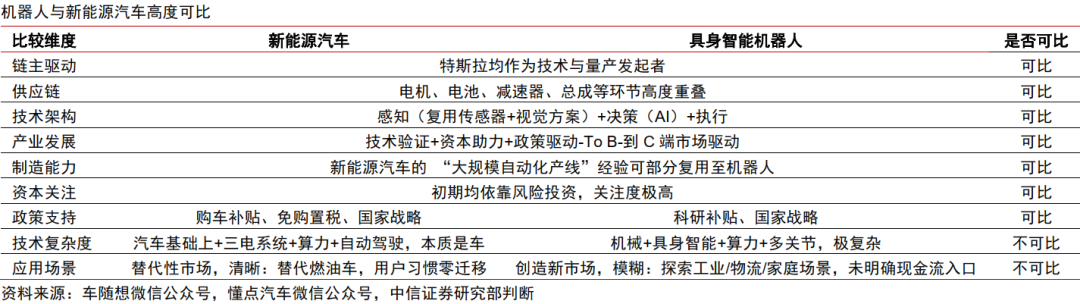
Core Viewpoint - The humanoid robot industry is currently in a technology validation phase, but the timeline for commercialization is expected to be shorter than that of the electric vehicle industry. The focus should be on segments with high value, clear structure, and high certainty, as these will have the greatest performance elasticity [1][22]. Industry Comparison - The humanoid robot industry is highly comparable to the electric vehicle industry, both being global strategic industries initiated by Tesla. They follow similar development patterns driven by technology validation, capital support, and policy incentives, although the complexity and fragmentation of robot intelligence present unique challenges [2][3]. Key Segments - High-value and high-barrier segments in the humanoid robot industry include platform companies (integrating hardware and software), high-performance SOC chips (driving the brain side), dexterous hands (integrated hardware and software small robots), actuators, and precision sensors [1][19][22]. Investment Strategy - The investment strategy should focus on identifying leading companies in the humanoid robot sector that have high non-standard, technical, cost, and production expansion barriers, as these companies are likely to navigate through industry cycles successfully [1][22]. Market Dynamics - The humanoid robot industry is expected to experience a more stable performance trajectory compared to the electric vehicle industry, which has faced significant volatility due to cyclical material performance. The industry is still in its early stages, with no dominant players yet emerging like CATL in the lithium battery sector [19][22]. Policy and Capital Support - Policy and capital support are crucial for the development of both the electric vehicle and humanoid robot industries. The approach for robots should follow a "plan first, market later" strategy, similar to the early days of electric vehicles [5][6].

润禾材料(300727)首次覆盖报告:领跑有机硅细分领域 加码高端材料布局
Xin Lang Cai Jing· 2026-01-30 00:34
Core Viewpoint - The company focuses on the differentiated competition in the silicone sector, consolidating its leading position through innovative, high-value-added products with strong import substitution advantages [1] - The company has received multiple honors, including "Leading Enterprise in China's Fluorosilicon Industry" and "Top 20 Global Silicone Enterprises in 2024" [1] - The company achieved a year-on-year increase of approximately 36.34% in net profit attributable to shareholders in the first three quarters of 2025, indicating potential for further profitability enhancement [1] Industry Demand - The demand for silicone materials is expected to grow, driven by emerging applications in new materials and new energy sectors [1] - The apparent consumption of domestic silicone DMC is projected to increase from 1.35 million tons in 2022 to 1.82 million tons in 2024, with a CAGR of approximately 16% [1] Growth Strategy - The company has a leading capacity in specialty silicone oils, with a designed production capacity of 98,000 tons for silicone deep processing and application products by 2024 [2] - The company is expanding its scale advantage through convertible bond fundraising projects and the establishment of high-end silicone new material projects in Zhuhai [2] - The company is also focusing on new strategic products like "coolants," which are expected to open up long-term growth opportunities [2] Profit Forecast and Investment Recommendation - The company is expected to see its net profit attributable to shareholders reach 139 million yuan, 182 million yuan, and 239 million yuan for the years 2025 to 2027, respectively [3] - Corresponding PE ratios are projected to be 48x, 37x, and 28x based on the closing price on January 26 [3] - The initial coverage recommends a "buy" rating for the company [3]
维远股份:化工新材料、新能源双产业链独特优势,聚碳酸酯需求持续增长-20260130
环球富盛理财· 2026-01-30 00:25
Investment Rating - The report assigns a "Buy" rating to the company, indicating a favorable outlook for its performance relative to the market [8]. Core Insights - The company is enhancing its industrial system through initiatives such as "casting chains, extending chains, supplementing chains, and strengthening chains," which aims to create a comprehensive industrial chain in chemical new materials and new energy [1]. - The demand for polycarbonate (PC) is expected to continue growing, driven by applications in various industries including home appliances, automotive, and high-tech fields such as rail transportation and aerospace [4]. - The company is positioned as a leader in the domestic market with a complete industrial chain from pure benzene to polycarbonate, which enhances its competitive edge [4]. Summary by Relevant Sections Latest Developments - The company is developing a new energy industrial chain that includes a 600,000 tons/year propane dehydrogenation and a 300,000 tons/year direct oxidation epoxy propane facility, integrating with existing production lines [1]. - The completion of projects such as a 250,000 tons/year electrolyte solvent and a 200,000 tons/year high-performance polypropylene is expected to enhance production capabilities [1]. Product Focus - The company specializes in chemical new materials and new energy, with products spanning phenolic ketone, new energy materials, specialty chemicals, and industrial gases [4]. - The polycarbonate industry chain is experiencing sustained demand growth, with the company producing differentiated products that meet or exceed international standards [4]. Market Trends - The consumption of bisphenol A (BPA) is projected to grow, with a compound annual growth rate (CAGR) of 16.59% over the next five years, driven by the expansion of downstream industries [4]. - The expected year-on-year growth for BPA consumption in 2024 is approximately 19.14%, indicating robust market dynamics [4].

赛道型产品走上C位 双刃剑效应不容忽视
Zhong Guo Zheng Quan Bao· 2026-01-29 22:25
Group 1 - The core viewpoint of the articles highlights the surge in popularity of sector-focused funds, driven by new investment opportunities in industries like artificial intelligence, semiconductors, and non-ferrous metals, while also cautioning about the inherent risks associated with such concentrated investments [1][5][8] - Sector-focused funds have seen significant inflows, with many funds experiencing growth despite overall market conditions, particularly in high-demand sectors such as semiconductors, high-end equipment, and renewable energy [2][3] - The performance of sector ETFs has been notably strong, with many funds in specific sectors like non-ferrous metals and gold seeing net inflows exceeding 100 billion yuan, indicating a clear preference among investors for targeted investments over broader market options [3][4] Group 2 - There is a marked increase in the enthusiasm of fund companies to launch sector-focused products, with over half of the newly launched equity funds in early 2026 being sector-specific, particularly in technology, non-ferrous metals, and healthcare [4][5] - The current macroeconomic environment, characterized by rapid technological advancements and supportive policies, has created a favorable backdrop for sector-focused investments, particularly in high-tech and renewable sectors [5][6] - Investors are increasingly drawn to sector-focused funds due to their ability to simplify investment choices and diversify risks, aligning with personalized investment strategies that cater to specific market views [6][7]
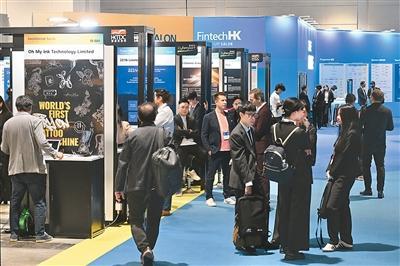
赋能产业发展 发挥独特优势
Ren Min Ri Bao· 2026-01-29 21:00
Core Insights - The 19th Asian Financial Forum in Hong Kong attracted over 4,000 global financial and business leaders from more than 60 countries, focusing on collaboration and new opportunities amid changing circumstances [2] - Hong Kong's unique advantages under "One Country, Two Systems" position it as a preferred location for global businesses, with plans to enhance its role as an international financial center by developing stock and bond markets, wealth management, and commodity trading [2][3] Group 1: Financial Market Development - Hong Kong aims to strengthen its financial center status by enhancing its stock, bond, and wealth management sectors, while also establishing an international gold trading market and a commodity trading ecosystem [3] - The city ranks third globally and first in Asia in the Global Financial Centers Index, and has improved its position in the World Competitiveness Yearbook, reflecting its recognized advantages [3] Group 2: Innovation and Technology - Emerging technologies such as AI, robotics, biotechnology, and renewable energy are seen as key drivers for future economic growth, with Hong Kong positioned to facilitate public-private dialogue and cross-sector collaboration [4] - The government is focusing on developing AI, data science, and biotechnology, supported by the establishment of the Hong Kong Investment Management Company to provide patient capital for businesses [6] Group 3: International Cooperation - A cooperation agreement was signed between the Hong Kong government and the Shanghai Gold Exchange to deepen collaboration in the gold market, including the establishment of a central clearing system [7] - The People's Bank of China supports the development of Hong Kong's offshore RMB market and aims to enhance financial market connectivity, contributing to Hong Kong's goal of becoming an international gold trading center [7]
上海正沧新能源科技有限公司成立,注册资本2000万人民币
Sou Hu Cai Jing· 2026-01-29 18:23
天眼查显示,近日,上海正沧新能源科技有限公司成立,法定代表人为胡继玉,注册资本2000万人民 币,由江苏正沧航运科技有限公司全资持股。 经营范围含新兴能源技术研发;无船承运业务;船舶港口服务;软件开发;互联网数据服务。(除依法 须经批准的项目外,凭营业执照依法自主开展经营活动)许可项目:公共铁路运输;道路货物运输(不 含危险货物);道路货物运输(网络货运);第二类增值电信业务;水路普通货物运输。(依法须经批 准的项目,经相关部门批准后方可开展经营活动,具体经营项目以相关部门批准文件或许可证件为准) 自主展示(特色)项目:技术服务、技术开发、技术咨询、技术交流、技术转让、技术推广;船舶设 计;船舶租赁;船舶销售;电机及其控制系统研发;储能技术服务;节能管理服务;碳减排、碳转化、 碳捕捉、碳封存技术研发;国内货物运输代理;信息系统集成服务;计算机系统服务;信息技术咨询服 务;网络与信息安全软件开发;新材料技术研发;信息系统运行维护服务;数据处理和存储支持服务; 咨询策划服务;供应链管理服务;互联网安全服务;物联网技术服务;物联网应用服务;大数据服务; 数据处理服务;价格鉴证评估;人工智能公共数据平台;数字技术服务 ...