
战略性新兴产业

Search documents
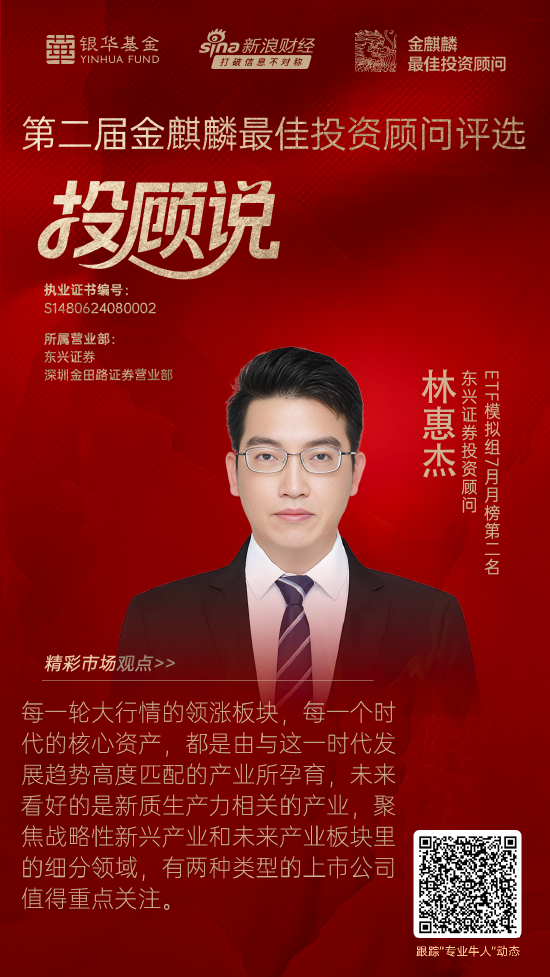
【金麒麟优秀投顾访谈】东兴证券投顾林惠杰:每一个时代核心资产都是与这一时代发展趋势高度匹配产业所孕育
Xin Lang Zheng Quan· 2025-08-18 06:04
Group 1 - The core viewpoint of the articles highlights the recognition of Lin Huijie from Dongxing Securities for achieving the second place in the ETF simulation portfolio ranking for July, with a monthly return rate of 17.97% [1][2] - The investment advisory industry in China is experiencing a high growth cycle, driven by an increase in residents' financial management awareness, which is influencing asset allocation trends [1][2] - The "Golden Unicorn Best Investment Advisor Selection" event aims to provide a platform for investment advisors to showcase their capabilities and enhance communication with investors, thereby promoting the healthy development of the wealth management industry in China [1][2] Group 2 - Lin Huijie expressed that the current market is driven by financing funds and event-driven factors, leading to a bullish sentiment, while cautioning about potential short-term corrections in popular sectors due to overheated trading emotions [2] - The focus for future investments is on industries related to new productive forces, particularly in strategic emerging industries and future sectors, with a specific emphasis on companies in semiconductor, artificial intelligence, robotics, low-altitude economy, and stablecoins [2] - Dongxing Securities is enhancing its investment advisory services by focusing on team building, product quality, and customer experience, leveraging AI applications to improve client interactions and educational initiatives [3]


20cm速递|创业板50ETF国泰(159375)涨超3.3%,成长风格占优或延续
Mei Ri Jing Ji Xin Wen· 2025-08-18 04:44
Group 1 - The core viewpoint is that the ChiNext 50 index is currently undervalued, with a valuation below the historical 30th percentile, and has shown strong performance with a Q3 increase of 17.71% [1] - The ChiNext index has a price-to-earnings ratio of 33.89 times, significantly lower than the Shanghai 50 index at the 83rd percentile, indicating a favorable earnings growth compared to the overall A-share market [1] - The index is expected to represent new economic directions in the medium to long term, particularly in technology sectors such as AI and innovative pharmaceuticals, following cyclical turning points [1] Group 2 - The ChiNext 50 ETF, managed by Guotai, tracks the ChiNext 50 index, which consists of 50 high-tech companies with large market capitalization and good liquidity, primarily in innovative fields [1] - The ChiNext 50 index focuses on technological innovation and strategic emerging industries, reflecting the characteristics of companies with core technologies and continuous innovation capabilities [1] - Investors without stock accounts can consider the Guotai ChiNext 50 ETF linked funds, which provide access to the index [1]

江苏省战新基金集群已投项目达93个
Zheng Quan Shi Bao Wang· 2025-08-18 04:13
Group 1 - The Jiangsu Provincial Strategic Emerging Industry Fund has established 41 industry-specific funds with a total scale of 106.9 billion yuan since its launch on June 21 last year, covering 13 municipalities, 6 provincial enterprises, and 1 central enterprise [1] - The fund cluster has invested in 93 projects, with notable IPO successes from companies like InnoCare and Zhengli New Energy [1] - The fund operates under a three-tier structure: provincial mother fund, industry-specific funds, and industry sub-funds, effectively supporting the development of strategic emerging industries and future industries [1] Group 2 - The revised management measures for the Jiangsu Provincial Strategic Emerging Industry Mother Fund have introduced pilot units in Nanjing Jiangbei New District, Suzhou Industrial Park, and the Provincial Research Institute, aiming to attract national funds and large state-owned financial asset investment companies [2] - Suzhou Industrial Park emphasizes the importance of strategic emerging industries in developing new productivity and seeks to expand investment cooperation with the Jiangsu Provincial Strategic Emerging Industry Mother Fund [2]
1-7月北京汽车出口交货值增长33%
Bei Jing Shang Bao· 2025-08-18 03:36
Economic Overview - In the first seven months of 2023, Beijing's industrial added value above designated size grew by 6.1% year-on-year in comparable prices [1] - The export delivery value of industrial enterprises above designated size reached 119.59 billion yuan, an increase of 4.6% [1] Key Industries Performance - The computer, communication, and other electronic equipment manufacturing industry saw a significant growth of 24.2% [1] - The automotive manufacturing industry grew by 11.5% [1] - The electricity and heat production and supply industry increased by 4.7% [1] - The pharmaceutical manufacturing industry experienced a decline of 9.3% [1] - The five major equipment manufacturing industries collectively grew by 9.5% [1] High-tech and Strategic Emerging Industries - The added value of strategic emerging industries and high-tech manufacturing increased by 17.2% and 9.5% respectively [1] - Notable growth in production for high-end or emerging products included lithium batteries (increased by 2.6 times), new energy vehicles (1.5 times), wind turbine units (38.6%), and integrated circuits (17.8%) [1]
产业变革中的商协会力量:把脉经济晴雨表,谋划突围新路径
2 1 Shi Ji Jing Ji Bao Dao· 2025-08-16 12:56
Core Insights - The role of industry associations in providing insights into the internal development of industries and connecting resources is emphasized during a recent seminar in Guangdong [1] - Guangdong's GDP reached 68,725.4 billion yuan in the first half of the year, showing a year-on-year growth of 4.2%, marking the third consecutive quarter of recovery since Q4 2024 [1] Economic Performance - Strategic emerging industries significantly contributed to Guangdong's industrial growth, becoming a core driving force for the economy [1] - The digital economy's core industry scale continues to expand, supporting the digital transformation of manufacturing [1] Industry Trends - In the electricity sector, renewable energy accounted for nearly 33% of the total installed capacity in Guangdong by mid-2025, indicating a robust development of a new power system focused on renewable energy consumption [2] - The logistics sector reported a cross-border e-commerce import and export total of 7,454 billion yuan in 2024, representing over one-third of the national total, with an annual growth rate of over 20% for cross-border air freight [2] Challenges - Supply chain security risks are prominent, with high dependency on foreign sources for key components in wind power and photovoltaic sectors [3] - Profit margins are shrinking across various industries, with the logistics sector experiencing declining profit rates and the electricity market facing increased competition and price declines [3] - A significant talent gap exists, particularly for high-end professionals such as power traders and chip design engineers, exacerbated by rapid industry growth [3] Recommendations for Improvement - To address supply chain bottlenecks, government investment and long-term commitment are necessary, as suggested by the integrated circuit industry association [4] - The logistics sector should enhance cross-border emergency logistics channels to mitigate geopolitical risks [4] - Companies are encouraged to adapt to market demands by driving technological innovation and strategic transformation [4] Talent Development - The electricity sector advocates for vocational skill recognition for power traders, while the integrated circuit sector calls for stronger collaboration between high-level universities and leading enterprises [5] - Increased investment in talent cultivation in artificial intelligence and robotics is recommended, promoting partnerships between educational institutions and industry associations [5] Future Outlook - Despite challenges, there is optimism for future economic development, with expectations for emerging companies to drive overall economic transformation in the coming years [5] - The government aims to leverage industry associations as a barometer for economic trends and a think tank for addressing key issues, enhancing service efficiency and optimizing the business environment [5]
国资国企谋篇“十五五”:锚定新兴产业 锻造发展新优势
Zhong Guo Jing Ying Bao· 2025-08-15 18:33
Core Viewpoint - State-owned enterprises (SOEs) are crucial for strengthening the industrial economy and serving national strategies, focusing on restructuring, technological empowerment, and effective investment to drive high-quality economic development [3][4]. Group 1: Achievements in the 14th Five-Year Plan - The SOEs have achieved a historic leap in development quality, with a focus on supply-side structural reforms and efficiency improvements [3][4]. - By 2022, central enterprises reported a total revenue of 39.4 trillion yuan and a net profit of 1.9 trillion yuan, marking increases of 30.03% and 35.71% respectively since 2020 [4]. - The reform actions initiated in 2020 have led to the establishment of boards in 38,000 state-owned enterprises and a significant market-driven asset revitalization exceeding 300 billion yuan [4]. Group 2: Investment and Performance Metrics - In the first half of 2023, Ningxia's state-owned enterprises achieved revenues of 16.215 billion yuan and profits of 1.878 billion yuan, with year-on-year growth rates of 31.5% and 27.4% respectively [6]. - The fixed asset investment by Ningxia's state-owned enterprises reached 13.632 billion yuan, accounting for 60.7% of the annual plan, reflecting a 7.2-fold increase year-on-year [6]. - In Hunan, 20 provincial state-owned enterprises are expected to generate revenues of 328.96 billion yuan, with a year-on-year growth of 8.8% [6]. Group 3: Strategic Planning for the 15th Five-Year Plan - The 15th Five-Year Plan is critical for the modernization of the socialist economy, with SOEs' strategic planning directly impacting their ability to serve national strategies [8][9]. - The focus will be on enhancing core competitiveness and avoiding blind diversification, with an emphasis on strategic new industries [8][9]. - Local SOEs are encouraged to align their development strategies with national macroeconomic goals while ensuring operational effectiveness and long-term objectives [10][11].
中国电信(601728):上半年科技创新引领,业绩总体优于行业
CMS· 2025-08-15 05:33
Investment Rating - The report maintains a "Strong Buy" rating for China Telecom [2][6] Core Views - In the first half of 2025, China Telecom's operating performance improved steadily, with revenue of 269.4 billion yuan, a year-on-year increase of 1.3%, and a net profit attributable to shareholders of 23 billion yuan, up 5.5% year-on-year [1][5] - The company has significantly enhanced its role in technological innovation, leading to improved shareholder returns [1][5] - The growth in basic business revenue is stable, with a notable increase in users and maintained user value [5][6] Summary by Sections Financial Performance - In H1 2025, China Telecom achieved revenue of 269.4 billion yuan, with service revenue at 249.1 billion yuan, reflecting a year-on-year growth of 1.2% [5] - For Q2 2025, the company reported revenue of 134.9 billion yuan, a 2.6% increase year-on-year, and a net profit of 14.2 billion yuan, up 7.1% from the previous quarter [5] - Mobile business revenue reached 106.6 billion yuan in H1 2025, with a year-on-year growth of 1.3% and a net user increase of 3.24 million in Q2 [5] Strategic Developments - The company is accelerating the development of strategic emerging industries, with significant achievements in cloud, AI, quantum, and satellite technologies [5] - The revenue from the Tianyi Cloud business reached 57.3 billion yuan in H1 2025, growing 3.8% year-on-year [5] - AI-related revenues surged by 89.4% year-on-year, reaching 6.3 billion yuan, with over 160 AI applications developed [5] Cost Management and Shareholder Returns - Operating costs increased by only 0.9% year-on-year, which is lower than the revenue growth rate, leading to a net profit margin increase to 9.2% [5] - The company has prioritized shareholder returns, continuing to distribute interim dividends of 0.1812 yuan per share, an increase of 8.4% year-on-year, with a payout ratio of 72% [6] - Capital expenditures in H1 2025 were 34.2 billion yuan, a decrease of 27.5% year-on-year, with a full-year budget of 83.6 billion yuan [5][6]

西部经济新势能丨AIGC绘就陕西开放新图景
Xin Hua Wang· 2025-08-15 04:12
Core Viewpoint - The western region of China, particularly Shaanxi, is undergoing rapid transformation and upgrading, serving as a model for the conclusion of the 14th Five-Year Plan and the planning of the 15th Five-Year Plan [3]. Group 1: Economic Development - Shaanxi is enhancing its open economic structure, effectively connecting with global markets despite being an inland province [5][7]. - The province is transitioning from an "economic corridor" to a "corridor economy," increasing its role as a logistics hub for goods from East, South, and North China [7]. Group 2: Technological Advancement - Shaanxi is improving the efficiency of technology transfer and attracting global innovation resources, significantly promoting the development of strategic emerging industries such as new energy vehicles and photovoltaic cells [9]. - The province's focus on digitalization and intelligence is leading to the upgrading of traditional industries, strengthening the economic foundation of the western region [10]. Group 3: Institutional Innovation - The China (Shaanxi) Pilot Free Trade Zone is a core vehicle for institutional opening, addressing the challenges of inland openness through innovative regulations [11]. - The introduction of the "Strategic Action Plan for Enhancing the China (Shaanxi) Pilot Free Trade Zone (2024-2027)" aims to build a robust open system and provide replicable experiences for inland regions to participate in the global value chain [11].

A股总市值破100万亿,两融时隔十年重返2万亿,沪指创近三年新高
Sou Hu Cai Jing· 2025-08-15 00:13
Group 1 - The capital market is undergoing profound changes, with various forces collaborating to build a stable and positive market ecosystem [1] - Regulatory authorities have systematically introduced a package of measures to stabilize the market, effectively countering unexpected external shocks and enhancing market resilience [1][3] - The total market value of A-shares has steadily increased, surpassing 100 trillion yuan by the end of June, indicating a significant rise in market activity [3] Group 2 - The new "National Nine Articles" and the "1+N" policy system for the capital market are being effectively implemented, focusing on enhancing the internal stability of the market [3] - Institutional funds, including social security, insurance, and annuities, have cumulatively net purchased over 200 billion yuan in A-shares, contributing to a virtuous cycle in the market [3] - The cash dividend total for A-share listed companies in 2024 is projected to reach 2.4 trillion yuan, a 9% increase from 2023, reflecting a growing internal drive for dividends among companies [4] Group 3 - The financing channels for technology innovation enterprises are continuously expanding, with the introduction of new listing standards for unprofitable companies on the Sci-Tech Innovation Board and the Growth Enterprise Market [4] - The merger and acquisition market is becoming increasingly active, with regulatory support for companies to engage in strategic mergers and acquisitions in emerging industries [4] - The technology innovation bond market has rapidly expanded, with 684 bonds issued, totaling 880.6 billion yuan, aimed at attracting funds to key areas of technology innovation [4]

“十五五”规划系列报告(五):从新兴支柱产业看“十五五”
Minsheng Securities· 2025-08-14 06:23
Group 1: Policy Direction - The political bureau meetings from April to July shifted focus towards cultivating "internationally competitive" emerging pillar industries, aligning with the dual core demands of the "14th Five-Year Plan" for technological self-reliance and global economic engagement[3] - Emerging pillar industries are expected to play a crucial role in addressing both domestic challenges and international competition, becoming a significant focus in the "15th Five-Year Plan"[3] - The "14th Five-Year Plan" established a precedent for strategic emerging industries, emphasizing the need to bridge gaps in key sectors while fostering new industries[4] Group 2: Historical Context and Trends - Historical analysis from the "12th" to "15th Five-Year Plans" reveals two key trends: continuous investment in critical areas to reduce gaps and proactive positioning in emerging industries to lead global technological innovation[12] - The "14th Five-Year Plan" continued this trend by deploying strategic emerging industries and future industries, focusing on both "bridging gaps" and "nurturing new growth"[15] - Key strategic emerging industries identified include biomedicine, new generation information technology, and advanced structural materials, which are crucial for enhancing global competitiveness[15] Group 3: Future Industry Focus - The "15th Five-Year Plan" is anticipated to expand the scope of strategic emerging industries to include deep-sea space development and intelligent connected vehicles, with a significant increase in exploration of future industries[24] - Key areas of focus for the "15th Five-Year Plan" include intelligent robotics, marine economy, deep-sea technology, low-altitude economy, intelligent connected vehicles, brain-like intelligence, 6G, quantum information, hydrogen energy, and gene technology[27][30] - The development of these industries is expected to enhance production efficiency, resource security, and technological advancement across various sectors[27][30] Group 4: Risks and Considerations - Potential risks include inaccuracies or incompleteness in data and information statistics, which may affect the understanding of industry deployment and development during the "15th Five-Year Plan" period[31] - There is a risk that the actual deployment of emerging pillar industries may not align with current expectations, as future policy directions could evolve beyond existing discussions[31] - The pace of deployment for emerging pillar industries during the "15th Five-Year Plan" may fall short of expectations, despite the rising necessity for accelerated development[31]