新型工业化

Search documents
8月5日晚间央视新闻联播要闻集锦
Yang Shi Xin Wen Ke Hu Duan· 2025-08-05 13:55
Group 1 - The total service trade volume in China for the first half of the year reached 38,872.6 billion RMB, showing a year-on-year growth of 8.0% [6] - Service exports amounted to 16,883 billion RMB, increasing by 15.0%, while imports were 21,989.6 billion RMB, growing by 3.2% [6] - The logistics industry in China has maintained a positive growth trend, with the logistics prosperity index at 50.5 in July, indicating expansion for five consecutive months [8][9] Group 2 - The mechanical industry in China reported a year-on-year increase of 9.0% in the added value of large-scale enterprises for the first half of the year, indicating stable economic performance [7] - The "Silk Road Maritime" container shipping route has seen over 20,000 voyages since its inception in December 2018, with a total cargo throughput of 23.92 million TEUs [20] - The national standard download volume exceeded 10 million times in the first half of the year, reflecting an increase in accessibility and usage of standards [17]
金融支持新型工业化“路线图”发布 七部门:坚持分类施策、有扶有控 防止“内卷式”竞争
Sou Hu Cai Jing· 2025-08-05 13:41
Core Viewpoint - The People's Bank of China and six other departments issued guidelines to enhance financial support for new industrialization, aiming for a mature financial system by 2027 that effectively supports the high-end, intelligent, and green development of the manufacturing sector [1][2]. Group 1: Financial Support Structure - The guidelines focus on optimizing the funding supply structure, providing loans, bonds, and equity financing to meet the effective credit demand of manufacturing enterprises by 2027 [2]. - The guidelines emphasize the use of structural monetary policy tools to encourage banks to provide medium- and long-term financing for key manufacturing sectors such as integrated circuits and advanced materials [2][3]. - The guidelines propose to implement re-loan and interest subsidy policies for technological innovation and transformation, utilizing various monetary policy tools to support key areas of new industrialization and small and medium-sized enterprises [2]. Group 2: Direct Financing and Technology Support - The guidelines establish a "green channel" for technology companies to access financing through public offerings, mergers, and bond issuance [3]. - There is a focus on attracting long-term capital and developing patient capital, encouraging financial institutions to collaborate with technology intermediaries to create diverse financing service models [3]. Group 3: Credit Policy Optimization - The guidelines propose a differentiated credit policy under the principle of "support with control," enhancing financial services for traditional manufacturing sectors transitioning to high-end, intelligent, and green development [4]. - Financial institutions are encouraged to provide financing services based on "data credit" and "physical credit" for small and medium-sized enterprises along the industrial chain [4]. Group 4: Mechanisms for Financial Services - The guidelines call for establishing a one-on-one mentoring mechanism for major industrial financing projects to address issues like incomplete documentation and information asymmetry [6][7]. - A collaborative approach among departments is emphasized, with a focus on risk prevention and the establishment of a joint risk assessment and early warning mechanism to avoid "involution" competition [7].
从信贷支持到上市护航!金融赋能新型工业化时间表、路线图来了
Sou Hu Cai Jing· 2025-08-05 13:41
21世纪经济报道记者唐婧 北京报道 金融支持新型工业化路线图出炉。 近日,中国人民银行等七部门联合印发《关于金融支持新型工业化的指导意见》(以下简称《意 见》)。《意见》对照新型工业化重点任务,坚持以产业需求牵引深化金融供给侧结构性改革,构建全 覆盖、差异化、专业性金融服务体系,形成金融支持新型工业化的清晰路径。 一是在宏观层面要优化资金供给结构,为新型工业化提供贷款、债券、股权等融资支持。二是完善科技 金融服务体系,支持核心技术攻关、新兴产业培育发展和传统产业改造升级。三是优化供应链金融和区 域、外贸金融服务,支持重点产业链和先进制造业集群发展。四是推进绿色金融和转型金融,支持新能 源产业和传统工业绿色低碳改造。五是积极有序发展数字金融,支持工业数字化智能化改造和数字基础 设施建设。 《意见》提出,强化产业政策和金融政策协同,提升金融支持强度精度效度,为建设以科技创新为引 领、先进制造业为骨干的现代化产业体系,扎实推进新型工业化,加快发展新质生产力提供高质量金融 服务。坚持分类施策、有扶有控,推动产业加快迈向中高端,防止"内卷式"竞争。 《意见》还明确了总体目标,即到2027年,支持制造业高端化智能化绿色化 ...
重磅!七部委联手出台金融支持新型工业化政策,万亿资金将精准滴灌实体经济,制造业迎来黄金发展期!
Sou Hu Cai Jing· 2025-08-05 13:29
Group 1 - The People's Bank of China and seven ministries issued guidelines to support the new industrialization, aiming for a mature financial system for high-end, intelligent, and green development of manufacturing by 2027 [1] - The policy emphasizes increased support for medium- and long-term loans and credit loans to the manufacturing sector, with banks required to establish separate credit plans for manufacturing [1] - The government is accelerating the digital transformation of manufacturing and supporting the upgrade of traditional manufacturing to high-end, intelligent, and green development [1] Group 2 - High-end equipment manufacturing will benefit from industrial upgrades and technological innovation support policies, particularly in areas like industrial mother machines, precision instruments, and intelligent manufacturing equipment [2] - The new energy sector, including electric vehicles, photovoltaics, and wind power, will receive green credit and bond support under the low-carbon transition policy [2] - The integrated circuit sector, as a key technology area, will enjoy medium- and long-term financing support for chip design, manufacturing, and testing [2] Group 3 - Sany Heavy Industry (600031) is positioned as a leader in engineering machinery, benefiting from intelligent manufacturing transformation and upgrades [2] - Zhongwei Company (688012), a leading semiconductor equipment enterprise, will benefit from financial support policies in the integrated circuit industry chain [3] - CATL (300750), a leader in new energy batteries, will see capacity expansion supported by green finance policies [4] - Xiaomi Group (01810), representing the smart manufacturing and consumer electronics sector, will benefit from policies promoting digital transformation in the industry [5]
信贷、保险、资本市场齐上阵!七部门打出金融“组合拳”支持新型工业化
Bei Jing Shang Bao· 2025-08-05 13:08
Core Viewpoint - The People's Bank of China and several government departments have jointly issued guidelines to enhance financial support for new industrialization, focusing on improving technological innovation and supply chain resilience in the manufacturing sector [1][4]. Financial Support Measures - The guidelines propose 18 financial support measures across five key areas, aiming to establish a mature financial system for high-end, intelligent, and green manufacturing by 2027 [4]. - Emphasis is placed on the integration of various financial tools, including structural monetary policy and macro credit policy, to provide long-term stable funding for advanced manufacturing [4][5]. Technology-Industry Financial Integration - The initiative includes the "Technology-Industry Financial Integration" project, which aims to attract long-term capital and facilitate the transformation of technological achievements [5]. - The project will implement monthly investment roadshows and cultivate small and medium-sized enterprises for listing, enhancing the evaluation system for hard technology attributes [5]. Cross-Border Financial Services - The guidelines aim to enhance the convenience of cross-border financial services, including facilitating cross-border settlements and upgrading foreign exchange hedging services [6]. - Support for enterprises in conducting cross-border fund pool pilot projects is also included, which will facilitate the management of domestic and foreign fund transfers [5][6]. Systematic Development of Financial and Industrial Collaboration - The issuance of these guidelines marks a significant step in the systematic deepening of financial and industrial collaboration in China, focusing on addressing the challenges faced by the real economy [6]. - The framework aims to direct financial resources precisely to areas where they are most needed in the industrial upgrade process, enhancing the ability of financial services to support high-quality development of the real economy [6].

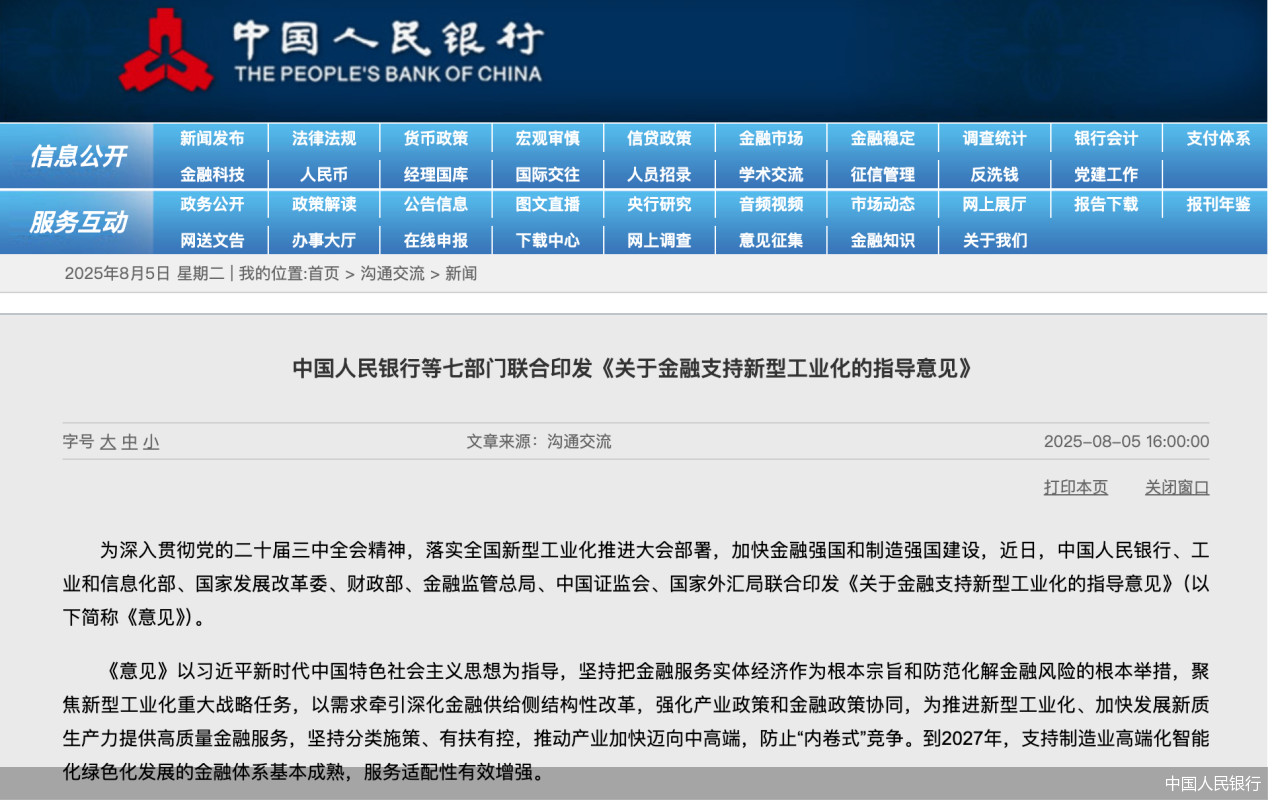
牛两个月了 钱愣是赚不到
Datayes· 2025-08-05 12:58
Market Overview - The A-share market experienced a comprehensive rise, with the Shanghai Composite Index increasing by 0.96%, the Shenzhen Component Index by 0.59%, and the ChiNext Index by 0.39% [7] - The total trading volume in the Shanghai and Shenzhen markets reached 16,160.55 billion, an increase of 976.95 billion compared to the previous trading day [7] Investor Sentiment - A significant portion of retail investors are facing losses, with 99.9% of accounts with less than 10,000 yuan experiencing losses, and 97% of accounts between 10,000 to 100,000 yuan also in the red [1][2] - In contrast, 90% of accounts with over 1 million yuan reported profits, indicating a disparity in performance among different account sizes [2] Sector Performance - The communication sector saw the largest net inflow of funds, followed by automotive, banking, electronics, and machinery sectors [20] - The PEEK materials sector showed strong performance, with several stocks reaching the daily limit, driven by increased interest in lightweight materials for robotics [7] Financing Trends - The financing balance in the market has reached 19,713 billion, surpassing the levels seen during the 2015 market peak, indicating a potential for further growth [3] - The overall market volume remains relatively low at 1.6 trillion, suggesting that while there is upward momentum, the market may lack sufficient strength for sustained growth [5] Key Developments - The upcoming launch of Apple's iPhone 17 series, which is expected to fully transition to eSIM technology, is anticipated to impact related stocks positively [6] - The Chinese government has initiated several policies to support new industrialization, including financial support for key technology sectors such as integrated circuits and advanced materials [13] Institutional Activity - Institutional investors showed a net inflow of 138.16 billion, with notable purchases in the communication and automotive sectors [20] - The top individual stocks attracting institutional interest included Zhangjiang Hi-Tech, Dongxin Peace, and Changcheng Military Industry [20] Valuation Insights - The current price-to-earnings (PE) ratios in various sectors indicate that some, like agriculture and non-bank financials, are at historically low levels, suggesting potential investment opportunities [32]
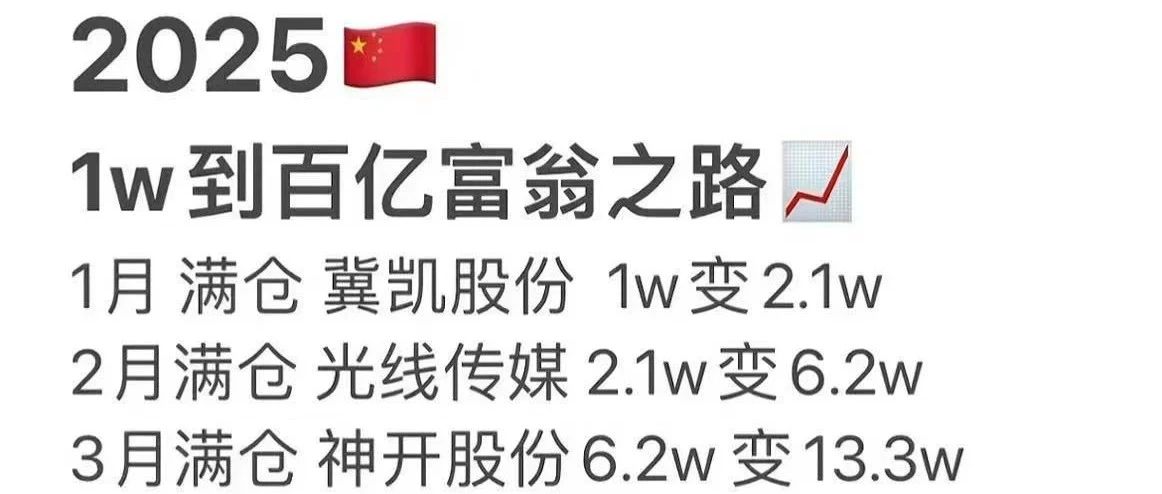
货币市场日报:8月5日
Zhong Guo Jin Rong Xin Xi Wang· 2025-08-05 12:34
Monetary Policy and Market Operations - The People's Bank of China conducted a 7-day reverse repurchase operation of 160.7 billion yuan at an interest rate of 1.40%, maintaining the previous rate, resulting in a net withdrawal of 288.5 billion yuan due to 449.2 billion yuan of reverse repos maturing on the same day [1] - The overnight Shanghai Interbank Offered Rate (Shibor) remained low at around 1.3%, with specific rates showing slight fluctuations: overnight Shibor increased by 0.10 basis points to 1.3150%, while 7-day Shibor decreased by 0.40 basis points to 1.4320% [1] Interbank Repo Market - In the interbank pledged repo market, short-term rates showed a slight decline, with DR001 and R001 weighted average rates remaining stable, while DR007 and R007 rates decreased by 0.7 basis points and 1.0 basis points respectively, with transaction volumes increasing significantly [3] - The weighted average rates for DR014 and R014 also decreased, indicating a trend of lower borrowing costs in the short-term market [3] Interbank Lending and Certificates of Deposit - The interbank lending market showed a relaxed funding environment, with overnight rates for various collateral types fluctuating between 1.30% and 1.48%, indicating a downward trend in borrowing costs [6] - As of 5:30 PM on August 5, 86 interbank certificates of deposit were issued, totaling 129.22 billion yuan, with overall market sentiment remaining subdued [7] Financial Policy and Industry Support - The People's Bank of China and six other departments issued guidelines to enhance financial support for new industrialization, emphasizing the need for coordinated industrial and financial policies to promote high-quality financial services and prevent excessive competition [9] - The guidelines aim to facilitate the aggregation of financial resources towards industrial clusters and specialized development, supporting reasonable industrial layout and expansion [9]
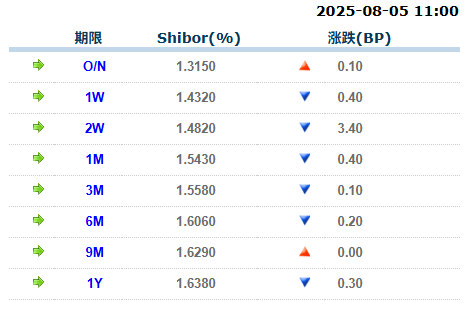
重磅!七部门印发,大利好!
Zhong Guo Ji Jin Bao· 2025-08-05 12:00
Core Viewpoint - The People's Bank of China and six other departments have jointly issued the "Guiding Opinions on Financial Support for New-Type Industrialization," which aims to enhance financial support for key industries and promote technological innovation and industrial upgrading [1][12]. Group 1: Financial Support for Key Industries - Financial institutions are encouraged to provide medium- and long-term financing for key manufacturing sectors such as integrated circuits, industrial mother machines, medical equipment, servers, and advanced materials [5][14]. - The policy aims to enhance the financing accessibility for small and micro enterprises in the manufacturing sector [6][20]. Group 2: Support for Emerging Industries - The guidance supports financing for emerging industries like new-generation information technology, smart vehicles, renewable energy, and biomedicine in multi-tiered capital markets [7][18]. - It emphasizes the importance of long-term capital and patient investment to accelerate the transformation of technological achievements into commercial applications [15][18]. Group 3: Enhancing Financial Services for Traditional Manufacturing - Financial institutions are directed to optimize credit policies to support the high-end, intelligent, and green development of traditional manufacturing [17][24]. - The guidance encourages the use of diverse financial tools, including loans, bonds, and insurance, to support the digital transformation of manufacturing enterprises [17][24]. Group 4: Green Finance and Sustainable Development - The policy promotes the establishment of a financial standard system to support the green and low-carbon transformation of high-carbon industries [19][26]. - It encourages the development of green financial products and the application of green credit and bonds in manufacturing [19][26]. Group 5: Strengthening Digital Financial Services - Financial institutions are urged to leverage technologies like big data and blockchain to enhance service efficiency for manufacturing, especially for small and medium-sized enterprises [20][21]. - The guidance supports the construction of digital financial service platforms to facilitate financing and cash management for the manufacturing sector [20][21]. Group 6: Policy Coordination and Risk Management - The document emphasizes the need for coordination between financial and industrial policies to create a supportive environment for new-type industrialization [26][27]. - It calls for the establishment of a joint risk assessment mechanism to monitor and manage financial risks associated with industrial projects [27][28].
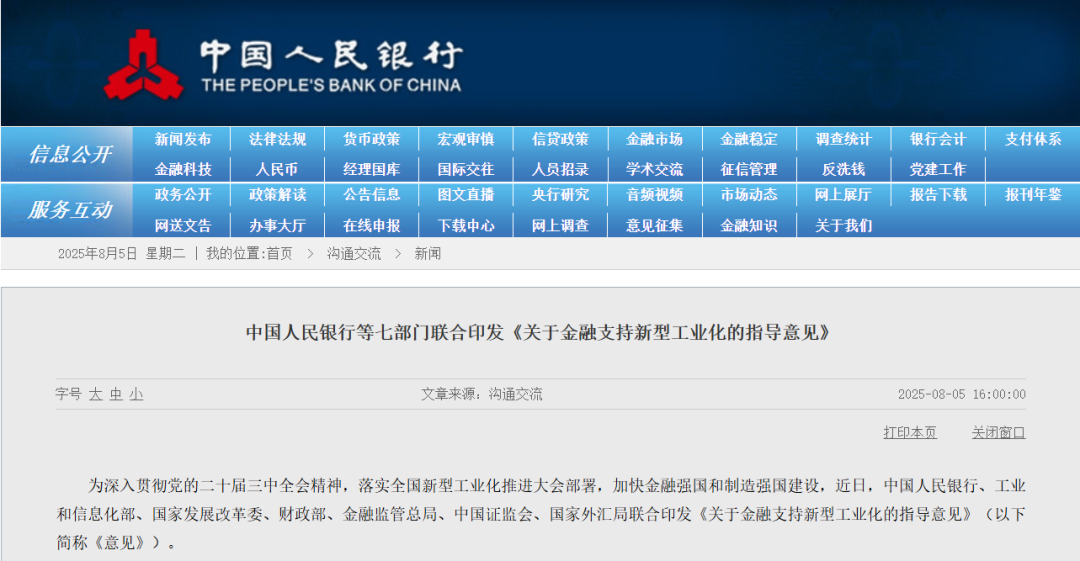
新华鲜报 | 金融活水润泽!支持新型工业化有了“路线图”
Xin Hua She· 2025-08-05 11:57
近年来,金融体系不断优化资金供给结构,加大对新型工业化提供债券、股权等融资支持。 6月末,我国制造业中长期贷款余额同比增长8.7%,高于各项贷款增速。上半年,A股市场通过首次公 开发行股票、增发和可转债的方式为工信领域企业募集资金1488亿元,同比增长51.6%。 在金融支持新型工业化实现总量增长的同时,企业对于金融服务的质效和适配性有着更高期待。 加快推进新型工业化,离不开金融活水的润泽。 8月5日,中国人民银行等7部门发布《关于金融支持新型工业化的指导意见》,聚焦新型工业化重大战 略任务需要,提出18条针对性支持举措。 意见明确了金融支持新型工业化的总体"时间表":到2027年,支持制造业高端化、智能化、绿色化发展 的金融体系基本成熟,服务适配性有效增强。制造业企业有效信贷需求得到充分满足,制造业企业发行 债券的户数和规模持续增长,股权融资水平显著提升。 坚持分类施策、有扶有控,围绕推动产业加快迈向中高端,意见勾勒出清晰的"路线图"—— 为支持制造业企业释放创新活力,意见提出优化金融政策工具,引入长期资金和发展耐心资本;为提升 产业链供应链韧性,意见提出强化重点企业金融服务;为支持加快建设现代化产业体系, ...
重磅!七部门印发,大利好!
中国基金报· 2025-08-05 11:43
Core Viewpoint - The article discusses the joint issuance of the "Guiding Opinions on Financial Support for New-Type Industrialization" by seven departments, including the People's Bank of China, aimed at accelerating the construction of a financial system that supports new-type industrialization and enhances the resilience of industrial chains [3][12]. Group 1: Financial Support for Key Industries - Financial institutions are encouraged to provide medium- and long-term financing for key manufacturing industries such as integrated circuits, industrial mother machines, medical equipment, servers, and advanced materials [4][14]. - The policy aims to enhance the financing accessibility for small and micro enterprises in the manufacturing sector [5][20]. Group 2: Support for Emerging Industries - The article highlights support for emerging industries like new-generation information technology, smart (connected) vehicles, and biomedicine to access multi-tiered capital markets for financing [6][18]. - It emphasizes the need for long-term capital and patient investment to accelerate the transformation of technological achievements into practical applications [15][18]. Group 3: Enhancing Financial Services for Traditional Manufacturing - Financial institutions are urged to optimize credit policies to support the high-end, intelligent, and green development of traditional manufacturing [17][19]. - The article suggests that banks should enhance their support for digital transformation in manufacturing, particularly for small and medium-sized enterprises [17][20]. Group 4: Promoting Green and Digital Finance - The article discusses the importance of green finance in supporting the low-carbon transformation of high-carbon industries, advocating for the development of green financial products [19][28]. - It also emphasizes the role of digital finance in improving the efficiency of financial services for the manufacturing sector, particularly through the use of big data and AI [20][28]. Group 5: Strengthening Policy Coordination - The article calls for enhanced coordination between financial policies and industrial policies to ensure effective implementation of the financial support measures [27][28]. - It highlights the need for a collaborative approach among various government departments to create a conducive environment for financing new-type industrialization [27][28].