先进制造业

Search documents
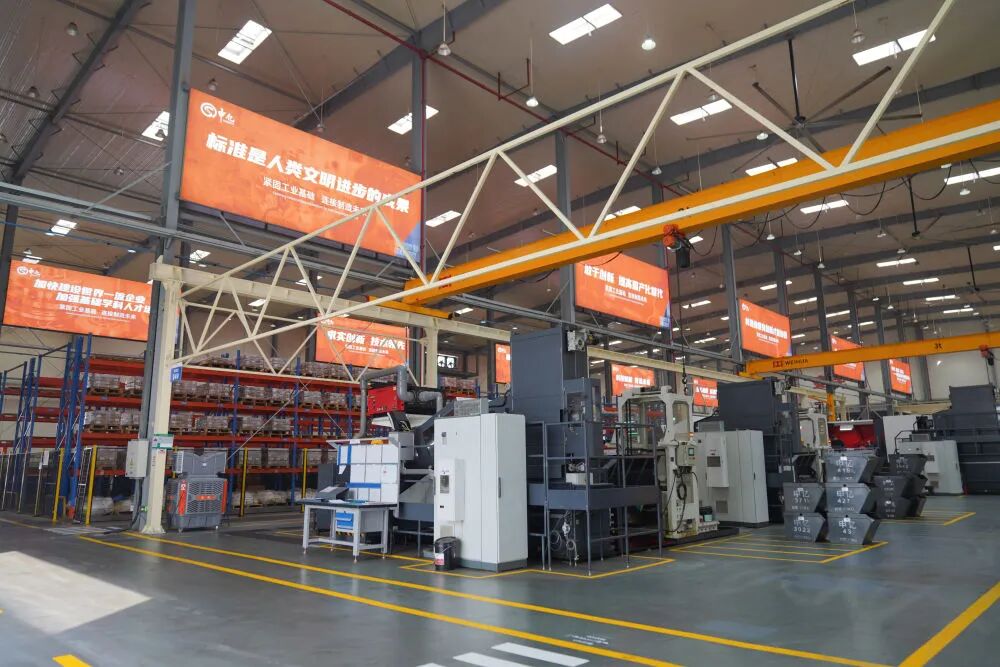
株洲“破”与“立”:一座工业老城的制造新变
2 1 Shi Ji Jing Ji Bao Dao· 2025-11-12 09:43
Core Viewpoint - Zhuzhou is positioning itself as a manufacturing city with a focus on advanced manufacturing, aiming to enhance its industrial and manufacturing GDP contributions by 2024, ranking first in Hunan Province [1] Group 1: Economic Contribution and Industrial Development - By 2024, Zhuzhou's industrial and manufacturing sectors are projected to contribute 39.9% and 37.4% to the GDP, respectively, showing increases of 0.9 and 1.2 percentage points since 2020 [1] - Zhuzhou has established itself as a key industrial base in China, recognized for its historical significance in the country's industrial development [1] - The city has cultivated three national advanced manufacturing clusters in rail transit equipment, small and medium-sized aviation engines, and ultra-high voltage transmission and transformation equipment [1] Group 2: Digital Transformation and Innovation - Zhuzhou is leveraging its large enterprises to drive digital transformation across the supply chain, achieving a digital network coverage rate of 81% among large manufacturing enterprises [2] - The city has developed the world's first intelligent manufacturing workshop for bogies and the first 5G automatic detection production line for ceramics in China [2] - Zhuzhou's digital transformation efforts have led to significant improvements in production efficiency and cost reduction for companies like Qianjin Pharmaceutical, which reported a 33% increase in output and a reduction in average R&D costs from 12.468 million yuan to 5.867 million yuan [4][5] Group 3: Future Industry and Strategic Planning - The city aims to build world-class industrial clusters in rail transit and small aviation engines by 2025, with a focus on strategic emerging industries such as new energy and new materials [6] - Zhuzhou has initiated the development of a Beidou industry cluster, achieving a scale of 11.3 billion yuan within three years and establishing the province's first commercial satellite factory [7] - The local government is providing substantial support for the Beidou industry, including a comprehensive development plan and lifecycle services for enterprises [8] Group 4: Performance Metrics and Growth - From January to September this year, Zhuzhou's manufacturing sector saw a year-on-year increase of 10.4% in added value, contributing significantly to the overall industrial growth of the city [9] - Key industrial clusters such as metal products and electrical machinery have shown remarkable growth rates of 36.8% and 30.8%, respectively [9]
21特写|株洲“破”与“立”:一座工业老城的制造新变
2 1 Shi Ji Jing Ji Bao Dao· 2025-11-12 09:33
Group 1: Economic Overview - In 2024, the industrial and manufacturing sectors in Zhuzhou are projected to account for 39.9% and 37.4% of GDP, respectively, marking increases of 0.9 and 1.2 percentage points since 2020, leading the province of Hunan [1] - Zhuzhou is recognized as a significant industrial base, having been one of the eight major industrial cities established during the early years of New China, contributing to various industrial milestones [1] Group 2: Advanced Manufacturing Development - Zhuzhou has developed three national advanced manufacturing clusters in rail transit equipment, small aircraft engines, and ultra-high voltage transmission equipment, along with three national characteristic industry clusters for small and medium enterprises [1] - The city has improved its ranking in the national advanced manufacturing cities from outside the top 50 in 2020 to 37th in 2024 [1] Group 3: Digital Transformation and Innovation - Zhuzhou has established the world's first intelligent manufacturing workshop for bogies and the first 5G automatic detection production line for ceramics in China, with digitalization coverage in large-scale manufacturing enterprises reaching 81% [2] - Zhuzhou's major enterprise, CRRC Zhuzhou Electric Locomotive Co., has implemented several intelligent production lines, enhancing manufacturing capabilities [2] Group 4: Pharmaceutical Industry Advancements - Zhuzhou Qianjin Pharmaceutical Co., a government-controlled listed company, has made significant strides in digital transformation, reducing average R&D costs from 12.468 million to 5.867 million yuan and cutting approval times for product registration from 8 years to under 3 years [5] - The company has also improved production efficiency, reducing monthly production scheduling time from over 3 days to under 30 minutes, and increasing output by 33% [5] Group 5: Future Industry Focus - The city aims to accelerate the development of world-class industrial clusters in rail transit and small aircraft engines by 2025, while also promoting advanced materials and semiconductor industries [8] - Zhuzhou is focusing on emerging industries, particularly in "bottleneck" areas, to support technological advancements and the development of strategic emerging industry clusters [8] Group 6: Government Support and Infrastructure - The local government has implemented a supportive environment for the North Star industry, with a comprehensive development plan and policies to facilitate business operations [9] - The establishment of a satellite manufacturing factory in Zhuzhou has been expedited due to favorable government policies and support, enhancing the city's industrial capabilities [9] Group 7: Manufacturing Growth Metrics - From January to September this year, Zhuzhou's manufacturing output value increased by 10.4% year-on-year, with 27 out of 37 industrial categories showing positive growth [12] - Key industrial clusters such as metal products and electrical machinery have demonstrated significant growth rates of 36.8% and 30.8%, respectively [12]



前三季度浙江“415X”先进制造业集群营收超7万亿元
Xin Lang Cai Jing· 2025-11-11 04:59
Core Insights - Zhejiang's "415X" advanced manufacturing cluster achieved a revenue of 7.23 trillion yuan in the first three quarters, marking a year-on-year growth of 4.8%, laying a solid foundation to meet the annual revenue target of 9.5 trillion yuan [1] - The total profit of the cluster's industrial enterprises reached 365.36 billion yuan, with a year-on-year increase of 12.7%, outpacing the growth rate of the overall industrial sector by 3.1 percentage points [1] - Emerging industry clusters showed strong growth, with eight sectors including high-end shipbuilding, artificial intelligence, new energy equipment, high-end software, new energy vehicles and components, smart IoT, integrated circuits, and robotics and CNC machine tools all achieving double-digit revenue growth [1]
商源乘势起高丘
Xin Hua Wang· 2025-11-07 00:08
Group 1 - The 10th Huashang Cultural Festival was held in Shangqiu, showcasing the city's historical significance as a commercial hub and providing a platform for cultural exchange among global Chinese merchants [2][21] - The Wangzhuang archaeological site, which dates back approximately 5000 years, was recognized as one of the top ten archaeological discoveries in 2023, highlighting the region's rich cultural heritage and its role in the development of Chinese commerce [3][21] - Shangqiu is increasingly recognized for its strategic position and the growth of local industrial clusters, particularly in manufacturing, which has been bolstered by the return of entrepreneurs and the transfer of industries from eastern regions [6][7] Group 2 - The local economy is diversifying, with significant developments in various sectors such as footwear manufacturing in Suixian, where over 600 shoe-related enterprises have established operations, achieving an annual production capacity of 350 million pairs [10] - Yucheng has become a leading producer of steel tape measures, with an annual output of nearly 1.5 billion units, capturing 85% of the domestic market and 65% of the global market [11] - The diamond industry in Zhecheng has transformed, with the region being a major producer of diamond powder and synthetic diamonds, contributing significantly to high-end manufacturing sectors [13][14] Group 3 - The refrigeration industry in Minquan is thriving, with the production of refrigerators and cold storage vehicles accounting for a significant portion of the national market, and innovations in smart manufacturing are being implemented [15][17] - The establishment of the "Minquan-Qingdao Port" sea-rail intermodal service has enhanced export capabilities for local businesses, allowing them to compete more effectively in the global market [18][19] - The overall economic development in Shangqiu is supported by a comprehensive transportation system and favorable business environment, attracting investment and fostering collaboration with various provinces [21][23]
MSCI中国指数调整 外资持续看好中国创新企业前景
Shang Hai Zheng Quan Bao· 2025-11-06 23:59
Core Insights - MSCI announced the results of its November index review, adding 26 stocks to the MSCI China Index, including 17 A-shares and 9 H-shares, while removing 16 A-shares and 4 H-shares [1] - The adjustments will take effect after the market closes on November 24, 2025, with significant implications for passive fund tracking [3] MSCI Index Adjustments - The MSCI China Index is part of a broader set of indices, including the MSCI China A-shares Onshore Index and the MSCI China All Shares Index, with the MSCI China Index being particularly significant as it is embedded in the MSCI Emerging Markets Index [1] - The number of new A-share inclusions in this review is notably higher than in previous adjustments this year, which had single-digit additions [2] Global Market Context - In the global context, the MSCI ACWI added 69 stocks and removed 64, with notable new inclusions from sectors like cloud services and biopharmaceuticals [2] - The largest new additions to the MSCI Emerging Markets Index include companies from Indonesia and Hong Kong [2] Market Sentiment and Predictions - Recent reports from foreign institutions indicate a positive outlook on A-shares and Chinese innovative companies, with Goldman Sachs raising its forecasts for China's export growth and GDP growth [3] - Goldman Sachs predicts a 5% to 6% annual growth in China's export volume over the next few years, leading to an upward revision of the actual GDP growth forecast to 5.0% for 2025 [3] - Nomura Securities has also expressed optimism regarding the Asian market's profit growth cycle, adjusting target levels for the MSCI China Index and other Asian indices [3]

构建以先进制造业为骨干的现代化产业体系
Ren Min Wang· 2025-11-06 01:05
Core Viewpoint - The construction of a modern industrial system is essential for maintaining economic stability and achieving high-quality development in China, emphasizing the importance of a robust manufacturing sector and technological innovation [1][2][3] Group 1: Industrial Achievements - China's manufacturing sector has shown significant advancements, with domestic large aircraft and cruise ships entering operation, and nuclear power units achieving grid connection [1] - The country has maintained its position as the world's largest producer of new energy vehicles for ten consecutive years, alongside extensive 5G network infrastructure [1] - The progress in semiconductor and industrial software sectors highlights the acceleration of domestic production capabilities, enhancing the resilience and security of the industrial chain [1] Group 2: Strategic Focus - The "14th Five-Year Plan" prioritizes the construction of a modern industrial system, with a focus on advanced manufacturing as the backbone [1][2] - The plan emphasizes the need for a strong material and technological foundation to achieve the goal of becoming a modern socialist power [2] - The strategy includes optimizing traditional industries, nurturing emerging sectors, promoting high-quality service development, and building modern infrastructure [3] Group 3: Global and Domestic Context - The evolving global landscape necessitates the establishment of a modern industrial system to ensure the stability of supply chains and to seize opportunities in the new technological and industrial revolutions [2] - The domestic environment requires further enhancement of supply chain resilience and acceleration of the digital transformation of manufacturing [2] - The construction of a modern industrial system is framed as both an economic and a significant political and strategic task for national development [3]
前三季度内蒙古制造业增加值同比增长8.8%
Nei Meng Gu Ri Bao· 2025-11-05 01:34
Core Viewpoint - The manufacturing sector in Inner Mongolia has shown robust growth in the first three quarters of the year, with a year-on-year increase of 8.8% in value added, surpassing the national average by 2 percentage points [1] Group 1: Manufacturing Growth - The value added of the above-scale manufacturing industry in Inner Mongolia increased by 8.8% year-on-year, which is 2 percentage points higher than the national average [1] - The growth in the manufacturing sector contributed 2.8 percentage points to the overall industrial economic growth in the region [1] Group 2: New Momentum Industries - The value added of the equipment manufacturing industry increased by 21.2% year-on-year, exceeding the overall industrial growth rate by 15.3 percentage points [1] - High-tech manufacturing also saw a significant increase, with a year-on-year growth of 16.5%, which is 10.6 percentage points higher than the overall industrial growth rate [1] Group 3: Traditional Industries - The chemical industry experienced a year-on-year increase of 14.7% in value added [1] - The metallurgy and building materials industry saw a growth of 5.3% year-on-year [1] Group 4: Economic Drivers - The stable growth in manufacturing is attributed to the influence of headquarters economy, leading enterprises in the industry, chain-leading enterprises, and advanced manufacturing [1] - The scale effect of the industry is gradually being released, further stabilizing growth and expectations [1]
长三角三季报暗藏玄机:浙江5城“霸榜”增速榜,江苏为何失落?
2 1 Shi Ji Jing Ji Bao Dao· 2025-11-03 13:08
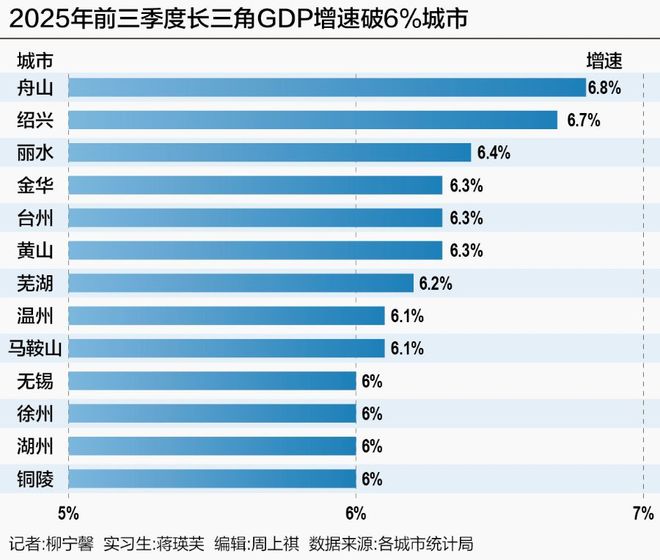
Economic Overview - The Yangtze River Delta (YRD) accounts for approximately 25% of China's GDP, with a total GDP of 251,797.17 billion yuan in the first three quarters of this year [1][5] - Among the 41 cities in the YRD, 28 cities outpaced the national average GDP growth rate of 5.2%, with 13 cities exceeding 6% [1][5] Economic Growth by Region - Zhejiang led the YRD with a GDP growth rate of 5.7%, followed by Shanghai, Jiangsu, and Anhui at 5.5%, 5.4%, and 5.4% respectively [5] - Jiangsu had the highest GDP total at 102,811 billion yuan, followed by Zhejiang at 68,495 billion yuan, Shanghai at 40,721.17 billion yuan, and Anhui at 39,770 billion yuan [6] Industrial Development - Advanced manufacturing is a key support for Jiangsu's economy, with significant contributions from high-tech manufacturing and digital core product manufacturing, both maintaining double-digit growth [4][12] - In Shanghai, the AI and integrated circuit sectors saw double-digit growth in output value, while Jiangsu's high-tech manufacturing increased by 27.8% [4][12] Consumption Trends - The consumption market in the YRD is steadily recovering, with policies like "old for new" driving sales in appliances, automobiles, and electronics [14] - Jiangsu's sports events, such as "Su Chao," have significantly boosted local consumption, with a 13% increase in sports service revenue [14][15] City-Specific Insights - Among the 13 cities with GDP growth exceeding 6%, all top five are from Zhejiang, indicating a strong manufacturing base and rapid advancement in traditional industries [6][7] - Shanghai's service sector, particularly information services, contributed significantly to its economic growth, with the tertiary industry accounting for 79.1% of its GDP [10][12] Future Directions - The YRD is focusing on enhancing traditional industries through digital transformation and innovation, with policies promoting smart factory development [8][12] - There is a strong emphasis on integrating consumption scenarios with digital economy advancements, particularly in Zhejiang, which is leveraging its e-commerce and digital payment systems [15][16]
巩固壮大实体经济根基,构建以先进制造业为骨干的现代化产业体系
Jing Ji Ri Bao· 2025-11-03 05:02
Group 1 - The core viewpoint emphasizes the importance of the real economy as the foundation of national economic stability and high-quality development, highlighting its priority in strategic tasks [1] - The real economy is identified as the fundamental source of wealth creation, contributing significantly to economic growth and employment, absorbing over 400 million jobs, and serving as a stabilizer for people's livelihoods [1] - The real economy is crucial for international competition, with a complete industrial system enhancing economic resilience against external shocks [1] Group 2 - The real economy currently faces multiple pressures, including weak global economic recovery, rising trade protectionism, geopolitical risks, and increased costs for raw materials and logistics [2] - Internally, there is insufficient effective demand, rising labor and raw material costs, severe market competition, and low profitability among small and medium-sized enterprises [2] - The transition from old to new economic drivers is experiencing challenges, with insufficient private investment and financing difficulties for some enterprises [2] Group 3 - Strengthening the real economy requires building a modern industrial system centered on advanced manufacturing, which is the most innovative and high-value-added sector of the manufacturing industry [2] - The focus should be on integrating technological innovation with industrial innovation to enhance the effectiveness of industrial technological innovation [2] Group 4 - Key directions for development include intelligentization, greening, and integration, which can enhance efficiency, reduce costs, and promote sustainable development [3] - Intelligentization leverages digital technology across production processes, while greening addresses resource consumption and environmental pressures, creating new growth points in green industries [3] - Integration breaks down industry boundaries, promoting synergy between various sectors and creating new value [3] Group 5 - Consolidating and strengthening the real economy involves optimizing traditional industries while nurturing emerging and future industries [4] - Traditional industries account for about 80% of the added value in manufacturing and are essential for economic stability [4] - Upgrading traditional industries requires focusing on key sectors and enhancing competitiveness through technological improvements [4] - Emerging industries such as new energy, new materials, and aerospace should be developed, alongside future industries like quantum technology and hydrogen energy, to create new growth points [4]
小物件、大作为——从零部件“向新”看湖南制造业提质升级
Zhong Guo Zheng Quan Bao· 2025-11-01 14:29
Group 1 - Hunan Sheny Precision Components Co., Ltd. specializes in precision fasteners, supplying critical components for major engineering projects and national key equipment [1][8] - The company has achieved significant breakthroughs in domestic substitution of fasteners for key engineering machinery enterprises in Hunan, contributing to the development of advanced manufacturing [1][8] - The manufacturing industry in Hunan is seeing a rise in "small and beautiful" enterprises focusing on specialized and innovative production, aligning with the national strategy for a modern industrial system [3][6] Group 2 - The company has expanded its client base to include the automotive and road bridge industries, developing high-performance fasteners such as weather-resistant steel rivets for major projects like the Lion's Ocean Bridge [8] - Innovations in technology, such as the "automotive to aviation" conversion for low-altitude aircraft engines, are driving down costs and enhancing competitiveness in the aviation sector [3][6] - The emphasis on innovation, industrial chain integration, and high-quality production is evident across various enterprises in Hunan, with a focus on customized solutions and advanced manufacturing capabilities [6][8]