多边贸易体制

Search documents
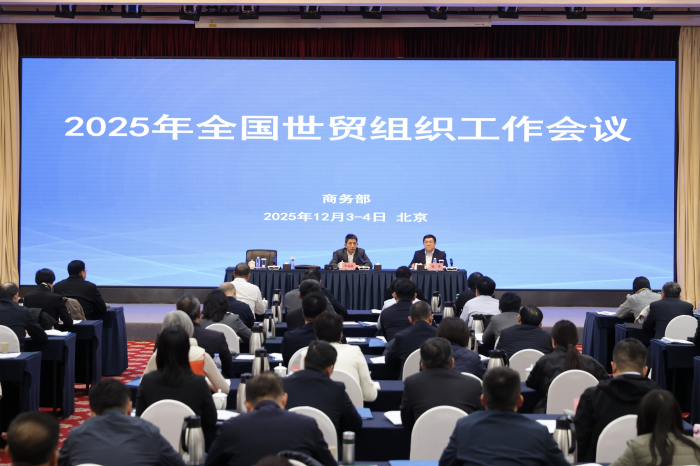
2025年全国世贸组织工作会议在京召开
Shang Wu Bu Wang Zhan· 2025-12-04 08:13
Group 1 - The 2025 National WTO Work Conference will be held in Beijing on December 3-4, focusing on the implementation of the spirit of the 20th Central Committee and the important speeches of General Secretary Xi Jinping [2] - The conference will summarize the main achievements and experiences of China's WTO work since the last national conference in 2024, analyze the new situations and tasks, and plan the goals for the "14th Five-Year Plan" period [2] - The meeting highlighted China's proactive role in promoting multilateralism and addressing unilateralism and protectionism, including the push for the effectiveness of the Fisheries Subsidies Agreement and the trial implementation of the WTO E-commerce Agreement in Beijing [2] Group 2 - The conference emphasized the importance of understanding Xi Jinping's core requirements regarding WTO work and the strategic deployment of high-level opening-up in the "14th Five-Year Plan" [2] - Participants included officials from provincial, autonomous region, and municipal commerce departments, as well as representatives from central and national agencies, research institutions, and business associations [3]

于逆风中守护,在大潮中前行(寰宇平)
Ren Min Ri Bao· 2025-12-03 22:29
在历史的十字路口,是筑起隔绝的"墙",还是搭建开放的"桥"?面对经济全球化大势,任何一个国家, 无论大小强弱,一旦背离了潮流大势,终将落后于时代 国际经贸格局正处于深度变革之中。在世界贸易组织成立30周年之际,国际贸易体系呈现出两个突出特 点:一方面,个别国家发起的贸易战、关税战,严重冲击世界经济、损害国际贸易规则;另一方面,各 国面对挑战主动求变,各类区域和多边贸易协定激增。有国际观察人士担忧,全球经贸合作版图正被一 种由地缘政治博弈塑造的"丘陵地貌"所侵蚀。以规则为基础的多边贸易体制,这个曾经的世界经济"稳 定器",正面临前所未有的考验。 破坏多边贸易规则的代价,是有可能回到关贸总协定和世界贸易组织建立之前以权力为基础的以强凌 弱、以大欺小的国际贸易体系。问题随之而来:人类是否会重蹈历史的覆辙? "尽管有'强劲的逆风',世界贸易展现出韧性",世界贸易组织总干事伊维拉指出。放眼全球,各方推动 开放贸易的努力不断加强。中国—东盟自贸区3.0版升级议定书正式签署,欧盟推进与南方共同市场和 墨西哥的贸易协定,巴西和印度宣布力争到2030年将双边贸易额提升至200亿美元……这些努力,共同 构成对单边主义的集体回应。 ...
于逆风中守护,在大潮中前行(寰宇平) ——世界贸易组织成立三十周年之思考
Ren Min Ri Bao· 2025-12-03 21:58
在历史的十字路口,是筑起隔绝的"墙",还是搭建开放的"桥"?面对经济全球化大势,任何一个国家, 无论大小强弱,一旦背离了潮流大势,终将落后于时代 国际经贸格局正处于深度变革之中。在世界贸易组织成立30周年之际,国际贸易体系呈现出两个突出特 点:一方面,个别国家发起的贸易战、关税战,严重冲击世界经济、损害国际贸易规则;另一方面,各 国面对挑战主动求变,各类区域和多边贸易协定激增。有国际观察人士担忧,全球经贸合作版图正被一 种由地缘政治博弈塑造的"丘陵地貌"所侵蚀。以规则为基础的多边贸易体制,这个曾经的世界经济"稳 定器",正面临前所未有的考验。 长远看,世界需要一个什么样的经贸秩序?多边贸易体制将何去何从?回答这两个问题,需要以客观理 性的全方位观察为基础,在纷乱形势中把握人心所向、大势所趋,避免一叶障目,才能不断汇聚共识和 力量,推动国际经贸合作行稳致远。 面对危机,各方的"应激反应"有其必然性。过去几十年,经济全球化高速发展已形成各国利益的深度互 嵌——世界经济这片汪洋大海,不会因局部暗礁而改变奔涌方向。正如美国哥伦比亚大学教授杰弗里· 弗里登所指出,单一国家摒弃多边主义并不意味着多边贸易体系终结,只要其他 ...
闪评 | 三大国际组织警示世界经济风险挑战
Sou Hu Cai Jing· 2025-12-03 13:09
Group 1 - The OECD's latest economic outlook report indicates that global economic resilience exceeds expectations, but trade barriers remain a challenge [1] - The UNCTAD's Trade and Development Report 2025 highlights the significant impact of financial market volatility on global trade, comparable to that of real economic activities [1] - The WTO's report on member trade measures emphasizes the turbulence in the global trade environment, with China urging members to fulfill trade measure notification obligations to enhance policy transparency [1] Group 2 - The overall sentiment from the reports is mixed, with emerging economies like China playing a crucial role in global economic growth due to stable supply chains and market demand [2] - The Western development model's flaws are exposed, characterized by excessive focus on asset price inflation and insufficient investment in manufacturing and infrastructure, leading to hollow economic growth [2] - China's proposal aims to safeguard WTO rules and inject stability into the global trade system, promoting a fair and predictable trading environment [2]
携手开启区域经济深度融合新篇章(国际观澜)
Ren Min Ri Bao· 2025-12-02 22:33
Group 1 - The China-ASEAN railway has become a vital "steel artery" connecting China and ASEAN, showcasing the increasing economic and trade exchanges between the two regions [1] - The signing of the upgraded version 3.0 of the China-ASEAN Free Trade Area agreement supports multilateralism and free trade, aiming to enhance bilateral cooperation and address global challenges [1][2] - The China-ASEAN Free Trade Area 3.0 version aims to lower institutional transaction costs and eliminate non-tariff barriers, stimulating consumption potential and innovation across a market of over 2 billion people [1][2] Group 2 - The 3.0 version of the China-ASEAN Free Trade Area has achieved qualitative breakthroughs in cooperation fields, openness levels, and integration depth, adding five new areas including digital economy and green economy [2] - The new agreement integrates traditional trade facilitation topics with emerging areas such as intellectual property and consumer protection, enhancing the institutional openness level and providing a stable business environment [2] - The establishment of a supply chain connectivity chapter in the 3.0 version promotes mutual recognition of standards and emphasizes resilience and collaborative innovation in supply chains [2] Group 3 - The China-ASEAN Free Trade cooperation is becoming a significant driver of regional economic integration, with the 3.0 version serving as a model for building a comprehensive and high-level Asia-Pacific Free Trade Area [3] - The signing of the 3.0 version marks the beginning of a new chapter in deep regional economic integration, aiming for a more prosperous, stable, and sustainable common future [3]
想拿中国当挡箭牌?欧洲27国通告美国,联手断中方后路,话音刚落,特朗普先向中国献礼
Sou Hu Cai Jing· 2025-11-29 07:10
Core Viewpoint - The EU's strategy to leverage its relationship with the US by sacrificing Chinese interests has backfired, leading to an embarrassing situation as the US unexpectedly resumed trade negotiations with China, undermining the EU's efforts [1][4][10] Group 1: EU's Economic Strategy - The EU submitted a memorandum to the US, attempting to gain concessions on steel and aluminum tariffs by emphasizing a "common competitor" in China [1] - Since the beginning of the year, EU investments in the US have surged by over €150 billion, and the share of US liquefied natural gas imports in the EU has increased from 45% to 60% [1] - The EU's reliance on digital regulations as a key asset is threatened by US demands to reconsider its digital market laws, which could undermine the EU's regulatory authority [3][6] Group 2: US Response and Implications - The US showed little interest in the EU's overtures and instead focused on requiring the EU to align its digital regulations with US interests, suggesting that a balanced regulatory framework could attract up to $1 trillion in investment [3] - The US's quick shift to a friendlier stance towards China after the EU's negotiations indicates a strategic move to counter the EU's attempts to leverage China against the US [4][8] - The US's insistence on digital regulations highlights its concern over the EU's policies that threaten the dominance of American tech giants [6] Group 3: Geopolitical Miscalculations - The EU's attempt to use China as a bargaining chip reflects a significant misreading of the geopolitical landscape, as the world moves towards a multipolar order [6][10] - The EU's strategy risks alienating China, which is a crucial trade partner, and could lead to long-term economic disadvantages for European companies [4][7] - The EU's contradictory approach of trying to suppress China economically while seeking defense cooperation illustrates a lack of coherent strategy [7] Group 4: International Reactions - ASEAN countries have expressed their intention not to follow unilateral sanctions or trade restrictions, emphasizing the importance of maintaining normal trade relations with China [8] - The African Union has openly opposed trade protectionism, reinforcing the idea that the EU's actions diverge from global expectations for cooperation and mutual benefit [8] - The EU's approach has been criticized as short-sighted, risking its strategic autonomy in favor of immediate gains [10]
“‘十五五’规划将书写中国奇迹的新篇章”
人民网-国际频道 原创稿· 2025-11-28 08:41
埃及著名中国和亚洲问题专家艾哈迈德·阿卜杜·德拉比克日前在接受人民网记者采访时表示,全球决 策者高度关注中国即将实施的"十五五"规划。"'十五五'规划勾画了未来五年中国发展的顶层设计,涉及 中国经济与社会发展的重大决策,必将因中国经济体量巨大而对世界产生深远影响。" 在德拉比克看来,"十五五"规划建议的意义,首先建立在"十四五"时期中国取得的卓越成果基础 上:中国经济保持稳步增长,科技进步明显加快,对外开放水平不断深化。 德拉比克说,"十五五"规划建议展现出中国推进中国式现代化的坚定决心,也为动荡不定的国际形 势注入了宝贵的确定性。"向世界传递了一个明确信号,即中国政策稳健、经济增长持续、经济发展预期 长期稳定。" 德拉比克指出, 中国共产党善于通过中长期规划引领经济社会发展,"十四五"规划的成功就是证 明。 "十四五"时期,中国GDP从110万亿元增长到130万亿元,今年有望接近140万亿元。"中国对世界经 济增长贡献率长期保持在30%左右,2025年进入全球创新指数前十,是过去十年创新能力提升最快的经 济体之一。"德拉比克说。 他指出,中国战略性新兴产业迅速崛起,人工智能、新能源等领域取得突破性进展,已从 ...
中国促进农业与贸易可持续发展经验在世贸组织广受赞誉
Xin Hua She· 2025-11-27 16:04
Core Insights - The World Trade Organization's Agricultural Committee held its 114th meeting from November 24 to 26, where China hosted a seminar on "Promoting Sustainable Development in Agriculture and Trade," receiving high praise from participants [1][2] - The seminar highlighted the interconnected global issues of chronic hunger, land degradation, and food insecurity, emphasizing the need for deepened digital cooperation to unlock a new future for global agriculture [1] Group 1: China's Role and Contributions - China's experience and solutions in sustainable agricultural and trade development are considered valuable references for many developing countries [2] - The seminar was co-hosted by various Chinese institutions, including the Chinese Permanent Mission to the WTO and the Chinese Academy of Agricultural Sciences, showcasing China's commitment to international agricultural cooperation [1] Group 2: Global Challenges and Solutions - The current global agricultural and trade landscape is undergoing transformation, with rising unilateralism and protectionism threatening the multilateral trade system and exacerbating market fragmentation [1] - Climate change, geopolitical tensions, and the lasting impacts of the COVID-19 pandemic have exposed vulnerabilities in global food supply chains, posing long-term risks to food security [1] - Specific actions are recommended to address the challenges of digitalization in international agricultural trade, including the establishment of public policy frameworks and inclusive digital trade [2]
微视频|中国影响力
Yang Shi Wang· 2025-11-26 01:20
新时代以来,习近平主席从构建人类命运共同体的高度出发,倡导共商共建共享的全球治理观,并强调 维护多边贸易体制,建设开放型世界经济。 不断扩大的"朋友圈",日益密切的合作交流,标注着中国与世界互动的新高度,也见证着不断提升的中 国影响力。 总监制丨骆红秉 魏驱虎 监 制丨王敬东 主 编丨李璇 策 划丨孟利铮 制 作丨及玥 张紫曦 视 觉丨陈腾 配 音丨张磊 校 对丨李珊珊 李雪菲 李英卓 毛长志 任佳 出 品丨中央广播电视总台央视网 [ 责编:张璋 ] "十四五"期间,我国对世界经济增长年均贡献率保持在30%左右。这既彰显了构建新发展格局的显著成 效,也印证了开放型世界经济的蓬勃生命力。 在今天的中国,平均每分钟,有价值约8320万元人民币的货物进出境,12辆汽车从中国"驶"向世界各 地;平均每天,约有377万吨货物从宁波舟山港进出,人民币跨境支付系统处理3.21万笔业务。 ...
维护多边贸易体制 推动共同发展繁荣
Ren Min Ri Bao· 2025-11-25 10:14
Core Viewpoint - The World Trade Organization (WTO) has played a crucial role in promoting global trade development and economic growth over the past 30 years, despite facing challenges such as unilateralism and protectionism [5][6][10]. Trade Growth and Economic Impact - From 1995 to 2023, global trade volume increased nearly fivefold, surpassing the growth rate of global GDP during the same period [5][6]. - The share of low- and middle-income countries in global exports rose from 17% in 1995 to 32% in 2022, contributing to a significant reduction in extreme poverty from 40% to 10% [6][10]. Role of China in WTO - China has been a significant beneficiary of the multilateral trading system since joining the WTO in 2001, contributing approximately 30% to global economic growth annually [7][10]. - The country actively participates in WTO reforms and negotiations, promoting trade facilitation and enhancing the global economic order [10][11]. Challenges to Multilateral Trade - The rise of unilateralism and protectionism poses significant threats to the multilateral trading system, disrupting global supply chains and trade [12][14]. - The WTO's dispute resolution mechanism has been weakened since December 2019, undermining its authority and effectiveness [13][16]. Reforming the WTO - There is a consensus that necessary reforms should enhance the efficiency and effectiveness of the WTO rather than weaken it [16][17]. - China emphasizes the importance of maintaining core values of non-discrimination and openness in WTO reforms, advocating for the interests of developing countries [17].