汽车出口

Search documents
两个“历史首次”!前11个月我国汽车产销量双超3100万辆 今年出口规模有望蝉联全球第一
Mei Ri Jing Ji Xin Wen· 2025-12-12 00:55
历年车市年底"翘尾"的惯例,在2025年迎来意外转折。 "由于现在很多地方的补贴政策在陆续退出,不少消费者在等着明年政策的出台,导致近期国内汽车终 端市场的表现出现波动。"中国汽车工业协会副秘书长陈士华在解读数据时表示。 细分车型数据更能反映市场降温态势。懂车帝援引乘联会数据显示,11月,在总销量超过3000辆的车型 中,有139款车型出现了销量下滑,17款车型的销量下滑超过3000辆。 尽管年末汽车国内市场销量遇冷,但从前11个月的整体表现来看,我国汽车产销仍保持良好态势。1至 11月,我国汽车产销分别完成3123.1万辆和3112.7万辆,同比分别增长11.9%和11.4%。 基于此,陈士华对2025年汽车表现持乐观态度:"汽车内需市场在政策组合效应推动下有效改善,新动 能加快释放,对外贸易呈现出较好韧性,汽车产销量全年有望再创历史新高,实现'十四五'圆满收 官。" 出口两大"历史性突破":月销首超70万辆,全年冲刺700万辆 中汽协数据显示,11月,我国汽车产量完成353.2万辆,同比增长2.8%,创历史新高。"这是中国汽车产 业发展史上月度产量首次超过350万辆。"陈士华表示。 12月11日,中汽协发 ...

多项指标表现亮眼 我国单月汽车产量首超350万辆
Zhong Guo Zheng Quan Bao· 2025-12-11 20:31
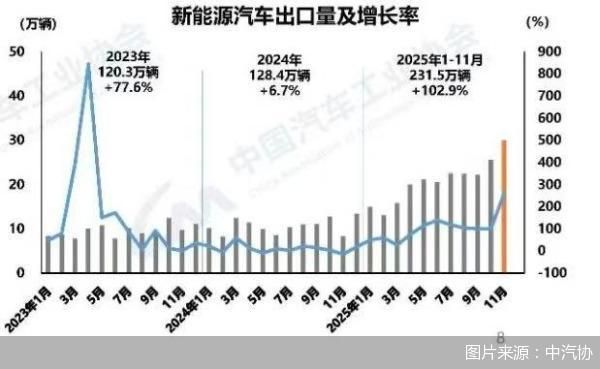
Core Insights - The Chinese automotive industry continues to show strong growth, with November production exceeding 3.5 million units and exports surpassing 700,000 units, indicating a robust market recovery and setting the stage for record annual sales [1][5] Production and Sales Data - In November, total automotive production and sales reached 3.532 million and 3.429 million units, respectively, marking a month-on-month increase of 5.1% and 3.2%, and a year-on-year increase of 2.8% and 3.4% [1] - Cumulatively, from January to November, production and sales totaled 31.231 million and 31.127 million units, reflecting year-on-year growth of 11.9% and 11.4% [1] Passenger Vehicle Market - The passenger vehicle segment maintained stable growth in November, with production and sales of 3.144 million and 3.037 million units, respectively, showing month-on-month increases of 5% and 2.6%, and year-on-year increases of 1.1% and 1.2% [2] - Cumulative figures for the first eleven months indicate production and sales of 27.388 million and 27.256 million units, with year-on-year growth of 12% and 11.5% [2] Commercial Vehicle Market - The commercial vehicle sector exhibited significant recovery, with November production and sales reaching 388,000 and 392,000 units, respectively, reflecting month-on-month increases of 6.6% and 8.6%, and year-on-year increases of 18.6% and 24.4% [3] - Natural gas commercial vehicles showed exceptional performance, with November sales of 23,000 units, a year-on-year increase of 87.5% [3] New Energy Vehicles (NEVs) - NEVs continued to experience high growth, with November production and sales of 1.88 million and 1.823 million units, representing year-on-year increases of 20% and 20.6% [4] - NEVs accounted for 53.2% of total new vehicle sales in November, significantly up from the previous year [4] - Cumulative NEV production and sales from January to November reached 14.907 million and 14.78 million units, with year-on-year growth of 31.4% and 31.2% [4] Export Performance - November saw a record high in automotive exports at 728,000 units, with a month-on-month increase of 9.3% and a year-on-year increase of 48.5% [5] - Cumulative exports for the first eleven months reached 6.343 million units, reflecting a year-on-year growth of 18.7% [5] - NEV exports were a key driver, with November exports of 300,000 units, a month-on-month increase of 17.3% and a year-on-year increase of 260% [5]
中汽协:全年出口有望冲刺700万辆
Bei Jing Ri Bao Ke Hu Duan· 2025-12-11 16:20
转自:北京日报客户端 新能源汽车是驱动市场增长的核心引擎,而出口则成为销量增长另一大亮点。12月11日,中国汽车工业 协会(以下简称"中汽协")发布的数据显示,今年前11个月汽车出口量达634.3万辆,同比增长18.7%。 其中,今年11月汽车出口72.8万辆,环比增长9.3%,同比增长48.5%,单月出口量首次超过70万辆。 崔东树表示,由于海外销售利润较高,"不出海就出局"的趋势明显,企业出口强势增长超预期。下半年 以来中国汽车出口局面持续向好,自主新能源的海外市场认可度不断提升,海外营销网络快速扩张,部 分海外市场增长良好。 车企出海速度明显加快之外,出口方式也正从单一的整车出口转向"本地化生产+全球化服务"的方向。 目前,包括上汽、长安、广汽、比亚迪等头部中国车企,都已有或计划建设海外生产基地,并同步在全 球建立了多个研发中心。 中汽协副秘书长陈士华表示,展望全年,汽车内需市场在政策组合效应推动下有效改善,新动能加快释 放,对外贸易呈现出较好韧性,汽车产销量全年有望再创历史新高。其中,今年汽车出口有望冲击700 万辆。 作为中国外贸商品"新三样"之一的新能源汽车,在汽车出口中的占比也在提升。今年前11 ...


月销首破70万辆,中汽协:全年出口有望冲刺700万辆
Bei Jing Shang Bao· 2025-12-11 14:41
车企出海速度明显加快之外,出口方式也正从单一的整车出口转向"本地化生产+全球化服务"的方向。 目前,包括上汽、长安、广汽、比亚迪等头部中国车企,都已有或计划建设海外生产基地,并同步在全 球建立了多个研发中心。 早在去年,广汽埃安宣布,泰国智能工厂正式竣工,旗下首款全球战略车型——第二代AION V也进行 全球同步下线。据悉,该智能工厂一期年产能5万辆,未来年产能将逐步升至10万辆,可实现第二代 AION V、AION Y Plus、昊铂HT等多款广汽埃安车型共线生产。 新能源汽车是驱动市场增长的核心引擎,而出口则成为销量增长另一大亮点。12月11日,中国汽车工业 协会(以下简称"中汽协")发布的数据显示,今年前11个月汽车出口量达634.3万辆,同比增长18.7%。 其中,今年11月汽车出口72.8万辆,环比增长9.3%,同比增长48.5%,单月出口量首次超过70万辆。 中汽协副秘书长陈士华表示,展望全年,汽车内需市场在政策组合效应推动下有效改善,新动能加快释 放,对外贸易呈现出较好韧性,汽车产销量全年有望再创历史新高。其中,今年汽车出口有望冲击700 万辆。 "插混和普混替代纯电动成为出口增长的新增长点,尤 ...

崔东树:2025年11月乘用车零售降8% 大幅低于批发2%的增长
Zhi Tong Cai Jing· 2025-12-11 14:28
Core Viewpoint - The automotive market is shifting towards a trend of "price reduction and moderate promotions," with retail sales of passenger cars declining by 8% in November 2025, significantly lower than the 2% growth in wholesale sales [1] Group 1: Market Trends - The retail sales of passenger cars fell by 8% in November 2025, while wholesale sales increased by 2% [1] - The A0-class sedans and C-class SUVs became the main retail drivers in November, with strong performance in high-end SUVs [1] - The retail environment is influenced by consumer urgency due to the expiration of tax exemptions for new energy vehicles, leading to increased sales in December [2] Group 2: Economic Vehicle Market Performance - A00-class sedans saw wholesale of 171,900 units in November 2025, with a year-on-year decline of 1% and a month-on-month increase of 4% [4] - A0-class sedans had wholesale of 183,500 units in November 2025, showing a year-on-year growth of 25% [5] - A0-class SUVs experienced a wholesale decline of 9% year-on-year in November 2025, with retail sales also down by 22% [6] Group 3: A-Class Vehicle Market - A-class sedans had wholesale of 445,800 units in November 2025, with a year-on-year decline of 7% [8] - A-class SUVs had wholesale of 880,000 units in November 2025, with a year-on-year decline of 2% [9] Group 4: B-Class Vehicle Market - B-class sedans had wholesale of 380,500 units in November 2025, with a year-on-year growth of 3% [10] - B-class SUVs saw wholesale of 454,200 units in November 2025, with a year-on-year growth of 10% [11] - The high-end SUV market is witnessing a rapid rise in autonomous new energy vehicles, while traditional fuel vehicles are losing their competitive edge [12] Group 5: MPV Market Trends - B-class MPVs had wholesale of 45,100 units in November 2025, with a year-on-year growth of 40% [13] - C-class MPVs experienced a year-on-year decline of 20% in wholesale in November 2025 [14] - The MPV market is transitioning from a high-growth phase to a low-growth trend, with strong performances from brands like BYD and Tengshi [14]


11月中国汽车出口超70万辆 创单月历史新高
Zhong Guo Xin Wen Wang· 2025-12-11 10:19
11月中国汽车出口超70万辆 创单月历史新高 中汽协分析,展望全年,汽车内需市场在政策组合效应推动下有效改善,新动能加快释放,对外贸易呈 现出较好韧性,汽车产销量全年有望再创历史新高。(完) 来源:中国新闻网 编辑:王永乐 广告等商务合作,请点击这里 本文为转载内容,授权事宜请联系原著作权人 中新社北京12月11日电 (记者 刘文文)11月,中国汽车产销延续良好表现。记者11日从中国汽车工业协 会(简称"中汽协")月度信息发布会上获悉,11月汽车出口72.8万辆,为历史上月度首次超过70万辆。 中汽协相关负责人分析,11月,企业抢抓政策窗口期,生产供给依然保持较快节奏,在高基数基础上, 产销环比、同比均实现增长。其中,乘用车市场运行平稳,商用车市场持续向好,新能源汽车表现强 劲,汽车出口较快增长。 当日公布的数据显示,11月,中国汽车产销分别完成353.2万辆和342.9万辆,环比分别增长5.1%和 3.2%,同比分别增长2.8%和3.4%。月度产量首次超过350万辆,创历史新高。其中,乘用车产销分别完 成314.4万辆和303.7万辆;商用车产销分别完成38.8万辆和39.2万辆。 出口方面,11月,汽车出 ...
机构:2026年看好出口占比高、国内高端化卓有成效的车企
Zheng Quan Shi Bao Wang· 2025-12-11 06:45
Group 1 - In November, China's automobile exports reached 728,000 units, marking a month-on-month increase of 9.3% and a year-on-year increase of 48.5%, with the total exports for January to November at 6.343 million units, up 18.7% year-on-year [1] - The importance of exports is highlighted, with expectations for a 12% growth in automobile export sales by 2026, while wholesale sales are projected to see a slight increase [1] - Companies recommended for investment include Great Wall Motors, Chery Automobile, Horizon Robotics, Seres, Xiaomi Group, Li Auto, Xpeng Motors, Geely Automobile, Yutong Bus, and Fuyao Glass, focusing on those with high export ratios and effective domestic high-end strategies [1] Group 2 - Dongguan Securities suggests that exports may become a new growth driver for capacity digestion and maintaining growth, with leading automakers expected to transition from merely exporting products to exporting production capacity through localized overseas production [2] - Recommended companies include BYD and Seres for their active overseas market expansion, as well as Fuyao Glass and Junsheng Electronics for their potential performance growth driven by increased penetration of intelligent driving configurations [2] - Yutong Bus is identified as a beneficiary of the "old-for-new" policy in the new energy bus sector [2]





中汽协:11月中国汽车出口72.8万辆 同比增长48.5%
Zheng Quan Shi Bao Wang· 2025-12-11 06:37
人民财讯12月11日电,中汽协发布的数据显示,11月,中国汽车出口72.8万辆,环比增长9.3%,同比增 长48.5%,当月出口量为历史上首次超过70万辆大关。1—11月,中国汽车出口634.3万辆,同比增长 18.7%。 ...
产业运行 | 2025年11月汽车工业产销情况
中汽协会数据· 2025-12-11 06:25
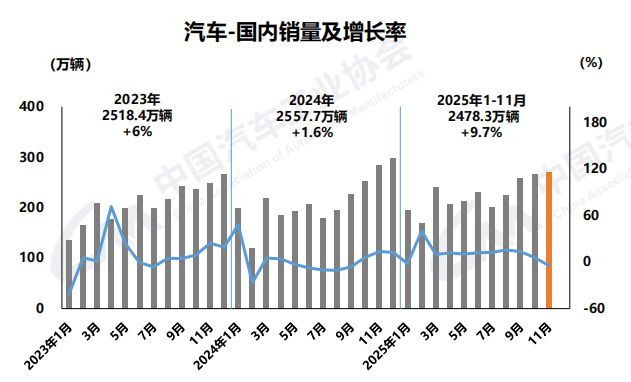
Core Viewpoint - The automotive industry in China continues to show strong performance in November, with production and sales maintaining a rapid pace, particularly in the new energy vehicle (NEV) sector, which has seen significant growth [1]. Group 1: Overall Automotive Production and Sales - In November, automotive production reached 3.532 million units and sales reached 3.429 million units, marking a historical high with a month-on-month increase of 5.1% and 3.2%, respectively, and a year-on-year increase of 2.8% and 3.4% [9]. - From January to November, total automotive production and sales were 31.231 million and 31.127 million units, reflecting year-on-year growth of 11.9% and 11.4% [9]. Group 2: Domestic Sales - In November, domestic automotive sales were 2.701 million units, showing a month-on-month increase of 1.7% but a year-on-year decrease of 4.4% [12]. - For the first eleven months, domestic sales totaled 24.783 million units, with a year-on-year increase of 9.7% [12]. Group 3: Export Performance - November saw automotive exports reach 728,000 units, a month-on-month increase of 9.3% and a year-on-year increase of 48.5%, marking the first time exports exceeded 700,000 units in a month [17]. - From January to November, total automotive exports were 6.343 million units, reflecting a year-on-year growth of 18.7% [17]. Group 4: New Energy Vehicles (NEVs) - In November, NEV production and sales were 1.88 million and 1.823 million units, respectively, with year-on-year growth of 20% and 20.6% [54]. - For the first eleven months, NEV production and sales reached 14.907 million and 14.78 million units, with year-on-year growth of 31.4% and 31.2% [54]. Group 5: Key Enterprises and Market Concentration - In the first eleven months, the top fifteen automotive groups sold a total of 28.772 million units, a year-on-year increase of 11.3%, accounting for 92.4% of total automotive sales [74]. - The top fifteen NEV groups sold 14.072 million units, a year-on-year increase of 32.6%, representing 95.2% of total NEV sales [76].
中国燃油车,在海外杀疯了
3 6 Ke· 2025-12-11 00:29
Core Viewpoint - The article discusses the significant transformation of Chinese fuel vehicles from being ridiculed to becoming competitive in international markets, highlighting their rapid growth and acceptance in regions where electric vehicles face challenges due to infrastructure and cost issues [3][19]. Group 1: Export Growth of Chinese Fuel Vehicles - Since 2020, three out of every four cars exported from China have been fuel vehicles [4]. - In the first eleven months of 2023, major exporters like Chery and SAIC have shown strong performance in fuel vehicle exports, with Chery exporting approximately 800,000 fuel vehicles [5]. - In 2021, 84.6% of China's car exports were fuel vehicles, with this figure slightly decreasing to 75.4% in 2023, but still indicating a strong presence in the market [6]. Group 2: Market Performance and Strategy - Chinese fuel vehicles have gained significant market share in regions like Eastern Europe, Latin America, and Africa, with Chinese manufacturers capturing nearly 16% of the South African market in the first half of the year [7]. - In Chile, Chinese fuel vehicles account for nearly one-third of the market, while traditional brands have seen significant declines in sales [8]. - The competitive strategy of Chinese manufacturers includes offering higher specifications at similar price points compared to established brands, appealing to cost-conscious consumers [11][13]. Group 3: Advantages of Chinese Fuel Vehicles - The appeal of Chinese fuel vehicles lies in their cost-effectiveness and reliability, addressing the practical needs of consumers in markets with limited electric vehicle infrastructure [9][15]. - Chinese automakers have upgraded their production standards to meet international safety and reliability benchmarks, enhancing their competitiveness [15]. - The establishment of local production bases in key markets allows Chinese companies to reduce costs and better respond to local demand, contributing to their growing global presence [15][17]. Group 4: Future Outlook - The narrative of Chinese fuel vehicles represents a strategic evolution from merely exporting products to establishing a sustainable global presence, leveraging cost and technological advantages [19]. - Despite challenges in brand recognition and market scale compared to global giants like Toyota and Volkswagen, Chinese fuel vehicles are carving out a niche in markets where practical needs outweigh technological aspirations [19][20].