
港股投资

Search documents
惠理投资盛今:南向资金定价权提升 港股中长期配置价值凸显
Shang Hai Zheng Quan Bao· 2025-11-16 18:17
Core Viewpoint - The Hang Seng Index has experienced a significant valuation recovery this year, driven by a global rebalancing of funds towards non-US markets and asset revaluation led by industry narratives [1] Group 1: Market Trends - The Hang Seng Index's decline was influenced by multiple factors, including a strong US dollar cycle that suppressed emerging market asset valuations [1] - With the weakening of the US dollar and emerging uncertainties, there has been a trend of global fund reallocation towards non-US assets, boosting emerging markets [1] - As of October 2023, the proportion of overseas active funds allocated to the Chinese market has risen to 7.2% [1] Group 2: Valuation Insights - The current valuation of the Hong Kong stock market is above historical averages, positioned at 1.5 to 1.7 standard deviations above the mean, indicating potential short-term pullback pressure [2] - The Hang Seng Index's price-to-earnings ratio is projected to be around 10.6 times by the end of 2024, with a risk premium above the 90th percentile historically, suggesting a high safety margin [1] Group 3: Capital Flows - There has been a strong inflow of southbound funds, with a cumulative net inflow exceeding 1.2 trillion yuan as of November 12, 2023 [2] - The daily trading volume of southbound funds in the Hong Kong main board has significantly increased, reaching nearly 40% at its peak, and currently stabilizing around 30% [2] Group 4: Investment Opportunities - Key investment opportunities in the Hong Kong market include the AI industry chain, the optimization of competition in the internet sector, and the recovery of demand in certain consumer segments [3] - The manufacturing sector is expected to maintain its advantages, with breakthroughs in key technologies and long-term value in high-end manufacturing and hard technology sectors [3] - The healthcare industry is seeing improved policy environments, enhancing competitiveness and growth potential in the biopharmaceutical sector [3] - The chemical and raw materials industries are experiencing a recovery in profit expectations, making related companies' performance worth monitoring [3] - There may be a rotation of capital from high-dividend sectors like telecommunications and utilities towards cyclical and growth assets [3]
1.31万亿南向资金扫货港股
Di Yi Cai Jing Zi Xun· 2025-11-13 13:21
Core Insights - The Hong Kong stock market is experiencing a surge in investment, with significant inflows from southbound funds and public funds, indicating strong market interest despite recent volatility [2][4][6] Group 1: Market Performance - The Hang Seng Index has shown a slight increase of 0.81% as of November 13, with a maximum drawdown of -8.17% and a maximum increase of 8.89% in the fourth quarter [3] - The Hang Seng Technology Index has seen a decline of 7.49% with a maximum drawdown exceeding 15% [3] - Both indices have outperformed major global markets with annual gains exceeding 33% [3] Group 2: Fund Inflows - Southbound funds have recorded a net inflow of 1.31 trillion HKD year-to-date, marking a historical high and a 60% increase compared to last year's total inflow of 807.87 billion HKD [4] - Public funds have significantly increased their holdings in Hong Kong stocks, reaching a market value of 1.36 trillion HKD by the end of Q3, a more than 40% increase from the previous quarter and a doubling from the same period last year [4][5] - Over half of the active equity funds have increased their allocation to Hong Kong stocks, with some funds raising their positions by over 20% in a single quarter [4] Group 3: ETF Trends - The trend of investing in Hong Kong stocks through ETFs has intensified, with 79 Hong Kong Stock Connect-themed ETFs seeing a net inflow of nearly 300 million HKD in the fourth quarter, totaling 2.184 billion HKD for the year [5] - The total size of these ETFs has surged to 352.87 billion HKD, a 3.4-fold increase from the end of last year [5] Group 4: Investment Preferences - Dividend-paying assets are gaining popularity, with significant net subscriptions to various dividend-focused ETFs [5] - There is a noticeable shift in capital flows, with previous high-growth sectors like technology and innovative pharmaceuticals experiencing a slowdown in inflows [5][9] Group 5: Market Dynamics - The alternating activity between A-shares and Hong Kong stocks is attributed to industry cycle rotations rather than significant capital shifts between the two markets [6] - The Hong Kong market is seen as attractive due to its valuation advantages, structural benefits, and the ongoing appeal of Chinese assets [6][7] Group 6: Growth and Value Considerations - The Hong Kong market offers a dual appeal for defensive and growth-oriented investments, with blue-chip stocks providing stable dividends and innovative sectors presenting growth opportunities [7][8] - Concerns about potential bubbles in growth assets are countered by the argument that recent price increases are corrections of previous undervaluations rather than speculative bubbles [8]


1.31万亿南向资金扫货港股
第一财经· 2025-11-13 12:18
Core Viewpoint - The Hong Kong stock market is experiencing a significant influx of capital, with southbound funds and public funds increasing their investments, indicating a strong interest in the market despite recent volatility [2][3][4]. Group 1: Market Performance - The Hang Seng Index has shown a "first decline then rise" pattern in Q4, with a cumulative increase of 0.81% as of November 13, and a maximum drawdown of -8.17% [3]. - The Hang Seng Technology Index has seen a decline of 7.49% during the same period, with a maximum drawdown exceeding 15% [3]. - Both indices have outperformed major global markets this year, with annual increases exceeding 33% [3]. Group 2: Capital Inflow - Southbound funds have net purchased 1.31 trillion HKD this year, a historical high, representing a more than 60% increase compared to last year's total inflow of approximately 807.87 billion HKD [3][4]. - The cumulative net purchase of southbound funds has surpassed 5 trillion HKD [3]. - Public funds have significantly increased their holdings in Hong Kong stocks, reaching an investment value of 1.36 trillion HKD by the end of Q3, a more than 40% increase from the previous quarter and a doubling from the same period last year [4]. Group 3: Fund Strategies - Over half of the active equity funds have increased their allocation to Hong Kong stocks, with notable increases in positions for several funds [5]. - The trend of using ETFs to invest in Hong Kong stocks has surged, with 79 Hong Kong Stock Connect-themed ETFs seeing a net inflow of nearly 300 million HKD in Q4 alone, and a total of 218.4 billion HKD for the year [5]. - The total scale of these ETFs has increased 3.4 times from 799.57 billion HKD at the end of last year to 3.5287 trillion HKD [5]. Group 4: Investment Preferences - Dividend-paying assets are increasingly favored, with specific ETFs attracting significant net subscriptions [6]. - There is a noticeable shift in capital flows, with reduced interest in previously popular sectors like technology and innovation drugs, indicating a rebalancing of investment styles [6]. Group 5: Market Dynamics - The alternating activity between A-shares and Hong Kong stocks is attributed to industry cycle rotations rather than significant capital shifts between the two markets [8]. - The Hong Kong market is seen as attractive due to its dual appeal for defensive and growth-oriented investments, with high dividend yields and innovative sectors [9]. - Concerns about potential bubbles in growth assets are tempered by the view that recent price increases are corrections of previously low valuations rather than speculative bubbles [10].

恒指重上27000点,1.31万亿南向资金扫货港股
Di Yi Cai Jing· 2025-11-13 11:29
Core Insights - The Hong Kong stock market is experiencing a significant influx of capital, with southbound funds reaching a record net purchase of 1.31 trillion HKD this year, surpassing 5 trillion HKD in total net purchases historically [1][2] - Public fund holdings in Hong Kong stocks have also surged, reaching 1.36 trillion HKD by the end of Q3, marking a more than 40% increase from the previous quarter and doubling from the same period last year [2][3] - The market is witnessing a shift in investment preferences, with dividend-paying assets gaining popularity over technology stocks, indicating a potential change in investment themes [1][7] Fund Flows and Performance - The Hong Kong stock market has shown a "first decline, then rise" pattern in Q4, with the Hang Seng Index up 0.81% as of November 13, despite a maximum drawdown of 8.17% [2] - Southbound funds experienced a net outflow of 35.21 million HKD on November 13, ending a streak of 16 consecutive days of net buying, although the year-to-date net inflow remains at a historic high [2][3] - Public equity funds have increased their exposure to Hong Kong stocks, with over half of the 1980 products analyzed raising their allocations significantly [3][4] ETF Growth and Investment Trends - The total size of Hong Kong stock ETFs has exploded, increasing 3.4 times from 799.57 billion HKD at the end of last year to 3.53 trillion HKD, making them a key channel for capital allocation [4][5] - Dividend-themed ETFs are particularly popular, with significant net subscriptions recorded for various funds, indicating a strong preference for stable income-generating assets [5][6] Market Dynamics and Sector Rotation - The alternating activity between A-shares and Hong Kong stocks is attributed to industry cycle rotations rather than significant capital shifts between the two markets [6][7] - The current market environment allows for both defensive and growth-oriented investments, with blue-chip stocks offering high dividend yields and innovative sectors attracting substantial capital [7][8] - Concerns about potential bubbles in growth assets are countered by the argument that recent price increases are corrections from previously low valuations rather than speculative bubbles [7][8]
公募基金港股持仓聚焦高成长性资产
Zheng Quan Ri Bao· 2025-11-12 16:15
Group 1 - Public funds have significantly increased their allocation to Hong Kong stocks, with the investment market value reaching 1.362211 trillion yuan by the end of Q3 2025, a 43.09% increase from the end of Q2 2025 [1] - The market value of equity and index funds in Hong Kong stocks reached 1.231653 trillion yuan and 701.284 billion yuan, reflecting increases of 45.02% and 73.07% respectively [1] - The surge in public fund holdings indicates a structural transformation in asset allocation, driven by the enhanced attractiveness of Hong Kong stocks, particularly in the technology and banking sectors [1][2] Group 2 - The influx of funds into Hong Kong ETFs is attributed to three main factors: valuation advantages compared to A-shares, trading convenience and low fees of ETFs, and risk diversification benefits [2] - The most favored Hong Kong stocks by public funds include SenseTime-W, Alibaba Health, China Biologic Products, and others, primarily in the information technology and healthcare sectors, aligning with the constituents of the Hang Seng Technology Index and the Hong Kong Pharmaceutical Index [2] - A total of 38 cross-border ETFs attracted a net inflow of 49.561 billion yuan in Q3, with a year-to-date net inflow of 72.642 billion yuan as of November 12 [3] Group 3 - The acceleration of fund flows into ETFs is expected to enhance market liquidity and pricing efficiency, supporting the stable development of the Hong Kong stock market [4]



南向资金年内净买入1.3万亿港元
Shen Zhen Shang Bao· 2025-11-12 00:34
Core Insights - Southbound funds have significantly increased their investment in Hong Kong stocks, with a cumulative net purchase amount exceeding 50 billion HKD since the launch of the Hong Kong Stock Connect program [1][2] Group 1: Investment Trends - As of November 11, southbound funds recorded a net inflow of 44.67 billion HKD, marking the 15th consecutive trading day of net buying [1] - Year-to-date, the net purchase amount by southbound funds has surpassed 1.3 trillion HKD, reaching 1,309.82 billion HKD, setting a new annual record since the program's inception in 2014 [1][2] Group 2: Market Performance - The strong performance of the Hong Kong stock market, with the Hang Seng Index and Hang Seng Tech Index both rising over 30% this year, has positively influenced the continuous net buying by southbound funds [2] - The IPO market in Hong Kong has attracted high-quality new listings, including secondary listings from U.S. and A-share companies, which have expanded the pool of attractive investment targets for southbound funds [2] Group 3: Stock Holdings - Major holdings by southbound funds include Tencent Holdings with a market value of 651.23 billion HKD, Alibaba-W at 344.21 billion HKD, and China Construction Bank at 273.32 billion HKD [2] - In the past month, the top ten net purchases by southbound funds included Xiaomi Group-W, China National Offshore Oil Corporation, and Meituan-W, with net purchase amounts ranging from 8.89 billion HKD to 1.68 billion HKD [3] Group 4: Valuation Insights - Industry experts believe that the current valuation levels of Hong Kong stocks remain attractive, suggesting that the trend of increased investment from southbound funds is likely to continue [4] - The market is seen as having many undervalued stocks with resilient earnings, indicating significant long-term investment value [4]



港股或迎来上行转折点,如何布局?
Mei Ri Jing Ji Xin Wen· 2025-11-11 05:52
Group 1: Market Signals - Recent market signals indicate a recovery in the Hong Kong stock market driven by policy, funding environment, and valuation factors [1] - Positive changes include signs of easing in US-China relations and supportive signals from China's "14th Five-Year Plan," particularly in technology innovation and domestic demand [1] - The central bank's recent resumption of government bond trading enhances the flexibility and effectiveness of monetary policy, boosting market confidence [1] Group 2: Liquidity Improvement - Market expectations suggest the Federal Reserve may lower interest rates in December and continue to do so three more times next year, which could alleviate liquidity pressure in Hong Kong [1] - Southbound capital has recorded the highest net inflow since the launch of the Hong Kong Stock Connect this year, indicating a positive trend and potential for long-term institutional and retail investor participation [1] Group 3: Valuation Levels - Despite market rebounds, the overall valuation of Hong Kong stocks remains at historically low levels, with the Hang Seng Index's PE (TTM) at 11.94 times and PB (LF) at 1.22 times, positioned at the 79% and 83% percentiles of the past decade [2] - Compared to global equity markets, the valuation of Hong Kong stocks offers significant value, with the Hang Seng Index's valuation still lower than that of US stocks and on par with Japan, South Korea, and Germany [2] Group 4: Market Trends - In the short term, the Hong Kong stock market is expected to stabilize and rebound in Q4, driven by the release of pessimistic sentiment, breakthroughs in AI technology, and easing US-China relations [3] - In the medium to long term, China's economy is anticipated to stabilize gradually, with continued profit growth in the technology sector, potentially leading to a "slow bull" market for Hong Kong stocks [3] Group 5: Investment Opportunities - The market style remains focused on growth, but sector rotation is rapid, and high-growth tech stocks are often accompanied by high volatility [4] - A low-interest-rate environment is likely to persist, making dividend-paying assets relatively attractive; thus, a "barbell strategy" combining offensive and defensive positions is recommended [4] - The Hong Kong Central Enterprises Dividend ETF (513910) is highlighted as a key investment tool, focusing on stable dividend-paying, low-valuation central enterprises [4] - Attention is also drawn to the AI industry chain and biopharmaceuticals, which are expected to benefit from technological advancements and economic recovery [4]
5万亿港元!南向资金,新纪录!
券商中国· 2025-11-10 15:22
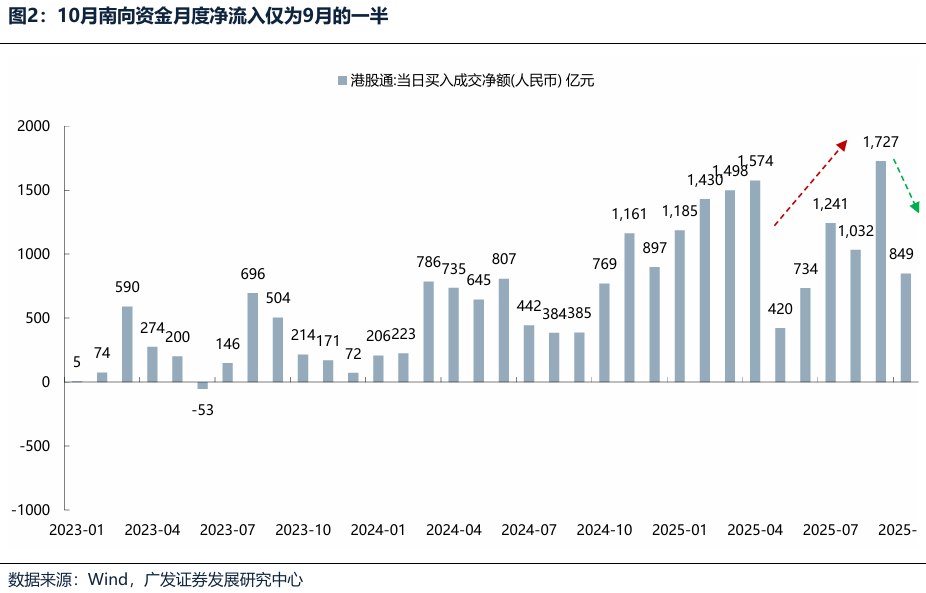
Core Viewpoint - Southbound funds have significantly increased their investment in Hong Kong stocks, with net purchases reaching record highs, indicating strong market interest and potential for future growth [1][2][3]. Group 1: Southbound Fund Inflows - On November 10, southbound funds recorded a net inflow of HKD 6.653 billion, marking the 14th consecutive trading day of net buying [1]. - Year-to-date, the total net inflow from southbound funds into Hong Kong stocks has exceeded HKD 1.3 trillion, surpassing the previous year's total [1]. - Cumulatively, since the launch of the southbound trading scheme, net purchases have historically exceeded HKD 5 trillion for the first time [2]. Group 2: Market Performance and Investment Opportunities - The Hong Kong stock market has seen impressive gains this year, driven by opportunities in AI asset revaluation, innovative pharmaceuticals, and the rise of new consumption [3]. - Major indices such as the Hang Seng Index and the Hang Seng Tech Index have risen over 30% year-to-date, while the Hong Kong Stock Connect Innovative Pharmaceutical Index has surged over 80% [3]. - Despite market fluctuations, the inflow of southbound funds remains robust, supported by a growing number of quality IPOs and secondary listings from US and A-share companies [3]. Group 3: Role of ETFs in Investment - The rise of passive investment strategies has made ETFs a key tool for buying Hong Kong stocks, with significant inflows into various ETFs [4]. - The China Universal Hong Kong Stock Connect Internet ETF has attracted HKD 55 billion this year, leading the inflow rankings among ETFs [4]. - Other notable ETFs, such as the ICBC Hong Kong Stock Connect Technology ETF and the E Fund Hong Kong Securities Investment Theme ETF, have also seen inflows exceeding HKD 20 billion [4]. Group 4: Pricing Power and Market Dynamics - The influx of southbound funds is gradually enhancing their pricing power in the Hong Kong market, with foreign capital starting to dominate trading volumes [5][6]. - Southbound funds are increasingly influencing the pricing dynamics in sectors like new consumption, dividends, and finance [6]. - ETFs have played a significant role in this shift, with substantial increases in holdings of Hong Kong brokerages by various ETFs [6]. Group 5: Valuation and Future Outlook - Current valuation levels in the Hong Kong market are considered attractive, with expectations of continued foreign capital inflows and enhanced pricing power for southbound funds [7]. - Analysts predict that the market will see a clearer influx of new capital in 2026, potentially exceeding HKD 1.5 trillion due to favorable conditions such as low allocation and anticipated interest rate cuts by the Federal Reserve [8].
广发证券:港股或再次迎来布局良机
智通财经网· 2025-11-09 23:28
Core Viewpoint - The foundation of the Hong Kong stock market bull run remains intact, but the evolution is likely to exhibit characteristics of "oscillating upward with a gradually rising focus" rather than a rapid one-sided increase. The fundamental drivers in November are strong, emphasizing the value of high-prosperity sectors [1][4]. Group 1: Market Dynamics - The recent volatility in the Hang Seng Technology Index is attributed to the reversal of previous favorable factors, leading to temporary liquidity pressure in the Hong Kong stock market [1]. - The current net profit growth rate and price increase may appear divergent; however, the recent rise in the Hong Kong stock market is strongly supported by fundamentals, with new industries experiencing explosive growth while traditional sectors lag [4]. - Industries with performance support, such as new energy, AI, non-ferrous metals, steel, and semiconductors, have seen larger price increases, while sectors with declining performance growth, like real estate, infrastructure, consumption, and finance, have seen smaller price increases [4]. Group 2: Economic Indicators - Over 70% of companies in the Hong Kong stock market are domestic enterprises, with revenue and profits derived from the Chinese economy. The operational trends of Hong Kong companies can be inferred from A-share financial reports [4]. - The overall stability and improvement in Chinese enterprises are attributed to advanced manufacturing, particularly in technology and external demand, despite ongoing pressures in traditional economic sectors [4]. Group 3: Future Triggers for Market Upturn - Potential triggers for the next phase of the Hong Kong stock market's rise include improvements in liquidity expectations, such as a dovish shift in the Federal Reserve's stance, the end of the U.S. government shutdown, and the cessation of balance sheet reduction by the Fed [8]. - The probability of a rate cut by the Federal Reserve in December has decreased to 66.9%, influenced by factors like the government shutdown and the Fed's balance sheet policies, which have led to a significant widening of the interest rate spread between SOFR and IORB [8][10].

国海富兰克林基金徐荔蓉: 资金结构发生质变 港股成配置“必选项”
Zhong Guo Zheng Quan Bao· 2025-11-09 22:28
Core Insights - The Hong Kong stock market is undergoing a fundamental value reassessment driven by changes in capital structure, asset quality, foreign capital trends, and market expectations [1][2] - Domestic capital has significantly increased its presence in the Hong Kong market, capturing a substantial share of quality assets and gradually gaining pricing power [1][2] Investment Landscape Changes - The investor structure in the Hong Kong market is shifting, with domestic funds increasingly participating and now accounting for a significant portion of trading volume [2][3] - Historically, the Hong Kong market was heavily influenced by offshore capital, which primarily focused on core assets, leaving many other assets under-researched and illiquid [2] - Domestic institutional investors, particularly public funds, have expanded their investment scope to include Hong Kong stocks, with nearly half of the public funds now able to invest in this market [2] Market Valuation and Opportunities - Despite recent fluctuations, the Hong Kong market has not shown signs of a bubble, with valuations merely returning to normal levels [4][5] - The core assets in the Hong Kong market, particularly internet companies, are expected to see a recovery in their traditional revenue streams, while AI-related business segments are still developing [5] - The banking sector in Hong Kong is viewed as undervalued, with price-to-book ratios significantly lower than global averages, indicating potential for long-term investment [5] Asset Allocation Perspective - The current asset allocation structure in China shows a low proportion of overseas investments, with public fund QDII products accounting for less than 4% [6] - A more balanced approach to asset allocation, including a reasonable increase in overseas investments, is suggested to enhance risk diversification and returns [6][7] - The Hong Kong market remains a crucial component for residents seeking to diversify risks and enhance their sources of returns [7] Investment Strategy and Product Development - The company emphasizes a bottom-up investment approach, focusing on fundamental research to uncover value in the Hong Kong market [8] - The investment team has developed capabilities in covering various sectors within the Hong Kong market, aiming for long-term returns while managing risk [8][9] - The company is expanding its product offerings to include passive index funds and thematic funds, targeting sectors such as dividends, consumption, innovative pharmaceuticals, and the internet [9]