
战略性新兴产业

Search documents
并购重组跟踪(二十九)
Soochow Securities· 2025-07-28 13:08
M&A Activity Overview - From July 21 to July 27, there were 95 M&A events involving listed companies, with 28 classified as major M&A transactions[10] - Out of the total, 19 M&A transactions were completed, including 2 major ones involving Anfu Technology and Fulede[10] Policy Updates - On July 25, the State-owned Assets Supervision and Administration Commission emphasized the importance of high-quality M&A and early investment in key sectors[7] - The Shenzhen Stock Exchange aims to enhance the quality and investment value of listed companies through M&A, streamlining the review process for eligible projects[8] Major M&A Transactions - Notable transactions included Hunan Development acquiring 90% stakes in multiple hydropower projects, with a total transaction value yet to be disclosed[14] - Anfu Technology completed a transaction for a 31% stake in Anfu Energy valued at approximately CNY 115.2 million[14] Failed M&A Events - There were 3 failed M&A attempts, including two by Beifang Changlong and one by Naer Co., with the latter involving a 51% stake in Jiangxi Lanwei Electronics valued at CNY 10,197.86[16] Control Changes - Four companies reported changes in actual control, including Bangjie Co. and Yueling Co., with the changes disclosed between July 18 and July 24[19] Market Performance - The restructuring index outperformed the Wind All A index by 0.61% during the week of July 21 to July 27[25] - Over a mid-term view, the restructuring index showed positive fluctuations compared to the Wind All A index over a rolling 20-day trading period[25] Risk Factors - Risks include potential misinterpretation of policies, slower-than-expected economic recovery, and geopolitical uncertainties impacting market conditions[28]
LP出资热度回升,创投市场走出 “寒冬”|月度LP观察
FOFWEEKLY· 2025-07-28 10:01
Core Insights - The domestic venture capital market in June showed signs of recovery, with increased activity from institutional LPs and a rise in new fund registrations, driven by policy LPs injecting crucial capital into the primary market [3][6][39]. Group 1: Institutional LP Activity - In June, the activity level of institutional LPs increased, with a month-on-month growth of 8.15% and a year-on-year increase of 41.12% in the number of contributions [6]. - A total of 409 new private equity and venture capital funds were registered in June, marking a 20.65% increase from the previous month and a 61.02% increase year-on-year [8]. - The types of LPs contributing in June were primarily policy LPs (39.05%), followed by industrial LPs (35.88%), financial LPs (19.23%), and others [10]. Group 2: Policy LPs - Policy LPs have been a significant force in the primary market, with over 800 billion yuan committed in the first half of 2025, accounting for nearly 70% of contributions [13]. - These LPs have provided stable funding during market fluctuations, effectively countering uncertainties and driving capital towards strategic emerging industries [13][14]. - In June, policy LPs primarily invested in strategic emerging industries, local特色产业, and advanced manufacturing sectors [14]. Group 3: Industrial LPs - Industrial LPs saw a 14% increase in activity in June, with non-listed companies showing a remarkable 17% growth, leading among all LP types [15]. - Key sectors for industrial LP investments included information technology, construction, and real estate, each demonstrating distinct investment strategies [15]. Group 4: Financial Institutions - Financial institutions increased their contributions by 16% in June, with insurance capital accounting for over half of the investments [23]. - Major insurance companies like China Life and Ping An Life led significant contributions, focusing on healthcare and strategic emerging industries [23][24]. Group 5: Regional Investment Trends - Jiangsu province led in both activity and contribution scale, with policy LPs driving capital towards strategic emerging industries and local economic development [28][32]. - The total scale of newly established specialized funds in Jiangsu reached 155 billion yuan, focusing on artificial intelligence, biomedicine, and advanced manufacturing [29]. - In contrast, central and western regions are increasing investments in local特色产业 to enhance regional economic development [33].


央企加快向“新”发力,努力开启增长“第二曲线”
Di Yi Cai Jing· 2025-07-28 05:46
Core Insights - The State-owned Assets Supervision and Administration Commission (SASAC) is focusing on exploring effective ways for investors to promote technological and industrial innovation, enhancing the "innovation resilience" of central enterprises [1][3] - Central enterprises are encouraged to accelerate the cultivation of new productive forces and shift from "sweat-type growth" driven by substantial input to "wisdom-type growth" driven by technological innovation [1][2] Group 1: Strategic Focus - SASAC emphasizes the importance of strategic orientation and long-termism, balancing traditional and emerging industries while expanding strategic emerging industries and future industries [1][3] - Central enterprises are urged to enhance their technological innovation capabilities and apply these innovations to specific industries and supply chains, transforming traditional industries and nurturing emerging ones [3][4] Group 2: Investment Trends - In 2022, central enterprises completed investments in strategic emerging industries totaling 2.7 trillion yuan, a year-on-year increase of 21.8%, with these investments accounting for over 40% of total investments for the first time [6][7] - In the first quarter of 2023, investments in strategic emerging industries by central enterprises grew by 6.6% year-on-year, with 79 future industry-related enterprises established [7] Group 3: Sectoral Development - Central enterprises are focusing on sectors such as artificial intelligence, quantum technology, and biomanufacturing, aiming to enhance their core competitiveness and development momentum [6][8] - SASAC is promoting a stable growth mechanism for investments in emerging industries, with a focus on high-quality investments that lead to high-value growth [5][7]

15个新一线城市排名更新:武汉领先苏州,南京仅第7,佛山入围
Sou Hu Cai Jing· 2025-07-28 05:02
Core Insights - The new ranking of emerging first-tier cities in China reveals a shift in urban development dynamics, highlighting intense competition and transformation among cities [1][2] - Wuhan's rise to fourth place, surpassing Suzhou, is a significant highlight, driven by strong advancements in technology innovation and industrial upgrades [1][2] Group 1: Economic Performance - Wuhan's GDP exceeded 2.1 trillion yuan in 2024, with high-tech industry output growth surpassing 15% for three consecutive years [1] - Suzhou maintains a GDP of 2.67 trillion yuan but faces a 7.8% decline in import and export volume due to a sluggish global consumer electronics market [2] - Nanjing, the only city in the top ten not to exceed 2 trillion yuan in GDP, is focusing on future industries like third-generation semiconductors and gene technology [2] Group 2: Industrial Development - Wuhan has seen the emergence of ten hundred-billion-level enterprises in sectors like optoelectronics and biomedicine, with significant contributions from companies like Yangtze Memory Technologies [1] - The manufacturing city of Foshan has successfully transformed its traditional industries, achieving an industrial output value exceeding 3 trillion yuan, with a 22% growth in smart equipment industry clusters [2] - Nanjing's strategic focus on cultivating new industries is evident, but its current strategic emerging industry proportion of 28.9% lags behind Wuhan's 35.6% [2] Group 3: Urban Transformation - The rankings reflect the differentiated development of new first-tier cities, with Chengdu's consumer vitality, Hangzhou's digital economy, and Foshan's manufacturing transformation being notable examples [2][5] - The ongoing urban evolution and industrial revolution in China are characterized by unprecedented vitality, indicating a robust process of new-type urbanization [5]

挖潜扩容 夯实民生之本
Liao Ning Ri Bao· 2025-07-27 02:09
Group 1 - The employment situation in the province is stable and improving, with a total of 281,000 new urban jobs created in the first half of the year, a year-on-year increase of 5.1%, achieving 59.8% of the annual target [1][3] - The province has implemented various measures to stabilize and expand employment, including the "Spring Warmth Liaoning" series of actions, which have helped address a labor shortage of 390,000 positions [2][4] - A total of 51,100 vocational training sessions have been conducted under the "Skills Liaoning Action," enhancing the skills of workers and improving employment quality [2][4] Group 2 - The province has introduced a comprehensive employment policy matrix consisting of 19 individual support policies to stabilize and expand job opportunities, alongside economic policies [4] - In the first half of the year, the province reduced labor costs for enterprises by 1.305 billion yuan through various subsidies and reduced unemployment insurance fees [4] - The establishment of 609 "Comfortable Employment" service stations has provided support to 128,000 unemployed individuals, facilitating job placements in local communities [7] Group 3 - The province has focused on promoting entrepreneurship, supporting 7,920 entrepreneurs in the first half of the year, which has led to the creation of 59,000 jobs [5] - Initiatives targeting key groups such as college graduates and migrant workers have been implemented, including 546 recruitment events and the release of 223,000 job postings [6] - The "Just Come to Liaoning" media platform has become a key resource for young job seekers, attracting nearly 900,000 active followers [6]
面向社会!昆仑集团战略性新兴产业专业人才及产业工人发布招聘公告
Bei Jing Ri Bao Ke Hu Duan· 2025-07-26 05:14
Group 1 - The core viewpoint of the announcement is the recruitment of specialized talents and industrial workers by China Railway Construction Kunlun Investment Group to strengthen the talent reserve for strategic emerging industries and promote the integration of innovation, industry, finance, and talent chains [1] - Kunlun Group, established in 2016 in Chengdu, focuses on strategic emerging industries and has comprehensive capabilities in investment, construction, and operation, with a significant presence in the southwestern region of China [1] - The company has invested in 41 expressways totaling 3,539 kilometers, with a contract amount exceeding 600 billion yuan, and operates 30 expressways with a total length of 2,488 kilometers [1] Group 2 - The recruitment process will follow principles of openness, fairness, and justice, including registration, qualification review, ability testing, and research for employment [4][5] - The recruitment timeline is open from the announcement date until December 31, 2026, with a first-come, first-served approach [4] - Candidates must submit a completed application form and relevant documents via email, ensuring the compressed file does not exceed 20MB [9] Group 3 - Basic conditions for applicants include loyalty to the company, strong political quality, good organizational and communication skills, and a healthy physical condition [3] - The salary and benefits will be determined based on the company's standards and the candidate's qualifications, with specifics to be discussed [8] - Candidates must provide original and photocopied documents for verification during the interview process, and any false information will lead to disqualification [11]

【省科技厅】需求牵引 加快聚集 有序流动 共享共用陕西统筹推进教育科技人才一体化发展
Shan Xi Ri Bao· 2025-07-26 00:06
Group 1 - The core viewpoint is that Shaanxi is focusing on breaking the bottlenecks in the interaction between education, technology, and talent, promoting integrated reforms and development in these areas [1] - Shaanxi is establishing a dynamic adjustment mechanism for university discipline and major settings to meet the needs of technological innovation and social development [1] - The province is implementing a "school recruitment shared" model to attract urgently needed talents, successfully recruiting 362 talents and training 1,500 master's and doctoral graduates through the "dual mentor system" [1] Group 2 - Shaanxi is promoting the orderly flow of technology talents through the "dual thousand plan," with 1,161 "technology vice presidents" and "technology consultants" appointed from universities and research institutes [2] - The province is focusing on cultivating a professional team of technology managers, establishing a training system, and supporting the creation of the first technology manager college at Xi'an Jiaotong University [2] - Shaanxi is enhancing the construction of the technology manager team and exploring flexible employment methods to stimulate the motivation and vitality of technology transfer talents [2]
江苏资本版图扩容 上半年新增A股公司12家
Shang Hai Zheng Quan Bao· 2025-07-25 18:21
Group 1: A-Share Market Performance - In the first half of the year, Jiangsu added 12 new A-share companies, including 3 on the Sci-Tech Innovation Board [2] - Among the new listings, Suzhou had 4, Changzhou 2, and other cities contributed 1 each [2] - Jiangsu also saw 6 companies listed on the Hong Kong Stock Exchange and 3 companies approved for the Beijing Stock Exchange [2][3] Group 2: Mergers and Acquisitions Activity - There were 152 disclosed equity mergers and acquisitions in Jiangsu, a year-on-year increase of 50.5%, with a total disclosed amount of approximately 39.6 billion yuan [4] - Companies are integrating upstream and downstream in their supply chains to enhance control, as seen with Canqin Technology's acquisition of a stake in Suzhou Weidu Antenna [4] - In the automotive sector, Yapu Co. announced a purchase of approximately 54.5% of Shanghai Yingshuang Technology for about 578 million yuan, enhancing its core competitiveness in automotive components [5] Group 3: Venture Capital and Fund Initiatives - The Jiangsu Provincial Strategic Emerging Industry Mother Fund, with a total scale of 50 billion yuan, was launched in June 2024, leading to the establishment of 36 industry-specific funds totaling 91.4 billion yuan [6][8] - Local governments are launching specialized funds focusing on key industries, such as the 10 billion yuan Wuxi Future Industry Angel Fund targeting strategic emerging industries [7] - Jiangsu's mother fund system has invested in 86 projects, with the third batch of industry-specific funds expected to attract more social capital [8]
上半年民企在银行间市场发行债务融资工具2384亿元 融资成本同比下降47BP
Xin Hua Cai Jing· 2025-07-25 13:54
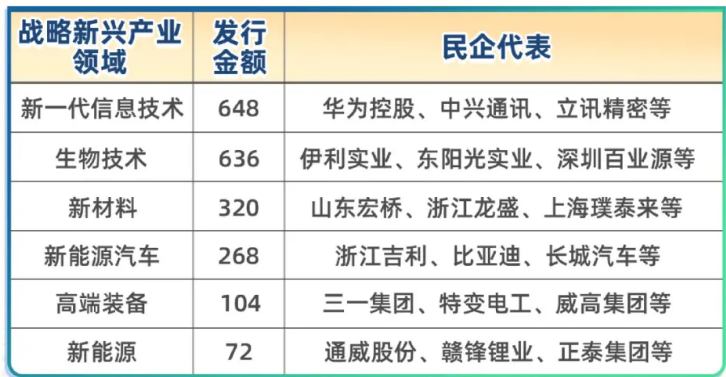
Group 1 - The core viewpoint emphasizes the ongoing efforts to address the financing difficulties faced by private enterprises, with a focus on enhancing bond financing channels and services [1] - In the first half of 2025, the Trading Association registered 60 private enterprises through the "Green Channel" mechanism, amounting to 236.6 billion, both figures doubling year-on-year [1] - The net financing of private enterprises through debt financing tools reached 55.7 billion, an increase of 42.6 billion year-on-year, with a weighted average interest rate of 2.11%, down 47 basis points, saving over 1.3 billion in financing costs [1] Group 2 - The issuance of medium and long-term debt financing tools for private enterprises reached 76.4 billion, a year-on-year increase of 21%, with the manufacturing sector holding the largest share at 45% [2] - The interbank market supported strategic emerging industries, facilitating the issuance of over 200 billion in debt financing tools for sectors such as new generation information technology, biotechnology, and new energy [2][3] - Specific amounts raised by various strategic emerging industries include 64.8 billion for new generation information technology, 63.6 billion for biotechnology, and 26.8 billion for new energy vehicles [3]
新华时评·年中经济观察丨让外贸发展韧性更强活力更足
Xin Hua She· 2025-07-25 10:52
Core Insights - China's foreign trade report for the first half of the year shows a total import and export value of 21.79 trillion yuan, a year-on-year increase of 2.9% [1] - Exports of high-end equipment grew by over 20%, and the export of "new three types" products accelerated [1] - The report highlights the need for innovation and market vitality to enhance the resilience of foreign trade amid a challenging global environment [1] Group 1 - The total import and export value of China's goods trade reached 21.79 trillion yuan, with growth in trade with over 190 countries and regions [1] - The focus is on transforming price and cost advantages into technological comparative advantages, emphasizing the value of "Made in China" [1] - There is a call to enhance the independent controllability of strategic emerging industries and to strengthen core technologies [1] Group 2 - The strategy includes diversifying trade markets to mitigate risks associated with reliance on single markets [2] - The importance of responding to diverse consumer demands with customized products is emphasized to maintain competitiveness [2] - China's deep integration into global supply chains is highlighted, showcasing mutual benefits in various sectors such as textiles and agriculture [2]