降息

Search documents
美国财长拉响警报:高利率正令住房陷入衰退,美联储必须加快降息
智通财经网· 2025-11-03 02:54
Group 1 - The U.S. Treasury Secretary Scott Basset indicated that certain sectors of the U.S. economy, particularly housing, may have entered a recession due to persistently high interest rates, urging the Federal Reserve to accelerate interest rate cuts [1][2] - Basset highlighted that high mortgage rates are hindering the real estate market, with the lowest-end consumers being the most affected due to high debt and low assets [1] - The National Association of Realtors reported that the number of existing home sales contracts remained flat month-over-month in September [1] Group 2 - Basset described the overall economic environment as a "transition period" and criticized Federal Reserve Chairman Jerome Powell's suggestion of a potential pause in rate cuts in December [2] - Federal Reserve Governor Stephen Milan expressed concerns that failure to quickly cut rates could lead to a recession, advocating for a more significant rate cut of 50 basis points instead of the recent 25 basis points [2] - Basset agreed with Milan's view, noting that the Trump administration's spending cuts have helped reduce the federal deficit as a percentage of GDP from 6.4% to 5.9%, which aids in lowering inflation [2]
美联储降息变数增加、市场对关税休战的反应
2025-11-03 02:35
Summary of Key Points from the Conference Call Industry or Company Involved - The discussion primarily revolves around the Federal Reserve's monetary policy and its implications for the U.S. economy and financial markets. Core Points and Arguments 1. **Federal Reserve's Stance on Interest Rates** Multiple Federal Reserve officials expressed opposition to interest rate cuts, with Chairman Powell's hawkish comments leading to a decrease in market expectations for a rate cut in December. This reflects the Fed's cautious approach towards inflation and the labor market [1][2] 2. **Market Reactions to Fed Policies** Following the Fed's hawkish signals, the U.S. dollar index rose to 99.7, marking its highest level since August 1. Additionally, U.S. Treasury yields increased significantly, indicating that the market has incorporated the Fed's signals into trading strategies [2][3] 3. **U.S. Trade Deficit and Dollar Strength** The U.S. trade deficit has returned to normal levels, alleviating some of the downward pressure on the dollar experienced earlier in the year. If the trade deficit does not expand significantly in the future, the dollar is expected to receive support [3][4] 4. **Fed's Policy Adjustments** The Fed announced it would halt the monthly reduction of $5 billion in Treasury securities and continue to reinvest maturing principal. This shift aims to ease market concerns about tightening liquidity and to adjust the average duration of its asset portfolio [4][5] 5. **Potential for Quantitative Easing (QE)** The likelihood of the Fed restarting QE is low unless interest rates fall to zero. Current high-interest rates provide sufficient room for rate cuts, making a return to QE unlikely in the near term [6] 6. **Liquidity Intervention Indicators** The difference between Sofra and IORB rates can indicate whether the Fed might intervene in liquidity. A widening spread suggests tightening liquidity, which has been a factor in the Fed's decision to stop balance sheet reduction [7] 7. **Market Response to U.S.-China Agreement** Following the recent U.S.-China agreement, U.S. stock markets reacted mildly while Hong Kong stocks declined. This response is attributed to the agreement's content being largely anticipated and not addressing fundamental issues such as trade imbalances [8][9] Other Important but Possibly Overlooked Content - The Fed's transition from MBS to T-Bills is seen as a return to traditional monetary policy operations, which may help stabilize market expectations and reduce government financing costs in a high-interest environment [5]
国际金融市场早知道:11月3日
Xin Hua Cai Jing· 2025-11-03 02:31
Market Insights - The U.S. stock market will adjust trading hours due to the start of Daylight Saving Time, with trading now occurring from 22:30 to 05:00 Beijing time starting November 3 [1] - The APEC joint statement acknowledges that the Asia-Pacific region is at a critical juncture, recognizing significant challenges to the global trade system and emphasizing the importance of creating a resilient trade and investment environment [1] - The U.S. federal government shutdown has reached its 32nd day, nearing the historical record of 35 days [1] Economic Indicators - U.S. Treasury yields have collectively decreased, with the 2-year yield down by 3.46 basis points to 3.574% and the 10-year yield down by 1.37 basis points to 4.083% [4] - The Eurozone's October CPI rose by 2.1% year-on-year, slightly down from 2.2% in September, while core CPI remained unchanged at 2.4%, exceeding market expectations [2] - Japan's Tokyo core CPI increased by 2.8% year-on-year in October, surpassing the Bank of Japan's 2% target, further raising expectations for a potential interest rate hike [2] Commodity Markets - International precious metal futures generally declined, with COMEX gold futures down 0.06% to $4013.40 per ounce, marking a weekly drop of 3.01% [5] - U.S. oil futures rose by 0.51% to $60.88 per barrel, while Brent crude oil futures increased by 0.33% to $64.58 per barrel [5] Currency Movements - The U.S. dollar index rose by 0.18% to 99.72, with most non-U.S. currencies declining against the dollar [5]
24小时环球政经要闻全览 | 11月3日
Ge Long Hui A P P· 2025-11-02 23:28
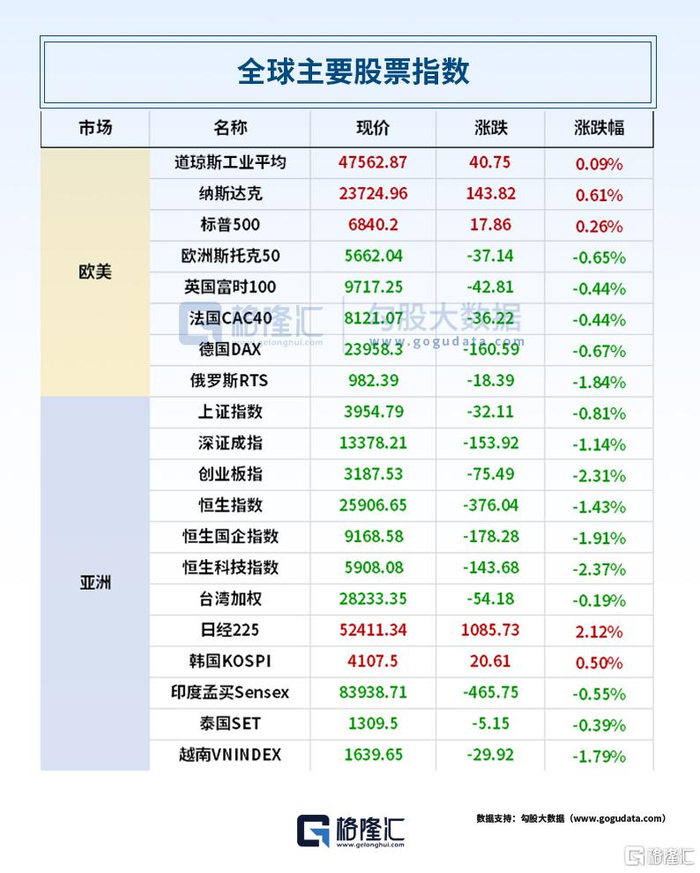
Market Overview - Major global stock indices showed mixed performance, with the Dow Jones Industrial Average at 47,562.87, up by 40.75 points (0.09%) and the Nasdaq at 23,724.96, up by 143.82 points (0.61%) [1] - European indices, such as the Euro Stoxx 50 and the UK FTSE 100, experienced declines of 0.65% and 0.44% respectively [1] - Asian markets also faced downward pressure, with the Shanghai Composite Index down by 0.81% and the Hang Seng Index down by 1.43% [1] Economic Policy - The U.S. Treasury Secretary, Yellen, indicated that if inflation decreases, the Federal Reserve should consider lowering interest rates, which could help end the real estate downturn [2] - Yellen emphasized that the U.S. economy is in a transitional phase, with some sectors already in recession [2] Oil Production - OPEC+ confirmed plans to increase oil production by 137,000 barrels per day in December, maintaining the same increase as in October and November [4] - The group anticipates a seasonal decline in demand in the first quarter of 2026 and has agreed to pause production increases at that time [4] Corporate Developments - Berkshire Hathaway reported a record cash reserve of $381.7 billion, surpassing its previous high of $347.7 billion in the first quarter of this year, and has not repurchased any stock for five consecutive quarters [10] - Vanke announced that its largest shareholder, Shenzhen Metro Group, plans to provide a loan of up to 22 billion yuan, which includes previous unsecured borrowings, to repay public market bond principal and interest [11]



美国财长贝森特:若通胀下降,美联储应该降息
Sou Hu Cai Jing· 2025-11-02 15:32
Core Viewpoint - US Treasury Secretary Becerra suggests that the Federal Reserve should continue to lower interest rates if inflation continues to decline, indicating a proactive approach to monetary policy in response to economic conditions [1] Economic Conditions - The Federal Reserve has implemented two rate cuts of 25 basis points each in September and October [1] - The preferred PCE inflation rate of the Federal Reserve remains at 2.7% [1] - Becerra describes the US economy as being in a "transitional period" [1] Government Spending and Economic Impact - Becerra criticizes the lack of attention to the Trump administration's efforts to cut government spending, especially as the fiscal year ended on September 30 coinciding with the government shutdown [1] - Overall, the economic condition is described as "good," but certain sectors are reported to be "in recession" [1] Real Estate Market - Becerra urges the Federal Reserve to lower mortgage rates to end the "real estate recession" [1]
美联储如期降息25bp,关注金铜铝优质标的:——金属&新材料行业周报20251027-20251031-20251102
Shenwan Hongyuan Securities· 2025-11-02 10:29
Investment Rating - The report maintains a positive investment rating for the metals and new materials industry, highlighting strong performance in various sub-sectors [3][4]. Core Insights - The report indicates that the overall performance of the metals sector has outperformed the broader market, with the non-ferrous metals index rising by 75.90% year-to-date, surpassing the CSI 300 index by 57.96 percentage points [4][8]. - Key drivers for the sector include a favorable supply-demand balance, particularly in energy metals and lithium, which have seen significant price increases [3][8]. - The report suggests that the recent interest rate cuts by the Federal Reserve may lead to upward adjustments in valuation multiples across the sector, particularly for companies with stable supply-demand dynamics [3][8]. Weekly Market Review - The Shanghai Composite Index increased by 0.11%, while the Shenzhen Component Index rose by 0.67%. The non-ferrous metals index increased by 2.56%, outperforming the CSI 300 by 2.99 percentage points [4][6]. - Precious metals saw a slight increase of 0.61%, while aluminum prices rose by 4.25%, and energy metals surged by 6.31% [3][8]. - Year-to-date performance shows significant gains across various metals, with copper up 96.09% and lithium carbonate prices increasing by 8.67% [8][12]. Price Changes and Key Company Valuations - The report details price changes for key metals, with copper prices at $10,888 per ton, reflecting a 24.17% increase year-on-year, while aluminum prices are reported at $21,300 per ton, up 7.68% year-on-year [13][15]. - The report provides valuations for key companies in the sector, indicating that companies like Zijin Mining and Shandong Gold have favorable price-to-earnings (PE) ratios, suggesting potential for growth [15][16]. Supply and Demand Dynamics - The report highlights that domestic social inventory of copper has increased slightly to 183,000 tons, while overall exchange inventories rose to 573,000 tons [22]. - The operating rates for copper processing facilities show a slight decline, indicating potential supply constraints in the near term [22][33]. - The aluminum sector is experiencing a tight supply-demand balance, with operating rates for downstream processing slightly decreasing [33]. Recommendations - The report recommends focusing on companies with integrated operations and those showing cost improvement potential, such as China Aluminum and Zhongjin Lingnan Nonfemet Company [3][8]. - It also suggests monitoring companies in the renewable energy manufacturing sector, which are expected to benefit from the ongoing transition towards sustainable energy solutions [3][8].
降息分歧显现,贵金属调整不改长期趋势
Tianfeng Securities· 2025-11-02 07:15
Investment Rating - Industry Rating: Outperform the market (maintained rating) [6] Core Views - The report indicates that the precious metals market is experiencing a decline in prices due to easing trade concerns and profit-taking activities, with gold and silver prices dropping by 3.89% and 3.62% respectively [2][28][30] - The base metals market shows mixed signals, with copper prices continuing to rise despite weak demand and high inventory levels, while aluminum prices have reached new highs due to stable supply and positive macroeconomic sentiment [1][21][22][32] Summary by Sections Base Metals & Precious Metals - Copper: Prices have continued to rise, with the current price at 87,130 CNY/ton, but demand remains weak, leading to cautious purchasing behavior from downstream enterprises [1][13] - Aluminum: Prices have increased to 21,415 CNY/ton, supported by stable supply and positive macroeconomic factors, with a notable increase in aluminum rod production [1][21][22] - Precious Metals: Gold and silver prices have decreased, attributed to reduced safe-haven demand following improved trade relations and market expectations regarding the Federal Reserve's monetary policy [2][28][30] Minor Metals - Antimony: Prices are under pressure, but new export regulations may help restore demand [3][41] - Rare Earths: Prices are beginning to rise, driven by expectations of export recovery and stable demand [4][41] Market Predictions - The report anticipates that copper prices will face upward pressure in the short term, while aluminum prices are expected to remain high due to favorable macroeconomic conditions [1][14][21] - Precious metals are likely to continue experiencing price fluctuations, influenced by geopolitical developments and monetary policy announcements [2][29][30]
本周外盘看点丨美联储官员密集发声,美最高法院举行关税案听证
Di Yi Cai Jing· 2025-11-02 03:30
Core Viewpoint - The article discusses the recent monetary policy decisions by various central banks, particularly the Federal Reserve's interest rate cut, and the implications for markets, including gold and oil prices, as well as upcoming economic data releases and corporate earnings reports. Group 1: Central Bank Decisions - The Federal Reserve announced a 25 basis point interest rate cut, leading to mixed reactions in the stock market, with the Dow Jones up 0.75%, Nasdaq up 1.97%, and S&P 500 up 0.71% for the week [1] - The focus is on whether the Fed will cut rates again in December, with significant attention on the potential resolution of the government shutdown affecting key economic data releases [2][3] - Other central banks, including those in the UK, Australia, Brazil, Mexico, Sweden, Norway, and Malaysia, are also expected to announce their interest rate decisions this week [1] Group 2: Employment Indicators - Despite the Fed's rate cut, the dovish tone was less than expected, with Chairman Powell indicating that further cuts are not guaranteed, raising concerns about the labor market [2] - The government shutdown has delayed the release of critical employment data, including the non-farm payrolls, which may impact market expectations for future rate cuts [2][3] Group 3: Commodity Prices - Oil prices have declined due to concerns over increased global supply overshadowing the impact of U.S. sanctions on Russian oil exports, with WTI crude down 0.85% to $60.98 per barrel [4] - Gold prices fell 3.41% to $3982.20 per ounce, influenced by a strong dollar and expectations of future interest rate cuts, with Morgan Stanley projecting an average gold price of $4300 per ounce in the first half of 2026 [5] Group 4: Economic Data and Corporate Earnings - Upcoming economic data releases include the ISM Purchasing Managers' Index (PMI) and ADP employment report, which will be closely watched for signs of economic weakness that could reignite rate cut expectations [3] - The earnings season continues with notable companies reporting, including AMD, Qualcomm, Uber, and Pfizer, which may influence market sentiment [3][8]

12 月降息要泡汤?美联储内讧吵翻天,鲍威尔亮底牌:非板上钉钉!
Sou Hu Cai Jing· 2025-11-01 08:48
就在本周的降息决策里,分歧已经摆到明面上:堪萨斯城联储主席杰弗里·施密德直接反对降息,美联 储理事斯蒂芬·米兰却觉得降得不够,得再加大幅度。合着这委员会对进一步降息的意愿已经明显降 温,这拉扯感简直没谁了。 美联储这波操作直接把市场看懵了!12月到底要不要再降息?官员们吵得不可开交,鲍威尔一句话浇凉 投资者期待,主打一个悬念拉满。 作为一把手的美联储主席杰罗姆·鲍威尔,周三直接亮明态度:12月能不能来第三轮降息,现在真说不 准。之前不少投资者还盼着降息顺顺利利,结果鲍威尔一盆冷水泼下来,强调最终得看后续经济数据的 脸色。 关键矛盾还在就业上:为啥就业增长放缓?官员们吵来吵去没共识,是移民少了?劳动力参与率下降 了?还是市场需求真的疲软了?更麻烦的是,政府关门导致就业数据没法按时发布,给决策又添了层不 确定性,纯属雪上加霜。 可另一边的风险也不小:高利率的影响慢慢累积,再加上贸易政策和移民政策调整,最后很可能冲击劳 动力市场。要是现在停了降息,失业率说不定就得往上走,鲍威尔都透露了,部分就业指标显示新增岗 位几乎快降到零了。 连续两次降息后,美联储利率已经快到中性水平,就是那种既不刺激经济也不抑制经济的状态,这 ...
美联储再降息25基点,缓解市场压力,资金流动性显著改善
Sou Hu Cai Jing· 2025-11-01 05:57
Core Points - The Federal Open Market Committee (FOMC) decided to lower interest rates by 25 basis points, bringing the rate range to 3.75-4.00% [5] - There were internal disagreements among committee members regarding the extent of the rate cut, with one member advocating for a 50 basis point cut [1][7] - The FOMC emphasized the need to monitor labor market conditions, inflation expectations, and international financial situations closely [3][10] Summary by Sections Interest Rate Decision - The FOMC's decision to cut rates by 25 basis points reflects a cautious approach to monetary policy, balancing the need for economic support with concerns about inflation [5][10] - The end of balance sheet reduction on December 1 is a significant milestone, indicating a shift in monetary policy strategy [5][10] Internal Disagreements - There were two dissenting votes during the meeting, highlighting differing views on the pace of monetary easing among committee members [1][7] - Member Stephen Milan has consistently advocated for a more aggressive approach, while Jeffrey Schmieding has favored a more cautious stance [1][7] Economic Outlook - The FOMC noted that economic activity is expanding moderately, with job growth slowing and a slight increase in the unemployment rate, indicating a stable but not robust labor market [1][9] - The committee reiterated its commitment to achieving maximum employment and returning inflation to the 2% target, emphasizing the importance of upcoming economic data [9][10] Future Monitoring - The FOMC will continue to assess economic data and risks, leaving room for potential policy adjustments in response to changing conditions [10][11] - The upcoming data releases will be critical in determining the future direction of monetary policy, particularly following the rate cut and the end of balance sheet reduction [11]