AI泡沫

Search documents
深夜暴跌!“AI泡沫”担忧再起
Zheng Quan Shi Bao· 2025-10-30 15:22
Core Viewpoint - Meta's stock plummeted nearly 12% following its unexpected capital expenditures, raising concerns about potential AI investment bubbles in the tech industry [3][4]. Group 1: Financial Performance and Market Reaction - Major tech companies, including Alphabet, Meta, and Microsoft, reported a combined capital expenditure of approximately $78 billion in Q3, an increase of 89% year-over-year [3]. - Meta's significant capital spending led to a sharp decline in its stock price, while Alphabet's stock rose over 5% as investors reacted more favorably to its spending increase [3][4]. - Despite a strong performance earlier in the year, Meta's single-day drop shocked the market, highlighting investor sensitivity to spending levels [4]. Group 2: Management Insights and Future Outlook - Meta's CEO Mark Zuckerberg addressed concerns about over-investment in infrastructure, stating that the company has contingency plans, including reallocating excess computing power to core business operations or selling it to other companies [4]. - The Reality Labs division of Meta, responsible for developing AI smart glasses and other wearable devices, reported a loss of $4.4 billion in Q3, with revenues of only $470 million [4]. - Microsoft’s CFO Amy Hood emphasized that despite significant investments in AI, the company still cannot meet the growing market demand across multiple sectors [5].

深夜暴跌!“AI泡沫”担忧再起
证券时报· 2025-10-30 15:05
Core Viewpoint - The article discusses the recent volatility in the stock market, particularly focusing on the significant drop in Meta's stock price following its earnings report, raising concerns about excessive capital expenditures in the AI sector and the potential for a bubble [2][5][10]. Financial Performance of Tech Giants - Major tech companies, including Alphabet, Meta, and Microsoft, reported a combined capital expenditure of approximately $78 billion in Q3, representing an 89% increase year-over-year. This spending is primarily directed towards data center construction and equipping them with GPUs and other devices [5][10]. - Meta's stock plummeted nearly 12% after its earnings report, attributed to unexpected high capital expenditures and warnings of significantly higher spending in 2026 compared to 2025 [5][9]. - In contrast, Alphabet's stock rose over 5% as investors reacted more favorably to its increased capital spending [5]. Market Sentiment and Concerns - Investors are increasingly questioning whether the substantial investments in AI by these companies are justified or if they indicate a bubble forming in the sector [2][5][10]. - Microsoft reported a record capital expenditure of $34.9 billion in Q3, which surprised investors and led to concerns about the return on investment in AI [10]. Federal Reserve's Monetary Policy - The Federal Reserve's potential interest rate cut in December is uncertain, with differing opinions among committee members. The likelihood of a rate cut has decreased from 90% to 67% according to CME data [4].




英伟达5万亿美元市值:新起点or泡沫?
Zhong Guo Jing Ying Bao· 2025-10-30 14:36
Core Viewpoint - Nvidia has become the first publicly traded company in the world to surpass a market capitalization of $5 trillion, reflecting its dominant position in the AI sector and raising questions about whether this valuation represents a new benchmark or an "AI bubble" [1][6]. Group 1: Market Performance - Nvidia's stock price increased by 3% to $207.04, with a year-to-date gain exceeding 50% [1]. - The company's market capitalization reached $5.03 trillion, marking a significant milestone in its valuation history [1][6]. - Since the launch of ChatGPT in November 2022, Nvidia's stock has surged approximately 11 times, indicating strong investor confidence in its growth potential [6]. Group 2: Demand and Supply Dynamics - The surge in Nvidia's market value is attributed to the explosive global demand for AI, positioning Nvidia as a key supplier in the AI "arms race" [2]. - Nvidia's AI chips, particularly the H100, are in high demand, with companies needing to place orders months in advance due to supply constraints [2][3]. - Major cloud computing companies are projected to increase capital expenditures significantly, indicating sustained demand for Nvidia's products [3]. Group 3: Competitive Landscape - Nvidia's competitive advantage is bolstered by its CUDA software ecosystem, which creates a high barrier to entry for competitors like AMD and Intel [2]. - Despite losing its market share in China, Nvidia is still expected to find growth opportunities in other global markets [3][5]. - The company faces increasing competition from emerging players in the AI chip market, particularly from Chinese firms [7]. Group 4: Valuation Concerns - Analysts have mixed views on whether Nvidia's valuation is justified, with some suggesting that the AI bubble has not yet burst [6][7]. - Nvidia's current price-to-earnings ratio is approximately 33 times its expected earnings, compared to the S&P 500 average of about 24 times, raising concerns about its high valuation [7]. - The potential for challenges in AI commercialization and regulatory issues could impact Nvidia's future growth trajectory [7].

英伟达的泡沫,或许能再吹5万亿美元
虎嗅APP· 2025-10-30 13:13
Core Viewpoint - Nvidia's stock price has surpassed $210, making it the first company in history to reach a market capitalization of $5 trillion, raising questions about the sustainability of this valuation and whether the bubble will burst soon [2][3]. Group 1: Market Comparison - Nvidia's market growth is compared to Intel's historical growth from $120 billion to $509 billion between 1996 and 2000, driven by the PC market, while Nvidia's growth is supported by diverse markets including AI, data centers, consumer graphics, and autonomous driving [5]. - Nvidia's revenue compound annual growth rate (CAGR) is projected to exceed 100% from fiscal year 2022 to 2025, contrasting with Intel's 12.6% CAGR from 1996 to 2020 [5]. - Nvidia operates as a fabless company, avoiding the heavy asset burdens of traditional chip manufacturers, which allows for more flexible capital allocation [6]. Group 2: AI Industry Context - The article discusses the potential for Nvidia's business model to be likened to an "energy company" in the AI industry, as it provides essential computational power rather than just infrastructure [10][13]. - Nvidia's recent $100 billion investment proposal to OpenAI for building data centers illustrates its role in the AI ecosystem, where it acts as a provider of computational resources [11][12]. - The AI industry is experiencing a bubble, potentially larger than previous internet bubbles, with companies like OKLO achieving high valuations despite minimal revenue [17]. Group 3: Future Outlook - Nvidia's growth is expected to continue for the next one to two years, driven by technology-driven industries that have yet to fully utilize computational power [18][20]. - The company has positioned itself to support various AI research directions, ensuring a steady demand for its computational resources, even if the commercial viability of these applications remains uncertain [21]. - Concerns about potential computational resource overcapacity are not immediate, as the demand for AI-related computational power is still growing [21].

10月美联储议息会议点评:10月FOMC:降息路径反转?
Tianfeng Securities· 2025-10-30 09:18
Report Summary 1. Report Industry Investment Rating The provided content does not mention the industry investment rating. 2. Core Viewpoints of the Report - The benchmark scenario is still a 25bp interest rate cut in December and about 3 more cuts next year. The sudden drop in interest rate cut expectations caused by Powell's speech may be temporary, and the expectations are expected to gradually recover [4][5]. - The impact of Powell's "hawkish speech" is expected to be temporary. Subsequently, the market may return to the trajectory of the interest rate cut cycle. Treasury yields will continue to decline, the dollar will weaken, and the gold price is expected to recover after a correction. The interest rate cut cycle will be beneficial to emerging market stocks and bonds. In a low - probability scenario, if the Fed pauses interest rate cuts in December and has difficulty advancing cuts in 2026, Treasury yields and the dollar may remain high, the gold price will be continuously suppressed, US stocks will face pressure, and emerging market assets will also face greater pressure [6][27]. 3. Summary by Related Catalogs 3.1 Meeting Statement Continues to Be Dovish, End Quantitative Tightening in December - On October 29, the Fed cut interest rates by 25bp as expected, lowering the federal funds target rate to the 3.75% - 4% range. There were 2 dissenting votes, indicating an escalation of internal game within the Fed [1][7]. - The economic description in the meeting statement was similar to that in September, maintaining a dovish tone. Employment growth has slowed, and the risk of employment decline has increased in recent months. Inflation is still slightly high [1][7]. - The Fed will end quantitative tightening (QT) on December 1. Since the start of QT in June 2022, the Fed's total assets have decreased from $9 trillion to $6.6 trillion. Currently, the bank reserve balance is $2.93 trillion. Excessive withdrawal of reserves may lead to a liquidity crisis, and there have been recent signs of tightened liquidity and pressure on the money market [1][7][8]. 3.2 Powell Is Hawkish, Emphasizes December Interest Rate Cut Is Uncertain - Different from the mild meeting statement, Powell showed a hawkish stance at the press conference, emphasizing that a December interest rate cut is far from certain. The Fed has not made a decision on the December meeting, and there are serious differences among committee members. More and more officials hope to postpone the interest rate cut [2][15]. - Powell believes that the economy is basically healthy, and inflation is still slightly high. He also comforted the market about concerns over the AI bubble, saying that AI is different from the 1990s bubble as companies are already profitable [2][15]. - Regarding the Fed's balance sheet, Powell's stance is dovish. He pointed out that there is obvious pressure in the money market, and quantitative tightening needs to be stopped immediately. Eventually, "we will increase reserves at some point" [2][15]. 3.3 Has the Interest Rate Cut Path Reversed? Currently, It's Uncertain - Market expectations for interest rate cuts in December and 2026 have significantly decreased. After Powell's press conference, the market - expected probability of a December interest rate cut dropped to 67.8% (90.5% before this FOMC), and the market expects only 1 interest rate cut in 2026 (3 cuts were expected last weekend) [3][18]. - Treasury yields rose significantly, the dollar strengthened, US stocks dived during the session but the Nasdaq closed higher due to AI, and gold turned down during the session [3][18]. - The interest rate cut path may not have reversed. Powell emphasized that the December interest rate cut is undecided, mainly to leave room for flexible operations. Leading indicators of CPI components such as used - car inflation, housing inflation, and wage - related service inflation are all declining [4][19].
A股4000点!既不是起点也不是终点
雪球· 2025-10-30 07:50
Core Viewpoint - The article discusses the recent rise of the A-share market, particularly the significance of the 4000-point level, emphasizing that liquidity is the key factor driving this market movement rather than fundamental performance [8][31]. Group 1: Market Sentiment and Trends - The A-share market recently surpassed the 4000-point mark, which was previously viewed as a potential peak by many investors [5][6]. - There is a tendency for investors to become more optimistic as the market rises and more pessimistic during declines [4]. - The article suggests that the 4000-point level may serve as a new starting point for the market rather than a peak [5][31]. Group 2: Liquidity and Market Dynamics - The current bull market is primarily driven by valuation expansion rather than earnings growth, indicating that liquidity is crucial for further price increases [8][9]. - The People's Bank of China (PBOC) announced the resumption of government bond trading, which coincided with the market reaching 3999 points, suggesting a strategic move to support the bond market [10][12]. - The relationship between U.S. monetary policy and Chinese liquidity is highlighted, with the PBOC's actions potentially influenced by ongoing U.S.-China negotiations [12][25]. Group 3: U.S.-China Relations and Economic Implications - The article posits that discussions between the U.S. and China extend beyond tariffs, encompassing financial matters that could impact market liquidity [14][15]. - China's international financial influence is growing, with significant capital held overseas that could affect U.S. markets [15]. - The potential for U.S. interest rate cuts is linked to China's economic strategies, particularly regarding rare earth materials and AI investments [16][17][22]. Group 4: Future Market Outlook - The article concludes that as long as liquidity continues to be released, the foundation for a bull market remains intact, with the possibility of economic recovery driving performance [31][33]. - The upcoming period may see a temporary ceasefire in U.S.-China tensions, allowing for potential advancements in technology and economic collaboration [34][36]. - The 4000-point level is deemed neither a definitive starting point nor an endpoint, emphasizing the importance of a robust investment strategy over short-term market fluctuations [46][47].

公司债ETF(511030):以稳健之道,捕捉债市机遇
Sou Hu Cai Jing· 2025-10-30 05:41
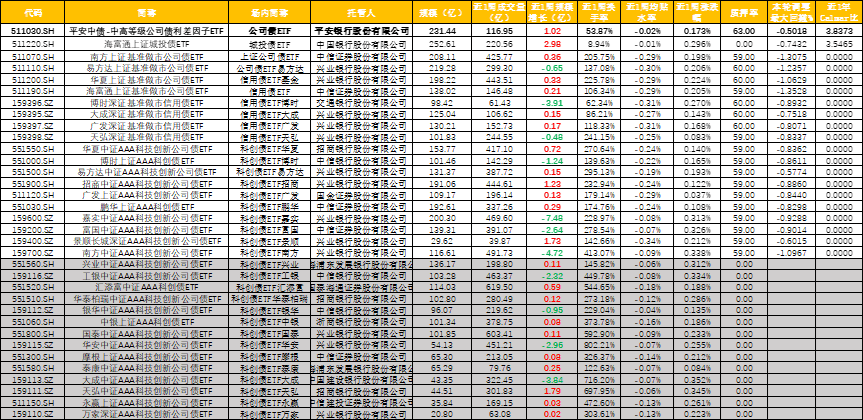
Group 1 - The Federal Reserve lowered interest rates by 25 basis points as expected, maintaining a dovish tone in its economic outlook, indicating rising risks in employment and persistent inflation [1] - The Fed will end its balance sheet reduction (QT) on December 1, which was anticipated by Powell in a previous speech [1] - Market signals indicate pressure in the money market, with significant usage of the Fed's standing repo facility (SRF) since October and a notable increase in the SOFR-IORB spread [1] Group 2 - Powell displayed a hawkish stance during the press conference, emphasizing that a rate cut in December is not guaranteed, with increasing divisions among committee members regarding the timing of future cuts [1] - Following Powell's comments, market expectations for a December rate cut dropped to 67.8% from 90.5%, with only one rate cut anticipated in 2026 compared to three previously expected [1] - U.S. Treasury yields rose significantly, the dollar strengthened, and the stock market experienced volatility, although the Nasdaq ultimately closed higher due to AI-driven gains [1] Group 3 - The Ping An Company Bond ETF (511030) saw a counter-trend growth of 102 million, attributed to its short duration (1.94 years), static high yield (1.95%), minimal discount (average -0.02%), and low drawdown (-0.50% year-to-date) [1] - The ETF's unique positioning and competitive advantages contributed to its performance amidst a broader trend of capital outflows from credit bond ETFs [1]
Coatue 最新报告:复盘 400 年、 30+ 次泡沫,我们离 AI 泡沫还很远
3 6 Ke· 2025-10-30 02:16
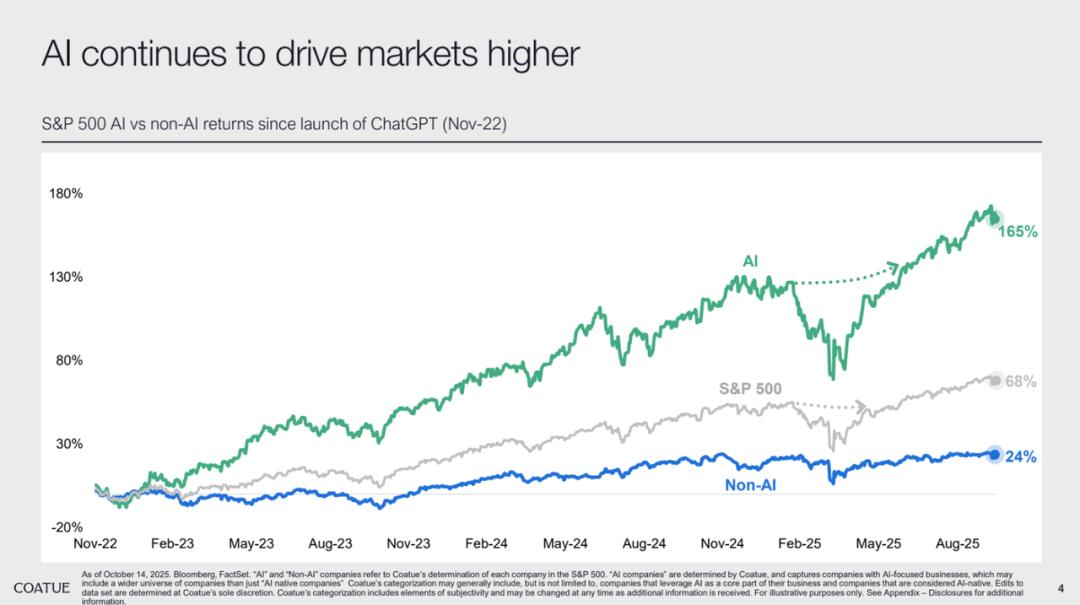
Core Viewpoint - The current AI trend is not a bubble but a genuine and long-term productivity revolution, as stated by Coatue in their latest secondary market report [1][2]. Market Analysis - The AI sector has been a core driver of growth in the U.S. stock market since the launch of ChatGPT in November 2022, with AI-related companies in the S&P 500 achieving a return of 165% over nearly three years, significantly outperforming the overall index return of 68% and the 24% return of non-AI companies [3]. - The growth of AI has expanded beyond the "Mag 7" companies, with AI-related returns in 2025 exceeding those of the Mag 7 for the first time, indicating a broader market penetration [6][8]. Sector Performance - AI sectors such as energy, semiconductors, and software have shown returns significantly higher than the Mag 7, with AI energy achieving a 53% return in 2025 YTD, three times that of the Mag 7 [8][12]. - The AI industry's growth is transitioning from being driven solely by algorithmic breakthroughs to include innovations in energy supply, semiconductor manufacturing, and data infrastructure [12]. Consumer Resilience - Strong consumer fundamentals have alleviated concerns about economic recession, providing crucial support for corporate earnings and financial assets [13]. Historical Context - Historical analysis indicates a 48% probability of continued market growth in 2026, based on past performance of the S&P 500 after three consecutive years of growth [15]. - Long-term holding strategies are emphasized, as premature selling during periods of high growth can lead to significant opportunity costs [18][20]. AI Bubble Characteristics - Coatue defines a bubble as a state where asset prices significantly exceed intrinsic value, driven by speculation and investor behavior. The current AI investment trend resembles characteristics of both stock market and infrastructure bubbles [21][25]. AI Adoption Concerns - Market skepticism regarding AI includes concerns about inflation, high valuations, concentration of AI winners, and capital expenditures. However, Coatue counters these concerns with data showing a decline in inflation expectations and a sustainable growth trajectory for AI companies [31][35][41][52]. AI Profitability Framework - Coatue outlines a profitability framework for AI, highlighting both direct and indirect benefits, such as revenue increases from AI products and cost savings from operational efficiencies [89]. - The potential for AI revenues to grow tenfold in the next 5-10 years, reaching $1 trillion in profits, is projected, with AI expected to account for 4% of global corporate profits [98]. Market Signals - Current IPO activity and leverage levels indicate that the equity market is not exhibiting bubble-like characteristics, although high retail investor leverage poses potential risks [102][106]. AI Infrastructure Focus - The AI infrastructure sector has outperformed software sectors since the launch of ChatGPT, with significant returns in semiconductor indices compared to cloud software indices [107][109]. - The rise of AI applications is also noted, with several private AI application companies achieving valuations exceeding $5 billion, indicating a shift towards scalable AI solutions [111]. Investment Principles - Coatue emphasizes the importance of long-term investment strategies in AI, advising against premature selling and highlighting the need to monitor private market dynamics for early signs of industry changes [124][125].

英伟达市值突破5万亿美元,“AI泡沫”在什么情况下会破裂?
Sou Hu Cai Jing· 2025-10-29 23:01
Group 1 - Nvidia's market capitalization has surpassed $5 trillion, equivalent to approximately 16% of the projected US GDP for 2024 [2] - Over the past three years, Nvidia's stock price and market value have significantly increased, with year-to-date gains of 54.13% for 2025, and 242.63% and 171.05% for 2023 and 2024 respectively [2] - Nvidia's market value has grown more than tenfold in three years, from under $400 billion to becoming the highest valued company globally [2] Group 2 - The rise of AI and robotics is seen as a new wave of global technological revolution, similar to previous eras such as the PC, smartphone, and electric vehicle revolutions [2] - The existence of a bubble in AI technology is debated, with two key assessment methods: whether new technology drives substantial enterprise growth and industry chain development, and whether there is significant market demand tied to various industries [2] Group 3 - Capital expenditure trends of leading companies can indicate actual market demand; sustained growth in capital expenditure suggests strong market demand [3] - Evaluating the profitability growth of listed companies or industry sectors is crucial to determine if it keeps pace with valuation increases, using metrics like PEG and forward P/E ratios [4] Group 4 - External factors such as policy and market environments play a role in supporting long-term valuation premiums [5] - Nvidia and other tech giants benefit from high valuation premiums due to their high-growth industry status and external factors like the Federal Reserve's interest rate cuts [6] - The current high growth state of AI is supported by capital expenditures and market demand, but caution is advised if profitability growth does not match valuation increases [6]
今夜!突然暴雷!
Sou Hu Cai Jing· 2025-10-29 16:27
Group 1 - The U.S. stock market saw an increase, with major indices reaching record highs ahead of the Federal Reserve's interest rate decision [1][2] - Nvidia's stock rose approximately 4%, making it the first company to reach a market capitalization of $5 trillion, amidst optimism surrounding AI [1] - Fiserv, a financial technology giant, experienced a significant stock drop of 40% after lowering its earnings per share forecast and reporting disappointing third-quarter results [2][3] Group 2 - Fiserv's CEO Mike Lyons announced a downward revision of the adjusted earnings per share (EPS) forecast for the year from $10.15-$10.30 to $8.50-$8.60, with third-quarter revenue and EPS falling short of analyst expectations [5][6] - The decline in Fiserv's performance was primarily attributed to its "Financial Solutions" division, which saw a 3% revenue drop and a profit margin decrease of approximately 5 percentage points year-over-year [7] - Analysts expressed shock at the rapid deterioration of Fiserv's business, with some stating that the management's explanations for the unexpected changes in revenue assessments were unconvincing [6][7]