技术迭代

Search documents
光伏行业一二级市场投融资火爆 产能过剩下掘金新技术
Xin Hua Wang· 2025-08-12 05:49
Core Insights - The photovoltaic industry has seen a surge in investment and expansion this year, with financing in the primary market reaching 90% of last year's total and over 130 billion yuan in refinancing plans from listed companies [1][2][4] - Despite the growth, concerns about overcapacity and declining prices across the supply chain persist, indicating a complex development stage for the industry [1][7] - The industry is experiencing a technological transformation, with a shift from P-type to N-type photovoltaic technologies, which is expected to drive new materials and processes [3][8] Financing and Investment - There have been 58 financing events in the photovoltaic sector this year, with major investments from top institutions and state-owned funds [2] - Notable unicorns in the industry include Yidao New Energy, valued at over 9 billion yuan after multiple funding rounds, and Zhengtai New Energy, valued at 13 billion yuan post-C round financing [2] - The total refinancing amount from 82 photovoltaic companies has exceeded 130 billion yuan, with significant contributions from companies like Tongwei Co. and Trina Solar [4][5] Market Demand and Production - The photovoltaic industry has achieved record production levels, with polysilicon, wafers, cells, and modules all seeing over 55% year-on-year growth in 2022 [2] - In the first quarter of this year, new installations reached 48.31 GW, and exports of photovoltaic modules grew by 40.11% year-on-year [2] - The industry is characterized by high demand and strong market expectations, driven by domestic and international market needs [3] Technological Advancements - The industry is at a critical juncture for technological innovation, with N-type technologies like TOPCon and HJT expected to dominate future developments [3][8] - Companies are under pressure to innovate and upgrade their technologies to remain competitive, as traditional P-type technologies approach their efficiency limits [8] - The need for new production capacity to meet demand for advanced technologies is driving significant capital investment [7][8] Challenges and Industry Dynamics - Overcapacity remains a significant concern, particularly in the context of traditional P-type cells, while the industry seeks to replace outdated capacities with new technologies [7] - The transition to a subsidy-free era for photovoltaic power generation necessitates continuous improvements in efficiency and cost reduction [8] - Companies are increasingly focused on expanding production capabilities to avoid being outpaced by competitors in a rapidly evolving market [8][9]


探展世界机器人大会 景顺长城孟棋:机器人产业迈入新阶段
Xin Lang Ji Jin· 2025-08-11 09:32
Group 1 - The core viewpoint is that the robotics industry is transitioning from a nascent stage to a more advanced phase, with a focus on companies that demonstrate technological iteration capabilities and practical application scenarios [1][2] - The robotics industry is experiencing significant iteration speed, with applications becoming clearer in industrial and commercial settings, including logistics, retail, and home environments [2][3] - The advancements in robotics are driven by improvements in hardware, control systems ("small brain"), and cognitive capabilities ("big brain"), leading to enhanced performance and cost efficiency [3][4] Group 2 - China's position in the robotics supply chain is highlighted, showcasing the innovation and cost optimization capabilities of Chinese manufacturers, which are essential for the global robotics market [4] - The robotics sector is expected to experience volatility, but a wave-like upward trend is anticipated, particularly with the potential mass production of Tesla's Optimus robot next year [4] - Long-term investment strategies are emphasized, focusing on identifying quality companies that maintain innovation and craftsmanship in the robotics industry [4]

宁德时代一锂矿项目暂停开采
Sou Hu Cai Jing· 2025-08-11 04:20
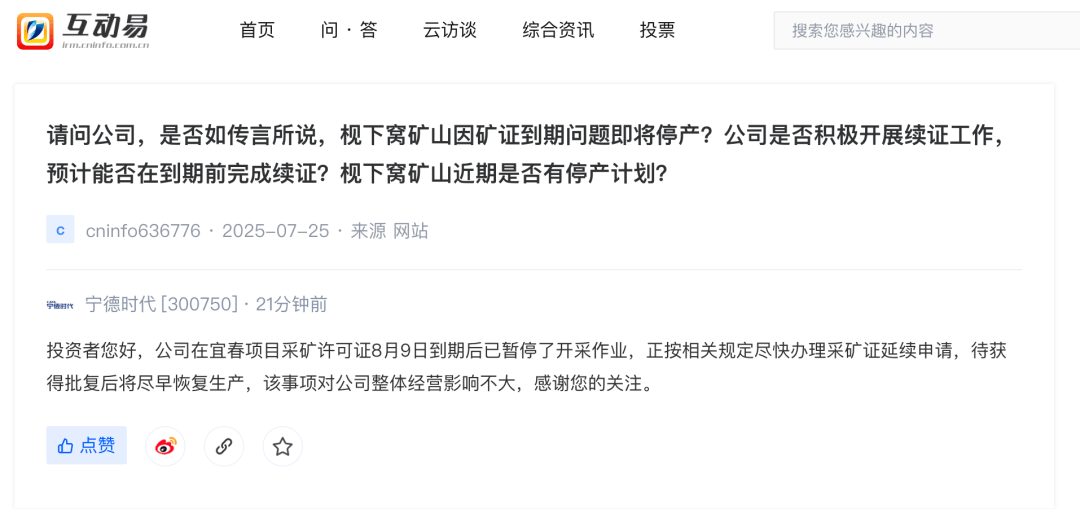
Core Viewpoint - The company, Ningde Times, has suspended mining operations at its Yichun project after the mining license expired on August 9, 2023, and is in the process of applying for a renewal, which is not expected to significantly impact overall operations [1] Group 1: Company Operations - Ningde Times' subsidiary, Yichun Times New Energy Mining Co., holds a mining right for the Zhenkoulai-Fengxin County Jiangxiawo mining area, which began on August 9, 2022, and is set to expire on August 9, 2025, with a substantial production capacity [1] - Local villagers reported that mining operations were halted, with visible signs of activity ceasing at the site [3] - Investors observed the cessation of operations firsthand, confirming that all machinery stopped working as scheduled [3][4] Group 2: Market Impact - Following the news of the mining suspension, lithium carbonate futures contracts hit the daily limit, with the main contract rising by 8% to 81,000 CNY per ton [6] - Analysts suggest that the suspension may lead to a significant reduction in lithium supply, estimating a potential impact of 7,000 to 8,000 tons of lithium carbonate equivalent per month due to mining license approval processes [8] - The new Mineral Resources Law, effective July 1, 2025, classifies lithium as an independent mineral and raises the standards for by-product mineral recognition, which could affect resource tax calculations and mining economics [7]

宁德时代重要矿山停产:投资者光着膀子 深夜上山蹲守见证
Mei Ri Jing Ji Xin Wen· 2025-08-11 02:18
Core Viewpoint - The suspension of mining operations at the Jiangxi Yichun lithium mines, particularly affecting Ningde Times' operations, has led to a significant increase in lithium carbonate prices and related stock prices in both Australia and Hong Kong [1][3][7]. Group 1: Company Impact - Ningde Times' subsidiary, Yichun Times New Energy Mining Co., has halted operations at the Zhanxiawo mining area due to the expiration of its mining license on August 9, 2023, with no immediate plans for resumption [1][2]. - The company is currently working on renewing its mining license and expects to resume production once the renewal is approved, stating that the suspension will not significantly impact overall operations [2][5]. - The mining area has a substantial capacity, with an estimated lithium resource of 2.6568 million tons, equivalent to approximately 6.57 million tons of lithium carbonate [6]. Group 2: Market Reaction - Following the news of the mining suspension, lithium carbonate futures surged, with the main contract rising by 8% to 81,000 CNY per ton [3][4]. - Australian lithium stocks experienced significant gains, with Liontown Resources up over 22% and Pilbara Minerals up over 17% [4][5]. - In Hong Kong, lithium mining stocks also rose, with Tianqi Lithium up 15% and Ganfeng Lithium up over 12% [5]. Group 3: Industry Context - The new Mineral Resources Law, effective July 1, 2025, classifies lithium as an independent mineral and raises the standards for associated mineral recognition, which may impact resource tax calculations and mining economics [5][7]. - Analysts suggest that the suspension of mining operations could lead to a reduction in lithium carbonate supply by 7,000 to 8,000 tons per month, further tightening the market during the traditional peak season from September to November [7]. - As of August 8, the average market price for battery-grade lithium carbonate was 72,000 CNY per ton, reflecting a 0.91% increase since August 1 [8].

宁德时代重要矿山停产,“投资者光着膀子,深夜上山蹲守见证”;相关商品和股票一波大涨,澳洲股票也在疯涨
Mei Ri Jing Ji Xin Wen· 2025-08-11 02:15
Core Viewpoint - The recent news regarding the suspension of lithium mining operations in Yichun, Jiangxi, has significantly impacted lithium carbonate prices, with expectations of supply constraints leading to price increases. Group 1: Company Impact - Ningde Times' subsidiary, Yichun Times New Energy Mining Co., has suspended operations at the Jiangkou lithium mine since August 9, 2023, due to the expiration of its mining license, with no immediate plans for resumption [1][8] - The company stated that the suspension would not have a significant impact on its overall operations and is in the process of applying for a mining license extension [1][8] - The mine has a substantial capacity, with an estimated lithium resource of 2.6568 million tons, equivalent to approximately 6.57 million tons of lithium carbonate [8] Group 2: Market Reaction - Following the news of the mine's suspension, lithium carbonate futures surged, with the main contract rising by 8% to 81,000 CNY per ton on August 11, 2023 [2][4] - Australian lithium stocks saw significant increases, with Liontown Resources up over 22% and Pilbara Minerals up over 17% on the same day [5][6] - Hong Kong-listed lithium companies also experienced gains, with Tianqi Lithium up 15% and Ganfeng Lithium up over 12% [7] Group 3: Industry Analysis - Analysts suggest that the suspension of mining operations may lead to a reduction in lithium carbonate supply by 7,000 to 8,000 tons per month, potentially driving prices higher due to increased costs associated with new tax regulations and seasonal demand [9] - The new Mineral Resources Law, effective July 1, 2025, will classify lithium as an independent mineral and raise the standards for associated mineral recognition, impacting resource tax calculations and mining economics [8][9] - As of August 8, 2023, the average market price for battery-grade lithium carbonate was 72,000 CNY per ton, reflecting a 0.91% increase since August 1, 2023 [10]
研判2025!中国锰酸锂行业价格、开工率及进出口分析:资源丰富成本低廉,但循环性能短板制约产业化进程[图]
Chan Ye Xin Xi Wang· 2025-08-01 01:25
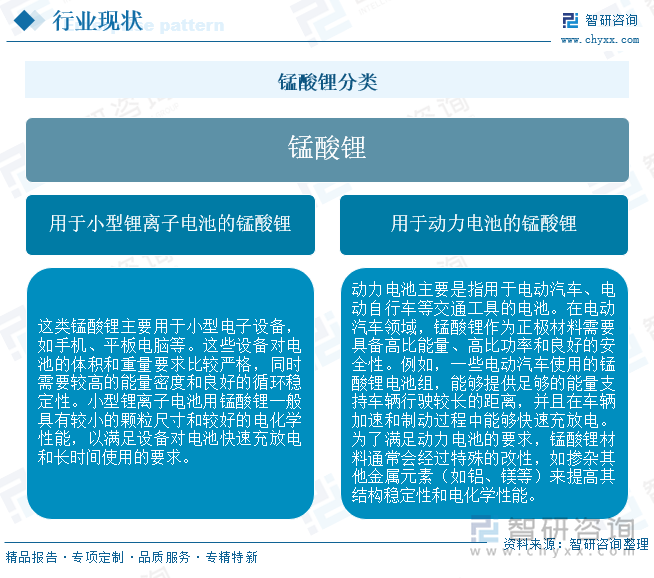
Core Viewpoint - Lithium manganese oxide (LiMn₂O₄) is a promising cathode material for lithium-ion batteries, offering advantages such as abundant resources, low cost, non-pollution, and good safety performance, but its poor cycling performance and electrochemical stability limit its industrialization [1][6]. Industry Overview - Lithium manganese oxide is characterized by its spinel structure and is categorized into two main types: manganese oxide for small lithium-ion batteries and for power batteries [2][4]. - As of June 2025, the price of lithium manganese oxide in China is 32,500 yuan per ton, a year-on-year decrease of 22.62% [6]. Industry Chain - The upstream of the lithium manganese oxide industry includes raw materials like manganese ore and lithium sources, while the midstream involves the production of lithium manganese oxide, and the downstream applications include power batteries, energy storage batteries, and 3C digital products [4]. Industry Status - The production capacity of lithium manganese oxide in China has been expanding rapidly, with leading companies like Boshikao and Xinxiang Hongli increasing investments and launching new production lines, leading to a significant increase in market supply [6][8]. - The operating rate of lithium manganese oxide in China was 35.91% in June 2025, a decrease of 1.12 percentage points month-on-month and 24.18 percentage points year-on-year [8]. Import and Export Dynamics - From January to May 2025, China imported 19.31 tons of lithium manganese oxide, a year-on-year increase of 147.18%, with an import value of 5.7292 million yuan, up 243.19% [10]. - In the same period, China exported 1,602.20 tons of lithium manganese oxide, a year-on-year increase of 85.80%, with an export value of 77.2702 million yuan, up 46.46% [10]. Key Enterprises - Boshikao holds a leading position in the lithium manganese oxide market, achieving an integrated production model from manganese ore to cathode materials, with a market share of 30% [12][13]. - Xiangtan Electric Chemical has a production capacity of 40,000 tons of lithium manganese oxide as of the end of 2024 and is expanding its capacity through a 487 million yuan convertible bond issuance [15]. Industry Development Trends - The industry is expected to accelerate technological iterations focusing on high voltage, single crystal, and pre-lithiation technologies, with domestic companies investing more in R&D to improve the localization rate of high-end products [17]. - The export volume of lithium manganese oxide is anticipated to increase, but challenges such as EU REACH regulations and UL certification will need to be addressed [18][19]. - Companies are increasingly adopting a full industry chain layout to enhance core competitiveness, integrating upstream resources and downstream recycling processes [20].

净利飙升、股价下跌,宁德时代站上转型十字路口|钛度车库
Tai Mei Ti A P P· 2025-07-31 15:03
Core Insights - The company reported a significant increase in net profit by 33% year-on-year, driven primarily by its core business in power batteries and overseas markets, despite a slight decline in energy storage revenue and a substantial contraction in battery materials revenue [2][3][4][5]. Financial Performance - Total revenue for the first half of 2025 reached 178.886 billion yuan, a year-on-year increase of 7.27%, with net profit attributable to shareholders amounting to 30.485 billion yuan, reflecting a substantial growth of 33.33% [3]. - The overall gross margin improved to 25.02%, up by 1.57 percentage points year-on-year, with the second quarter showing particularly strong performance, achieving a net profit of 16.6 billion yuan, a 34% increase year-on-year [3][4]. Business Segmentation - The power battery system remains the core business, generating revenue of 131.573 billion yuan, a 16.80% increase year-on-year, accounting for 73.55% of total revenue, driven by the expansion of the global new energy vehicle market [4]. - Energy storage battery systems reported revenue of 28.4 billion yuan, a slight decline of 1.47%, while the battery materials and recycling business faced significant challenges, with revenue dropping by 44.97% to 7.887 billion yuan [5]. - The battery mineral resources business performed relatively well, with revenue of 3.361 billion yuan, a year-on-year increase of 27.86%, although it remains small in scale and has a low gross margin of 9.07% [5]. International Expansion - The company's successful listing on the Hong Kong Stock Exchange raised 41 billion HKD (approximately 37.5 billion yuan), facilitating its global expansion strategy [6]. - Overseas revenue accounted for 34.22% of total revenue, with a growth rate of 21%, significantly outpacing domestic revenue growth of 1.24% [6][7]. - The company is heavily investing in local production capacity in Europe, with ongoing projects in Germany and Hungary, and a joint venture in Spain with Stellantis for a lithium iron phosphate battery factory [6]. Market Challenges - Despite strong performance, the company's stock price fell by 5.05% in A-shares and 7.66% in H-shares on the day of the earnings report, indicating market concerns about future growth sustainability and competition [7][8]. - The company is facing challenges in activating its energy storage business and addressing the significant contraction in its materials segment, which could impact its long-term growth trajectory [8].
欣旺达闯关港股:动力电池单价腰斩,前五大客户贡献超40%隐忧浮现
Jin Rong Jie· 2025-07-31 01:39
Core Viewpoint - XINWANDA has submitted its listing application to the Hong Kong Stock Exchange, indicating its growth and expansion in the lithium battery industry [2] Group 1: Industry Positioning - XINWANDA has established a comprehensive layout in the lithium battery industry, covering consumer batteries, power batteries, and energy storage systems, with a market share of 34.3% in mobile phone batteries, ranking first globally, and 21.6% in laptop and tablet batteries, ranking second globally [3] - The company is experiencing significant growth in power battery shipments, leading among the top ten manufacturers globally, and its energy storage system business ranks among the top five worldwide [3] Group 2: R&D and Innovation - The core competitiveness of XINWANDA is driven by continuous technological innovation, with over 9,100 patents filed and a research and development team of 9,700 people, alongside a cumulative R&D investment of 8.8 billion yuan over the past three years [4] - The company has developed a laser etching process that supports the mass production of 120W fast-charging batteries, and its fully automated production line for steel shell batteries improves capacity efficiency by 50% compared to traditional methods [4] Group 3: Financial Performance - Despite industry fluctuations, XINWANDA's revenue is projected to grow from 52.2 billion yuan in 2022 to 56 billion yuan in 2024, with a compound annual growth rate of 3.6% [5] - Gross profit is expected to rise from 6.3 billion yuan to 8.2 billion yuan during the same period, reflecting a compound growth rate of 14.2%, while net profit is anticipated to increase from 1.1 billion yuan to 1.5 billion yuan, with an annual growth rate of 17.5% [5] - In the first quarter of 2025, revenue reached 12.3 billion yuan, showing a year-on-year growth of 12%, indicating sustained business expansion [5] Group 4: Risks and Challenges - The company faces significant risks due to high customer concentration, with the top five customers contributing over 40% of revenue from 2022 to 2024, and the largest single customer accounting for over 20% of sales [6] - Supply chain stability is also a concern, with the top five suppliers accounting for over 30% of procurement, and the largest supplier representing 18% of purchasing volume [6] - The competitive landscape is intensifying, with major players like CATL and LG Energy Solution dominating over 90% of the market, posing challenges in technology iteration and market share [8]

兵贵神速:中国锆矿重大突破,军工与能源或迎变革
Sou Hu Cai Jing· 2025-07-30 10:41
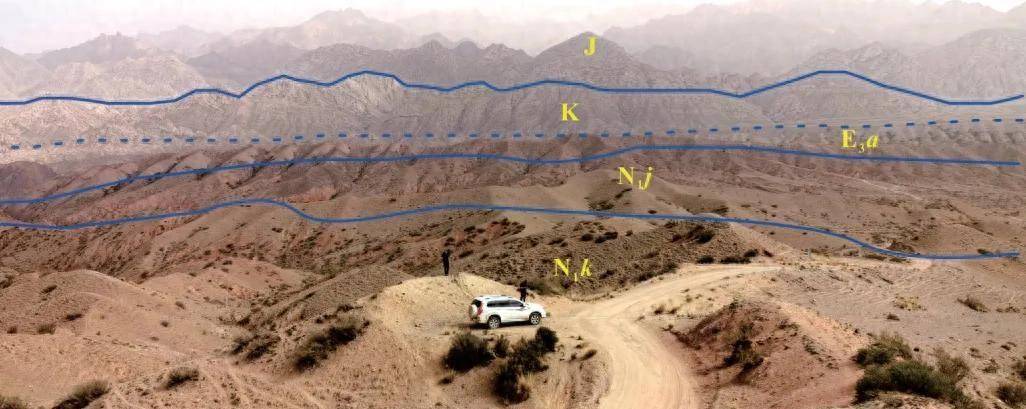
Core Viewpoint - The discovery of a super-large zirconium mine in the Kuobai Basin of Xinjiang, China, significantly increases the country's zirconium resource reserves and may reshape the global zircon supply landscape [1][4][12]. Group 1: Resource Significance - The new zircon mine has the potential to transform China from a resource-importing nation to one with abundant local resources, impacting various high-tech and military sectors [1][5][10]. - The mine's estimated zircon stone mineral reserves exceed 2 million tons, which is four times China's previously known zircon resources [4][12]. - China currently consumes over half of the global zircon resources while holding only 500,000 tons, less than 1% of the global total [5][19]. Group 2: Market Impact - The discovery is expected to influence the global zircon market, with major suppliers in Australia and South Africa becoming wary of the "China variable" affecting supply and demand dynamics [16][19]. - The domestic zircon sand imports have sharply decreased by nearly half, leading to high volatility in local prices and prompting foreign suppliers to raise their quotes [14][16]. Group 3: Strategic Implications - The find represents a significant geological event, challenging previous assumptions about zircon deposits being primarily located near coastlines [7][9]. - The mine's location in a sparsely populated area minimizes potential ecological damage, allowing for a balance between economic benefits and environmental considerations [13][24]. - The discovery aligns with China's broader strategy to secure critical mineral resources, similar to its past advancements in rare earth elements [17][26]. Group 4: Future Outlook - The demand for zircon is projected to increase significantly, with estimates suggesting that global demand for zircon sand could more than double by 2027 [19][22]. - The successful development of this mine could enhance China's negotiating power in global markets and stimulate advancements in high-tech processing of zircon [22][25]. - The ongoing exploration and evaluation of this new resource will be crucial for ensuring sustainable and effective utilization [23][24].
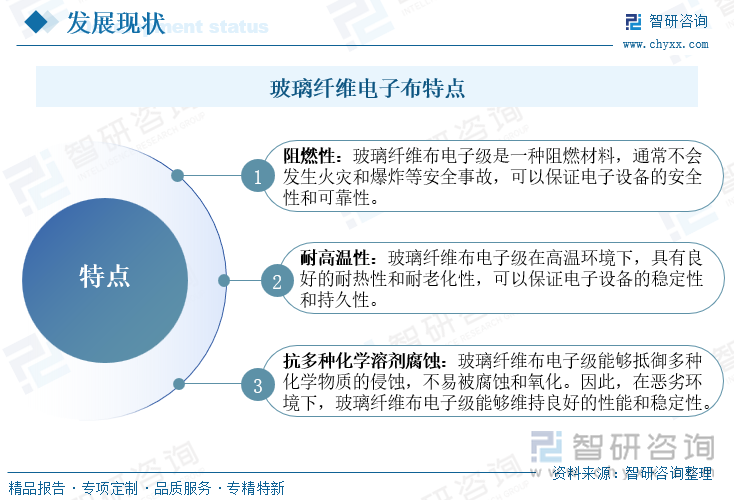
研判2025!中国玻璃纤维电子布行业特点、技术迭代路径、市场规模及企业产能布局情况分析:有望实现高端领域从“跟跑”到“并跑”[图]
Chan Ye Xin Xi Wang· 2025-07-29 01:12
Industry Overview - Glass Fiber Electronic Cloth, also known as electronic cloth, is a high-performance fabric made from glass fiber, essential for the electronic information industry [1][8] - The demand for glass fiber electronic cloth in China is directly related to its status as a global PCB manufacturing center, driven by strong downstream applications such as consumer electronics, communication, automotive electronics, and AI computing [14][27] - The market size for glass fiber electronic cloth in China is projected to grow from 18.52 billion yuan in 2020 to 28.65 billion yuan in 2024 [14] Product Segmentation - Glass fiber electronic cloth can be categorized based on thickness into thick, thin, ultra-thin, and extremely thin types [4][5] - High-end products include ultra-thin cloth (thickness <28 micrometers) and super-thin cloth (28-35 micrometers), primarily used in high-end smartphones and IC substrates [5][7] - Different types of electronic cloth serve various applications, such as Low Dk/Df cloth for high-speed signal transmission and Low CTE cloth for advanced IC substrates [7][9] Technological Advancements - The industry is experiencing rapid technological iteration, with a focus on performance upgrades, material innovation, and process breakthroughs to meet the demands of high-frequency and high-speed applications in sectors like 5G and AI [11][29] - The transition from first-generation electronic cloth (Dk≈4.0) to third-generation quartz cloth (Dk<3.0) illustrates significant advancements in signal transmission capabilities [29] Market Dynamics - The global supply of electronic-grade glass fiber cloth is increasingly concentrated in China, with domestic companies accelerating the pace of high-end market localization [16][17] - Major players in the market include China Jushi, Owens Corning, and others, with significant production capacities being developed to meet rising demand [16][18] Company Performance - Honghe Technology, a key player in the industry, has seen fluctuations in revenue from 793 million yuan in 2021 to 780 million yuan in 2024, influenced by market conditions and competition [20][23] - The company has successfully developed ultra-thin and extremely thin cloth products, achieving international quality standards and gaining recognition from major global smartphone manufacturers [19][20] Future Trends - The market for glass fiber electronic cloth is expected to continue expanding, driven by the increasing demand for high-performance electronic materials in AI servers and advanced communication devices [27][28] - The shift towards high-end electronic cloth products, such as Low-Dk and Low-CTE materials, is anticipated to be a core growth driver in the coming years [27][29]