新能源转型

Search documents
亮点抢鲜看!2026中国商用车论坛将于3月25日-27日在湖北十堰举办
中汽协会数据· 2026-01-28 09:02
Core Viewpoint - The 2026 China Commercial Vehicle Forum aims to address the new requirements and pathways for commercial vehicle development under the themes of "New Energy Transition" and "Digital Intelligence Empowerment" in the context of the 14th Five-Year Plan, emphasizing the importance of high-quality development in the commercial vehicle industry for the national economy [1][21]. Group 1: Forum Overview - The forum will take place from March 25 to 27, 2026, in Shiyan, Hubei Province, focusing on the commercial vehicle industry's role in ensuring supply chain stability and promoting green transformation [1][21]. - The event will adopt a "1+1+6+N" format, including one closed-door summit, one main forum, and six thematic sub-forums, along with related networking and exhibition activities [2][21]. Group 2: Thematic Sub-Forums - The six thematic sub-forums will cover topics such as breakthroughs in new energy vehicle technology under carbon neutrality goals, lifecycle quality management of commercial vehicles, market and policy development directions, commercialization of intelligent networking and autonomous driving, globalization strategies and opportunities for Chinese commercial vehicles, and supply chain security and collaborative innovation [2][21]. Group 3: Key Dates and Registration - Registration for the forum is available until March 10, 2026, with early bird pricing for members at 1,500 RMB and non-members at 2,500 RMB [3][26]. - The forum's schedule includes registration on March 24 and various sessions from March 25 to 27, including a closed-door summit and thematic discussions [4][21]. Group 4: Venue and Accommodation - The forum will be held at the Shiyan Century Baijun Wudang Yage International Hotel, with special accommodation rates for attendees [5][29]. - Transportation arrangements will be provided from Shiyan Wudangshan Airport and Shiyan East Station to the hotel on March 25 [6][31]. Group 5: Collaboration and Sponsorship - The forum offers opportunities for companies to showcase new products and technologies, advertise in the conference materials, and participate in speaking engagements [10][32]. - Companies are required to coordinate with the organizing committee for any promotional activities during the forum [10][32].


长江有色:宏观面多空交织资金获利了结引价格回调 28日镍价或下跌
Xin Lang Cai Jing· 2026-01-28 03:19
市场对主要供应地区政策变动的交易情绪已渐趋理性,加之当地新增产能的持续释放,共同缓解了供应 侧的紧张预期。与此同时,新能源汽车产业链与不锈钢行业均步入季节性淡季,采购活动以刚性需求为 主,作为关键中间产品的硫酸镍价格连续走弱,也从侧面印证了终端消费动能的不足。在此背景下,前 期累积的多头资金选择获利离场,放大了价格的调整幅度,而产业链各环节的普遍观望态度,使得现货 市场流动性显著下降。 伦敦金属交易所(LME)1月27日伦镍库存报285726吨,较前一交易日库存量增加174吨。 长江镍业网讯:今日沪镍期货全线高开;主力月2603合约开盘报147200涨770元,9:20分沪镍主力2603 合约报143770跌2660;沪期镍开盘低开低走,盘面维持弱势震荡;宏观面,在全球宏观局势错综复杂之 际,镍价迎来显著回调,打破了此前独立于有色板块的上涨走势。本轮下跌由多重因素共振触发:宏观 层面,美元指数创四年新低与美股市场分化,并未能延续对大宗商品的提振,反而因美联储政策不确定 性加剧了资金的风险规避倾向;产业层面,市场对印尼镍矿政策的减产预期有所降温,而下游需求在节 前呈现疲软态势;资金层面,前期累积的涨幅使得镍成为 ...

一汽-大众三大品牌13款新车力拼“智电”起势
Zhong Guo Qi Che Bao Wang· 2026-01-28 02:13
Core Insights - In 2025, FAW-Volkswagen achieved annual sales of 1.587 million vehicles, maintaining its position as the top-selling joint venture automaker in China for seven consecutive years and becoming the first domestic passenger car company to surpass cumulative production and sales of 30 million vehicles, demonstrating strong resilience and systemic strength during the industry's transformation period [1] Group 1: 2026 Strategy and Product Launches - 2026 marks the beginning of the "14th Five-Year Plan" and the 35th anniversary of FAW-Volkswagen, with a strategic focus on "stabilizing the foundation, strengthening smart electric vehicles, and forging a new situation," planning to launch 13 new models across its three brands, including 6 fuel vehicles and 7 new energy vehicles [3][4] - The new models include the all-new Sagitar S, which aims to redefine the value standard for "national family cars," and the new Audi Q5L, which has already been launched, enhancing Audi's competitiveness in the luxury fuel vehicle market [5][9] Group 2: New Energy Vehicle Initiatives - FAW-Volkswagen plans to accelerate its electric transformation, targeting a 60% share of new energy vehicle sales by 2030, with a significant push for new energy products starting in the second half of 2026 [7][9] - The company will introduce a comprehensive range of new energy vehicles across all brands, including the Passat PHEV, Tayron PHEV, and the new energy model J01 from the Jetta brand, ensuring coverage from mainstream to luxury segments and from hybrid to pure electric vehicles [9] Group 3: Technological Advancements - FAW-Volkswagen has intensified its focus on self-research and development, launching 155 innovation projects in the past 12 months, with 50 results successfully integrated into mass production, enhancing its capabilities in fuel, hybrid, and pure electric vehicles [10] - The company has developed a high-integrated 6-in-1 electric drive solution, achieving 170 kW power and 90% efficiency, leading the industry in its class, and has implemented advanced technologies in thermal management to improve performance [11] Group 4: Customer-Centric Approach and Global Expansion - FAW-Volkswagen emphasizes a customer-centric approach, aiming to enhance product quality and customer experience, ensuring that every product meets high standards of equipment, intelligence, and reliability [12] - The company plans to expand its overseas operations through a CBU+SKD model, establishing a marketing system and after-sales service network to achieve efficient regional collaboration [12]

正泰电源2026年1月27日涨停分析:控股股东背书+新能源战略+业绩增长
Xin Lang Cai Jing· 2026-01-27 05:55
2026年1月27日,正泰电源(维权)(sz002150)触及涨停,涨停价25.88元,涨幅9.99%,总市值93.39 亿元,流通市值92.79亿元,截止发稿,总成交额9.16亿元。 声明:市场有风险,投资需谨慎。本文为AI大模型基于第三方数据库自动发布,任何在本文出现的信 息(包括但不限于个股、评论、预测、图表、指标、理论、任何形式的表述等)均只作为参考,不构成 个人投资建议。受限于第三方数据库质量等问题,我们无法对数据的真实性及完整性进行分辨或核验, 因此本文内容可能出现不准确、不完整、误导性的内容或信息,具体以公司公告为准。如有疑问,请联 系biz@staff.sina.com.cn。 责任编辑:小浪快报 根据喜娜AI异动分析,正泰电源涨停原因可能如下,控股股东背书+新能源战略+业绩增长: 1、公司控 股股东变更为正泰电器,正泰系在电力设备领域品牌影响力强大,更名"正泰电源"后市场认可度显著提 升,为股价上涨提供支撑。2026年关联交易预计达23.4亿,显示公司新能源业务扩张预期明确,"正泰 电源"命名也直接体现业务属性,契合当下新能源发展趋势。 2、公司三季度净利润同比增长27.26%, 每股收益增 ...

江铃集团售车52万辆33%出口海外 挑战2030年百万销量营收2000亿
Chang Jiang Shang Bao· 2026-01-26 23:49
Core Viewpoint - Jiangling Motors Group has set ambitious targets for the "14th Five-Year Plan" period, aiming for annual vehicle sales of 1 million units, revenue of 200 billion yuan, 30% of sales from overseas markets, and 60% from new energy vehicles by 2030 [1][2]. Group 1: Sales and Revenue Performance - In 2025, Jiangling Group achieved vehicle sales of 520,000 units, a year-on-year increase of 10.5%, surpassing the industry growth rate by 1.1 percentage points [4]. - The company's revenue for 2025 exceeded 126.9 billion yuan, marking a historical high [4]. - New energy vehicle sales grew by 20.2% year-on-year, while exports increased by 38.4%, achieving a three-year target for export growth ahead of schedule [4][5]. Group 2: Future Goals and Strategic Vision - For 2026, Jiangling Group targets vehicle sales of 575,000 units, a 10.6% increase, and aims for exports of 195,000 units, a 14.8% increase, with revenue projected to reach 130 billion yuan, a 2.5% increase [4][5]. - The company emphasizes a strategic focus on intelligent and green development, aiming to enhance product intelligence, brand positioning, and new energy transformation [5]. Group 3: Asset Management and Financial Adjustments - Jiangling Motors reported a net profit of 1.188 billion yuan for 2025, a decline of 22.71% due to adjustments in its subsidiary's business operations [6]. - The company made provisions for asset impairments totaling 351 million yuan, impacting pre-tax profits [7][8]. - The company has seen continuous sales growth over three years, with total sales reaching 31,000 units in 2023, 341,200 units in 2024, and 520,000 units in 2025 [8].

我们为何看好电力配置机会-中美对比
2026-01-26 15:54
我们为何看好电力配置机会 - 中美对比 20260126 摘要 中美批发侧电价接近,燃料成本相似,但中国工业用电价格上涨,美国 下降,2025 年底美国最便宜工业用电价格低于中国,需关注两国电力 成本竞争力的变化。 美国面临尖峰负荷供给压力,容量市场机制显示供给不足,预计 2029 年缓解;中国基荷供给充足,但 2025 年后基荷增速放缓,可能面临尖 峰负荷紧张。 美国电力公司可能处于资本开支上行或盈利反弹状态,中国需关注能否 走出弱势环境。两国应关注尖峰负荷而非传统指标,以适应新能源转型。 中国 A 股电力公司 PE、PB 指标下降,美国同类公司 PB 快速上升,达 中国公司 3-4 倍,反映市场对美国电力供需紧张的乐观预期,对中国相 对保守。 中美经济增长具韧性,供应链调整需考虑超预期需求。中国 2022 年超 预期需求由制造业驱动,美国数据中心接入延长至五年,应对电力压力。 中国 2022 年缺电后,核准大量煤电机组,预计 2025 年投产,并依靠 省间调配缓解电力紧张。美国则通过拉长需求侧并网时间,控制集合电 源增速。 燃料成本上涨是美国电价上涨核心因素,天然气价格影响占比 40%,带 动煤、电、水、 ...
三一重工:公司将继续利用其在产品、技术和服务方面的优势,进一步拓展国际市场
Zheng Quan Ri Bao Wang· 2026-01-26 14:15
Core Viewpoint - The engineering machinery industry is experiencing a recovery, driven by long-term government bond issuance, deepening equipment renewal policies, and accelerated energy transition, leading to growth in domestic sales of core products such as excavators, concrete machinery, and cranes [1] Group 1: Domestic Market Performance - Domestic demand for core products has fully achieved growth due to supportive policies and market conditions [1] - The company reported that excavators, concrete machinery, and cranes are seeing increased sales in the domestic market [1] Group 2: International Market Performance - The overseas market remains robust, particularly in mineral development and energy infrastructure, with strong demand for the company's products [1] - The company maintains a competitive edge in international markets, resulting in continued growth in overseas sales [1] Group 3: Future Plans - The company plans to leverage its advantages in products, technology, and services to further expand into international markets, especially in sectors with high demand such as mineral development and energy infrastructure [1] - The company will closely monitor changes in international markets and adjust its strategies flexibly to respond to potential market fluctuations [1]

AI和能源转型驱动,铜价偏强震荡
Tong Guan Jin Yuan Qi Huo· 2026-01-26 02:00
Report Title - Copper Weekly Report, dated January 26, 2026 [1] Report Industry Investment Rating - Not provided in the report Core Viewpoints - Last week, copper prices showed a strong and volatile trend. The main reasons were the upward revision of the US GDP growth rate in Q3 2025, the mild performance of the core PCE in November, and the robust consumer spending. Trump's announcement of deploying the US fleet to blockade Iran further fermented the global risk - aversion sentiment. The continuous new highs of gold and silver limited the downward adjustment space of copper prices. AI and new - energy transformation provided strong impetus for the refined copper consumption market. Fundamentally, the tight supply pattern at the mine end continued, the output of domestic smelters declined marginally, the global visible inventory continued to rise, the domestic trade spot premium increased, and the C - structure of the near - month contract widened [2][7]. - Overall, the further fermentation of overseas risk - aversion sentiment continuously boosted the valuation center of copper prices. The better - than - expected performance of the US economic fundamentals made the market confident about the future expansion of the global refined copper consumption market. Fundamentally, the resumption of production of overseas interrupted mines was slow. The global refined copper continued to accumulate inventory, but the supply in the distribution areas was still tight. New trends were gradually replacing traditional drivers as the mainstream in the refined copper consumption market. It was expected that copper prices would continue to oscillate strongly at a high level in the short term. Attention should be paid to the latest interest rate decision of the Federal Reserve in January [2][10] Summary by Directory I. Market Data - **Price Changes**: LME copper rose from $12,808.50 to $13,128.50 per ton, a 2.50% increase; COMEX copper rose from 584.85 to 593.7 cents per pound, a 1.51% increase; SHFE copper rose from 100,770 to 101,340 yuan per ton, a 0.57% increase; international copper rose from 89,650 to 91,120 yuan per ton, a 1.64% increase. The Shanghai - London ratio decreased from 7.87 to 7.72. The LME spot premium decreased from $61.52 to - $66.06 per ton, a - 207.38% change. The Shanghai spot premium decreased from - 125 to - 180 yuan per ton [3] - **Inventory Changes**: As of January 23, the total inventory of LME, COMEX, SHFE, and Shanghai bonded area increased to 1.067624 million tons. LME copper inventory increased by 28,125 tons (19.59%); COMEX inventory increased by 19,691 short tons (3.63%); SHFE inventory increased by 12,422 tons (5.82%); Shanghai bonded area inventory increased by 7,800 tons (7.83%) [6] II. Market Analysis and Outlook - **Macro - aspect**: The US core PCE in November increased by 2.8% year - on - year, in line with expectations. Personal consumption expenditure increased by 0.5% month - on - month, and personal income increased by 0.4% month - on - month, indicating robust consumer spending. The annualized growth rate of the US GDP in Q3 2025 was revised up to 4.4%. The IMF raised the US economic growth forecast for 2026 to 2.4%. Trump's actions and statements on geopolitical issues and the Federal Reserve's policy and personnel appointment further fermented the market risk - aversion sentiment, and the new highs of gold and silver boosted the copper price valuation center. In China, the industrial added value of large - scale industries in December increased by 5.2% year - on - year, with different growth rates in various industries [7][8] - **Supply - demand aspect**: Rio Tinto's copper production in Q4 increased by 5% year - on - year. In November, the domestic copper production was basically flat month - on - month. The import of copper concentrates in November reached 2.526 million tons, a year - on - year increase of 13.1%. In terms of demand, traditional industries were affected by high copper prices at the beginning of the year, while emerging industries such as new - energy vehicles, photovoltaics, AI data centers, and robots showed good prospects [9] III. Industry News - **Rio Tinto**: Its Q4 copper production increased by 5%. The expansion of the Oyu Tolgoi underground mine in Mongolia offset the decline in the Escondida copper mine in Chile. It is in key acquisition negotiations with Glencore and must make a formal offer by February 5 [11] - **Lundin Mining**: Due to the decline in the underground mining efficiency of its Candelaria copper mine in Chile, it lowered its copper and gold production guidance for 2026. The company's stock price fell by more than 10% on Thursday [12] - **Capstone Copper**: A copper mine in northern Chile has been shut down due to a nearly three - week labor strike, intensifying the global copper supply shortage [13] IV. Related Charts - The report provides 18 charts, including the price trends of Shanghai copper and LME copper, LME copper inventory, global visible inventory, etc., with data sources from iFinD and Tongguan Jinyuan Futures [15][16][20]
无脑看好?大金重工股价创历史新高,逻辑全兑现仍低估,出海龙头稳了!
Xin Lang Cai Jing· 2026-01-25 00:34
Core Viewpoint - The article highlights the strong performance and growth potential of Dajin Heavy Industry, driven by Europe's need to reduce reliance on Russian energy and increase local renewable energy production, with Dajin positioned as a key player in offshore wind infrastructure [1][8]. Group 1: Company Performance - Dajin Heavy Industry has become the number one provider of offshore wind infrastructure in Europe, benefiting from the ongoing development of offshore wind projects [1][10]. - The company's stock has reached historical highs, reflecting the market's confidence in its growth prospects [1][8]. - Dajin's recent innovations, including a multi-purpose transport vessel for wind power equipment, have significantly enhanced its operational efficiency and market position [5][14][15]. Group 2: Financial Outlook - Dajin Heavy Industry's overseas orders have reached 10 billion, with an expected delivery of 400,000 tons by the second quarter of 2027, indicating a strong growth trajectory [7][16]. - Market expectations for Dajin's earnings in the coming year range from 1.7 billion to 2 billion, with a year-on-year growth rate of 40%-50% anticipated [7][16]. - The company is projected to achieve a price-to-earnings ratio of 17-20 times based on its current market capitalization of 33.5 billion [7][16]. Group 3: Legal Issues - Dajin Heavy Industry is currently facing a lawsuit regarding a construction contract dispute, with potential liabilities amounting to 570 million, which is significant compared to its projected net profit [4][13]. - Despite the legal challenges, the company has a history of successfully resolving similar disputes, suggesting a reasonable chance of a favorable outcome [4][13]. - Even in the event of an unfavorable ruling, the financial impact is expected to be one-time and should not affect the company's long-term cash flow or valuation significantly [5][13].

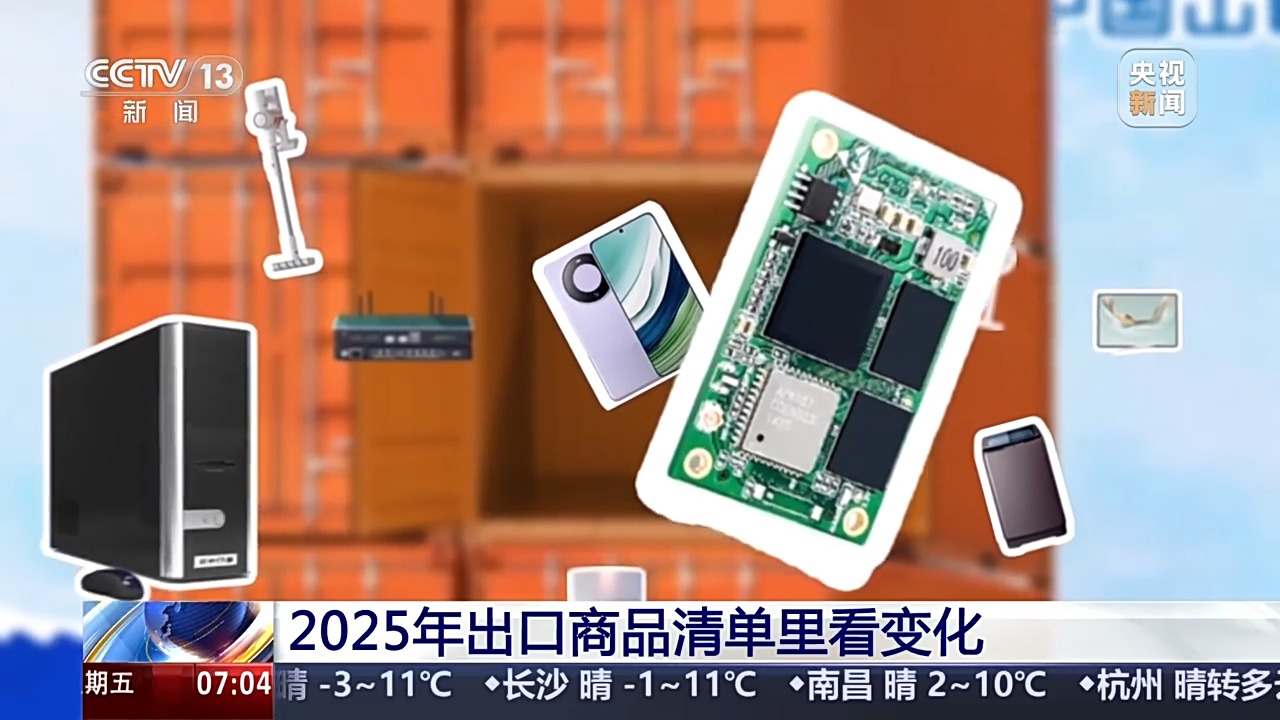
顶压前行、逆势增长 出口商品清单看中国外贸新变化
Yang Shi Xin Wen Ke Hu Duan· 2026-01-23 07:04
Core Insights - China's foreign trade has shown resilience and growth over the past year, with notable changes in export products, particularly a trend of "five increases and one decrease" in export volumes [1] Group 1: Export Trends - Exports to Asia have seen the most significant growth, followed by Africa and Europe, with the scale of growth in Africa and Europe being relatively similar [1] - High-tech products such as integrated circuits, smartphones, and data processing equipment are increasingly in demand in Asia due to the region's push for green, smart, and digital transformation [3] - In 2025, exports to Europe have shown new characteristics, with notable increases in products like transformers, air conditioners, and ice cream, contributing to a refreshing summer in Europe [5] Group 2: Key Products - Among over 200 major export products, electrical machinery remains a significant category, with transformers experiencing a 35.6% year-on-year increase in exports in 2025 [5] - The demand for transformers is driven by a long-term supply gap in the US and Europe, as many electrical grid facilities are outdated and require upgrades [11] - Drones have outperformed transformers with a 45% increase in exports in 2025, being utilized in various professional applications beyond just aerial photography [13] Group 3: Market Dynamics in Africa - China's exports to Africa increased by 26.5% year-on-year, with a diverse range of products from textiles to major projects like offshore production platforms [5] - In South Africa, multifunctional Bluetooth speakers have gained popularity, reflecting local consumer preferences for portable and multifunctional devices [15] - Nigeria has seen a surge in solar product sales, with a 75% increase in the previous year, indicating a growing acceptance and integration of solar energy solutions in daily life [17][19]