智能化

Search documents
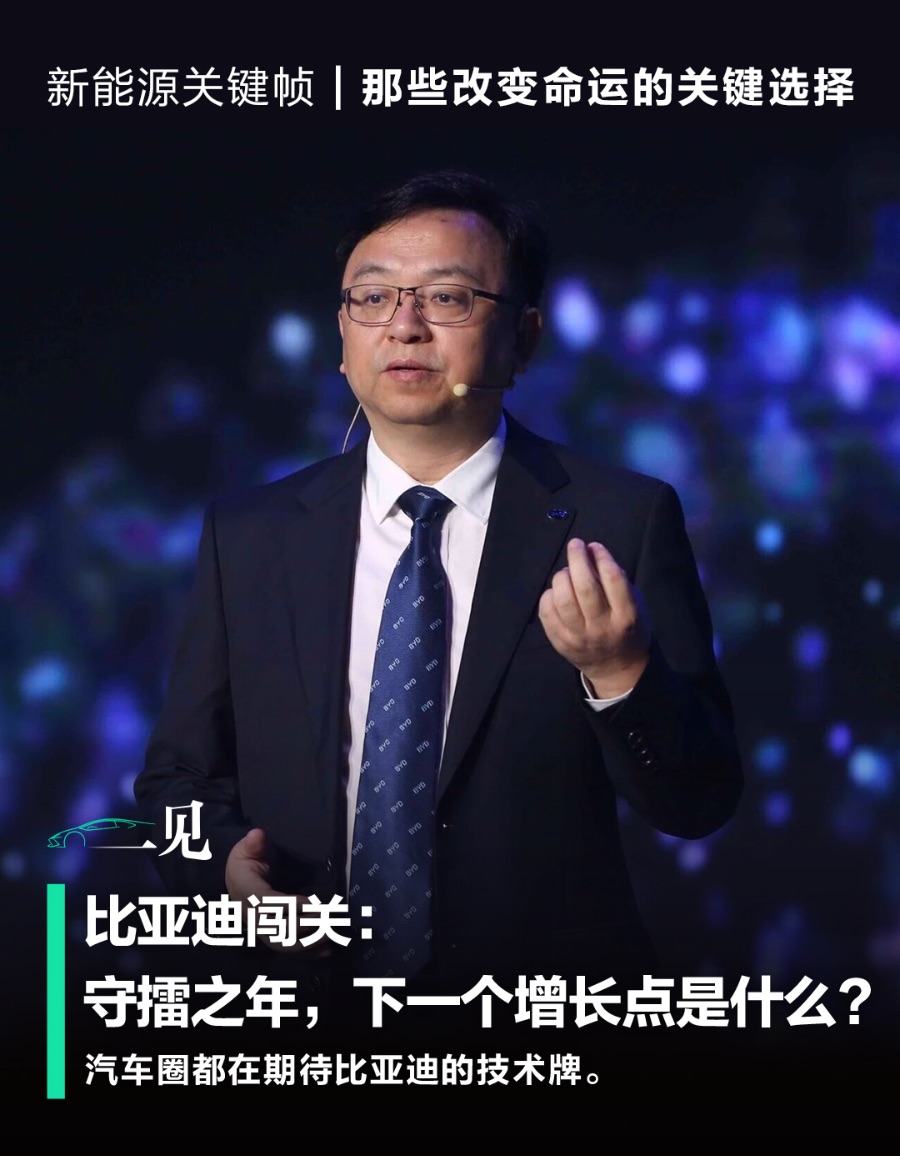
比亚迪闯关:守擂之年,下一个增长点是什么?
2 1 Shi Ji Jing Ji Bao Dao· 2026-03-03 23:31
Core Insights - BYD is facing increasing competition and challenges in maintaining its market share, particularly in the entry-level electric vehicle segment, as competitors like Geely are gaining ground [3][4][18] - The company is undergoing strategic adjustments, focusing on product innovation and marketing to better align with consumer demands and market dynamics [5][22][23] - BYD's historical success has been driven by its pricing strategy and technological advancements, but it now faces diminishing returns on its growth model as competition intensifies [13][14][17] Group 1: Market Performance - In early 2026, BYD's sales dropped significantly, with January and February figures showing a year-on-year decline of 30% and 41.1%, respectively [3] - Geely's sales in the same period surpassed BYD's, indicating a shift in market leadership [12][14] - BYD's Dolphin and Seagull models are under pressure from competitors entering the affordable electric vehicle market [4][18] Group 2: Strategic Adjustments - BYD is focusing on launching new models to reclaim market share in the sub-200,000 yuan electric vehicle segment, which is seen as a critical area for growth [5][21] - The company is also shifting its marketing approach to emphasize emotional value and user experience rather than just technical specifications [23][24] - A hybrid sales model combining direct sales and authorized dealerships is being implemented to enhance market penetration [24] Group 3: Technological Innovation - BYD's technological advancements, such as the DM-i technology and blade battery, have historically provided a competitive edge, but the rapid pace of innovation in the industry poses challenges [9][17] - The company is committed to continuous improvement and innovation, with plans to introduce new technologies by 2026 [5][24] - The competitive landscape is evolving, with rivals quickly replicating successful technologies, necessitating BYD to reassess its technological strategies [14][16] Group 4: Future Growth Opportunities - BYD is targeting international markets for growth, with overseas sales projected to reach 1.3 million units in 2026, representing over 30% of total sales [29][32] - The company is also focusing on high-end market segments, with new brands like Tengshi and Fangchengbao aimed at capturing higher price points [25][26][28] - The overall trend in the automotive industry indicates a shift towards international markets, which is expected to provide significant growth opportunities for BYD [32]


比亚迪(002594):出海销量再超10万辆,3月新技术+产品周期蓄势待发:比亚迪2026年2月销量点评
Changjiang Securities· 2026-03-03 23:30
Investment Rating - The investment rating for BYD is maintained as "Buy" [6] Core Insights - In February, BYD's total sales reached 190,000 vehicles, a year-on-year decrease of 41.1% and a month-on-month decrease of 9.5%. Passenger car sales were 188,000 units, down 41.0% year-on-year and 8.6% month-on-month. The export volume remained strong at 100,000 units, up 41.4% year-on-year and flat month-on-month [2][4][10] - The company is expected to enter a new technology and product cycle in March, with significant advancements in its electric vehicle technology and a focus on high-end market expansion [10] Summary by Relevant Sections Sales Performance - February total sales: 190,000 vehicles, down 41.1% YoY, down 9.5% MoM - Passenger car sales: 188,000 units, down 41.0% YoY, down 8.6% MoM - Brand performance: Ocean series 165,000 units (-45.8% YoY), Fangcheng Leopard 17,000 units (+244.7% YoY), Tengshi 6,000 units (-35.4% YoY) - Export sales: 100,000 units, up 41.4% YoY, flat MoM [2][10] Market Strategy - Continued focus on overseas expansion and high-end product offerings, with new models expected to enhance profitability - The company is enhancing its technological capabilities, particularly in battery technology and smart driving features, to strengthen its competitive position in the global market [10] Financial Projections - Expected net profit for 2025 is projected at 35 billion yuan, corresponding to a PE ratio of 23X, indicating strong future profitability potential [10]
21深度|比亚迪闯关:守擂之年 下一个增长点是什么?
2 1 Shi Ji Jing Ji Bao Dao· 2026-03-03 23:23
Core Insights - BYD is facing increasing competition and challenges in maintaining its market share, particularly in the entry-level electric vehicle segment, as competitors like Geely and Wuling ramp up their offerings [3][16] - The company is undergoing strategic adjustments, focusing on product innovation and marketing to better align with consumer demands and market dynamics [19][20] - BYD's technological advancements, such as the DM-i technology and blade battery, have been pivotal in its growth, but the company must continue to innovate to stay ahead of competitors [5][9][24] Sales Performance - In early 2026, BYD's sales were impacted by seasonal factors, with January and February sales dropping to 210,000 and 190,200 units, representing year-on-year declines of 30% and 41.1% respectively [2] - Geely's sales in the same period were 270,000 and 206,000 units, indicating a competitive threat to BYD's market position [2][13] - BYD's Dolphin and Seagull models are facing pressure from new entrants in the market, particularly as Geely's Star Wish model has shown significant growth [18] Product Strategy - BYD is focusing on launching new models to reclaim market share in the under 200,000 yuan electric vehicle segment, which is seen as a critical area for growth [3][16] - The company is also adjusting its pricing strategy, with the Qin PLUS DM-i's price dropping significantly over the years to maintain competitiveness [6] - The introduction of the Super e-platform is part of BYD's strategy to innovate and meet evolving consumer needs, with expectations for new technology releases by 2026 [4][20] Technological Innovation - BYD's DM-i technology has set a new standard in fuel efficiency, with a thermal efficiency of 43.04% and a fuel consumption of 3.8L per 100 km, outperforming many competitors [5] - The blade battery technology has allowed BYD to maintain a competitive edge in the electric vehicle market by offering lower costs and longer ranges [8][9] - The company is aware of the rapid pace of technological advancement in the industry and is committed to continuous innovation to avoid losing its competitive advantage [14][20] Market Dynamics - The competitive landscape is shifting, with traditional automakers like Toyota and Honda lagging in electric vehicle adoption, allowing BYD to capture significant market share [9][11] - The overall market for electric vehicles is expanding, with projections indicating continued growth in exports and international sales for Chinese automakers, including BYD [26] - BYD's overseas sales have surpassed domestic sales for the first time, indicating a strategic shift towards international markets [24] Brand Positioning - BYD is working to enhance its brand perception and emotional connection with consumers, moving beyond technical specifications to focus on user experience [19] - The company is also exploring high-end market segments with new brands like Tengshi and Fangchengbao, aiming to establish a presence in the luxury vehicle market [21][22] - The success of Fangchengbao, particularly with its Titanium series, highlights BYD's ability to adapt its product offerings to meet specific consumer needs [22]
21深度|比亚迪闯关:守擂之年,下一个增长点是什么?
2 1 Shi Ji Jing Ji Bao Dao· 2026-03-03 23:17
Core Insights - BYD is facing increasing competition and challenges in maintaining its market share, particularly in the 10-20 million yuan segment, as competitors like Geely and Wuling ramp up their efforts in the electric vehicle market [2][13] - The company is undergoing a strategic shift from aggressive market share acquisition to focusing on building barriers to protect its existing market position [1][3] - BYD's success has been largely driven by its competitive pricing and technological innovations, but it now needs to adapt to changing consumer demands and market dynamics [8][11] Sales Performance - In January and February 2026, BYD's sales were 210,000 and 190,200 units, representing year-on-year declines of 30% and 41.1% respectively [1] - Geely's sales during the same period were 270,000 and 206,000 units, indicating a competitive threat to BYD's market position [1] Product Strategy - BYD is focusing on launching new models to regain market share in the under 200,000 yuan electric vehicle segment, which is seen as crucial for its future growth [2][13] - The company has implemented a pricing strategy that includes reducing the starting price of models like the Qin PLUS DM-i, which has seen significant price cuts since its launch [6][4] Technological Innovation - BYD's technological advancements, such as the DM-i technology and blade battery, have allowed it to maintain a competitive edge in the electric vehicle market [4][7] - The company is aware of the rapid pace of technological change and the need to continuously innovate to stay ahead of competitors [11][12] Market Dynamics - The automotive market is experiencing a shift, with increasing competition from both established players and new entrants, making it essential for BYD to adapt its strategies [8][9] - The company is also focusing on expanding its presence in international markets, with overseas sales surpassing domestic sales for the first time in early 2026 [20][21] Brand Positioning - BYD is working on enhancing its brand image and marketing strategies to appeal to a broader audience, particularly in the high-end market segment [14][17] - The introduction of new brands like Fangcheng Leopard aims to fill gaps in the market and target specific consumer demographics [17][19]
何小鹏:完全自动驾驶将在未来1~3年内到来
第一财经· 2026-03-03 12:46
Core Viewpoint - Xiaopeng's second-generation VLA is set to launch this month, featuring an end-to-end structure that eliminates the language translation step, achieving a 12-fold increase in operational speed and an 80% reduction in response latency, marking a significant step towards fully autonomous driving [3][4]. Group 1: Technology and Development - The second-generation VLA is designed for fully autonomous driving, with iterations expected to occur rapidly over the next 1-3 years, although it currently does not achieve 100% L4 autonomy [3][4]. - Xiaopeng plans to equip all Ultra and Ultra SE models with the second-generation VLA, offering both basic and advanced intelligent driving options in global markets [3][4]. - The Robotaxi equipped with the second-generation VLA has begun public road testing, with plans for trial operations within the year and global deployment by 2027 [4]. Group 2: Market Position and Strategy - Xiaopeng's CEO emphasizes the importance of moving directly from L2 to L4 levels of autonomy, viewing L4 as a critical milestone in the development of autonomous driving in China [4]. - The automotive industry is currently focused on enhancing intelligence capabilities, with many companies competing in a "computing power arms race," but Xiaopeng stresses the need for effective utilization of computing power rather than just increasing numerical values [4]. Group 3: Software and Upgrades - Xiaopeng has long believed in the upgradability of vehicles, utilizing OTA and FOTA methods for software and firmware updates, and is exploring AI applications for maintenance and service efficiency [5].


2025年全球及中国叉车行业研究:身智能赋能,叉车行业加速升级
Tou Bao Yan Jiu Yuan· 2026-03-03 12:36
Investment Rating - The report indicates a positive investment outlook for the forklift industry, driven by advancements in electric and intelligent technologies, with a projected annual growth rate of 5% for the global market and 5.9% for the Chinese market from 2025 to 2030 [2][26][29]. Core Insights - The forklift industry is undergoing a significant transformation towards automation and intelligence, spurred by labor shortages and the need for cost reduction. AI technology is evolving forklifts from mere transportation tools to intelligent decision-making terminals [2]. - The Chinese forklift market is expected to grow from 1.52 million units in 2007 to 1.286 million units by 2024, maintaining its position as the largest market globally. Domestic brands are capturing 80% of the market share due to their competitive pricing and technological advancements [2][15]. - The report highlights three main upgrade paths for the forklift industry: electrification, automation, and intelligence, focusing on the differentiated technological strategies of leading companies [2][3]. Summary by Sections Market Overview - The global forklift market is closely tied to economic activity, with sales growth rates approximately 1.6 times that of GDP growth. Asia is the largest market due to its manufacturing sector, while Europe focuses on automation upgrades [11][13]. Chinese Market Dynamics - The Chinese forklift market is projected to reach 1.81 million units by 2030, with an electrification rate increasing from 74% to 96%. The market is driven by e-commerce logistics and industrial land cost pressures [29][32]. Technological Advancements - The AGV/AMR market is experiencing rapid growth, with a 12.5-fold increase in six years, driven by the need for automation in logistics. The penetration rate is expected to reach 18% by 2024, with average prices dropping significantly [4][35]. Competitive Landscape - Domestic forklift manufacturers benefit from advanced battery technology and cost advantages, with prices significantly lower than international brands. This competitive edge allows for quicker market responses and greater market share [20][22]. Future Projections - The report forecasts that the global forklift market will grow to 2.96 million units by 2030, with significant contributions from Europe and Asia. The market is expected to transition from high growth to maturity, with a focus on electric warehouse equipment [26][52].
2025年全球及中国叉车行业研究:具身智能赋能,叉车行业加速升级(精华版)
Tou Bao Yan Jiu Yuan· 2026-03-03 12:24
Investment Rating - The report indicates a positive investment outlook for the forklift industry, highlighting significant growth potential driven by automation and electrification trends [2][26]. Core Insights - The global forklift industry is experiencing a transformative upgrade period fueled by embodied intelligence, with labor shortages and cost reduction demands accelerating the shift towards automation and AI integration [2]. - China's forklift market is projected to grow from 1.52 million units in 2007 to 1.286 million units by 2024, maintaining its position as the largest market globally [15][17]. - The report emphasizes the dual drive of electrification and intelligence, with domestic brands capturing 80% of the market due to competitive pricing and advanced technology adoption [2][20]. Summary by Sections Electrification and Automation - The forklift industry is undergoing a dual transformation towards electrification and automation, with a projected annual growth rate of 5% for the global market, reaching 2.96 million units by 2030 [26]. - In China, the electrification rate is expected to rise to 96% by 2030, with electric warehouse equipment accounting for 68% of the market [29][32]. Technological Advancements - The AGV/AMR market is expanding rapidly, driven by a doubling of logistics volume and advancements in laser navigation technology, transitioning from optional to essential in smart logistics [3][35]. - Leading companies are building technological barriers through acquisitions and in-house development, demonstrating a successful transition from technology exploration to large-scale application [3][40]. Market Dynamics - The report notes that the demand for forklifts is closely tied to economic activity, with sales growth historically outpacing GDP growth by approximately 1.6 times [11][13]. - The Chinese forklift market is characterized by a strong domestic supply chain and competitive pricing, with local brands offering products at one-third the price of international competitors [20][22]. Future Projections - The report forecasts that the sales of unmanned forklifts will grow at an annual rate of 19%, reaching 70,000 units by 2030, as the market transitions from high growth to maturity [52]. - The price of unmanned forklifts is expected to stabilize at around 135,000 yuan, driven by domestic component production and technological advancements [52].
九号公司(689009):首次覆盖报告:智能筑基,多元绽放
Western Securities· 2026-03-03 11:00
Investment Rating - The report assigns a "Buy" rating for the company, Jiuhua Company (689009.SH), indicating a positive outlook on its investment potential [4]. Core Insights - The market has concerns regarding the new national standards affecting the electric two-wheeler industry and the EU's anti-dumping investigation on Chinese lawnmowers. However, the company is actively responding to external fluctuations, and growth momentum remains strong across its business lines. The report emphasizes the importance of monitoring future data to capitalize on the undervaluation of quality companies [1][4]. Summary by Relevant Sections Electric Two-Wheelers - The two-wheeler business is adapting to new national standards, with the company focusing on expanding products, stores, channels, and brand presence. Despite challenges in high-tier cities, growth potential remains robust, with expectations for a positive trend in Q1 2026 due to increased demand from electric motorcycles and high dealer purchasing intentions [1][2]. - Revenue projections for the two-wheeler segment are optimistic, with expected growth rates of 68.0%, 26.1%, and 25.0% for the years 2025, 2026, and 2027, respectively [11]. Lawn Mowers - The impact of the anti-dumping investigation on the lawn mower segment is expected to be limited in the short term, as the company is actively expanding overseas production capacity and has been proactive in shipping before tariffs take effect. The introduction of new products at CES in January is anticipated to drive penetration rates higher [2][11]. - The lawn mower market is projected to grow significantly, with expectations of a 254.8% year-on-year increase in revenue for the robot business in 2024, maintaining high growth rates in subsequent years [11]. Other Businesses - The company is also seeing positive trends in its scooter and all-terrain vehicle segments, with expected revenue growth rates of 19.1%, 12.8%, and 15.1% for scooters, and 10%, 20%, and 10% for all-terrain vehicles over the next three years [11]. - The report highlights the company's strategic focus on product innovation and channel expansion, which is expected to sustain growth across its various business lines [12]. Financial Projections - The company is projected to achieve a net profit of 1.79 billion, 2.42 billion, and 3.20 billion yuan for the years 2025, 2026, and 2027, respectively, with corresponding P/E ratios of 18.0, 13.8, and 10.7 [2][14].
没有意外还是第一,比亚迪2月销售19万辆说明什么|车界观察
2 1 Shi Ji Jing Ji Bao Dao· 2026-03-03 10:09
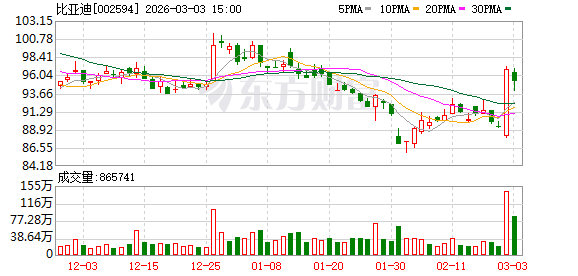
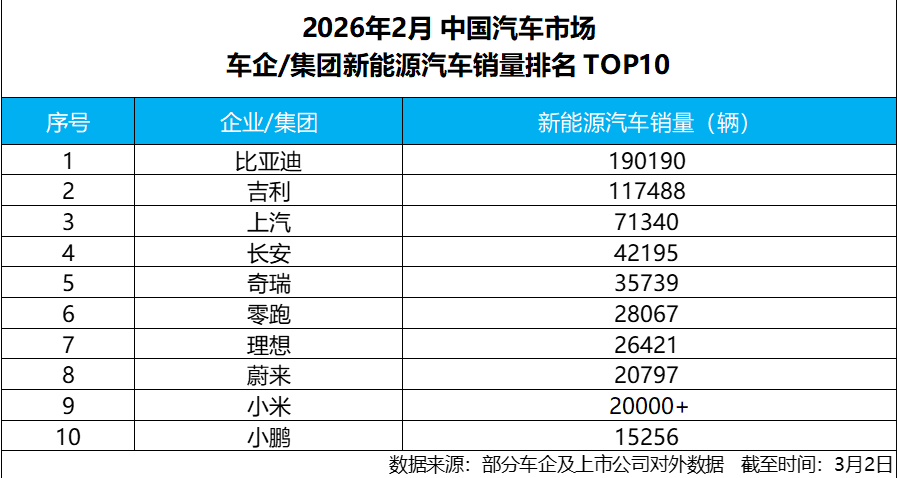
Core Insights - The competition landscape in China's new energy vehicle (NEV) market has become clearer as of early 2026, with BYD Group leading the industry with a sales volume of 190,190 units in February, maintaining a significant advantage over competitors [1][4]. Group 1: Sales Performance - BYD has maintained its position as the top seller in China's NEV market for 57 consecutive months since June 2021, with cumulative sales surpassing 15.5 million units [3]. - In February, BYD's overseas sales of passenger cars and pickups reached 100,151 units, marking a year-on-year growth of 41.4%, with total overseas sales for January-February 2026 at 200,160 units, up 42.3% year-on-year [4]. Group 2: Market Position and Strategy - BYD's strong performance in February signals its ability to build systemic advantages in the NEV market, indicating that its leadership is structural rather than coincidental [4]. - The company is set to hold a groundbreaking technology release on March 5, which has already positively impacted its stock price, reflecting investor confidence in its technological capabilities [5]. Group 3: High-End Market Development - BYD's high-end brands, including Fangchengbao, Tengshi, and Yangwang, achieved combined sales of 23,000 units in February, showing significant growth and enhancing the company's product structure and profitability [5]. - The increasing share of high-end products is expected to strengthen BYD's brand value and market influence [5]. Group 4: Future Considerations - Despite the positive outlook, BYD must focus on advancements in intelligent driving technology to compete effectively against rivals like Huawei and new entrants [5]. - The company faces challenges related to geopolitical risks as its overseas sales grow, including trade policies, tariff barriers, and localization requirements [5].
研报 | 预估2026年全球新能源车销量年增14%,USMCA重启谈判牵动汽车产业关键变量
TrendForce集邦· 2026-03-02 09:01
Core Insights - The article highlights the growth of the global electric vehicle (EV) market, with total sales of battery electric vehicles (BEV), plug-in hybrid electric vehicles (PHEV), and hydrogen fuel cell vehicles reaching 2.053 million units in 2025, marking a 26% year-on-year increase. The forecast for 2026 predicts sales to reach 2.340 million units, with growth slowing to 14% [2]. Market Performance - In 2025, China accounted for approximately 66% of the global EV market, but its growth rate was only 24%, slightly below the average due to a high base effect. In contrast, the Western European market saw nearly 30% growth, the highest since 2022 [2]. - BYD emerged as the top seller of BEVs in 2025 with a market share of 15.6%, surpassing Tesla, which experienced a 9% decline in sales due to a lack of product innovation. SAIC-GM-Wuling maintained third place, while Geely's market share increased from 3% to 6% due to the popularity of its "Xingyuan" model priced below 100,000 RMB [3]. PHEV Sales Insights - In the PHEV segment, BYD led with a market share of approximately 31.5%, although it faced a decline in both sales and market share for the first time. Geely, supported by its Galaxy series, rose to second place with a 6.3% market share. Li Auto, which was second in 2024, saw a 30% decline in sales and dropped to fifth place due to intense market competition and late overseas expansion [5]. Policy Changes and Market Dynamics - TrendForce indicates significant policy changes for EVs in 2026 across major markets: China's subsidies will shift from fixed amounts to a percentage of vehicle prices; the U.S. will no longer provide federal subsidies; and Germany will restart subsidies without production location restrictions, which is expected to benefit Chinese electric vehicle manufacturers [6]. - The article also notes that the demand for high-capacity, high-bandwidth memory in electric vehicles is strong due to their high level of intelligence. However, memory costs only account for about 1%-5% of total vehicle material costs, leading manufacturers to prioritize stable supply to maintain new vehicle launch schedules and feature updates [6].