
线上线下融合

Search documents
2025中国消费者图鉴:健康超收入,国货逆袭国际品牌
Sou Hu Cai Jing· 2025-11-12 20:44
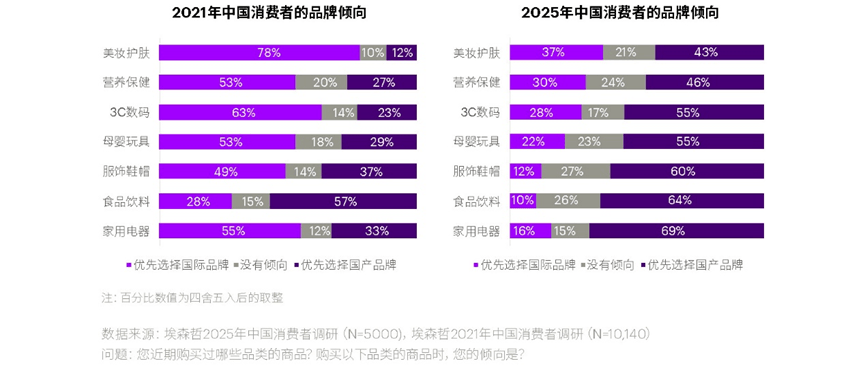
Core Insights - The Chinese consumer market has undergone a silent yet profound structural transformation over the past four years, with international brands losing their traditional advantages at an unprecedented pace, replaced by more rational, independent, and culturally confident Chinese consumers [1][2]. Group 1: Rise of Domestic Brands - Domestic brands have made a significant comeback, with preference for domestic beauty and skincare products soaring from 12% in 2021 to 43% by 2025, marking a historic surpassing of international brands [3]. - In the 3C digital sector, domestic brands dominate with a 55% preference rate [3]. - Key factors driving this shift include: - Price-performance ratio becoming paramount, with 85% of consumers citing it as the primary reason for choosing domestic products, an increase of 8 percentage points since 2021 [7]. - Product quality has seen a qualitative leap, with 70% of consumers recognizing the strength of domestic products, up 11 percentage points over four years [7]. - Cultural confidence has emerged as an emotional connection point, with domestic brands effectively blending traditional Chinese culture with modern aesthetics [7]. Group 2: Changing Consumer Behavior - Brand loyalty is diminishing, with 55% of consumers frequently comparing multiple brands even if they have a favorite, a significant increase of 13 percentage points since 2021 [11]. - The shift in information channels shows that live streaming and video platforms have become the second-largest source of information, rising by 28 percentage points since 2021, while the influence of family and friends has dropped by 13 percentage points [13]. - Over 70% of consumers now view the selection process as an important part of the shopping experience, indicating a shift from a purely outcome-oriented approach to one that values both process and result [17]. Group 3: Marketing and Consumer Sentiment - A significant 68% of consumers feel indifferent or even negative towards marketing content, with 22% stating that it diminishes their desire to shop [20]. - The report highlights a disconnect between brand marketing and consumer needs, emphasizing that quality of content is more important than quantity [22]. - There is a notable shift in consumer priorities from idealism to realism, with increased focus on health and wealth, rising by 9 and 8 percentage points respectively, while emphasis on career, love, and personal growth has declined [25]. Group 4: The Role of AI and Shopping Preferences - The rapid adoption of AI tools is evident, with 77% of consumers using them frequently, and AI is transitioning from a tool to a partner in decision-making [32]. - 85% of Chinese consumers prefer online shopping, with 43% opting for online browsing and purchasing, and 42% choosing online browsing with offline purchasing [37]. - The integration of online and offline shopping experiences is crucial, as 51% of consumers report their happiest shopping experiences come from a blend of both [41]. Group 5: Experience Economy and Brand Evolution - The focus on experiential consumption has shifted from mere product functionality to emotional engagement, with consumers seeking joy and relaxation from their shopping experiences [45]. - Brands are urged to redefine their roles, emphasizing value beyond product functionality to include brand philosophy and emotional connections [50]. - Community engagement is becoming a vital aspect of consumer interaction, with interest-based communities providing social support and opportunities for entrepreneurship [51].

合百集团:1月—10月份实现酒水销售4.12亿元,同比增长11%
Zheng Quan Ri Bao Zhi Sheng· 2025-11-12 13:39
Core Viewpoint - The company emphasizes the importance of its beverage procurement and sales operations, establishing a dedicated beverage division to enhance supply chain management and develop a new retail model that integrates online, offline, and group purchasing channels [1] Group 1: Sales Performance - From January to October, the company achieved beverage sales of 412 million yuan, representing an 11% year-on-year increase [1] - The sales structure has evolved to a model that combines online and offline sales while advancing in both high-end and niche markets [1] Group 2: Brand Management - The company has strengthened its direct brand management, with key brands such as Gujing, Yingjia, Rio, and Zongzi collectively increasing sales by 4 million yuan [1] Group 3: Group Purchasing Channel - The company has focused on developing its group purchasing channels, achieving cumulative group sales of 27.25 million yuan, which is an 8% increase year-on-year [1] Group 4: New Product Launch - The company launched its first proprietary brand, "Hejia Chun" beer, positioned as a high-cost-performance option for family gatherings, with sales exceeding 1.2 million yuan since its introduction in May [1]

中国消费向新而行丨今年“双11” 融合有新意
Ren Min Ri Bao· 2025-11-12 02:15
Core Viewpoint - The article emphasizes the importance of expanding domestic demand as a strategic foundation, integrating consumer needs with supply, and enhancing the internal circulation of the economy during the "Double 11" shopping festival [1] Group 1: Online and Offline Integration - The "Double 11" event showcased a deep integration of online and offline shopping experiences, allowing consumers to experience products in-store while also having the option to order online for home delivery [2] - The Ministry of Commerce's initiative aims to promote the deep integration of physical retail and digital economy, enhancing retail efficiency and creating new productive forces [2] Group 2: Consumption Data and Trends - During the "Double 11" period, JD MALL's foot traffic increased by 30% year-on-year, with home goods sales rising by 191% and full-home customization sales growing nearly 7 times [3] - Meituan reported that nearly one million offline stores participated in its "Double 11" event, with significant sales increases in various categories, including over 100% growth for brands like Xiaomi and OPPO [3] Group 3: Consumption Experience and Service Integration - The event highlighted a shift from product purchasing to service enjoyment, with a focus on creating richer consumer experiences and breaking down industry barriers [4] - The automotive aftermarket saw significant growth, with tire sales on JD increasing over 4 times and car service orders rising by 165% during the event [4] Group 4: Global Market Expansion - The "Double 11" event expanded its reach to global markets, with significant sales growth in countries like Japan, South Korea, and Australia, and cross-border services seeing over 300% growth in transaction volume [5] - Taobao's international marketing efforts included a 1 billion yuan investment to help 100,000 merchants achieve doubled overseas sales during the event [5] Group 5: Supply and Demand Matching - The C2M (Customer-to-Manufacturer) model was highlighted as a successful approach for precise matching of supply and demand, with notable sales records for customized products [6] - In the 3C digital sector, the C2M model led to over 100% growth in sales, with significant customization ratios for gaming laptops and AI products [6] Group 6: Automotive Sector Innovations - The automotive sector is experiencing renewed vitality through supply-demand integration, with new energy vehicles being developed based on consumer preferences for price, space, safety, and range [7]

今年“双11” 融合有新意
Ren Min Ri Bao· 2025-11-12 01:37
Core Insights - This year's "Double 11" event emphasizes the integration of online and offline shopping experiences, enhancing consumer engagement and market potential [2][3][4] Group 1: Online and Offline Integration - The integration of online and offline shopping is deepening, allowing consumers to experience products in-store while also having the option to order online for home delivery [3] - Data shows significant increases in foot traffic and sales during the "Double 11" period, with JD MALL's foot traffic up 30% and home appliance sales up 191% [4] - The "Super Good Buy" event at JD's offline stores saw a 450% increase in daily sales, indicating strong consumer interest and engagement [4] Group 2: Consumer Experience and Service Integration - The event showcases a shift from merely purchasing products to enjoying services, with a focus on creating diverse consumer experiences [5] - The automotive aftermarket is highlighted as a rapidly growing sector, with online orders for car services seeing a 165% increase [5] - Industrial products are also participating in the "Double 11" promotions, with a 172% increase in average order value for enterprise customers [5] Group 3: Global Market Expansion - The "Double 11" event has expanded its reach to global markets, with significant growth in transaction volume and order numbers in countries like Japan, South Korea, and Australia [6] - Taobao's international launch in 20 countries aims to double overseas sales for 100,000 merchants, supported by substantial marketing investments [6] Group 4: Supply and Demand Alignment - The C2M (Customer-to-Manufacturer) model is gaining traction, allowing for precise alignment of supply with consumer demand, leading to efficient production cycles [7] - Successful examples include a new thermos product that set sales records through pre-orders, demonstrating the effectiveness of reverse customization [7] - In the 3C digital sector, C2M products have seen significant sales growth, with over 100% increase in transaction value for AI products [7] Group 5: Large Item Consumption - The automotive sector is experiencing renewed vitality through supply-demand integration, with new electric vehicles being launched based on consumer preferences [8]
打造消费新供给、新场景 今年“双11”融合有新意
Ren Min Ri Bao· 2025-11-12 00:31
Core Insights - The article emphasizes the integration of online and offline retail experiences during this year's "Double 11" shopping festival, highlighting the importance of new consumer demands and innovative supply chains to stimulate market potential [1][2]. Group 1: Online and Offline Integration - The "Double 11" event showcased a deep integration of online and offline shopping, allowing consumers to experience products in-store while also having the option to order online for home delivery [2]. - Data from JD MALL indicated a 30% year-on-year increase in foot traffic, with home goods sales surging by 191% and full-home customization sales increasing nearly sevenfold [3]. Group 2: Consumer Experience and Service Innovation - The event marked a shift from merely purchasing products to enjoying services, with various consumer experiences being enriched through the blending of different retail formats [4]. - The automotive aftermarket saw significant growth, with tire sales on JD increasing over four times and car service orders rising by 165% during the event [4]. Group 3: Global Market Expansion - The "Double 11" festival expanded its reach to global markets, with JD reporting over 100% growth in transaction volume and order quantity across several countries [5]. - Taobao's international efforts included launching in 20 countries and regions, supported by a marketing budget of 1 billion yuan to help merchants double their overseas sales [5]. Group 4: Supply and Demand Alignment - The C2M (Customer-to-Manufacturer) model was highlighted as a successful approach for aligning supply with consumer demand, leading to more efficient production processes [6]. - Notable successes included a record-breaking sales performance for a jointly launched thermos by Fuguang and JD, demonstrating the effectiveness of reverse customization [6]. Group 5: Automotive Sector Dynamics - The automotive sector, particularly in large-item consumption, is experiencing revitalization through enhanced supply-demand integration, as seen with the launch of a new electric vehicle model by GAC Aion in collaboration with JD [7].
青观察|解锁国贸商圈的迭代密码
Sou Hu Cai Jing· 2025-11-11 23:13
Core Insights - The development of the Guomao business district reflects the evolution of China's commercial landscape over the past 40 years, from its inception in 1985 to its current status as a major international trade center [2][10] Historical Development - The Guomao business district originated as a response to China's need for an international trade window during the early 1980s, with the construction of the China International Trade Center [3] - The first phase of the project, completed in 1989, marked the beginning of high-end retail in Beijing, attracting consumers from across the region [3][4] - The establishment of the CBD in 1993 solidified Guomao's position as a commercial hub, leading to the development of surrounding business facilities [3] Business Evolution - The second phase of Guomao expanded its retail space and introduced more international brands, transforming it into a key venue for business networking and socializing [4] - Following China's accession to the WTO in 2001, Guomao became the preferred location for international brands entering the Chinese market, with over 200 new international brand stores opening between 2002 and 2010 [5][10] - The annual sales of the Guomao business district surged from less than 1 billion yuan in 2001 to over 5 billion yuan in 2010, establishing it as one of Beijing's top sales districts [5] Recent Developments - The introduction of the first indoor ice rink in Beijing in 2010 marked a significant expansion of the Guomao complex, enhancing its appeal to families and business professionals [7] - The business district faced challenges from the rise of e-commerce post-2010, leading to a decline in sales growth rates, which prompted a strategic shift towards experiential and social retail [8][9] - Guomao has successfully integrated digital solutions and diversified its offerings, transforming from a high-end retail focus to a multi-faceted commercial ecosystem [9][10] Current Status - Guomao now features over 400 merchants within 230,000 square meters of commercial space, with more than 100 flagship stores, solidifying its status as a premier shopping destination [10] - The district has evolved into a vibrant community space, catering to a diverse consumer base, including business professionals, families, and young consumers [11][12]

今年“双11” 融合有新意(中国消费向新而行)
Ren Min Ri Bao· 2025-11-11 22:40
Core Insights - The article emphasizes the importance of expanding domestic demand as a strategic foundation, integrating consumer welfare and investment to stimulate new supply and demand dynamics [1] Group 1: Online and Offline Integration - The "Double 11" shopping festival showcased a deep integration of online and offline retail, allowing consumers to experience products in-store while also having the option to order online for home delivery [2] - Data indicates a 30% year-on-year increase in foot traffic at JD MALL, with home goods sales surging by 191% and full-home customization sales increasing nearly sevenfold [3] Group 2: Consumption Model Evolution - The event highlighted a shift from merely purchasing goods to enjoying services, with the automotive aftermarket seeing significant growth through online ordering and in-store services [4] - The integration of industrial products into the "Double 11" promotions has also been noted, with a 40% reduction in procurement communication costs for clients [4] Group 3: Global Market Expansion - The "Double 11" event expanded its reach to 20 countries and regions, with a marketing investment of 1 billion yuan aimed at doubling overseas transactions for 100,000 merchants [5] - Cross-border services saw a 300% increase in transaction volume, with user numbers growing by over 400% [4][5] Group 4: Supply and Demand Alignment - The C2M (Customer-to-Manufacturer) model has enabled precise matching of supply and demand, leading to successful product launches such as a new thermos that set sales records [6] - In the 3C digital sector, C2M collaborations resulted in significant sales growth, with AI products seeing over 100% year-on-year increases [6] Group 5: Automotive Sector Dynamics - The automotive sector is experiencing renewed vitality through supply-demand integration, with new electric vehicles being launched that cater to consumer preferences for price, space, safety, and range [7]
打造消费新供给、新场景 激发消费市场潜能 今年“双11” 融合有新意(中国消费向新而行)
Ren Min Ri Bao· 2025-11-11 22:31
Core Insights - The "14th Five-Year Plan" emphasizes expanding domestic demand as a strategic foundation, integrating consumer welfare and investment to stimulate new supply and demand dynamics [1] - The "Double 11" shopping festival showcases a deep integration of online and offline retail, enhancing consumer experience and driving sales growth [2] Group 1: Online and Offline Integration - The "Double 11" event saw a 30% year-on-year increase in foot traffic at JD MALL, with home goods sales surging by 191% [3] - The integration of online platforms and physical stores allows consumers to experience products in-store while ordering online for home delivery, enhancing retail efficiency [2][3] - Meituan reported that nearly one million offline stores participated in its "Double 11" campaign, with significant sales increases in various categories [3] Group 2: Consumption Patterns and Market Trends - The automotive aftermarket is rapidly growing, with online orders for car services and products seeing substantial increases during "Double 11" [4] - Industrial products are also participating in the "Double 11" promotions, with significant growth in service clients and transaction values [4] - The global reach of "Double 11" expanded, with sales and order volumes in international markets growing over 100% [4] Group 3: Financial and Consumer Integration - Financial services are increasingly integrated with consumer experiences, providing discounts and incentives that enhance shopping during "Double 11" [5] - The collaboration between financial institutions and retail platforms is driving consumer spending by offering direct benefits [5] Group 4: Supply and Demand Alignment - The C2M (Customer-to-Manufacturer) model is effectively aligning supply with consumer demand, leading to successful product launches during "Double 11" [6] - The introduction of customized products, such as gaming laptops and insulated bottles, demonstrates the effectiveness of reverse customization in meeting market needs [6] Group 5: Automotive Sector Developments - The launch of new electric vehicles through collaborations between automotive manufacturers and e-commerce platforms highlights the evolving consumer preferences in the automotive sector [7]
动作迅猛!电商巨头争相转战线下开店
Zheng Quan Shi Bao· 2025-11-11 00:12
Core Insights - The article discusses the aggressive offline expansion strategies of major e-commerce platforms, JD.com and Tmall, in reshaping China's home appliance retail market amid increasing consumer demand and government policies promoting trade-in programs [1][5]. Offline Expansion Strategies - JD.com has opened four new stores in a single month, while Tmall has established over 14,000 digital stores nationwide, indicating a significant push into offline retail [1][3]. - Tmall's strategy began with the rural Taobao project in 2014, transitioning to Tmall Supermarket in 2017, and has rapidly expanded into first- and second-tier cities in 2023 [3][10]. - JD MALL, launched in September 2021, focuses on major cities and has plans to open 26 stores by September 2025, emphasizing a self-operated model with over 200,000 products available [4][3]. Market Dynamics and Consumer Behavior - The online retail sector is facing a bottleneck in traffic growth, prompting platforms to seek new consumer bases offline [6]. - The e-commerce penetration rate is projected to decline from 27.6% in 2023 to 26.8% in 2024, with a stagnation at 25.0% from January to September 2025 [6]. - The shift in consumer focus from "what can be bought" to "what can be bought immediately" highlights the importance of speed, certainty, and convenience in purchasing decisions [8]. Supply Chain and Digitalization - To avoid pitfalls experienced by traditional appliance retailers like Gome and Suning, e-commerce giants are enhancing their supply chains and digital capabilities [10][11]. - JD MALL employs a direct sourcing model to reduce costs and improve price competitiveness, while Tmall focuses on refined operations and service enhancement [10][11]. - Digitalization is identified as a core competitive advantage for offline stores, with plans to integrate online and offline data for targeted marketing and inventory management [11]. Future Retail Trends - The future of retail is shifting towards enhancing service quality, reimagining offline experiences, and creating intangible value such as trust and loyalty [11]. - Retailers are encouraged to redefine their roles from mere sales platforms to service providers and community spaces, emphasizing the integration of online and offline experiences [11].
从流量争夺到全域融合 电商巨头争相转战线下开店
Sou Hu Cai Jing· 2025-11-10 22:11
Core Insights - The article discusses the aggressive offline expansion strategies of major e-commerce platforms, JD and Tmall, in reshaping China's home appliance retail market amidst changing consumer demands and government policies [1][2]. Offline Expansion - JD has opened four new stores in a month, while Tmall has established over 14,000 digital stores nationwide, indicating a significant push into offline retail [1][2]. - Tmall's offline strategy began with the rural Taobao project in 2014, transitioning to Tmall Supermarket in 2017, and has recently accelerated its presence in first- and second-tier cities [2]. - JD MALL, launched in September 2021, focuses on major urban centers and has opened 26 stores by September 2025, emphasizing a self-operated model with over 200,000 products [2][3]. Market Drivers - The shift to offline retail is driven by a saturation of online traffic and the need to reach more consumers, alongside the government's "trade-in" policy which has been enhanced to include more product categories [4]. - E-commerce penetration rates have declined from 27.6% in 2023 to 26.8% in 2024, with a stagnation at 25.0% from January to September 2025, highlighting the necessity for platforms to explore offline channels [4]. Consumer Behavior - The article notes a shift in consumer preferences from merely being able to purchase items to wanting immediate availability, emphasizing speed, certainty, and convenience as key factors in purchasing decisions [6]. Supply Chain and Digitalization - To avoid pitfalls faced by traditional appliance retailers, JD and Tmall are enhancing their supply chains and digital capabilities. JD employs a direct sourcing model to reduce costs and improve price competitiveness [8]. - Tmall focuses on refining operations and enhancing service experiences through various initiatives aimed at strengthening supply chain capabilities [8]. - Digitalization is identified as a core competitive advantage for offline stores, with plans to integrate online and offline data for targeted marketing and inventory management [8]. Future Retail Trends - The future of retail competition is expected to shift from online market share to enhancing service quality, reimagining offline experiences, and creating intangible value such as trust and loyalty [9].
