高股息策略

Search documents
今天,显著下挫!
Zhong Guo Ji Jin Bao· 2025-11-21 11:23
【导读】港股显著下跌;黄金股调整,锂业"双雄"大跌 中国基金报记者 储是 受海外市场影响,11月21日,港股三大指数集体大幅下跌。科网股、半导体板块拖累恒生科技指数盘中跌至3.8%。降息预期减弱,国际金价日内调整, 导致黄金股走低。 招商证券认为,市场前期预期的多项边际利好正逐步兑现,构成了推动市场情绪转向乐观的核心动力。 美股重挫影响港股 半导体板块同样遭遇重挫,中芯国际、华虹半导体、贝克微等分别跌6.39%、6.09%、5.20%。 11月21日,全球多个主要股市显著下跌,港股三大指数大幅下挫。其背后原因是美联储降息预期降温引发的全球流动性担忧和人工智能泡沫担忧。 恒生科技指数当日收跌3.21%,恒生指数、国企指数分别下跌2.38%、2.45%。 盘面上,大型科网股、金融股等权重股集体承压,拖累市场情绪。港股全市全天交易额为2857亿港元,南向资金净买入额为1亿港元。 由于投资者对美联储12月降息的预期降温,导致全球风险资产情绪转向谨慎。 据芝商所美联储观察工具,交易员当前定价下个月降息25个基点的可能性约为40%。摩根士丹利改变此前作出的"美联储12月会议将降息25个基点"的预 测,不再预计美联储会于1 ...


今天,显著下挫!
中国基金报· 2025-11-21 11:23
Market Overview - The Hong Kong stock market experienced significant declines on November 21, with the Hang Seng Index, Hang Seng Tech Index, and the Hang Seng China Enterprises Index dropping by 2.38%, 3.21%, and 2.45% respectively, influenced by the downturn in global markets and concerns over liquidity and AI bubble risks [4][6][9] - The total trading volume in the Hong Kong market reached HKD 285.7 billion, with net inflows from southbound funds amounting to HKD 10 million [4] Sector Performance - Major technology stocks such as Baidu, Alibaba, and Tencent saw declines of nearly 6%, 4.65%, and 1.77% respectively, reflecting the overall market sentiment [9] - The semiconductor sector also faced significant losses, with stocks like SMIC and Hua Hong Semiconductor dropping by 6.39% and 6.09% respectively [11] Gold and Lithium Sectors - The decline in interest rate expectations led to a drop in international gold prices, with COMEX gold futures falling to approximately USD 4040 per ounce, resulting in declines for gold stocks such as China Silver Group and WanGuo Gold, which fell by 6.25% and 5.61% respectively [13][14] - Lithium stocks were heavily impacted, with Ganfeng Lithium and Tianqi Lithium experiencing declines of 12.47% and 11.93% respectively, amid changes in trading fees for lithium futures [17][18] Analyst Insights - According to招商证券, the market's previous expectations of several marginal benefits are gradually being realized, which is shifting market sentiment towards optimism. The firm suggests focusing on AI and technology stocks, as well as sectors benefiting from overseas power shortages [20][21] - The report emphasizes the potential for growth in the electric power sector due to increasing demand driven by AI development, alongside opportunities in non-ferrous metals due to global easing and inflation expectations [21]

124家A股公司股息率超5%
Di Yi Cai Jing Zi Xun· 2025-11-21 00:31
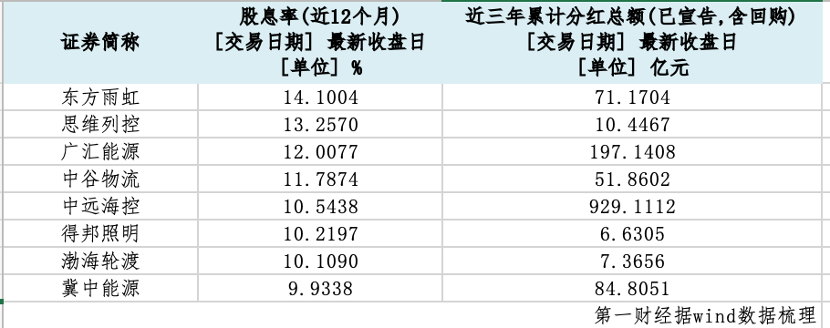
Group 1: Bank Sector Performance - The bank sector in A-shares is gaining attention, with major banks like China Bank and Construction Bank seeing significant stock price increases, with China Bank reaching a historical high [2] - As of November 20, 2023, the total market capitalization of the four major banks in A-shares exceeds 20 trillion yuan [2] - Hong Kong-listed banks are also performing well, with Minsheng Bank leading the gains [2] Group 2: Dividend Trends - A total of 24 out of 42 A-share listed banks have announced mid-term dividends, with a total payout of approximately 263.8 billion yuan, marking an increase from the previous year [2] - High dividend assets are becoming increasingly attractive, with 124 companies in A-shares having a dividend yield exceeding 5%, and 7 companies exceeding 10% [3][4] - The top three companies with the highest dividend yields are Dongfang Yuhong, Siwei Liekong, and Guanghui Energy, with yields of 14.1%, 13.25%, and 12% respectively [5][6] Group 3: Policy Support for Dividends - The regulatory environment is encouraging companies to increase dividend payouts, with the China Securities Regulatory Commission advocating for more frequent and stable dividends [7] - Companies are encouraged to adopt methods like "cancellation-based buybacks" to enhance returns to investors [7] Group 4: Characteristics of High Dividend Stocks - High dividend companies are typically found in stable sectors such as utilities, energy, telecommunications, and consumer staples, which are less affected by economic cycles [8][9] - These companies often have clear and stable dividend policies, viewing consistent dividends as a means to maintain credibility and attract long-term investors [9] Group 5: Risks Associated with High Dividend Strategies - High dividend strategies are not without risks, as some cyclical stocks may experience significant fluctuations in dividend yields [3][11] - There is a caution against "high dividend traps," where declining stock prices artificially inflate dividend yields, potentially indicating deteriorating fundamentals [3][12] - Investors are advised to be vigilant about companies that may use high dividends to attract investment while facing underlying financial pressures [12]

124家A股公司股息率超5%
第一财经· 2025-11-21 00:28
Core Viewpoint - The high dividend-paying stocks, particularly in the banking sector, are gaining attention in the market as they continue to show strong performance and increasing dividend payouts [3][4]. Group 1: Banking Sector Performance - On November 20, A-share banking stocks continued their strong performance, with China Bank (601988.SH) rising by 4%, reaching a historical high, while other major banks also saw increases of over 3% [3]. - The total market capitalization of the four major banks (ICBC, CCB, ABC, and BOC) in A-shares has exceeded 2 trillion yuan [3]. - In the Hong Kong market, Minsheng Bank (01988.HK) led the gains with over a 3% increase, while other banks also saw significant rises [3]. Group 2: Dividend Distribution - As of November 20, 24 out of 42 A-share listed banks have announced mid-term dividends totaling approximately 263.8 billion yuan, marking an increase from the previous year [3]. - High dividend assets are becoming increasingly attractive as deposit rates continue to decline, with many companies in various sectors offering dividends above 4% [7]. Group 3: High Dividend Stocks - There are currently 124 companies in the A-share market with a dividend yield exceeding 5%, with 7 companies yielding over 10% [4][6]. - The top three companies with the highest dividend yields are Dongfang Yuhong (002271.SZ) at 14.1%, Siwei Liekong (603508.SH) at 13.25%, and Guanghui Energy (600256.SH) at 12% [7][8]. - Among the 124 companies with yields over 5%, 85 have seen their stock prices rise in the past year, indicating the resilience of high dividend strategies in the current market [8]. Group 4: Policy Support for Dividends - The regulatory environment is encouraging companies to increase dividend payouts, with the China Securities Regulatory Commission advocating for more frequent and stable dividends [9]. Group 5: Long-term Dividend Trends - For the 2024 reporting period, the companies with the highest dividend yields include Haoxiangni (002582.SZ) at 16.91%, Meiyingsen (002303.SZ) at 15.95%, and Jinshi Technology (002951.SZ) at 14.97% [10][12]. - In 2023, the top dividend yielders were Libai Shares (603519.SH) at 15.34%, Rong'an Real Estate (000517.SZ) at 13.06%, and Yutong Bus (600066.SH) at 11.32% [10][12]. Group 6: Risks of High Dividend Strategies - High dividend strategies are not without risks, as some cyclical stocks may experience significant fluctuations in dividend yields [5]. - Investors should be cautious of "high dividend traps," where declining stock prices artificially inflate dividend yields, potentially indicating deteriorating fundamentals [5][15]. - The market has seen instances where companies maintain high dividends to attract investors despite underlying financial pressures [16][17].




中信建投万字报告!展望2026年经济、债市、全产业链投资策略
Sou Hu Cai Jing· 2025-11-20 23:47
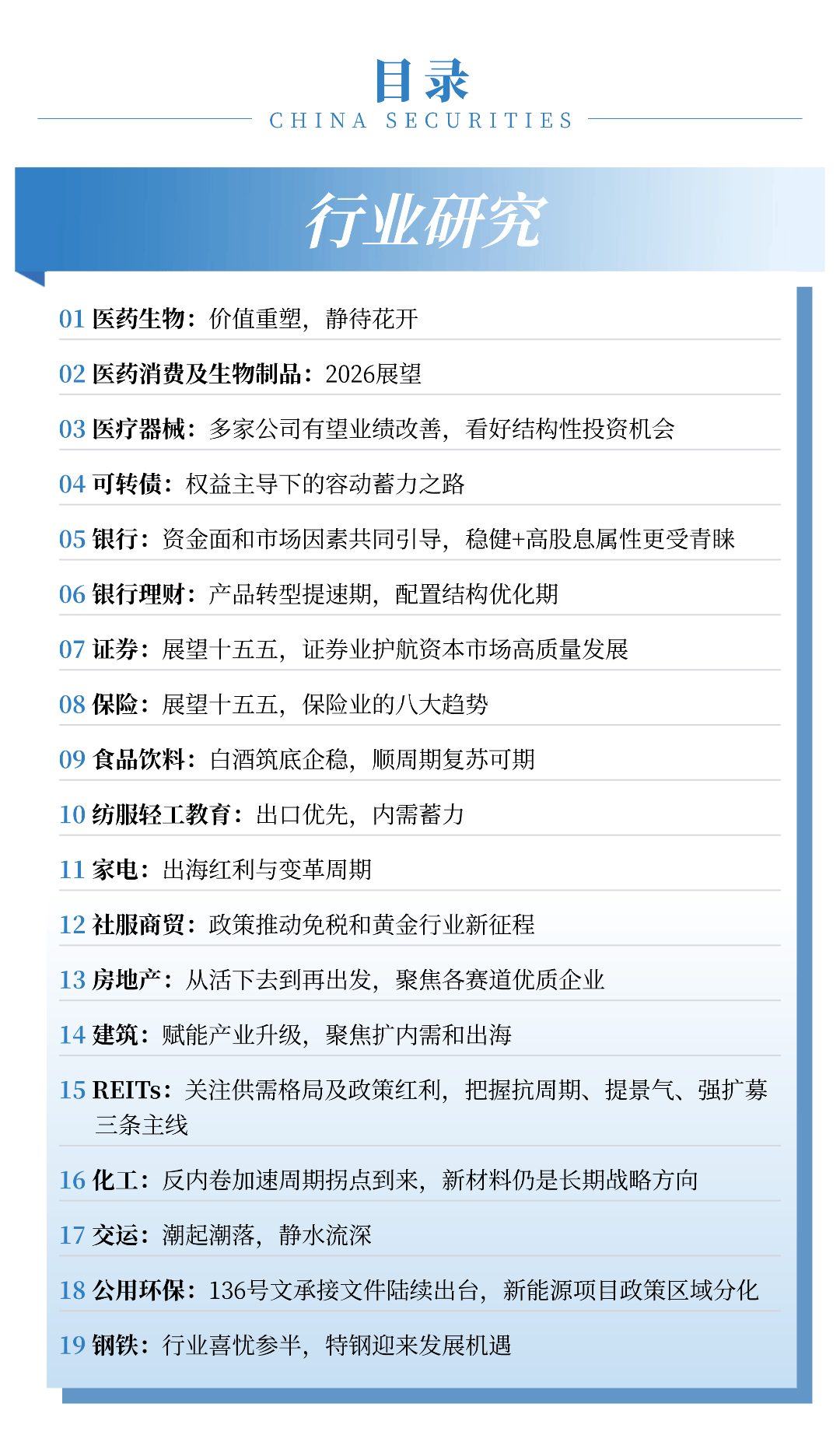
Group 1: Investment Strategies Overview - CITIC Securities released a comprehensive report on investment strategies for 2026, covering global capital markets, macroeconomic policies, A-shares, overseas markets, bond markets, asset allocation, and industry investment strategies [1] - The report includes insights from 19 research teams and spans approximately 30,000 words [1] Group 2: Pharmaceutical and Biotech Investment Strategies - The Chinese pharmaceutical industry is entering a critical phase characterized by "innovation realization + global layout," supported by population and domestic demand, as well as manufacturing capabilities [3][4] - The industry needs to focus on internal supply chain security and compliance while exploring diversified international expansion [3] - Key investment opportunities for 2026 include innovation commercialization, global breakthroughs, policy optimization, and industry mergers and acquisitions [3][5][6] Group 3: Medical Device Investment Strategies - The medical device sector is expected to see performance improvements in 2026 due to policy easing, new product launches, and international expansion [14] - The long-term investment opportunities in this sector stem from innovation, internationalization, and mergers and acquisitions [14] - The industry is witnessing a shift towards high-value consumables and innovative technologies such as brain-computer interfaces and AI in healthcare [14][15] Group 4: Consumer Healthcare and Bioproducts - The traditional Chinese medicine sector is expected to recover from short-term pressures, with improved demand anticipated by year-end [9] - The blood products industry is focusing on supply growth and consolidation, with significant demand for immunoglobulin and factor products [10] - The vaccine sector is under pressure but is expected to improve with new product sales and international expansion [10] Group 5: Banking Sector Investment Strategies - The banking sector is expected to continue its weak recovery in 2025, with a focus on high dividend strategies [25][26] - The sector's fundamentals are stabilizing, with credit growth projected at 7%-8% and non-interest income expected to improve [26] - High dividend yield strategies are favored, particularly for state-owned banks and those with solid fundamentals [27] Group 6: Wealth Management and Financial Products - The wealth management sector is entering a phase of product transformation and structural optimization, with an expected growth rate of 10% in 2026 [28][33] - The focus is on multi-asset and multi-strategy products, with a significant increase in mixed product offerings anticipated [29][30] - The integration of AI and digital technologies is expected to enhance risk management and operational efficiency in wealth management [30] Group 7: Non-Banking Financial Institutions - The securities industry is poised for a new growth cycle, driven by policies that enhance capital market inclusivity and adaptability [35][36] - The industry is experiencing a shift from self-operated models to collaborative, light-asset business strategies [36][37] - The internationalization of Chinese securities firms is gaining momentum, providing new opportunities for growth [38][39] Group 8: Insurance Sector Trends - The insurance industry is expected to undergo significant changes during the "14th Five-Year Plan" period, focusing on balancing interests among insurers, channels, and customers [43][44] - Key trends include the transformation of savings products, innovation in health insurance, and the development of new distribution channels [43][44] - The sector is anticipated to benefit from improved performance and valuation recovery, presenting investment opportunities [43][44] Group 9: Food and Beverage Sector - The food and beverage sector is recovering from a prolonged downturn, with a focus on premium products like liquor and health-oriented snacks [48][49] - The liquor industry is expected to stabilize as consumer confidence improves, with a focus on high-quality brands [49][50] - The snack and beverage segments are seeing growth driven by health trends and innovative product offerings [52][53]

124家A股公司股息率超5%,历年高股息“牛股”含金量如何?
Di Yi Cai Jing· 2025-11-20 11:20
Group 1: Bank Sector Performance - The bank sector is becoming a market focus, with A-share banks showing strong performance, particularly China Bank, which rose 4% to reach a historical high [1] - As of November 20, the total market capitalization of the four major banks in A-shares has exceeded 2 trillion yuan [1] - In the Hong Kong market, Minsheng Bank led gains with over 3% increase, while other banks also saw significant rises [1] Group 2: High Dividend Stocks - There are currently 124 companies in A-shares with a dividend yield exceeding 5%, with 7 companies yielding over 10% [2][3] - The top three companies with the highest dividend yields are Dongfang Yuhong (14.1%), Siwei Liekong (13.25%), and Guanghui Energy (12%) [3][4] - High dividend stocks are not limited to the banking sector but are also found in utilities, energy, and telecommunications, providing a buffer against market volatility [2][3] Group 3: Dividend Distribution Trends - As of November 20, 24 out of 42 A-share listed banks have announced mid-term dividends totaling approximately 263.8 billion yuan, marking an increase from the previous year [1] - Regulatory bodies are encouraging companies to enhance shareholder returns through measures like "cancellation-style buybacks" and multiple annual dividends [5] Group 4: Long-term Dividend Trends - For the 2024 reporting period, the companies with the highest projected dividend yields are Haoxiangni (16.91%), Meiyingsen (15.95%), and Jinshi Technology (14.97%) [6] - In 2023, the top dividend yielders included Libai Co. (15.34%), Rong'an Real Estate (13.06%), and Yutong Bus (11.32%) [7][8] Group 5: Characteristics of High Dividend Companies - High dividend companies are typically found in stable sectors like utilities, energy, telecommunications, and consumer staples, which are less affected by economic cycles [8] - These companies often have clear and stable dividend policies, viewing consistent dividends as a means to maintain credibility and attract long-term investors [8] Group 6: Risks Associated with High Dividend Strategies - High dividend strategies may carry risks, as some companies with high yields may face declining performance or debt issues [10][12] - The phenomenon of "high dividend traps" can occur when a company's stock price falls, artificially inflating the dividend yield without a corresponding increase in earnings [12]




关注红利港股ETF(159331)投资机会,市场关注跨境互联扩容预期
Mei Ri Jing Ji Xin Wen· 2025-11-17 05:39
Group 1 - The China Securities Regulatory Commission (CSRC) aims to enhance the quality and efficiency of overseas listing filings and expand the scope of stocks eligible for trading under the Shanghai-Hong Kong and Shenzhen-Hong Kong Stock Connect programs [1] - The CSRC supports the inclusion of RMB-denominated stocks, REITs, and the launch of government bond futures in Hong Kong, which will enrich offshore RMB risk management tools [1] - The deepening of China's capital market opening will facilitate complementary advantages and collaborative development between the two markets, strengthening Hong Kong's position as an international financial center and providing robust support for the high-quality development of China's economy and enterprises [1] Group 2 - The Hong Kong Dividend ETF (159331) tracks the Hong Kong Stock Connect High Dividend Index (930914), which selects 30 liquid securities with consistent dividends and high dividend yields from those eligible for Stock Connect [1] - The index is weighted by dividend yield and primarily covers sectors such as finance, industry, and energy, aiming to reflect the overall performance of quality securities under a high dividend strategy within the Stock Connect framework [1]
高股息资产成避风港!银行股大面积拉升,银行含量近半的价值ETF(510030)逆市收红!
Xin Lang Ji Jin· 2025-11-14 11:49
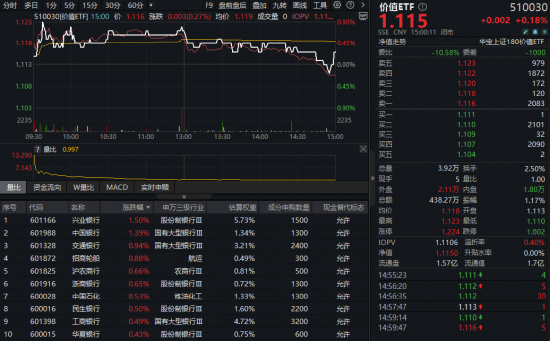
Core Viewpoint - The market experienced a pullback on November 14, but high dividend stocks, particularly in the banking sector, showed resilience, with the value ETF (510030) gaining 0.18% despite the overall market decline [1][3]. Market Performance - The value ETF (510030) fluctuated positively throughout the day, reaching a peak increase of 0.9% before closing up 0.18% [1]. - Key stocks contributing to this performance included Industrial Bank and Bank of China, both rising over 1%, along with other stocks in the shipping and petrochemical sectors [1]. Banking Sector Insights - Recent data from the central bank indicated that by the end of October, the balance of deposits in both domestic and foreign currencies reached 332.92 trillion yuan, marking an 8.3% year-on-year increase [3]. - Several small and medium-sized banks have recently adjusted their deposit products, including the removal of certain long-term deposit offerings, aimed at optimizing their liability structure and reducing costs [3]. Investment Strategy - Analysts suggest that the banking sector's high dividend yield will become increasingly attractive as market investment styles rebalance, particularly favoring state-owned banks and regional banks with strong recovery potential [3][6]. - The value ETF (510030) is heavily weighted towards the banking sector, which constitutes 47.5% of the index as of October 2025 [3]. Valuation Metrics - As of November 14, the price-to-book ratio of the value ETF's underlying index was 0.86, indicating a relatively reasonable valuation compared to historical levels [5]. - The current valuation places the index at the 46.27 percentile over the past decade, suggesting a favorable long-term investment opportunity [5]. Market Trends - The fourth quarter is typically a period of style shifts in the market, with a tendency for low valuation and value styles to gain traction [6]. - The financial sector, particularly banks, is expected to benefit from a continued focus on high dividend strategies amidst a backdrop of moderate economic recovery [6].
工行、农行创新高!机构普遍看好板块配置前景
Zhong Guo Zheng Quan Bao· 2025-11-14 05:59
Core Viewpoint - The A-share banking sector has seen a collective rise, with major banks like ICBC, ABC, BOC, CCB, and Bank of Communications all increasing by over 1%, indicating a recovery from the previous quarter's downturn [1] Group 1: Market Performance - Since the beginning of Q4, the banking sector has shown strong performance, reversing the decline observed in Q3 [1] - Major banks, including ICBC and ABC, reached new highs during intraday trading [1] Group 2: Investment Sentiment - Analysts attribute the banking sector's rebound to its defensive attributes of low valuation and high dividends, which have regained recognition amid year-end risk aversion [1] - Institutions are generally optimistic about the banking sector's investment prospects, believing that the combination of funds, policies, and fundamentals will support the high dividend theme in the market [1] Group 3: Future Outlook - CITIC Securities forecasts a continued weak recovery in the macro economy through 2025, suggesting that while the banking sector's fundamentals may not significantly improve, the high dividend strategy will remain a key focus [1] - Long-term funds such as insurance capital, public funds, and state-owned enterprises are expected to increase their allocation to bank stocks due to their stable dividends and low valuation characteristics [1] - Huatai Securities notes that the shift in financial support towards emerging fields like technology finance, green finance, and pension finance is accelerating the optimization and upgrading of bank business structures, which will open up long-term growth opportunities and support valuation recovery [1]
银行逆袭时刻!双百亿银行ETF(512800)涨近1%,机构:多重因素支撑银行价值回归
Xin Lang Ji Jin· 2025-11-14 02:20
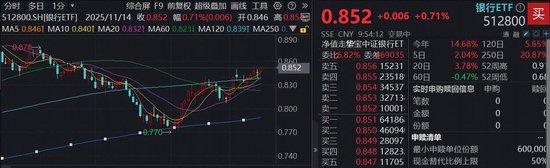
11月14日,三大指数早盘低开,银行股集体走强,双百亿顶流银行ETF(512800)场内价格一度涨近 1%,现涨0.71%,刷新2025年9月以来新高。 银行ETF(512800)最新规模约206亿元,年内日均成交额超8亿元,为A股10只银行业ETF中规模最 大、流动性最佳! 数据来源:沪深交易所等。 风险提示:银行ETF被动跟踪中证银行指数,该指数基日为2004.12.31,发布于2013.7.15。中证银行指 数近5个完整年度涨跌幅为:2024年,34.71%;2023年,-7.27%;2022年,-8.78%;2021年,-4.41%; 2020年,-4.23%。指数成份股构成根据该指数编制规则适时调整,过往业绩不预示未来表现。文中指数 成份股仅作展示,个股描述不作为任何形式的投资建议,也不代表管理人旗下任何基金的持仓信息和交 易动向。基金管理人评估的该基金风险等级为R3-中风险,适宜平衡型(C3)及以上的投资者。任何在 本文出现的信息(包括但不限于个股、评论、预测、图表、指标、理论、任何形式的表述等)均只作为 参考,投资人须对任何自主决定的投资行为负责。另,本文中的任何观点、分析及预测不构成对阅读者 ...